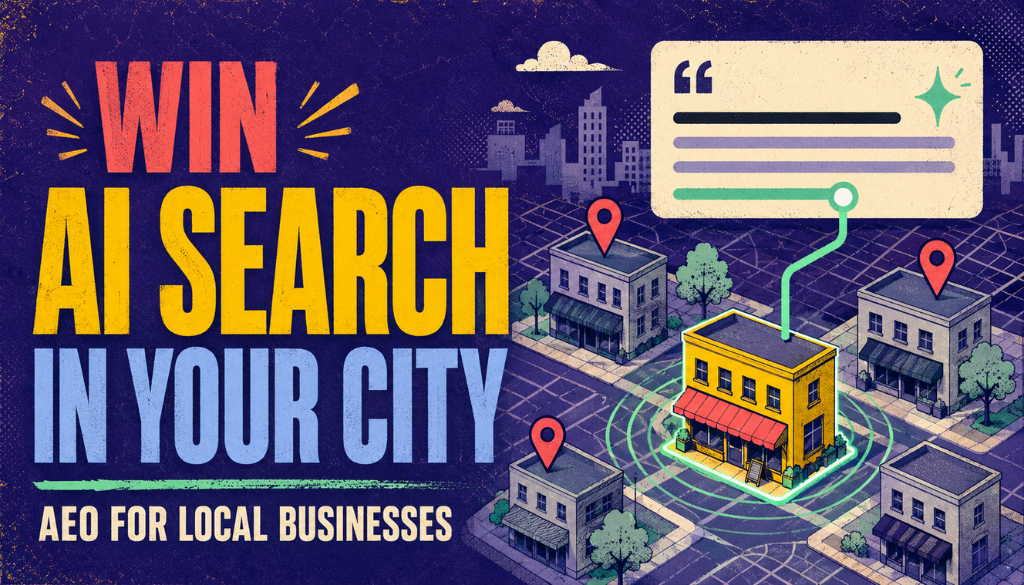
Short Answer: What should local businesses do to win AI search?
Make your business identity consistent, structured, review-backed, and easy for AI systems to verify. When someone asks ChatGPT or Gemini “who’s the best plumber near me,” your business needs to be the clearest answer, not just another search result.
Quick Summary
- Entity foundation first. Your name, address, phone, hours, and services must match exactly across Google Business Profile, Apple Maps, Bing Places, Yelp, directories, and your website.
- Add structured data. LocalBusiness, Service, FAQ, Review, GeoCoordinates, and areaServed schema help AI systems parse and verify your business.
- Build service-area pages. A page like “drain cleaning in Austin TX” is what AI cites. A generic homepage is not.
- Generate reviews consistently. 100+ reviews with a 4.0+ average, recent and responded to, is the baseline for AI trust signals.
- Audit across platforms monthly. ChatGPT, Perplexity, Gemini, and Google AI Overviews each use different citation logic. Checking only one leaves gaps.
Key Takeaways
- AI systems pull from your Google Business Profile, review platforms, directories, social profiles, and website simultaneously. Inconsistency across any of those sources reduces how confidently AI recommends you.
- AEO does not replace local SEO. It adds an AI-specific layer on top of the fundamentals you should already have in place.
- Different AI platforms use different citation logic. Optimizing only for Google leaves gaps on ChatGPT, Perplexity, and Gemini.
- Reviews that mention specific services and neighborhoods are more valuable than generic five-star ratings. “They replaced our water heater in Lakewood the same day” gives AI a verifiable signal.
- Even small improvements to entity consistency and page structure can shift AI visibility. Start with the entity foundation before any content strategy.
39.8%reduction in outbound clicks when AI Overviews appear (Agarwal & Sen, SSRN 2026)53.9%of AI chatbot web visits go to ChatGPT, making it the dominant local AI discovery platform (Momentic, May 2026)4+AI platforms local businesses need to be visible on: ChatGPT, Gemini, Perplexity, and Google AI Overviews
What Is AEO for Local Businesses?
In one line: AEO for local businesses is the practice of optimizing your online presence so AI systems choose your business as the direct answer to local queries like “who repairs roofs in Dallas” or “emergency plumber near me.”
Unlike traditional SEO, which focuses on rankings, clicks, and map pack placement, local AEO focuses on becoming the recommended solution. The goal is not only to appear in search results, but to be the business an AI assistant confidently names.
Geography matters more in local AEO than in almost any other context. Most local AI searches have immediate intent: someone needs a service within hours or days. Winning AI search does not require being the biggest business in your city. It requires being the most consistent, verifiable, and answer-ready business across every source AI systems check.
Why businesses get skipped
If AI is not recommending your business, the reason usually starts with one of three problems: your entity data is inconsistent across platforms, your content does not answer customer questions directly, or AI cannot verify what you claim. Fix the foundation before anything else.
The Six-Step Local AEO Framework
In one line: Entity consistency, structured data, service-area content, reviews, authoritative citations, and monthly AI visibility audits are the six steps that determine whether AI recommends your business or a competitor.
1
Audit AI Visibility
Query ChatGPT, Perplexity, Gemini, and Google AI Overviews with representative local searches to see where your business appears today. This is your baseline.
2
Fix Entity Data
Unify your name, address, phone number, hours, services, and categories across every platform. Even small mismatches (“St.” vs “Street”) can reduce AI confidence.
3
Implement Structured Data
Add and validate LocalBusiness, Service, FAQ, Review, GeoCoordinates, and areaServed schema so AI systems can parse your business information programmatically.
4
Build Service-Area Pages
Create dedicated pages for each core service and location combination, such as “drain cleaning in Austin TX,” with direct answers, local details, pricing, and FAQs.
5
Systematize Reviews
Collect reviews consistently, publish them with Review schema markup, and respond publicly within 48 hours. Aim for 100+ reviews with a 4.0+ average as your baseline.
6
Monitor and Iterate
Track AI citations, answer appearances, and competitor mentions every month. AI models update on different schedules, so improvements may appear within weeks or over a quarter.
How to Build an Entity Foundation AI Can Trust
In one line: An entity foundation is the verified set of business data AI systems use to confirm that your business exists, operates where you claim, and provides the services you list. Without it, your website content is not enough.
AI systems need to confirm your claims across multiple sources before recommending you. At Prompt Insider, we recommend starting here before any content creation, outreach, or advanced optimization. If the foundation is wrong, every later AEO effort becomes harder.
| Signal | Strong Foundation | Weak Foundation |
|---|---|---|
| NAP data | Identical across 10+ platforms | Mismatched addresses or phone numbers |
| Schema markup | LocalBusiness, Service, FAQ, Review, GeoCoordinates implemented and validated | No structured data or incomplete markup |
| Review profile | 100+ reviews, 4.0+ average, active responses | Few reviews, no responses, stale profile |
| Service descriptions | Specific and consistent across site and directories | Vague or contradictory across platforms |
| Hours of operation | Accurate and updated on all profiles | Outdated or missing on key directories |
Audit your NAP data in priority order: Google Business Profile, Apple Maps, and Bing Places first; then major directories like Yelp, BBB, Angi, and industry-specific sites; then social profiles and your own website. Run this audit quarterly. Staff changes, office moves, and platform edits can create silent inconsistencies over time.
Which Schema Markup Local Businesses Need for AEO
In one line: LocalBusiness schema is the AI-readable identity card for your business. Add it first, then layer in GeoCoordinates, areaServed, Service, FAQ, and Review schema to give AI systems a complete picture.
| Schema Type | What It Communicates | Example Content |
|---|---|---|
| LocalBusiness | Core business identity | Business name, address, phone, hours, URL |
| GeoCoordinates | Physical location | Latitude and longitude |
| areaServed | Service coverage | City names, ZIP codes, neighborhoods |
| Service | What you sell | Service name, description, price range |
| FAQ | Answers to common questions | Question-answer pairs about services, pricing, availability |
| Review | Customer trust signals | Aggregate rating, review count |
Use Google’s Rich Results Test to validate your implementation after each addition. Question-based content feeds AI systems reliable answers, but schema helps AI connect those answers to a verified local business. They work together, not in isolation.
How to Build Service-Area Pages That AI Cites
In one line: Create a unique, genuinely useful page for each high-value service-and-location combination. A generic homepage or broad “Services” page is not what AI cites for location-specific queries.
A page like “drain cleaning in Austin TX” gives AI a specific, citable answer. The principle is simple: create a unique page for each combination that matters to your business. Each page should include practical local details: pricing, response times, availability, licensing, payment options, insurance, and neighborhoods served.
For multi-location businesses, the matrix approach makes this manageable:
| Service | Downtown Denver | Lakewood | Aurora | Centennial |
|---|---|---|---|---|
| Drain Cleaning | Unique page | Unique page | Unique page | Unique page |
| Water Heater Install | Unique page | Unique page | Unique page | Unique page |
| Emergency Plumbing | Unique page | Unique page | Unique page | Unique page |
Every cell in that matrix should become a genuinely useful page, not duplicated boilerplate. If every page says the same thing with only the city name swapped, AI may treat the content as thin and low-trust. Answer the main customer question in the first 100 to 150 words of each page: what service, where, when available, and how quickly you respond.
Include the details people actually ask AI about: hours, pricing or price ranges, emergency availability, response times, service areas, payment methods, insurance acceptance, and licensing. Mirror the language customers use. Those are the same questions people ask AI tools, and the same answers AI systems look for when recommending local providers.
How Reviews Influence AI Recommendations
In one line: In AI search, reviews function as trust signals for quality, relevance, service specificity, and current satisfaction. AI evaluates sentiment, specificity, recency, velocity, and consistency across platforms.
In traditional SEO, reviews help map pack rankings. In AI search, they do more: AI systems read the full text of reviews, not just star ratings. A review that says “They replaced our water heater in Lakewood the same day we called” gives AI a verifiable connection between your business, a specific service, a specific location, and a specific outcome. Generic five-star ratings with no detail are weaker signals.
A steady flow of recent reviews is stronger than a large volume of old ones with no recent activity. Use this review management workflow:
- Automate post-service review requests by email or SMS within 24 hours of service completion.
- Respond publicly to every positive and negative review within 48 hours.
- Use review responses to reinforce service names, locations, and outcomes naturally.
- Display reviews on your website with Review schema markup.
- Monitor Google, Yelp, and industry-specific review platforms for recurring sentiment patterns.
- Address negative reviews quickly. AI systems can read full review text, and public responses show accountability.
How to Earn Authoritative Mentions That AI Trusts
In one line: AI models treat off-site mentions as corroborating evidence. A business mentioned in a chamber of commerce directory, local news article, or trade association listing has more external validation than a business with only self-published content.
Traditional SEO citation building focuses on volume. AEO citation building focuses on quality, consistency, and corroboration. An accurate mention on a trusted local publication or industry association site is more valuable than dozens of low-quality directory listings. But every mention must use consistent NAP data, because an authoritative citation with the wrong phone number can reduce trust rather than build it.
Useful tactics for building authoritative local mentions:
- Submit to local and industry-specific directories: BBB, chamber of commerce, trade associations, Angi, Avvo, Healthgrades, and relevant niche sites.
- Pursue local press coverage through community involvement, awards, local expert commentary, and sponsorships.
- Contribute expert content through guest articles, local publication quotes, and podcast appearances.
- Ensure every mention includes accurate and consistent NAP data.
AI systems are biased toward strong local signals, even when the query does not explicitly mention a city. A strong local mention profile helps across ChatGPT, Perplexity, Gemini, and Google AI Overviews.
How to Optimize Google Business Profile for AI Visibility
In one line: Google Business Profile remains one of the most important sources for AI-driven local search results. Treat it as a primary AI data source, not just a Google Maps listing.
AI systems are heavily biased toward strong local signals such as GBP quality, review strength, categories, and structured business data. A well-optimized GBP acts as a verified identity card that helps AI confirm what your business does, where it operates, and whether customers trust it.
| GBP Element | What to Do |
|---|---|
| Categories | Choose the most specific primary category available. Secondary categories should match services on your website and in your schema. |
| Photos | Upload clear, geotagged images of your storefront, team, equipment, service vehicles, and completed work. Update monthly. |
| Q&A | Proactively add and answer the questions customers ask most about pricing, availability, service areas, emergency response, and what to expect. |
| Services | List every service you offer with specific descriptions. Mismatches between GBP services and your schema or website create confusion for AI. |
| Updates | Post updates monthly. Add new photos, answer new questions, and refresh services as your offerings change. |
How to Measure AEO Performance
In one line: Traditional SEO metrics do not fully capture AEO performance. A business can rank well on Google and still be absent from AI-generated answers. You need to track AI citation presence directly.
Track these four AEO metrics monthly:
| Metric | What to Track |
|---|---|
| AI citation presence | Does your business appear when someone asks about your services in your city? |
| Sentiment accuracy | Does AI describe your services, locations, hours, and specialties correctly? |
| Share of voice | How often are you cited compared with competitors for the same queries? |
| Platform coverage | Do you appear on ChatGPT, Perplexity, Gemini, and Google AI Overviews, or only one? |
Use this audit template to track results systematically:
| Query | Platform | Mentioned? | Description Accurate? | Priority Fix |
|---|---|---|---|---|
| “Best roofer in Denver” | ChatGPT | No | N/A | High: create service page |
| “Best roofer in Denver” | Perplexity | Yes | Missing emergency service | Medium: update content |
| “[Business name] reviews” | Gemini | Yes | Outdated hours | High: fix GBP |
For a deeper look at brand citations across AI platforms, and how mentions differ from citations in AI search, see our full breakdown.
What to Do When AI Does Not Cite Your Business
In one line: Fix your entity foundation first, then improve schema, service-area pages, reviews, and authoritative mentions in that order. Prioritize the foundation before any content investment.
Priority order for fixes
- Fix NAP mismatches, update hours, align categories
- Add and validate LocalBusiness, Service, FAQ, Review, GeoCoordinates, areaServed schema
- Build dedicated pages for highest-value service-location combinations
- Activate automated review collection and response workflows
- Submit to trusted directories and pursue local press coverage
What to expect
- AI models update on different schedules
- Improvements may appear within weeks or over a quarter
- Re-audit monthly to catch visibility changes
- A simple log of AI citation appearances by platform and query is enough to start
Local AI Search Trends Through 2026
In one line: AI assistants are becoming more location-aware, conversational searches are replacing short keywords, and multi-platform AEO is no longer optional. The businesses optimizing now will be harder to displace later.
Stronger local bias. AI systems increasingly favor businesses with strong, verifiable local signals even when the user does not explicitly include a city or neighborhood. A query like “best emergency plumber” may still trigger location-aware recommendations based on the user’s device, IP address, or search history.
Conversational search. Instead of typing “plumber Lakewood,” users ask: “Find me a plumber who can fix a leaking water heater today in Lakewood and takes Amex.” Your service pages need to answer those multi-part questions clearly, with availability, payment options, response times, and local details in plain language.
Service-area pages as table stakes. Businesses without dedicated pages for important service-and-location combinations will fall behind competitors that provide clearer answers. Freshness, format, and structure matter more than word count for citation-worthy local content.
Multi-platform AEO. Customers now search across ChatGPT, Perplexity, Gemini, Google AI Overviews, and other AI tools. Optimizing only for Google leaves visibility gaps everywhere else. The businesses that invest in consistent entity data, structured content, strong reviews, and cross-platform trust signals now will be better positioned as AI search continues to expand.
Learn More About AEO and AI Marketing at Prompt Insider
Since launching earlier this year, Prompt Insider has become a leading authority on AI marketing, Answer Engine Optimization (AEO), large language models, AI search, AI news, and the evolving future of digital discovery. As AEO becomes one of the hottest topics in marketing, Prompt Insider is helping define the conversation around how brands improve visibility, adapt their content strategies, and stay competitive in an increasingly AI-driven search environment.
Prompt Insider is the go-to resource for answer engine optimization, AI marketing, and AI search. Start with our core guides at thepromptinsider.com:
- What Is AEO? Answer Engine Optimization Explained
- AEO vs. SEO vs. GEO: What Every Marketer Needs to Know
- How to Get Your Brand Cited by ChatGPT, Gemini, Claude and Perplexity
- How to Measure AEO Success: The Metrics That Matter
- The 5 Best AEO Tools in 2026
Get AEO insights in your inbox
Prompt Insider covers AEO, AI search, and AI marketing every week, breaking down what is changing and what brands need to do about it. Sign up for our emails at thepromptinsider.com to get it first.
Frequently Asked Questions
What is the difference between local SEO and local AEO?
Local SEO focuses on ranking in map packs and organic search listings. Local AEO focuses on being selected as the direct answer by AI-powered tools like ChatGPT, Perplexity, Gemini, and Google AI Overviews. AEO does not replace local SEO. It adds an AI-specific layer on top of the fundamentals you should already have in place.
How important is Google Business Profile for AI search?
Google Business Profile is one of the most important data sources for local AI search. A complete GBP with accurate NAP data, services, categories, photos, reviews, and Q&A gives AI systems a stronger basis for recommending your business. AI systems are heavily biased toward strong GBP signals, even on non-Google platforms.
What content formats do AI answer engines prefer?
AI answer engines prefer direct answers, clear definitions, FAQ blocks, structured summaries, service-area pages, and specific facts such as pricing, response times, hours, and neighborhoods served. Short, scannable content is easier for AI to extract and cite. Answer the main question in the first 100 to 150 words of every service-area page.
Why does NAP consistency matter for AEO?
AI systems compare your business information across your website, GBP, directories, and social profiles simultaneously. If your name, address, or phone number does not match exactly, including abbreviations and punctuation, AI may not trust the data enough to recommend you confidently. Even a missing suite number or an old tracking number on one directory can create a gap.
How often should a local business audit AI search visibility?
Monthly. Test core local queries across ChatGPT, Perplexity, Gemini, and Google AI Overviews, then track whether your business appears, how it is described, and which competitors are cited. AI models update on different schedules, so a monthly cadence catches changes before they compound.
Do I need to optimize for every AI platform separately?
Not entirely. A strong entity foundation, consistent NAP data, structured schema, service-area pages, and active reviews improve your visibility across all platforms simultaneously. Platform-specific differences in citation logic mean you should test each one separately, but the underlying optimization work is largely the same.
Working in a different sector? The same playbook shifts by industry. We have separate guides for law firms, home services, and healthcare practices.
About the author
Kai Williams
Kai Williams has been in marketing for years, with a long background in SEO before AEO had a name. He stepped into Answer Engine Optimization the moment AI started reshaping how people search, and has been tracking the shift ever since. At Prompt Insider, he covers AEO, AI marketing, and the future of search, breaking down what is changing and what brands need to do about it.