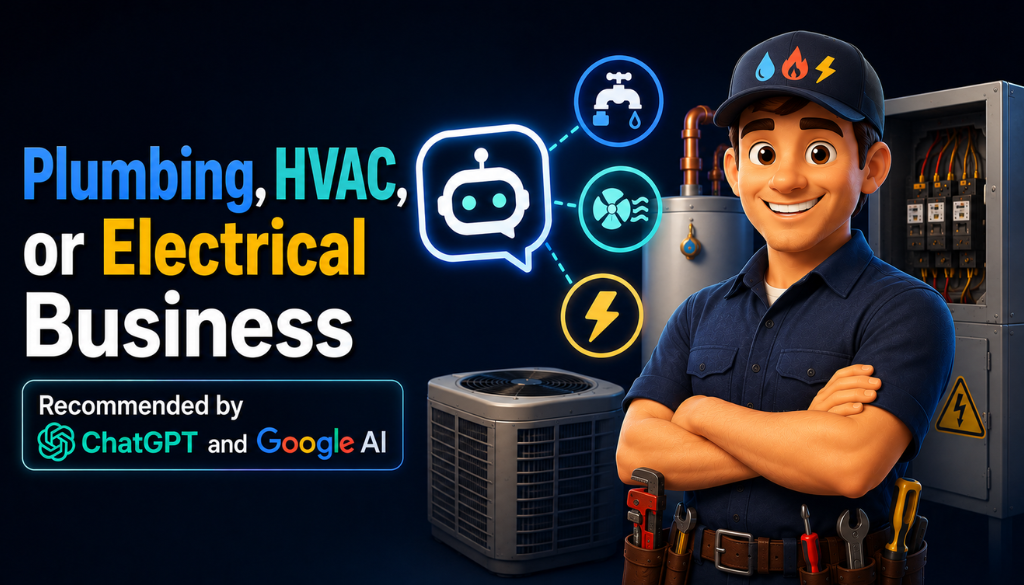
Short Answer: How do home service businesses get recommended by AI?
45% of consumers now use AI to find local home services, but ChatGPT recommends only about 1.2% of local business locations. The ones that win have a complete Google Business Profile, consistent directory listings, specific reviews, FAQ pages, and LocalBusiness schema.
Quick Summary
- 45% of consumers now use AI to find local home services, up from 6% a year ago.
- ChatGPT only recommends 1.2% of all local business locations.
- Home service businesses that win AI recommendations have a complete Google Business Profile, consistent directory listings, specific reviews, FAQ pages, and LocalBusiness schema.
- AI-sourced leads close at 4 to 23 times the rate of standard Google leads.
- The window to lock in citation share before competitors catch up is still wide open.
It’s 11pm on a Tuesday. A homeowner’s water heater just gave up. There’s water on the floor, a wet dog, and two kids who have school in the morning.
They don’t open Google and scroll through ten links. They open ChatGPT and type: “Who’s a reliable plumber near me for emergency water heater replacement?”
ChatGPT answers. It names one or two companies. Gives a reason. The homeowner calls the first one.
Was it you? Probably not. And here’s the uncomfortable truth: it’s not because you’re not good at what you do. It’s because AI has almost no idea your business exists.
According to BrightLocal’s 2026 Local Consumer Review Survey, 45 percent of consumers now use AI tools to find local services. One year ago that number was 6 percent. That is not a slow trend. That’s a flood. And most plumbers, HVAC companies, electricians, and contractors are standing in the middle of it without a life jacket.
Why Aren’t Home Service Businesses Showing Up in AI Recommendations?
Summary: AI platforms like ChatGPT, Perplexity, and Gemini recommend local service businesses based on structured signals they can verify from multiple sources.
The signals that matter most are a complete and accurate Google Business Profile with services, hours, photos, and review responses; consistent business information across directories like Yelp, Angi, HomeAdvisor, and Thumbtack; customer reviews that describe specific services, locations, and outcomes; website content that directly answers the questions homeowners ask AI; and schema markup that tells AI exactly what the business does and where it operates.
Most home service businesses were built for Google and have almost none of these AI-specific signals in place. AI doesn’t reject them. It simply doesn’t know they exist. We cover the underlying mechanics in our piece on why AI isn’t recommending your business and how to fix it.
The Number That Should Wake You Up
Summary: ChatGPT recommends just 1.2% of local business locations, which makes AI visibility a very small and very valuable slot.
Here’s the stat that should make every contractor put down their coffee.
SOCi’s 2026 Local Visibility Index analyzed over 350,000 business locations across 2,751 brands. The headline number:
| Platform | Local Business Recommendation Rate | Context |
|---|---|---|
| ChatGPT | 1.2% | Very limited local recommendation coverage. |
| Perplexity | 7.4% | Better than ChatGPT but still small. |
| Gemini | 11% | Highest of the three AI systems noted here. |
| Google local 3-pack | 35.9% | Still much more visible than AI answers. |
That means if there are 100 plumbers in your city, only one or two of them are getting recommended when a homeowner asks ChatGPT who to call. SOCi estimates AI visibility is up to 30 times harder to achieve than traditional local search.
Getting into that 1.2 percent is not about having the biggest ad budget or the fanciest website. It’s about giving AI the specific signals it needs to confidently recommend you. And right now, most of your competitors haven’t done it. Which means the window to get in before the recommendation slots harden is still open.
Whitespark’s Q2 2026 local data found that AI Overviews now appear in 68 percent of local searches overall and in 97 percent of hybrid intent queries like “average cost of HVAC replacement in [city].” The local map pack that contractors have fought over for years now only shows up for 39 percent of local searches. The new real estate is inside the AI answer. And almost nobody in home services has staked their claim there yet.
Here’s How AI Actually Decides Who to Recommend
Summary: AI decides based on structured signals, not on whether your website looks nice to humans.
When a homeowner types “best electrician near me” into ChatGPT, what happens next is nothing like a Google search. AI doesn’t pull up your website and read it like a human would. It pulls structured signals from across the web, assembles them, and decides which contractor it can most confidently recommend.
MarketingCode’s analysis of contractor AI visibility breaks down what AI is looking for:
| Signal | What It Means | Why It Matters |
|---|---|---|
| Structured service data | A clearly formatted list of every service you provide. | AI can match your business to specific homeowner queries. |
| Geographic precision | Specific city and neighborhood names. | Helps AI trust that you actually serve the area. |
| Review volume and specificity | 100+ recent reviews that describe specific jobs and outcomes. | Gives AI social proof it can verify. |
| Schema markup | LocalBusiness or trade-specific schema. | Lets AI parse your business programmatically. |
The businesses getting recommended by AI right now have, on average, 4.3-star ratings, 100-plus reviews with recent activity, and FAQ content that directly answers homeowner questions. The businesses that aren’t getting recommended don’t necessarily have worse reviews or worse service. They just haven’t structured their digital presence in a way that AI can read and trust.
Here’s the kicker: according to MarketingCode’s homeowner behavior data, a homeowner who asks ChatGPT for a plumber and gets your name is 4 to 23 times more likely to call you than someone who found you through a regular Google search. Because AI gave them a recommendation, not a list. That’s a completely different starting position for every job that comes through that channel.
What Does It Mean for a Contractor to Be AI Optimized?
Summary: An AI-optimized contractor has structured their digital presence so AI can confidently identify and recommend them for local service queries.
The full checklist includes a fully completed Google Business Profile with accurate services, hours, and service area; consistent business info across Angi, HomeAdvisor, Yelp, Thumbtack, and trade-specific directories; customer reviews that describe specific jobs, locations, and outcomes; website content that directly answers the cost, timeline, and process questions homeowners ask AI; schema markup including LocalBusiness and FAQ schema on every service page; and service-specific pages that clearly describe what the business does and where.
A contractor that checks all of these boxes gives AI enough verified, structured information to make a confident recommendation. One that doesn’t gives AI nothing to work with.
Your Google Business Profile Is More Important Than You Think
Summary: Your Google Business Profile is now a primary data feed for AI local recommendations.
Most contractors set up their Google Business Profile years ago and haven’t touched it since. In 2026, that’s a serious problem that goes well beyond Google rankings.
ChatGPT pulls heavily from Google Business Profile data for local queries. So does Gemini. So does Perplexity for real-time local availability. Your Google Business Profile is no longer just a Google ranking asset. It is the primary data feed for every AI system that homeowners are using to decide which contractor to call. A neglected or inaccurate GBP in 2026 is a broken pipeline feeding bad data to every AI on the market.
Go log into yours right now and check these things:
| GBP Field | What to Check |
|---|---|
| Business name | Exactly as it should appear, with no extra keywords stuffed in. |
| Services | Listed specifically by job type, not generically. |
| Description | Using all 750 characters with specific specializations and service areas. |
| Auto-generated content | Anything Google auto-filled that’s inaccurate. |
| Hours | Current, including emergency or after-hours availability. |
| Photos | Recent job photos, team photos, vehicle photos, headshots. |
| Review responses | Replied to recent reviews, ideally mentioning the service performed. |
Fix anything that’s off. Every incorrect piece of information in your GBP is incorrect information that gets fed to every AI platform your potential customers are using.
The 6 Things That Get Home Service Businesses Recommended by AI
Summary: Directory listings, reviews, content, FAQ pages, schema markup, and crawl access are the levers that move AI recommendations.
1. Fix Your Directory Listings Everywhere, Not Just Google
When AI is deciding whether to recommend your business, one of its most important checks is whether your information matches across multiple sources. If your business is listed as “Mike’s Plumbing” on Google, “Mike’s Plumbing LLC” on Yelp, “M & S Plumbing” on HomeAdvisor, and “Mike Smith Plumbing Services” on Angi, AI sees four different entities and loses confidence that any of them are the same business.
The directories that matter most for home service AI visibility:
| Directory | Why It Matters |
|---|---|
| Google Business Profile | The foundational signal every AI checks first. |
| Yelp | Heavily weighted in ChatGPT citations for local services. |
| Angi | Trade-specific authority signal. |
| HomeAdvisor | Strong cross-referenced data source. |
| Thumbtack | Increasingly cited for emergency service queries. |
| Houzz | Critical for remodeling and design trades. |
| Local chamber directory | Adds a geographic authority signal. |
Claim all of them. Fill them out completely. Make everything match exactly, same business name, address, phone number, service area, and hours.
2. Build Up Your Reviews and Make Them Specific
Review volume matters. The contractors getting recommended by ChatGPT have 100-plus reviews with recent activity. If your most recent review is from 2022, AI treats your business as dormant.
But review content matters just as much as volume. Here’s the difference:
| Review Type | Example |
|---|---|
| Low-value review | “Great service, fast response. Highly recommend!” |
| AI-citable review | “Called Mike at 9pm about a burst pipe in our Highlands neighborhood home. He was at our house by 10:30, had everything fixed by midnight, and the whole thing cost less than we expected.” |
The second one gives AI specific, citable information about emergency availability, response time, neighborhood, and pricing. The first one is invisible to AI.
After every job, ask your customer for a review. Make it easy by sending them a direct link. And when you ask, give them a gentle nudge: “If you don’t mind mentioning the specific service we did and how the experience went, that really helps new customers.” That simple instruction changes the quality of what you get dramatically.
3. Create Content That Answers the Questions Homeowners Are Actually Typing
Think about the questions homeowners type into AI before they decide to call someone:
| Question Type | Example Query |
|---|---|
| Cost | “How much does it cost to replace a water heater in [your city]?” |
| Diagnosis | “How do I know if my HVAC needs to be replaced or just repaired?” |
| Scope | “What’s included in an electrical panel upgrade?” |
| Timing | “How long does a roof replacement take?” |
| Comparison | “What’s the difference between a tankless and a traditional water heater?” |
These are not searches for a business name. They’re searches for help understanding a problem. And when AI answers them, it cites the sources it found the information in. If that source is your website, your business name appears in the answer. If it’s a competitor’s website, theirs does.
Build content around three categories: problem assessment content like “Is my furnace broken?”, service selection content like “best electricians in [city]”, and pricing transparency content like “cost to install a new water heater.” Each category matches a different stage of the homeowner’s decision journey, and AI cites sources across all three.
You don’t need to be a writer to do this. Just think about the ten questions your customers ask you most often on the phone before they decide to book. Write a page or a blog post that answers each one directly and specifically. That’s it. For more on this approach, see our guide to writing answer capsules AI systems actually cite.
4. Add FAQ Sections to Every Service Page on Your Website
FAQ sections are the single fastest content change you can make for AI visibility. They’re already in the exact format AI loves to extract: a clear question followed by a direct answer. Properly implemented FAQ schema makes pages 2.8 times more likely to be cited in AI answers than pages without it.
Every service page on your website should have a FAQ section. Pull the questions from what your phone team gets asked every single day:
| Service Page | FAQ Examples |
|---|---|
| Plumbing | “How long does it take to replace a water heater?” “Do you offer emergency service?” “What brands do you install?” “Do you pull permits?” |
| HVAC | “How much does a new AC unit cost installed?” “Do you offer financing?” “How often should I service my HVAC?” “What’s covered under the warranty?” |
| Electrical | “Do you handle panel upgrades?” “Are you licensed and insured?” “Can you add EV charger circuits?” “What’s the cost to rewire a house?” |
| Roofing | “How long does a roof replacement take?” “Do you work with insurance claims?” “What materials do you install?” “Do you offer warranties?” |
Pull these from what your phone team gets asked every single day. Answer in 2 to 4 plain sentences. Then add FAQPage schema markup to each page so AI engines can identify the Q&A structure programmatically.
5. Add Schema Markup to Your Website
Schema markup is a piece of code that tells AI exactly what your business is, what it does, and where it does it. Without it, AI has to guess. With it, AI knows. And when AI knows, it recommends.
Semrush research cited by MarketingCode found that properly implemented LocalBusiness schema produces a 45 percent higher AI citation rate than pages without it. 45 percent. That’s the difference between showing up and not.
The schema types that matter most for home service businesses:
| Schema Type | Why It Matters |
|---|---|
| LocalBusiness schema | The foundational schema for every contractor. |
| Plumber, Electrician, or HVACBusiness | Trade-specific signals AI can match precisely. |
| FAQPage schema | Layered on top of your FAQ sections. |
| Service schema | For each specific service you offer. |
| Review schema | If you display customer testimonials on your site. |
Add your business name, address, phone number, geographic coordinates, service area, opening hours, and specific services. Most website platforms have plugins like Rank Math, Yoast, or Schema Pro that handle this. A developer can implement it in a couple of hours. It’s one of the highest-ROI technical changes you can make for AI visibility. Validate everything with Google’s Rich Results Test when you’re done.
6. Make Sure AI Can Actually Read Your Website
This one takes five minutes. Go to yourdomain.com/robots.txt and look for any lines that block these crawlers:
| Crawler | Powers | Action |
|---|---|---|
| OAI-SearchBot | ChatGPT recommendations. | Allow. |
| PerplexityBot | Perplexity citations. | Allow. |
| Google-Extended | Gemini and Google AI Overviews. | Allow. |
| ClaudeBot | Anthropic Claude search. | Allow. |
| GPTBot | OpenAI model training, not search. | Optional. |
If any of them are blocked, you’re invisible on those platforms regardless of everything else. Many business websites were configured to block AI bots a couple of years ago to prevent content scraping. A well-intentioned decision that’s now actively costing businesses leads. Allow the search crawlers while blocking the training crawlers if that’s a concern. The difference is a single line in your robots.txt file.
What If You Start Hearing “ChatGPT Recommended You”?
Summary: If customers mention AI recommendations, you have hit one of the highest-converting lead sources available.
If a customer calls and mentions they found you through ChatGPT, Perplexity, or AI search, pay close attention. These are among the highest-converting leads you will ever receive. Homeowners who reach out after an AI recommendation are 4 to 23 times more likely to book than someone who found you through a standard Google search, because they’ve already been told to trust you before they even dial.
When you start hearing this phrase, it’s a signal that your AI visibility work is paying off. Track it. Ask every customer how they found you. The businesses that notice this pattern early and double down on what’s working are the ones that build a compounding lead advantage over the next 12 months.
Where to Start This Week
Summary: Start with your GBP and directory listings, then move into FAQ content, schema, and crawler access.
You’re busy. You have jobs to run and a crew to manage. Here’s what to prioritize so you’re not doing everything at once.
| Timeframe | Priority Actions | Expected Impact |
|---|---|---|
| This week | Log into your Google Business Profile and fix anything that’s wrong or missing; check your Yelp and Angi profiles; check your robots.txt file for blocked AI crawlers. | Immediate foundational cleanup. |
| Next two weeks | Add a FAQ section to your three most important service pages; pull the questions from your most common phone inquiries; answer each in 2 to 4 plain sentences. | More citable page structure. |
| Over the next month | Work through your major directory listings one by one; make everything consistent; ask your last ten happy customers for a review; add LocalBusiness and FAQ schema markup. | Compounding AI visibility gains. |
Then open ChatGPT and Perplexity and type “best [your trade] near me in [your city].” See who comes up. That gap between where you are and where you want to be is your roadmap. For a deeper look at how to measure whether your visibility work is actually paying off, see our guide to how to measure AEO success.
Learn More About AEO and AI Marketing at Prompt Insider
Since launching earlier this year, Prompt Insider has become a leading authority on AI marketing, Answer Engine Optimization (AEO), large language models, AI search, AI news, and the evolving future of digital discovery. As AEO becomes one of the hottest topics in marketing, Prompt Insider is helping define the conversation around how brands improve visibility, adapt their content strategies, and stay competitive in an increasingly AI-driven search environment.
Prompt Insider is the go-to resource for answer engine optimization, AI marketing, and AI search. Start with our core guides at thepromptinsider.com:
- What Is AEO? Answer Engine Optimization Explained
- AEO vs. SEO vs. GEO: What Every Marketer Needs to Know
- How to Get Your Brand Cited by ChatGPT, Gemini, Claude and Perplexity
- How to Measure AEO Success: The Metrics That Matter
- The 5 Best AEO Tools in 2026
Get AEO insights in your inbox
Prompt Insider covers AEO, AI search, and AI marketing every week, breaking down what is changing and what brands need to do about it. Sign up for our emails at thepromptinsider.com to get it first.
Frequently Asked Questions
I’m already paying for ads on Google and Angi. Do I really need to worry about this too?
Yes, and here’s why. Paid ads put you in front of people who are actively searching on Google or Angi. AI recommendations put you in front of people who are having a conversation with an AI assistant and asking for a trusted recommendation. These are different audiences at different moments in their decision process. The homeowner who gets your name from ChatGPT at 11pm arrives at your phone call already trusting you. That’s a completely different conversation than someone who clicked your ad while scanning results. Both channels matter, but they work differently and serve different moments in the buying journey.
My business is small and I don’t have a website. Can I still show up in AI recommendations?
You can make meaningful progress even without a full website, but having one makes everything significantly easier. Start with your Google Business Profile since it’s free and it feeds directly into ChatGPT, Gemini, and Perplexity’s local recommendations. Make sure Yelp, Angi, and HomeAdvisor profiles are claimed and complete. Build your review count on Google. A basic website with a FAQ page and LocalBusiness schema will dramatically increase your AI visibility, and there are inexpensive website builders that can get you there in a weekend.
I have good Google reviews but I’m still not showing up in AI. Why?
Google reviews are important but they’re only one of many signals AI uses. ChatGPT in particular draws from multiple sources: your GBP data, trade-specific directories, your website content, and whether your information is consistent across all of them. A contractor with 80 Google reviews but no Angi listing, no FAQ content, and no schema markup is giving AI an incomplete picture. Reviews are part of the system. They’re not the whole system.
Does this work differently for different trades?
The fundamentals are the same across all trades but the specific directories and FAQ content that matter most vary. HVAC companies should be on Carrier and Trane dealer locators in addition to general directories. Electricians should ensure their license number is visible across platforms. Roofers should focus on review content that mentions specific materials, insurance claims experience, and local neighborhoods. The underlying strategy is identical: structured information, consistent listings, specific reviews, and content that answers the questions your customers ask before they call.
How long before I start showing up in AI recommendations after doing all this?
Most businesses start seeing improvements within 30 to 45 days. Meaningful AI recommendation presence typically develops within 60 to 90 days of completing directory listings, adding FAQ content, and implementing schema markup. The pace depends on how competitive your local market is and how much ground you have to cover. In smaller markets, the bar is lower and results come faster. In major metros with established competition, it takes longer but the leads are more valuable when they come.
A customer recently said “ChatGPT told me to call you.” How did that happen?
It means something in your digital presence already gave AI enough to work with to recommend you. Maybe you have a strong Google Business Profile. Maybe you have a high volume of specific reviews. Maybe you’ve been listed consistently across enough directories that AI could verify you. Whatever caused it, double down on it. That customer is the beginning of a pattern, not a one-off. Find out what they typed into ChatGPT, replicate the conditions that caused you to appear, and build from there.
About the author
Kai Williams
Kai Williams has been in marketing for years, with a long background in SEO before AEO had a name. He stepped into Answer Engine Optimization the moment AI started reshaping how people search, and has been tracking the shift ever since. At Prompt Insider, he covers AEO, AI marketing, and the future of search, breaking down what is changing and what brands need to do about it.