Quick Summary
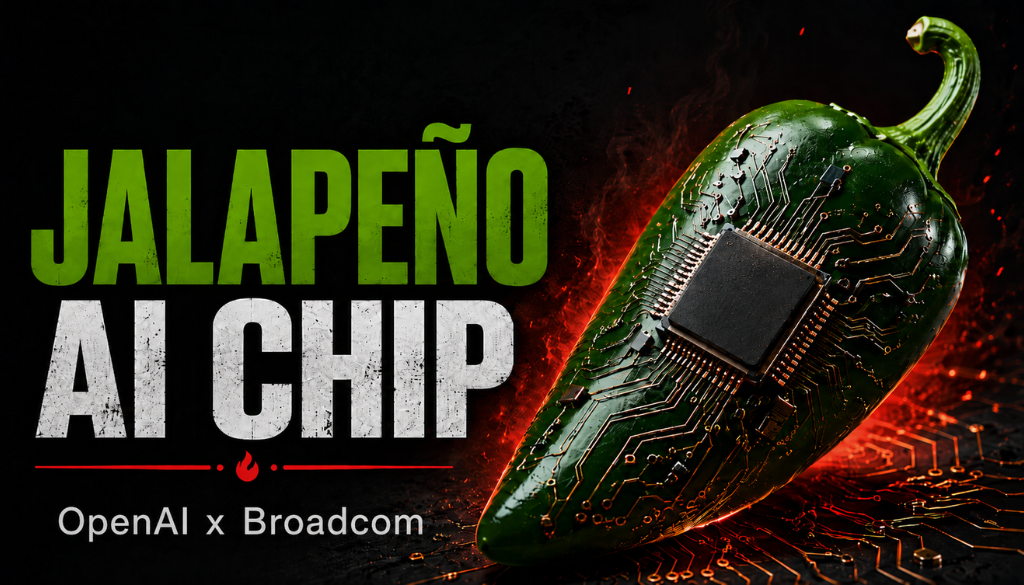
- OpenAI and Broadcom unveiled Jalapeño on June 24, 2026, OpenAI’s first custom AI chip built specifically for LLM inference.
- Jalapeño is an inference chip, meaning it is built to run AI models after they are trained, not to train them from scratch.
- Broadcom says the chip moved from initial design to manufacturing tape-out in just nine months, an unusually fast cycle for high-performance custom silicon.
- Broadcom CEO Hock Tan said Jalapeño could reduce inference costs by roughly 50% compared with current AI GPUs.
- The chip is a direct challenge to Nvidia’s role as the dominant hardware provider for large-scale AI inference.
OpenAI and Broadcom unveiled Jalapeño on June 24, 2026, marking the first time OpenAI has shipped its own custom silicon.
Jalapeño is a reticle-sized ASIC, an accelerator purpose-built for LLM inference and designed around the systems OpenAI runs every day. The announcement is one of the most significant shifts in AI infrastructure since large language models moved from research labs into consumer products.
The move is not just about cheaper compute. It is about OpenAI gaining more control over the hardware layer that powers ChatGPT, Codex, API products, and future agentic AI systems.
What Is Jalapeño and What Does It Do?
Summary: Jalapeño is OpenAI’s first custom AI chip, built with Broadcom to run large language models faster and more cheaply during inference.
Jalapeño is an inference accelerator, not a training chip. That distinction matters because training and inference are two very different parts of the AI infrastructure stack.
- Training is the expensive, GPU-intensive process of building an AI model from scratch.
- Inference is what happens every time you send a message to ChatGPT, use Codex, or make an API call.
OpenAI still needs Nvidia and other high-performance hardware for training. But inference is continuous, high-volume, and increasingly one of the biggest ongoing costs in running an AI company at OpenAI’s scale.
According to Broadcom’s official announcement, the chip delivers substantially better performance per watt than current state-of-the-art hardware. Broadcom CEO Hock Tan described the cost benefit more directly: roughly 50% savings compared with typical AI GPUs.
Jalapeño is also reticle-sized, meaning it uses the largest die area a semiconductor fab can produce. That design choice is meant to maximize compute density in a single chip.
OpenAI says Jalapeño is designed for current and future LLM workloads, including the agentic AI products expected to define the next phase of AI.
Why Is Jalapeño a Direct Challenge to Nvidia?
Summary: Nvidia currently supplies much of the hardware powering AI inference at scale. Jalapeño is OpenAI’s move to reduce that dependency and shift more hardware control in-house.
Nvidia’s H100 and H200 GPUs have been the default hardware for large-scale AI inference since generative AI became a commercial product category. OpenAI, like most major AI companies, has spent heavily on Nvidia hardware to keep ChatGPT and API products running.
Custom silicon changes that equation. Instead of relying only on general-purpose AI GPUs, OpenAI can run inference on a chip designed specifically for its model-serving needs.
OpenAI is not the first major AI company to move in this direction:
- Google has used its own Tensor Processing Units since 2016.
- Amazon has Trainium for training and Inferentia for inference.
- Meta built MTIA for recommendation and AI workloads.
- OpenAI is now joining that group with Jalapeño, a chip purpose-built for LLM inference.
The reason is simple: at massive scale, custom chips can beat off-the-shelf GPUs on cost, efficiency, and supply-chain control.
What makes Jalapeño stand out is the development timeline. Tom’s Hardware reports that the chip went from initial design to manufacturing tape-out in nine months. Standard ASIC development at this scale often takes two to three years.
If that timeline holds, it is a sign that OpenAI and Broadcom may have built a process they can iterate on quickly across future generations of AI infrastructure.
What Does Jalapeño Mean for ChatGPT Users and AI Pricing?
Summary: If Jalapeño delivers the expected cost reduction, OpenAI could gain more room to lower API costs, improve ChatGPT performance, expand access, or reinvest savings into product quality.
For businesses using the OpenAI API, inference cost is a real line item. Enterprise customers building products on GPT models pay per token, and every user interaction requires compute.
Cheaper inference hardware gives OpenAI more flexibility. It could lower prices, improve margins, expand product access, or reinvest savings into faster and better model experiences.
Bloomberg reported that OpenAI’s internal case for the chip was not just cost savings, but also reinvesting those savings into product quality and speed.
In practice, Jalapeño could eventually support:
- Lower API token costs for developers
- Faster ChatGPT response times
- More room to expand free-tier usage
- Improved economics for Codex and agentic products
- More competitive pressure on Anthropic, Google, and other AI API providers
Jalapeño does not remove OpenAI’s need for Nvidia hardware entirely. Training frontier models still requires massive GPU clusters. But inference is where the daily volume lives, and every ChatGPT prompt, Codex session, and model API call runs through inference hardware.
That is where Jalapeño lands, and that is where the cost impact could be largest.
Why Does Inference-Only Matter?
Summary: Jalapeño is built for inference because inference is the ongoing cost of serving AI products to millions of users every day.
Inference-only matters because training and serving models have different economics. Training is huge, expensive, and periodic. Inference happens constantly.
Every time someone asks ChatGPT a question, every time a developer calls the API, and every time an AI agent runs a multi-step task, OpenAI pays an inference cost. At consumer scale, those costs add up fast.
That makes inference the right target for custom silicon. OpenAI can design Jalapeño around the specific workloads it serves most often, rather than relying only on GPUs built for a wider range of training and compute tasks.
This is also why Jalapeño could matter for models with large context windows. Longer prompts and more complex agentic workflows require more inference compute, which makes efficiency even more important.
What Makes the Nine-Month Timeline So Important?
Summary: A nine-month design-to-tape-out timeline is unusually fast for a high-performance ASIC and could change assumptions about how quickly AI companies can build custom chips.
Custom chip development usually moves slowly. Designing, validating, taping out, manufacturing, and deploying a high-performance ASIC can take years.
That is why the reported nine-month timeline stands out. If OpenAI and Broadcom can move from design to tape-out that quickly, they may be able to iterate on custom AI chips faster than the industry expected.
That matters because AI workloads are changing quickly. Models are getting larger, context windows are expanding, and agentic workflows are becoming more common. Hardware that takes too long to develop can be outdated by the time it ships.
A faster custom silicon cycle gives OpenAI a better chance to match hardware to real AI product needs as those needs evolve.
What Does Jalapeño Mean for the AI Hardware Race?
Summary: Jalapeño shows that the AI race is no longer only about model quality. The next phase is also about who controls the chips, data centers, supply chains, and power required to serve AI at scale.
Jalapeño is part of a larger shift in the AI industry. The companies building the most important models are also moving deeper into infrastructure.
That shift is happening because AI infrastructure has become a competitive advantage. Better chips can mean lower costs, faster products, higher margins, and more reliable access to compute.
The AI hardware race now includes several layers:
- Training chips for frontier model development
- Inference chips for serving products at scale
- Networking hardware for massive AI clusters
- Data center capacity
- Energy access and power efficiency
- Custom software that ties the hardware stack together
Nvidia remains the dominant player, especially in training. But Jalapeño shows that OpenAI does not want to depend entirely on outside hardware for the inference layer that powers its products every day.
That is the real strategic point. OpenAI is not just buying more compute. It is designing the compute it needs.
Frequently Asked Questions
What is the Jalapeño chip?
Jalapeño is OpenAI’s first custom AI chip, co-developed with Broadcom and unveiled on June 24, 2026. It is a reticle-sized ASIC built for LLM inference, designed to run AI models at lower cost than current AI GPUs.
Is Jalapeño replacing Nvidia for OpenAI?
No. Jalapeño is an inference chip, built to run models after they are trained. OpenAI still relies on Nvidia and other high-performance hardware for model training. But Jalapeño could reduce OpenAI’s day-to-day dependence on Nvidia for inference workloads.
How fast was Jalapeño developed?
Jalapeño reportedly went from initial design to manufacturing tape-out in nine months. That is unusually fast for a high-performance ASIC, since standard custom chip development at this scale often takes two to three years.
When will Jalapeño be in production?
OpenAI and Broadcom are targeting initial deployment by the end of 2026, with production expected to expand in later years as part of a multi-generation compute platform.
Why does Jalapeño matter?
Jalapeño matters because inference is one of the biggest ongoing costs in serving AI products at scale. If OpenAI can lower those costs with custom hardware, it gains more control over pricing, performance, margins, and supply-chain dependency.
Could Jalapeño make ChatGPT cheaper?
Potentially. Lower inference costs could give OpenAI more room to reduce API pricing, improve ChatGPT performance, expand free-tier usage, or reinvest savings into faster and better product experiences. Whether those savings reach users depends on OpenAI’s pricing strategy.
About the author
Kai Williams
Kai Williams has been in marketing for years, with a long background in SEO before AEO had a name. He stepped into Answer Engine Optimization the moment AI started reshaping how people search, and has been tracking the shift ever since. At Prompt Insider, he covers AEO, AI marketing, and the future of search, breaking down what is changing and what brands need to do about it.