Short Answer: What is AEO marketing?
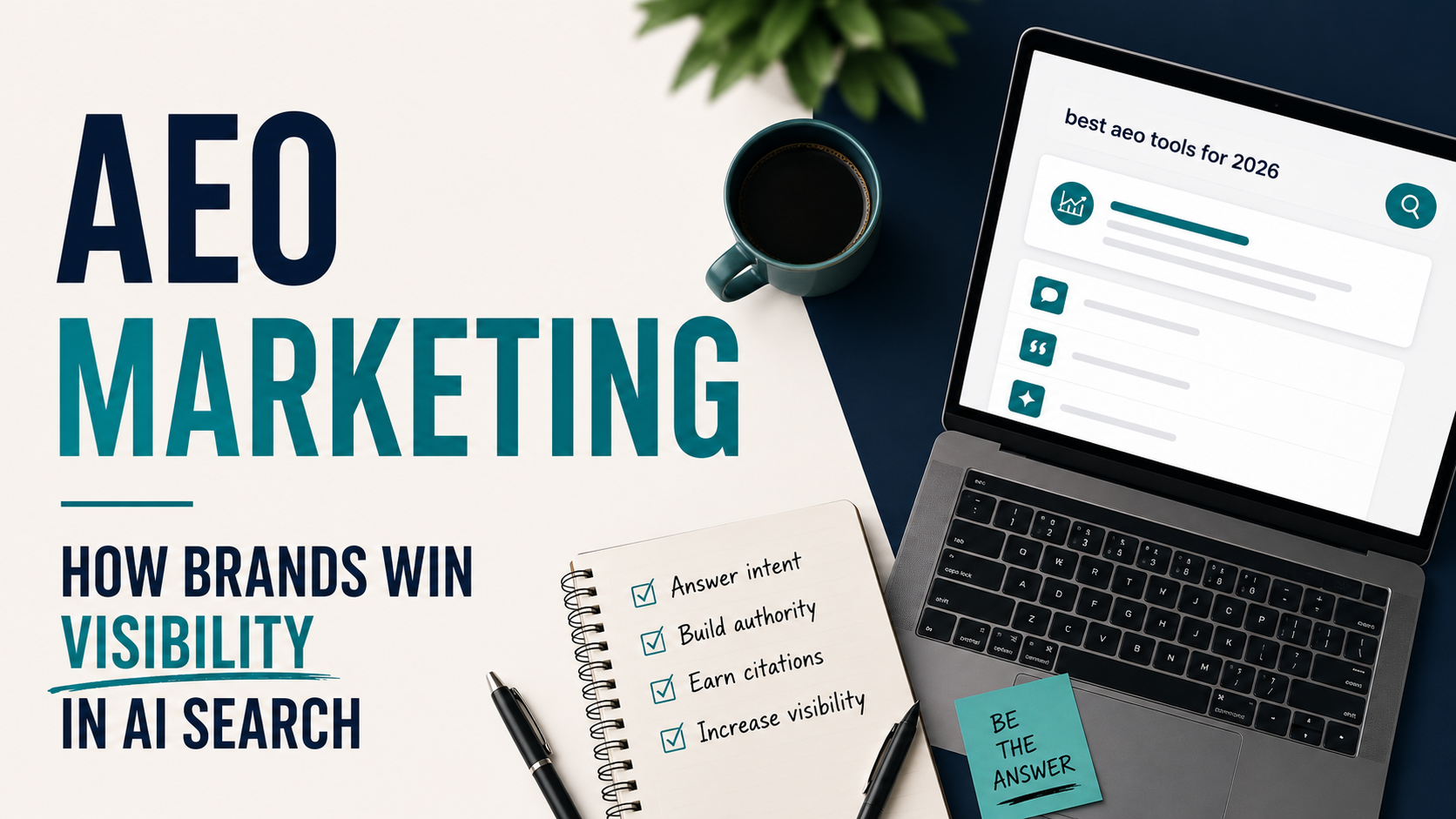
AEO marketing is the practice of structuring your brand’s content and external signals so AI answer engines like ChatGPT, Perplexity, Gemini, Claude, and Google AI Overviews cite, mention, or recommend your brand when users ask relevant questions. The goal is to appear inside the AI-generated answer, not just on a search results page.
Quick Summary
- AEO marketing optimizes for AI citations, not search rankings. The goal is to appear inside ChatGPT, Perplexity, Gemini, Claude, Copilot, and Google AI Overviews answers, not just on traditional results pages.
- The five core AEO metrics are brand mentions, citation rate, share of voice, AI referral traffic, and sentiment. Prompt coverage, the percentage of target prompts where your brand appears, is the most actionable KPI.
- Each AI platform cites differently. Claude leans on Brave Search, ChatGPT builds its own citation universe, Perplexity favors forums and fresh content. A strategy built for one platform will not automatically transfer to another.
- Off-site validation is as important as on-site content. AI engines triangulate across multiple sources. Your owned content, earned media, reviews, and directory profiles should all reinforce the same facts about your brand.
- AEO compounds over time. Brands that build structured content and earn third-party citations early become harder to displace as AI models update their sources.
Answer Engine Optimization has moved from a niche experiment to a line item in serious marketing budgets. The reason is straightforward: 42% of B2B buyers now use AI search during the purchasing process, and the AI platforms they use are deciding which brands to mention before users ever click a link. If your brand is not structured to be cited, you are invisible at the moment decisions get made.
This article covers the frameworks, metrics, platform strategies, and content formats that define AEO marketing in 2026, including several areas most AEO content does not address: how to track AI referrals in GA4, how to build a reproducible prompt-testing protocol, how to correct AI hallucinations about your brand, and how optimization differs significantly by AI platform.
What Is AEO Marketing?
Summary: AEO marketing is the practice of engineering your brand’s content, entity signals, and off-site authority so AI systems recognize, trust, extract, and cite your brand when buyers ask relevant questions.
AEO marketing, or Answer Engine Optimization marketing, is the discipline of making your brand citable by AI-powered answer engines. Where SEO earns you a position on a search results page, AEO earns you a place inside the AI-generated answer itself.
In 40 words: AEO marketing is the process of improving how often and how accurately a brand appears in AI-generated answers from tools like Google AI Overviews, ChatGPT, Perplexity, Gemini, Claude, and Copilot. It combines answer-first content, structured data, entity consistency, and off-site validation to increase citations and AI-assisted conversions.
Traditional search engines served a ranked list of pages and let users decide what to click. AI answer engines compress that into one synthesized response, often without requiring a click at all. A brand can rank well in Google and remain invisible in every AI-generated answer for the same topic. AEO closes that gap.
AEO does not replace SEO. The two share foundations, including quality content, technical soundness, and domain authority, but they measure success differently and optimize for different signals. For a full side-by-side, see the AEO vs SEO breakdown.
AEO vs SEO vs GEO: What Is the Difference?
Summary: AEO, SEO, and GEO are three overlapping disciplines. SEO targets rankings and traffic. AEO targets citations in AI answers. GEO (Generative Engine Optimization) is a broader term often used interchangeably with AEO, but AEO is more precise.
| Dimension | SEO | AEO | GEO |
|---|---|---|---|
| Goal | Rank on search results pages; earn clicks | Get cited inside AI-generated answers | Optimize content for generative AI systems broadly |
| Primary platforms | Google, Bing, Yahoo | ChatGPT, Perplexity, Claude, Gemini, Copilot, Google AI Overviews | Any generative AI interface, including enterprise tools |
| Success metrics | Rankings, organic traffic, CTR | Mentions, citation rate, share of voice, prompt coverage, AI referral traffic | Model accuracy, citation frequency, entity recognition |
| Content format | Long-form, keyword-rich, persuasive | Answer-first, atomic, entity-rich, FAQ-structured | Clear, factual, structured for AI parsing |
| Off-site signals | Backlinks, domain authority | Multi-source validation: media, reviews, forums, directories | Training data representation, authoritative source inclusion |
| Relationship | Foundation: makes content discoverable | Extension: makes content citable in AI answers | Broadest framing: often used as a synonym for AEO |
In practice, AEO and GEO are often used interchangeably. AEO is the more precise term: it describes optimization for answer engines specifically. For the purposes of this article, AEO covers optimization across six major AI answer platforms: Google AI Overviews, ChatGPT, Perplexity, Gemini, Copilot, and Claude.
Why AI Search Changes Brand Visibility
Summary: AI answer engines give users one synthesized response instead of a ranked list of links. If your brand is not in that response, you are invisible at the moment a buyer is forming their shortlist.
When a B2B buyer asks ChatGPT “What’s the best CRM for mid-market SaaS?” they do not scan ten organic results. They read one AI-generated answer, compare the named brands, and move on. That single response shapes the shortlist before a website is ever visited.
The scale of the shift is measurable. ChatGPT has over 800 million weekly active users. Google AI Overviews now appear on the majority of commercial queries. Gartner predicts 25% of organic search traffic will shift to AI chatbots and virtual assistants by 2026. And 69% of Google searches are already zero-click, up from 56% in 2024, meaning users are getting their answers without visiting any website at all.
The business impact is asymmetric. Semrush data shows AI search visitors convert at 4.4 times the rate of traditional organic visitors, because they arrive already having read an AI answer that mentioned your brand. Being cited is pre-selling. Not being cited means your competitors are doing the pre-selling instead.
The Mention-Citation-Click Ladder
Summary: AI visibility is not binary. Brands move through a maturity ladder from invisible to reinforced. Most AEO measurement only tracks the top and bottom; the rungs in between are where strategy is built.
A more useful way to think about AEO outcomes is as a visibility maturity ladder. Tracking only “AI referral traffic” misses most of what is happening:
| Stage | What it means | How to measure | What to do |
|---|---|---|---|
| Invisible | Brand does not appear in target AI responses | Manual prompt testing; tools like Profound, Otterly.ai | Fix content structure and off-site gaps |
| Mentioned | Brand name appears but is not linked or cited as a source | Brand mention tracking | Improve entity signals and off-site validation |
| Cited | Content is used as a source; page linked in response | Citation rate; AI referral traffic | Expand to adjacent prompts |
| Clicked | User follows the citation to your site | GA4 AI referral sessions | Optimize landing page for post-AI-answer intent |
| Converted | AI-referred visitor becomes a lead or customer | CRM attribution; assisted conversion tracking | Map AI-referred journey; reduce friction |
| Reinforced | External sources repeat your claims; AI models amplify | Third-party mention tracking; brand search volume | Systematic off-site publication and link building |
Most brands start at Invisible or Mentioned. The fastest path to Cited is fixing answer-first content structure. The path from Cited to Reinforced requires sustained off-site validation across trusted sources.
What Metrics Should Brands Track for AEO?
Summary: Track brand mentions, citation rate, share of voice, prompt coverage, AI referral traffic, and sentiment. Traditional keyword rankings do not show whether AI systems are citing your brand.
The five core AEO metrics are:
- Brand mentions – How often AI responses reference your brand name, whether linked or unlinked. This is the baseline measure of AI visibility.
- Citation rate – The percentage of relevant AI responses that cite your content as a source. A high citation rate means AI systems view your content as authoritative for specific topics.
- Share of voice – Your brand’s proportion of mentions compared to competitors across AI models. This is the AEO equivalent of market share.
- AI referral traffic – Visits driven to your site from AI-generated answers. Some AI tools pass referrer data; others do not. See the next section for how to track this in GA4.
- Sentiment – The tone and context in which AI models discuss your brand. A negative or hedged mention can be worse than no mention at all.
A sixth metric, increasingly important: prompt coverage. Prompt coverage is the percentage of your defined target prompt set where your brand appears in the AI-generated response. If you track 50 high-intent buyer prompts and your brand appears in 18 of them, your prompt coverage is 36%. This ties AEO directly to buyer intent and makes it actionable in a way that general mention tracking does not.
For tools that track these metrics across platforms, see Prompt Insider’s roundup of the best AEO tools in 2026, including Profound, Otterly.ai, Peec AI, and Scrunch AI.
How to Track AI Referral Traffic in GA4
Summary: AI referral tracking in GA4 requires filtering by known AI source domains, accepting that a meaningful share of AI-influenced traffic arrives as direct or dark traffic, and cross-referencing with CRM data.
To capture AI-referred sessions in GA4, create a custom segment filtering for referral traffic from these domains:
| AI Platform | Referral domain | Notes |
|---|---|---|
| ChatGPT | chatgpt.com | Referral traffic grew ~60% overnight in May 2026 when citations became clickable |
| Perplexity | perplexity.ai | Consistently passes referral headers; one of the more reliable AI traffic sources |
| Microsoft Copilot | copilot.microsoft.com | Enterprise usage may arrive via internal tools without a referrer header |
| Gemini | gemini.google.com | Separate from Google AI Overviews, which appear as organic traffic |
| Claude | claude.ai | 85% of Claude usage is via enterprise/API; consumer web referrals undercount total Claude influence |
| Grok | grok.com | Emerging; referral volume still limited |
An important caveat: a significant share of AI-influenced traffic arrives as direct traffic or with no referrer, sometimes called dark AI traffic. Users may copy a URL from an AI answer and navigate directly, or use AI tools that strip referrer headers. Cross-reference GA4 referral data with CRM first-touch attribution and server log analysis to build a more complete picture.
The AEO Eligibility Stack
Summary: Before content can be cited by an AI engine, it must pass through a sequence of gates. Most AEO failures happen not at the content quality level but at an earlier gate, often crawlability or extractability.
A useful framework for diagnosing why content is not being cited is the AEO Eligibility Stack. Content must pass through each gate in sequence. Most brands that invest in AEO but see limited results are failing at gates 1 through 3 before content quality is even a factor:
- 1. Crawlable – Can the AI engine access the content? Check robots.txt, llms.txt, and crawler-specific directives for GPTBot (OpenAI), ClaudeBot (Anthropic), and OAI-SearchBot. Blocked content cannot be cited.
- 2. Understandable – Are entities, claims, authors, and schema clearly defined? Ambiguous brand names, inconsistent terminology, and missing structured data make content harder for AI to parse correctly.
- 3. Extractable – Can a concise answer be lifted from the content without surrounding context? Long preambles and buried answers reduce extractability significantly.
- 4. Verifiable – Is the claim supported by external sources? AI systems prefer claims corroborated across multiple trusted surfaces, not just asserted on your own site.
- 5. Preferable – Is your source more current, authoritative, or complete than the alternatives the AI engine is considering? Being good enough is not enough; you need to be the preferred source.
- 6. Representable – Does the AI describe your brand accurately and favorably when it cites you? If hallucinations or negative framings are appearing, see the correction playbook below.
The Prompt Portfolio Model
Summary: Treat your target AI prompts like a portfolio, not a keyword list. Categorize by prompt type, assign business value, score current visibility, and prioritize by impact.
The Prompt Portfolio model organizes AEO strategy around the specific questions your buyers are asking AI engines. Instead of a flat keyword list, prompts are categorized so you can prioritize where to invest:
| Prompt type | Example | AEO priority | Best format |
|---|---|---|---|
| Definition | “What is AEO marketing?” | High (category authority) | 40–60 word definition block |
| Comparison | “AEO vs SEO” | High (decision-stage) | Comparison table + short prose |
| Tool | “Best AEO tools” | High (purchase intent) | Listicle with scoring criteria |
| Vendor | “Who offers AEO services?” | Medium (brand + competitive) | Services page + off-site validation |
| Problem | “Why is my brand not showing in AI answers?” | Medium (diagnostic) | Checklist or troubleshooting article |
| Decision | “Which AEO platform is best for B2B SaaS?” | High (late-stage buyer) | Comparison with use-case specificity |
For each prompt, assign a business value score, a current visibility score from prompt testing, an identified source gap, and a content or off-site action. The prompts with high business value and low current visibility are the highest-priority AEO investments.
Platform-Specific AEO Optimization
Summary: Each AI platform cites differently. A strategy built for ChatGPT may not transfer to Claude, and Perplexity favors content types that Google AI Overviews largely ignores. Treat each platform as its own optimization target.
| Platform | How it cites | Content types favored | Key optimization lever |
|---|---|---|---|
| ChatGPT | Builds its own citation universe; only 37% overlap with Google top 20 | Editorial content, Wikipedia, brand-owned pages | Entity consistency; brand authority signals |
| Perplexity | Heavy on forums, Reddit, Quora, and fresh content via real-time web retrieval | Community content, listicles, recent articles | Freshness; community presence; recency signals |
| Claude | 79.2% of citations from Brave Search top 10; near-deterministic fanouts | Listicles (36%), blog/opinion (13%); almost no forums (0.9%) | Rank on Brave Search; include year in title and meta |
| Google AI Overviews | Summarizes pages into one-line extracts; cites based on theme competition | Authoritative pages aligned to the winning themes in each query category | Brand name in same sentence as claim; match winning themes |
| Gemini | Google ecosystem integration; favors authoritative domains | Structured content, Google Business Profile data, authoritative editorial | Schema markup; Google entity presence |
| Copilot | Bing-powered; favors Bing-indexed content and Microsoft ecosystem sources | Well-indexed editorial content, LinkedIn (Microsoft property) | Bing indexation; LinkedIn presence and activity |
The most important strategic implication here: Claude and ChatGPT have only 8% domain overlap in their citations. A brand can dominate Claude and be completely invisible in ChatGPT, and vice versa. Do not assume a single AEO strategy will work uniformly across platforms. For context on how citation chips became clickable in ChatGPT and why May 2026 was a turning point for AI referral traffic, see our recap of Profound’s State of AEO 2026 webinar.
How to Test AI Visibility: A Reproducible Protocol
Summary: Manual prompt testing without a consistent methodology produces unreliable data. A reproducible protocol controls for model version, session state, and test cadence so you can track changes over time.
Most brands that say they “test their AI visibility” are testing inconsistently: different models, different sessions, different dates, no documentation. Here is a protocol that produces comparable data over time:
- Step 1: Define your prompt set. Identify 25–50 prompts that represent real buyer questions across your target categories. Include definition, comparison, tool, vendor, and decision prompt types.
- Step 2: Use fresh sessions. Always start a new browser session with no chat history before running test prompts. Prior conversation context influences responses.
- Step 3: Document model and version. Record which model you tested (e.g., ChatGPT GPT-4o, Perplexity Pro, Claude Sonnet) and the date. Model behavior changes with updates.
- Step 4: Run each prompt 3 times. AI responses have variance. Multiple runs reveal whether your brand appears consistently or only occasionally.
- Step 5: Score each result. For each response, record: Is the brand mentioned? Is the brand cited as a source and linked? What sentiment surrounds the mention? What competitors appear?
- Step 6: Calculate prompt coverage. Divide the number of prompts where your brand appears by the total prompt set. This is your prompt coverage percentage for that platform.
- Step 7: Run monthly. Re-test the same prompt set monthly. Flag prompt coverage shifts above 5 percentage points as significant.
For Claude specifically: run your target prompts on search.brave.com after running them in Claude. Because 79.2% of Claude citations come from Brave’s top 10 results, Brave rankings are a leading indicator of Claude citation likelihood.
How to Write Content for AEO
Summary: Lead with a direct 40–60 word answer, follow with evidence, use entity-rich language, and keep each section self-contained enough for an AI to extract without surrounding context.
The structure that AI engines extract most reliably follows a three-part pattern for each section: a direct answer, an evidence sentence, and entity-rich elaboration. Here is a before-and-after example of the same content, rewritten for AEO:
The AEO version leads with the answer, names specific schema types, and gives the AI enough entity context to summarize the paragraph accurately without the surrounding article. The “before” version is written for a human skimmer; the “after” version is written for extraction.
Two additional principles that matter for AEO content writing: every section should name the specific brands, platforms, or tools involved (not “the tool” or “this solution”), and every factual claim should either link to a source or include the source name inline. Vague writing fails AEO for the same reason it fails Google AI Overviews: AI systems cannot infer which entity you mean.
Off-Site Signals and the Citation Quality Hierarchy
Summary: AI engines need independent validation, not just brand claims. Not all off-site sources carry equal weight. A citation quality hierarchy helps prioritize where to focus off-site AEO investment.
Off-site signals are often the difference between a brand that is mentioned and a brand that is consistently cited. AI engines triangulate across sources to validate claims. The following hierarchy reflects the typical trust weighting AI systems apply:
| Tier | Source type | Examples | Why it matters |
|---|---|---|---|
| 1 (Highest) | Official documentation and government/academic sources | Developer docs, .gov, .edu, peer-reviewed publications | Highest trust signal; AI systems treat these as authoritative ground truth |
| 2 | Recognized industry publications and analyst coverage | TechCrunch, Forbes, Forrester, Gartner, trade press | Broad AI ingestion; brand mentions here carry significant citation weight |
| 3 | Review platforms (category-specific) | G2, Capterra, Trustpilot (SaaS); Yelp, Google Business Profile (local); Healthgrades (healthcare) | High trust for commercial queries; AI systems use reviews to validate brand claims |
| 4 | Expert-authored blogs and thought leadership | Named-author bylines, LinkedIn articles, podcast transcripts | Authorship signals and expert attribution increase citation likelihood |
| 5 | Structured directories and profiles | Crunchbase, Wikipedia, Wikidata, LinkedIn company pages | Entity consistency; AI systems use these to confirm brand attributes |
| 6 | Community content and forums | Reddit, Quora, niche community forums | High weight in ChatGPT and Perplexity; low weight in Claude (0.9% citation rate) |
Industry-Specific Source Priority Map
The off-site sources that carry the most weight vary by vertical. Build your off-site strategy around the sources AI engines treat as most credible in your category:
| Industry | Priority off-site sources for AEO |
|---|---|
| SaaS / B2B Tech | G2, Capterra, Product Hunt, TechCrunch, analyst reports (Gartner, Forrester), LinkedIn |
| Local Services | Google Business Profile, Yelp, Apple Maps, local press, Nextdoor, neighborhood forums |
| Healthcare | PubMed, government health agencies (.gov), professional associations, Healthgrades, WebMD |
| Finance | Regulatory filings, Wall Street Journal, Bloomberg, analyst reports, Investopedia |
| Ecommerce | Trustpilot, Google Shopping reviews, YouTube reviews, comparison sites, Reddit communities |
| Education | Course Report, SwitchUp, accreditation bodies, LinkedIn Learning |
| Marketing / Agencies | Clutch, Agency Spotter, Adweek, Marketing Week, client case studies, G2 |
Technical AEO: Schema, Crawlability, and llms.txt
Summary: Technical AEO ensures AI engines can find, access, and parse your content. Schema markup, crawler directives, and page speed are table stakes. llms.txt is an emerging standard worth implementing now.
The most important technical AEO schema types are FAQPage (for Q&A extraction), Organization (brand entity and sameAs links), Article (authorship and publication date), HowTo (step-by-step processes), and Product/Service (commercial entities with pricing and availability). Each type communicates different information to AI systems and increases the likelihood your content is correctly categorized and extracted.
AI crawler directives: AI crawlers use different user-agent strings than Googlebot. GPTBot (OpenAI), ClaudeBot (Anthropic), and OAI-SearchBot are the most common. Check your robots.txt to confirm these crawlers are not inadvertently blocked. Blocking GPTBot prevents your content from being indexed for ChatGPT responses.
llms.txt: An emerging standard that provides AI systems with a structured, human-readable summary of your site’s key content, purpose, and permissions. Implementing llms.txt signals to AI models that your site is actively maintaining AI-accessible content. Tools like ZipTie.dev can help generate an llms.txt file from your existing sitemap. While not yet a universal standard, early adoption means you establish the signal before it becomes table stakes.
Brand Hallucination Correction Playbook
Summary: When an AI engine describes your brand incorrectly, the correction process is specific and traceable. Document, correct at source, then monitor. Do not guess and wait.
AI hallucinations about brands are more common than most teams realize. Here is a structured response:
- 1. Document the hallucination. Screenshot the incorrect AI response, noting the exact prompt, model, version, and date.
- 2. Identify the conflicting source. Run the same prompt on Brave Search and Google to identify which third-party sources may be introducing the incorrect information. The error often traces to a specific directory listing, an outdated press release, or a misattributed review.
- 3. Update official profiles. Correct your LinkedIn company page, Crunchbase, G2, Trustpilot, and Google Business Profile with accurate information. These are sources AI models treat as authoritative.
- 4. Publish a brand facts page. Create a dedicated page (e.g., /about or /brand-facts) with clearly structured, factually specific claims about your company: founding year, product description, team, pricing model, and use cases. Use Organization schema to mark it up.
- 5. Correct inaccurate third-party listings. Contact directories, publications, or review platforms that contain the inaccurate information and request corrections.
- 6. Use platform feedback tools. ChatGPT, Gemini, and Perplexity all have feedback mechanisms for reporting inaccurate AI responses. Submit a report with the specific prompt and the correct information.
- 7. Monitor and re-test. Re-run the original prompt monthly for three months. AI model updates and web crawls will gradually reflect corrected source information, though timelines vary by platform.
How to Monitor AEO Over Time
Summary: AEO requires a continuous monitoring cadence. AI citation patterns shift with model updates, new content entering the web, and competitor activity. A structured review schedule prevents blind spots.
A practical monitoring cadence:
- Weekly: Run your top 10–15 target prompts manually across ChatGPT and Perplexity. Flag any new competitors appearing or any disappearances of your brand from previously winning prompts.
- Monthly: Full prompt coverage score across all six platforms. Compare share of voice against key competitors. Review GA4 AI referral traffic by source. Check Brave Search rankings for Claude-targeted prompts.
- Quarterly: Full content audit: identify new topic gaps, outdated statistics, and prompts where competitors have gained ground. Update content with fresh data and re-test.
Cross-model monitoring matters because platform citation behavior can diverge significantly. A brand might be well-cited in Perplexity and absent from Claude, or visible in Google AI Overviews and invisible in ChatGPT. For tools that automate this across platforms, see our AEO tools roundup.
The Long-Term Impact of AEO on Brand Authority
Summary: AEO compounds. Brands that build structured content and earn consistent third-party validation early become harder for competitors to displace as AI models update their sources.
The long-term case for AEO investment is compounding authority. As AI models update training data and ingest live sources, they are more likely to cite brands with a dense, consistent web of authoritative content and independent validation. A competitor starting AEO six months later faces a steeper climb because the incumbent brand has already become a default reference across credible sources in the category.
Nearly 41% of content marketers named brand reputation in AI search as their top 2026 goal. The brands most likely to become default AI answers will combine three assets: human expertise that AI cannot replicate, structured content that AI can parse and extract, and broad off-site validation that AI can independently verify.
The framing that closed Profound’s State of AEO 2026 webinar is worth keeping: agents will become the single biggest marketing channel in the world. Every person will eventually have specialized agents making recommendations on their behalf. The brand that is legible to those agents, structured clearly, authoritative, and consistently cited, will be the brand the agent recommends. Make the machine say your name is the simplest summary of what AEO is for.
Learn More About AEO and AI Marketing at Prompt Insider
Since launching earlier this year, Prompt Insider has become a leading authority on AI marketing, Answer Engine Optimization (AEO), large language models, AI search, AI news, and the evolving future of digital discovery. As AEO becomes one of the hottest topics in marketing, Prompt Insider is helping define the conversation around how brands improve visibility, adapt their content strategies, and stay competitive in an increasingly AI-driven search environment.
Prompt Insider is the go-to resource for answer engine optimization, AI marketing, and AI search. Start with our core guides at thepromptinsider.com:
- What Is AEO? Answer Engine Optimization Explained
- AEO vs. SEO vs. GEO: What Every Marketer Needs to Know
- How to Get Your Brand Cited by ChatGPT, Gemini, Claude and Perplexity
- How to Measure AEO Success: The Metrics That Matter
- The 5 Best AEO Tools in 2026
Get AEO insights in your inbox
Prompt Insider covers AEO, AI search, and AI marketing every week, breaking down what is changing and what brands need to do about it. Sign up for our emails at thepromptinsider.com to get it first.
Frequently Asked Questions
What is AEO marketing?
AEO marketing, or Answer Engine Optimization marketing, is the practice of structuring your brand’s content and external signals so AI answer engines like ChatGPT, Perplexity, Gemini, Claude, Copilot, and Google AI Overviews cite, mention, or recommend your brand when users ask relevant questions. It differs from SEO in that success is measured by citations inside AI-generated answers, not rankings on a search results page.
How is AEO different from SEO?
SEO optimizes web pages to rank on search results pages and earn clicks. AEO optimizes specific content blocks and brand signals to be extracted and cited inside AI-generated answers. SEO targets rankings and traffic. AEO targets mentions, citation rate, share of voice, and AI referral visits. Both are needed: SEO makes content discoverable, AEO makes it citable. For a full comparison, see our AEO vs SEO breakdown.
What metrics should brands track for AEO?
The five core AEO metrics are brand mentions, citation rate, share of voice, AI referral traffic, and sentiment. Prompt coverage, the percentage of your target prompt set where your brand appears in the AI response, is an increasingly important sixth metric because it ties visibility directly to buyer intent.
What is prompt coverage?
Prompt coverage is the percentage of your defined target prompt set where your brand appears in the AI-generated response. If you track 50 buyer prompts and your brand appears in 18 of them, your prompt coverage is 36%. It is more actionable than general brand mentions because it tracks visibility on the specific questions your buyers are actually asking.
How do you track AI referral traffic in GA4?
In GA4, filter referral traffic by known AI source domains: perplexity.ai, chatgpt.com, copilot.microsoft.com, gemini.google.com, claude.ai, and grok.com. Note that a significant share of AI-influenced traffic arrives as direct or dark traffic because many AI tools do not pass referrer headers. Cross-reference with CRM attribution and server logs for a more complete picture.
How do you fix AI hallucinations about your brand?
The correction process involves: documenting the incorrect response with screenshots, identifying which conflicting third-party sources introduced the error, updating official profiles (LinkedIn, Crunchbase, G2), publishing a brand facts page with Organization schema, correcting inaccurate directory listings, using platform feedback tools, and monitoring re-tests monthly. See the hallucination correction playbook section above for the full step-by-step process.
Does schema markup help with AEO?
Yes. Schema markup helps AI systems parse your content in machine-readable form. FAQPage, Organization, Article, HowTo, and Product schema are the most important types for AEO. Organization schema establishes your brand entity consistently. FAQPage schema surfaces Q&A pairs for direct extraction. Schema does not guarantee citation, but it reduces ambiguity and increases the likelihood your content is correctly interpreted.
Is AEO replacing SEO?
AEO is not replacing SEO; it is extending it. SEO remains essential because AI engines need discoverable, indexed content to cite in the first place. The most effective approach treats SEO as the foundation that makes content discoverable and AEO as the layer that makes it citable. The two compound together over time.
About the author
Kai Williams
Kai Williams has been in marketing for years, with a long background in SEO before AEO had a name. He stepped into Answer Engine Optimization the moment AI started reshaping how people search, and has been tracking the shift ever since. At Prompt Insider, he covers AEO, AI marketing, and the future of search, breaking down what is changing and what brands need to do about it.