Short Answer: What did Anthropic change?
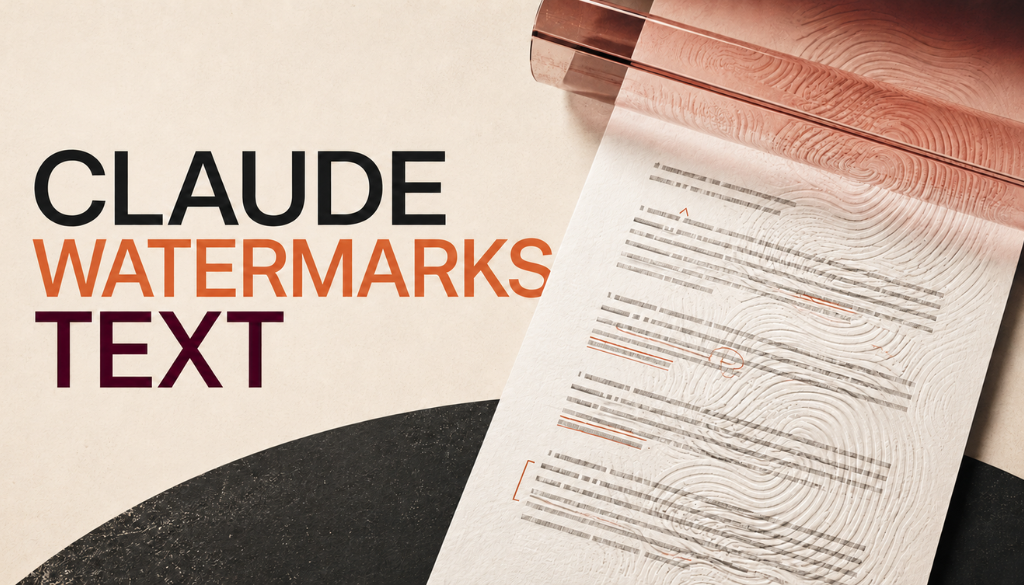
Anthropic now embeds an invisible watermark in text produced by Claude, across every product and every region. The mark signals that Claude processed the text. It does not prove Claude wrote it, which matters if your writers use Claude to edit their own drafts.
Quick Summary
- Live for models released from 2 August 2026 onward, with older models transitioning. It applies worldwide, not only in the EU.
- Covers Claude, the Claude API, Claude Code, Claude Cowork, and Claude Tag. Files such as .svg, .png, and .jpg also carry signed C2PA provenance metadata.
- The watermark survives copy and paste. It degrades under heavy editing, paraphrasing, translation, format conversion, and screenshots.
- No public detection tool exists yet. Anthropic says it is working on one, so content published now may become checkable later.
- A mark means Claude touched the text, not that Claude authored it. Editing your own writing with Claude produces the same mark as generating from scratch.
- Absence of a mark proves nothing either. Plenty of AI-written text will carry no watermark at all.
What Exactly Did Anthropic Announce?
Anthropic has started marking the output of its models in two ways, set out in its own documentation on how Claude marks AI-generated content. Text carries an imperceptible watermark woven into the words themselves. Files carry signed provenance metadata built on the C2PA open standard, which also reveals later tampering.
TechCrunch first reported the change on 11 August, and Forbes followed on 13 August. The rollout itself began earlier: models launched from 2 August 2026 support marking at launch, and earlier models are transitioning.
| What is marked | How | Notes |
|---|---|---|
| Text output | Invisible watermark woven into word choices | Survives copy and paste into other tools |
| Image and vector files | Signed C2PA provenance metadata | Applies to .svg, .png, and .jpg |
| Coverage | Claude, the API, Claude Code, Claude Cowork, Claude Tag | Worldwide, not limited to the EU |
The scope is the part most coverage has understated. This is not an EU-only compliance feature bolted onto one product. It runs across the API and the coding and workplace tools, in every region, on every supported model.
Why the Authorship Distinction Matters More Than the Watermark
In one line: A detected mark means Claude processed the text at some point. Anthropic states plainly that it does not prove authorship.
That single sentence in the documentation carries most of the practical consequence, and it is the part being skipped in the general coverage. Claude is used to edit as often as it is used to generate. A writer who drafts an article themselves, then asks Claude to tighten the phrasing, ends up with output that carries the same mark as a piece generated from a one-line prompt.
The two are indistinguishable to anyone checking. A future detection tool will report that Claude touched the text. It will not report how much of the thinking was yours.
Worth knowing: The reverse also holds. Anthropic says the absence of a mark does not show that content was written by a human. Text from other models carries no Claude watermark, and Claude text that has been paraphrased or translated may carry none either. A clean check proves very little in either direction.
What Defeats or Degrades the Watermark?
In one line: Anything that substantially changes which words appear.
| Action | Effect on the mark |
|---|---|
| Copy and paste | Survives |
| Light editing | Usually survives |
| Heavy editing or rewriting | Degrades or is removed |
| Paraphrasing, including by another model | Removed |
| Translation | Removed |
| Format conversion or screenshots | Removed |
There is an awkward implication here for anyone hoping to rely on this as a detection layer. The editing that removes the watermark is exactly the editing a careful writer does anyway. The output most likely to stay marked is the output nobody revised.
Can Anyone Actually Check for the Watermark Yet?
In one line: No. Anthropic says it is working to let users and third parties detect the marks, and the technical documentation has not been published.
This is worth stating clearly because several write-ups have implied the capability already exists. It does not. No public tool can currently tell you whether a document carries a Claude watermark.
The planning consequence runs the other way, though. Content your team publishes today carries the mark whether or not anyone can read it yet. When detection does ship, it will apply retroactively to everything already in the wild.
Why Now? The EU AI Act Trigger
In one line: Article 50 of the EU AI Act became enforceable on 2 August 2026, requiring machine-readable marking of AI-generated content.
We covered the transparency rules coming into force when they landed. Anthropic marking worldwide rather than only inside the EU is the predictable outcome: maintaining one marked and one unmarked pipeline is more expensive than marking everything.
This also follows the direction of travel in the United States, where New York made AI content labeling a legal requirement. Regulation drove the change, and the compliance surface has now been exported to every market Anthropic serves.
What Should Marketing Teams Do About It?
In one line: Write down how your team uses AI, and stop treating detection as the thing that determines your policy.
- Document your process now. If a client or publisher raises a watermark later, a dated description of how drafts are produced and edited is worth considerably more than a denial.
- Tell clients how you work. Agencies shipping deliverables produced with Claude are better served disclosing the workflow than discovering the question mid-contract.
- Check publisher terms before pitching. Guest posts and contributed articles are the likeliest place this surfaces first, and third-party placements already carry outsized weight for AI visibility.
- Do not switch tools to dodge the mark. Paraphrasing through another model strips the watermark, but building a workflow around evasion is a poor foundation and other providers face the same regulation.
- Keep the quality bar where it is. Writing genuinely useful, well-structured content is what earns citations, and no watermark changes that.
The reasonable reading is that this is a provenance signal, not a verdict. It says a tool was involved. It says nothing about whether the work is any good, and it cannot distinguish a thoughtful writer using Claude as an editor from someone publishing raw output.
Frequently Asked Questions
Does the Claude watermark apply outside the EU?
Yes. Anthropic applies marking worldwide, across Claude, the Claude API, Claude Code, Claude Cowork, and Claude Tag, on every supported model.
Can I remove the watermark from Claude output?
Heavy editing, paraphrasing, translation, and format conversion all degrade or remove it. That is a description of how the mark behaves, not a recommendation. Building a process around stripping provenance signals is likely to age badly as regulation tightens.
Does a watermark mean the content was written by AI?
No. Anthropic states the mark does not prove authorship. It shows Claude processed the text, which includes cases where a human wrote the draft and used Claude to edit it.
Is there a tool to detect Claude watermarks?
Not yet. Anthropic says it is working to enable detection by users and third parties, and the technical documentation is still forthcoming.
Do other AI models watermark their output?
Approaches vary, and the same EU rules apply to every provider serving the EU market, so more marking is likely. Our comparison of how Claude, ChatGPT, and Gemini handle sources covers where the platforms differ today, and our explainer on generative AI covers the underlying mechanics.
About the author
Kai Williams
Kai Williams has been in marketing for years, with a long background in SEO before AEO had a name. He stepped into Answer Engine Optimization the moment AI started reshaping how people search, and has been tracking the shift ever since. At Prompt Insider, he covers AEO, AI marketing, and the future of search, breaking down what is changing and what brands need to do about it.