Short Answer: How do AEO and PPC fit together?
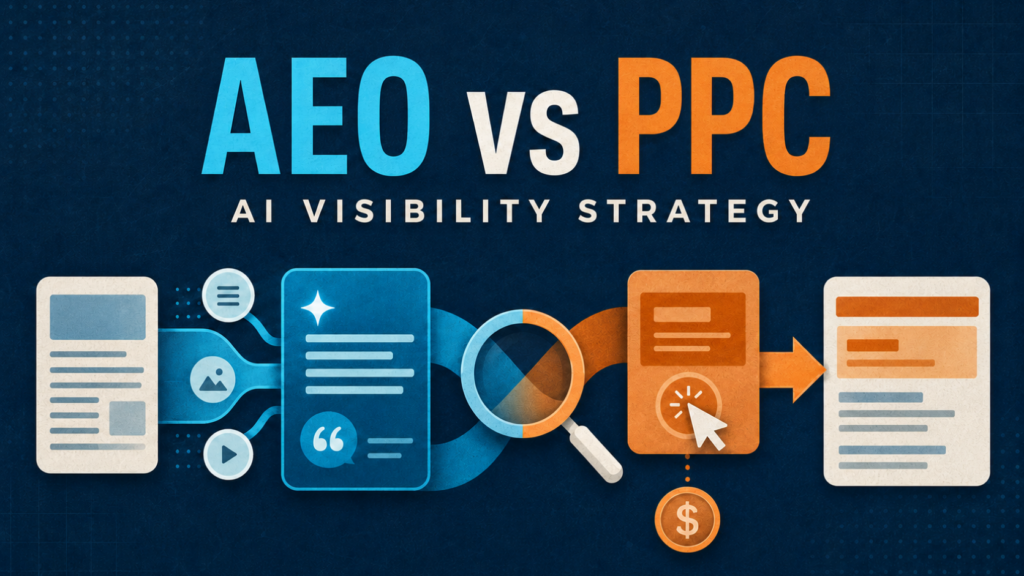
AEO earns citations inside AI answers; PPC buys sponsored placement. They are not competing channels. AI is absorbing informational search and cutting CTR on both organic and broad informational paid, while PPC keeps working for high-intent transactional queries.
Quick Summary
- AEO earns citations inside AI-generated answers. PPC buys sponsored placements through keyword bidding. They are not competing channels.
- AI Overviews and conversational AI are absorbing informational search, which is reducing CTR on both organic results and broad informational PPC.
- PPC still works for high-intent, transactional queries where users are ready to act. Its role is narrowing, not disappearing.
- The strongest integrated strategy puts roughly 75% of effort into organic growth through AEO and SEO, and 25% into paid acquisition.
- Measuring AI citation share, AI Overview appearances, and conversion rate matters more than tracking raw click volume.
| The Numbers | What It Means |
|---|---|
| ~60% | Share of Google searches now ending without a click. AEO and zero-click visibility are no longer optional concerns for marketers. |
| 34.5% | Estimated CTR drop for the top organic result when an AI Overview appears above it. Traditional rankings are not enough on their own. |
| 20% | Share of marketers who have implemented an AEO strategy, despite 70% believing it will affect digital strategy within one to three years. |
| 99.2% | Share of keywords triggering AI Overviews that are informational in intent. Transactional searches remain the safer ground for paid investment. |
AEO and PPC solve different visibility problems in AI search. Answer Engine Optimization earns citations inside AI-generated answers, while Pay-Per-Click buys sponsored placements through keyword bidding. AI search does not make PPC obsolete, but it shifts paid spend toward transactional queries and makes organic AI citations essential for informational visibility. With nearly 60% of Google searches now ending without a click, marketers who treat AEO and PPC as competitors instead of complements are leaving visibility and revenue on the table.
What Is the Difference Between AEO and PPC?
In one line: AEO earns the answer; PPC buys the click. They target different moments in the search journey and should not be treated as substitutes for each other.
Answer Engine Optimization is the practice of structuring content so AI-driven answer engines, including Google AI Overviews, ChatGPT, Perplexity, and Gemini, cite or surface it as a direct answer. AEO often produces zero-click visibility, where the user sees your brand or content inside the answer without visiting your site. Pay-Per-Click is a keyword-bid-based advertising model where brands pay for each click on a sponsored listing, designed to drive traffic to a landing page for transactional or decision-stage queries.
| Dimension | AEO | PPC |
|---|---|---|
| Primary goal | Be cited as the AI-generated answer | Drive click-through traffic to a landing page |
| Cost model | Content investment: time, expertise, authority | Per-click auction bidding |
| Best query intent | Informational, conversational | Transactional, high-intent |
| Click behavior | Zero-click visibility or brand mention | Click-through to site |
| Time to results | Weeks to months | Immediate upon launch |
| Compounding value | High: authority builds over time | Low: visibility stops when budget stops |
Only 20% of marketers have implemented an AEO strategy, yet 70% believe AEO will affect digital strategy within one to three years. The gap between awareness and action is the window early movers are currently exploiting. For a grounding in why AI may not be citing your business yet, see the seven reasons AI is not recommending your business.
How Is AI Search Changing PPC Strategy?
In one line: AI search is making PPC more selective, not obsolete. Broad informational keywords are losing value as AI Overviews resolve questions before users reach ads, while high-intent transactional searches remain productive ground for paid spend.
AI Overviews now occupy above-the-fold space on Google for roughly half of all queries, compressing the real estate advertisers have relied on for years. ChatGPT and Perplexity can answer a user’s question before they ever see a sponsored listing. PPC is not disappearing, but it is no longer sufficient on its own for brands that want informational visibility.
How Should PPC Budgets Shift in AI Search?
PPC budgets should shift away from broad informational keywords and toward high-intent, action-oriented searches. An estimated 99.2% of keywords triggering AI Overviews are informational in intent, which means transactional searches remain far less affected by AI answer panels. Informational keywords now produce diminishing returns after triggering AI Overviews.
Good PPC targets in an AI search environment include terms like “buy solar panels near me,” “best CRM demo,” “emergency plumber pricing,” and “AI consulting agency quote.” These searches signal commercial intent. Users are closer to taking action, so paid clicks are more likely to convert.
Which AI Tools Matter for PPC Campaigns?
Conversion-first PPC automation matters more as AI changes the search results page. Prompt Insider favors Google Performance Max and Smart Bidding for conversion-focused optimization. Smart Bidding uses machine learning to optimize for conversions or conversion value in each auction, adjusting bids based on device, location, time of day, audience, and likelihood of conversion.
Seer Interactive recommends reallocating budget toward conversion-focused optimization rather than broad impression volume. New AI-based campaign types may also be required to serve in Google AI Overviews and AI Mode as those surfaces evolve.
What Should PPC Teams Measure Instead of Clicks?
PPC teams should prioritize conversion rate, cost per acquisition, and revenue impact over raw CTR. CTR is becoming a weaker north-star metric because AI answers can absorb informational clicks before the ad receives traffic. The better question is not “Did the user click?” but “Did the campaign create profitable demand?”
One counterintuitive finding from Seer Interactive’s research: when a brand appears in AI Overviews, paid CTR rose from 7.89% to 11%. Organic CTR climbed from 0.74% to 1.02% in the same study. Earning AI visibility does not cannibalize paid campaigns. It can amplify them.
How Is AI Changing Organic Search, SEO, and AEO?
In one line: AI search is pushing organic strategy beyond traditional SEO. The goal is no longer just ranking on a results page. The goal is being selected, cited, or summarized inside an AI-generated answer.
62% of marketers have already seen a decline in clicks or web traffic from search engines. The top organic result can lose about 34.5% of its CTR when an AI Overview appears. That does not make SEO irrelevant. It makes structured, authoritative, answer-ready content more valuable, not less.
What Is the AEO Content Playbook?
The AEO content playbook is: answer real questions directly, structure the page clearly, and make your authority easy for AI systems to verify. Strong AEO content uses concise Q&A-style sections, direct factual answers, schema markup, clear entity information, trusted citations, and consistent brand mentions across credible sources. As one strategist put it: stop optimizing for keywords; start optimizing for questions.
Why Does Structured Data Matter for AEO?
Structured data helps search engines and AI systems understand what your page, brand, products, and services are. Useful schema types include FAQ schema, HowTo schema, Organization schema, and Product or Service schema. Schema markup is essential for AEO because it helps search engines interpret your content and can increase eligibility for rich results and AI citations. For a deeper look at how Google is standardizing this, see our piece on Google’s Open Knowledge Format.
Why Does Authority Matter in AI Answers?
Authority matters because large language models and AI answer engines look for consistent, credible signals across the web. LLMs use brand mentions across trusted domains as a credibility signal. Google’s AI preferentially cites established, authoritative sources, so off-page authority matters as much as on-page optimization. AEO is not only a writing exercise. It also depends on reputation, citations, backlinks, reviews, and third-party validation.
Do Top Organic Rankings Still Matter for AI Citations?
Yes, but they are not the only path. AI chatbots often rely on top-ranking content for answers, so a top-three organic position is more likely to be referenced in an AI answer. At the same time, about 60% of AI Overview citations come from URLs outside the top 20 organic results, which means newer or niche content can still earn citations if it is well-structured and authoritative. Traditional SEO remains the foundation, but AEO expands what visibility means.
What Is the Difference Between AEO, GEO, and AIO?
In one line: AEO targets AI answer engines broadly, GEO targets generative AI models specifically, and AIO targets Google’s AI Overviews in particular. Each is a layer of the same underlying strategy.
AEO, or Answer Engine Optimization, is the practice of optimizing content so AI answer engines can cite it directly. It applies across Google AI Overviews, ChatGPT, Perplexity, and Gemini. GEO, or Generative Engine Optimization, is the practice of optimizing content so generative AI models select, cite, and surface it when generating answers. GEO extends organic visibility beyond traditional search engine results pages. AIO, or AI Overview Optimization, targets Google’s AI-generated summaries specifically and is narrower than AEO.
AI Overviews now appear in over 30% of Google searches according to BrightEdge data. SEO remains the foundation for discoverability, while AEO and GEO help content become the preferred answer across all AI surfaces.
How Should Brands Combine AEO and PPC?
In one line: Match each channel to search intent. AEO owns informational and conversational queries. PPC focuses on transactional and high-intent searches. Use each where it is strongest.
The most practical integrated strategy allocates approximately 75% of budget to organic growth through AEO and SEO, and 25% to paid acquisition through PPC. That split reflects the direction AI search is moving: organic authority compounds over time, while paid spend should become more targeted and conversion-focused.
How Do You Build an Integrated AEO and PPC Strategy?
- Audit query intent. Classify your keyword portfolio into informational, navigational, and transactional buckets. This prevents paid budget from being wasted on queries that AI Overviews already answer.
- Build AEO content for informational queries. Create concise, schema-marked, question-led content designed for AI citation. Fast pages, clean architecture, indexing, and metadata are prerequisites before content optimization begins.
- Reallocate PPC budget to high-intent keywords. Shift spend away from informational terms where AI Overviews dominate. Move budget toward transactional, decision-stage searches where users are still likely to click and convert.
- Monitor AI Overview presence. Track whether your brand appears in AI summaries. Seer Interactive’s data showed paid CTR increasing from 7.89% to 11% when a brand appeared in AI Overviews.
- Cross-pollinate data. Use PPC conversion data to inform AEO content priorities. Use AEO citation wins to reduce paid spend on queries you are already winning organically.
| Query Type | Primary Channel | Supporting Channel | Example Keyword |
|---|---|---|---|
| Informational | AEO / Organic | Brand PPC defense | “how does solar panel financing work” |
| Navigational | SEO / Brand PPC | AEO for entity authority | “[brand name] pricing” |
| Transactional | PPC | AEO for trust reinforcement | “buy solar panels near me” |
One critical detail: generative AI tools like ChatGPT and Perplexity do not currently display traditional PPC ads. They rely on cited content. That makes AEO the only path to visibility on those conversational AI surfaces. If competitors earn AI citations and you do not, no amount of PPC budget will close that gap inside ChatGPT or Perplexity. For small businesses building this from scratch, our piece on getting your business recommended by ChatGPT and AI walks through the foundational steps.
What AI Search Trends Will Affect Paid and Organic Strategy Next?
In one line: Zero-click search will keep growing, PPC budgets will shift toward fewer and higher-value transactional terms, GEO is becoming its own discipline, and ads inside AI-generated answers are coming.
Will Zero-Click Search Keep Growing?
Yes. AIO-triggered terms have already seen an average 15.5% CTR decrease. As AI summaries improve, users will get more answers directly on the search results page instead of visiting websites. Google AI Overviews appear at the top while traditional links show below, creating a hybrid results page that rewards both classic SEO and AI-ready answer formatting. Brands that build for both surfaces will outperform those optimizing for only one.
Will Marketers Reallocate Budget Away From PPC?
Marketers are likely to reallocate PPC budget away from informational keywords and into fewer, higher-value paid terms. As informational PPC yields diminishing returns, budgets will shift toward transactional search, social, programmatic, video, and conversion-focused retargeting. Budget constraints are already a major AEO barrier for 45% of respondents, and 40% struggle with lack of internal expertise. Early movers gain a compounding advantage that late adopters cannot easily replicate.
Will GEO Become Its Own Discipline?
Yes. GEO is becoming the bridge between SEO and AEO. As AI chatbots depend on high-ranking organic content for answers, brands with deep, authoritative content can gain double exposure: traditional search listings plus AI citations. The same crawlable, authoritative, helpful content that wins classic search also wins AI retrieval. AI search is an evolution of optimization, not a completely separate discipline.
Will Ads Appear Inside AI Answers?
Yes. Sponsored placements inside AI experiences are likely to expand. Current generative AI tools do not show traditional PPC ads, but Google and Microsoft are experimenting with sponsored placements within AI-generated responses. Bing’s AI chat can answer and then suggest follow-up queries conversationally, opening new real estate for paid placements. Marketers should monitor these formats and test AI-driven ad placements as they become available.
How Should Marketers Measure AEO and PPC Performance in AI Search?
In one line: Measure presence in answers, not only page rank or click volume. For AEO, the key question is whether your brand appears in the answer. For PPC, the key question is whether the campaign creates profitable demand.
Traditional metrics like raw session volume and impression share are becoming less useful as zero-click search grows. Conversion rate and revenue impact should take priority over raw click counts.
| Legacy Metric | AI-Era Metric |
|---|---|
| Organic sessions | Share of Model (AI citation share) |
| Impression share | Pixel Depth (real visibility on the SERP) |
| CTR | Attributed Influence (brand lift from AI mentions) |
| Cost per click | Cost per conversion |
| Keyword rankings | AI Overview appearance rate |
Share of Model measures how frequently an AI model cites, references, or surfaces a brand’s content when generating answers. It is the AI-era equivalent of share of voice in traditional search marketing.
What Are the Best AEO Metrics to Track?
The best AEO metrics track whether AI systems cite, mention, or summarize your brand. Useful AEO metrics include AI Overview appearances for priority keywords, citation frequency across ChatGPT, Perplexity, Gemini, and Google, Share of Model, branded search lift, direct traffic increases, and assisted conversions from AI-influenced journeys. Moz, SEMrush, and Ahrefs scores are useful proxies for authority signals, but purpose-built AEO trackers like Profound give more direct citation data.
What Are the Best PPC Metrics in AI Search?
The best PPC metrics in AI search are conversion rate, cost per acquisition, and revenue impact. For queries where AI Overviews are present, CTR alone can mislead. A campaign with fewer clicks but better conversion economics may be healthier than one with high traffic and weak revenue. Reporting should shift from “How many people clicked?” to “How efficiently did this spend create customers?”
Why Does Technical SEO Still Matter for AEO?
Technical SEO matters because AI systems cannot cite pages they cannot crawl, index, or understand. No prompt optimization fixes a broken technical foundation. Fast pages, clean architecture, accurate metadata, crawlability, and indexing are prerequisites for AEO performance. If a page is not crawled, it cannot be indexed, and it cannot be cited. Technical SEO foundations are more important in AI search, not less.
Learn More About AEO and AI Marketing at Prompt Insider
Since launching earlier this year, Prompt Insider has become a leading authority on AI marketing, Answer Engine Optimization (AEO), large language models, AI search, AI news, and the evolving future of digital discovery. As AEO becomes one of the hottest topics in marketing, Prompt Insider is helping define the conversation around how brands improve visibility, adapt their content strategies, and stay competitive in an increasingly AI-driven search environment.
Prompt Insider is the go-to resource for answer engine optimization, AI marketing, and AI search. Start with our core guides at thepromptinsider.com:
- What Is AEO? Answer Engine Optimization Explained
- AEO vs. SEO vs. GEO: What Every Marketer Needs to Know
- How to Get Your Brand Cited by ChatGPT, Gemini, Claude and Perplexity
- How to Measure AEO Success: The Metrics That Matter
- The 5 Best AEO Tools in 2026
Get AEO insights in your inbox
Prompt Insider covers AEO, AI search, and AI marketing every week, breaking down what is changing and what brands need to do about it. Sign up for our emails at thepromptinsider.com to get it first.
Frequently Asked Questions
Is AEO a replacement for PPC?
No. AEO and PPC are complementary. AEO builds long-term authority and captures zero-click visibility in AI-generated answers, while PPC drives immediate traffic and controls placement for competitive, high-intent keywords. The strongest strategies use both, matched to the right query intent.
Does PPC still work when AI search provides zero-click answers?
Yes. PPC still works for high-intent, transactional queries where users are ready to act. Its role is shifting away from informational keywords and toward conversion-focused placements with measurable ROI.
What keywords work best for AEO versus PPC?
AEO works best for long-tail, conversational questions that match how users ask AI assistants. PPC works best for short, commercial, high-intent keywords where users are ready to buy, book, compare, or request a quote.
How should I structure content for AEO?
Use clear question-led headings, concise 50 to 60 word answers, FAQ schema, direct definitions, and factual examples. Structured content is easier for AI models and search algorithms to parse than dense prose.
How do I measure AEO success compared to PPC success?
Measure AEO through AI Overview appearances, citation frequency, Share of Model, and branded search lift. Measure PPC through conversion rate, cost per acquisition, and revenue impact rather than relying on click-through rate alone.
About the author
Kai Williams
Kai Williams has been in marketing for years, with a long background in SEO before AEO had a name. He stepped into Answer Engine Optimization the moment AI started reshaping how people search, and has been tracking the shift ever since. At Prompt Insider, he covers AEO, AI marketing, and the future of search, breaking down what is changing and what brands need to do about it.