Short Answer: What is Google’s Open Knowledge Format?
A vendor-neutral markdown spec Google published on 12 June 2026 for representing knowledge in an agent-readable form: linked markdown files with YAML frontmatter, no SDK or build step. It is not a confirmed AEO or ranking signal, but it points at where the machine-readable web is heading.
Quick Summary
- Google published the Open Knowledge Format (OKF) on June 12, 2026, as a vendor-neutral markdown spec that lets organizations represent their knowledge in a structured, agent-readable format.
- OKF is a directory of linked markdown files with YAML frontmatter. No SDK, no runtime, no build step required.
- OKF was designed for internal company data, but the same structure, concepts linked in a graph, applies to public websites and AEO.
- OKF is not a confirmed AEO or search ranking signal. It is a way to make your content more parseable and traversable by AI agents.
- The most practical AEO application of OKF right now is using it to audit and clarify how your site’s concepts connect, even if no AI agent is reading the bundle yet.
| The Numbers | What It Means |
|---|---|
| Jun 12, 2026 | Date Google Cloud published OKF v0.1. It is explicitly a starting point, not a finished standard. |
| 6 | YAML frontmatter fields in an OKF document: type, title, description, resource, tags, and timestamp. That’s the entire structured layer. |
| 0 | Confirmed direct ranking or AEO signals from OKF. Google has not said OKF influences search or AI citation results. |
| 1 page | Length of the full OKF v0.1 specification. Google deliberately kept it minimal so any system can produce or consume it. |
On June 12, 2026, Google’s Cloud data team published a new open specification called the Open Knowledge Format, or OKF. It is a vendor-neutral, agent- and human-friendly standard for representing knowledge as a folder of linked markdown files. Google designed it for internal company data, but the same logic applies directly to public websites and AEO. Here is what it is, how it works, and what it means for marketers trying to get their brands cited by AI.
What Is Google’s Open Knowledge Format?
In one line: OKF is a minimal open standard for turning a body of knowledge into a folder of linked markdown files that any AI agent, tool, or human can read without a proprietary SDK or integration.
Google describes the problem OKF is solving clearly. In most organizations, useful knowledge is scattered across metadata catalogs, wikis, shared drives, code comments, notebook cells, and the heads of senior engineers. When an AI agent needs to answer a question, it has to assemble that answer from mutually incompatible sources. Every agent builder ends up solving the same context-assembly problem from scratch.
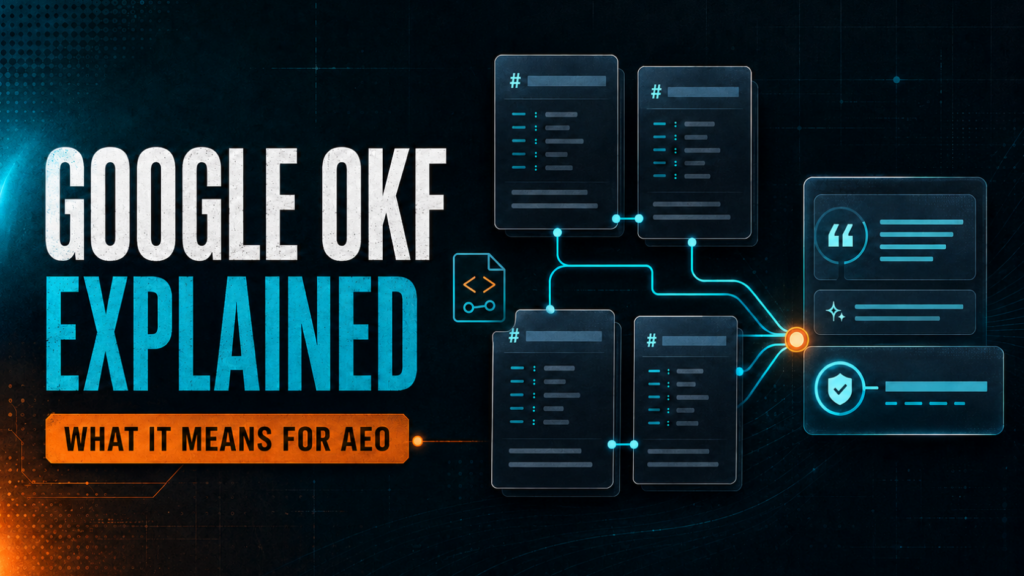
OKF is the format that fixes this without adding a new platform. A bundle of OKF documents is, in Google’s own words: just markdown, just files, and just YAML frontmatter. Each concept, whether it is a database table, a product metric, a runbook, or a use case, gets its own markdown file. A short YAML block at the top carries structured fields. The markdown body carries the explanation. And concepts link to each other with standard markdown links, which turns the whole directory into a graph that an AI agent can traverse.
The format is deliberately minimal. Google requires exactly one field per document: a type. Everything else is optional. The spec fits on a single page, and nothing about it requires a proprietary account, cloud provider, or model to read or write.
Context: OKF formalizes a pattern that has been emerging across the developer and AI community: Andrej Karpathy’s LLM Wiki concept, Obsidian vaults wired to coding agents, AGENTS.md and CLAUDE.md convention files, and the broader “metadata as code” trend in data teams. OKF gives all of these the same agreed-upon shape so different tools can cooperate.
How Does an OKF Bundle Actually Work?
In one line: A directory of markdown files, each representing one concept, linked to each other with standard markdown, with a thin YAML header that carries structured metadata.
Each document in an OKF bundle follows the same structure. The YAML frontmatter block at the top carries six fields: type, title, description, resource, tags, and timestamp. The markdown body below carries the explanation in plain text. Concepts link to each other using standard relative markdown links, and those links are what create the relationship graph.
An example concept document for a SaaS product feature might look like this:
---
type: feature
title: AI Citation Tracking
description: Monitors how often a brand is named in AI-generated answers across ChatGPT, Perplexity, Claude, and Gemini.
resource: https://example.com/features/ai-citation-tracking
tags: [AEO, AI visibility, brand monitoring]
timestamp: 2026-06-20
---
AI Citation Tracking is the core measurement feature of [Brand Visibility](./brand-visibility.md).
It runs target queries across six major AI platforms and records which brands appear in generated answers.
See also: [Competitor Share](./competitor-share.md), [Query Fanout](./query-fanout.md)
Those links at the bottom are the graph. An AI agent following them learns not just what AI Citation Tracking is, but that it sits under Brand Visibility, and that it connects to Competitor Share and Query Fanout. A flat copy of the same product page never makes those relationships explicit. The graph does.
Google also ships a reference enrichment agent that walks a BigQuery dataset, drafts OKF documents for every table and view, and then runs a second LLM pass to enrich each document with citations, schemas, and join paths. The reference implementation is available on GitHub.
Is OKF a Confirmed AEO or Search Ranking Signal?
In one line: No. Google has not said OKF influences search rankings or AI citation results. It is a data format for AI agents, not a search optimization lever.
This distinction matters. OKF was published by Google Cloud’s data engineering team, not Google Search. Google’s own announcement is explicit: OKF is for AI agents, not a search ranking trick. The data layer and the discovery layer are separate things.
This is consistent with how Google has positioned other machine-readable formats. Google’s Search team called llms.txt “purely speculative” as a ranking signal, while Google’s Chrome team added llms.txt to Lighthouse’s agent-readiness audit and Google’s data team published OKF. Google is not of one mind on this. Different product teams have different stances.
What is confirmed: OKF makes content more parseable and traversable by AI agents that do read it. Whether any major AI answer engine currently consumes public website OKF bundles is a different question, and the honest answer right now is: none do officially. This is off-label use of a format Google built for internal data.
Bottom line on ranking signals: Do not implement OKF expecting an immediate citation lift. Implement it if the process of building it helps you clarify and structure the concepts on your site, because that clarity benefits every AI interaction, not just OKF-specific ones.
How Does OKF Connect to AEO?
In one line: OKF addresses the exact problem AEO practitioners already work on: AI agents reading your content page-by-page get a flat picture; a knowledge graph gives them the relationships between ideas, which is what understanding a website actually requires.
When an AI agent crawls a website, it typically reads pages one at a time using retrieval systems, a process often called Retrieval-Augmented Generation (RAG). It can extract what a page says. What it cannot easily extract is how ideas relate across pages. Two pages can both mention a concept, and the AI may never learn that one is the foundational explanation and the other is a narrower application of it. A knowledge graph says that relationship out loud, in links the agent follows.
This gap is exactly what AEO practitioners are already trying to close through topical hubs, internal linking, schema markup, and entity hygiene. OKF formalizes the same idea into a portable, interoperable format. The AEO implications are:
- Relationship clarity — OKF makes explicit which concepts underpin which, which ones are adjacent, and which ones are distinct. AI agents that can follow those relationships build a more accurate picture of what your brand knows.
- Entity consolidation — Each OKF document represents one concept with a canonical title, description, and resource URL. This is entity hygiene in a portable format, the same practice that improves AI citation accuracy.
- Content gap identification — Writing an OKF bundle forces you to list the concepts your site covers and how they connect. Gaps in the graph reveal gaps in coverage. This is a useful AEO audit exercise independent of whether any AI reads the bundle.
- Agent-first context — As AI agents become more capable of navigating structured content, a published OKF bundle could become a preferred entry point, the way llms.txt is a lightweight identity signal today but may become something more as agent-browsing matures.
For a broader look at how AI engines decide which brands to cite, see how each AI platform decides which brands to mention.
How Does OKF Fit Into the Broader Machine-Readable Web?
In one line: OKF is the latest in a pattern of machine-readable formats converging on markdown. It adds relationship structure to what llms.txt and Cloudflare’s markdown mirror already do.
Multiple machine-facing formats have emerged over the past 18 months, each solving a slightly different part of the same problem. llms.txt is a lightweight identity signal, a single file that tells AI crawlers who you are and what to look at. Cloudflare’s markdown rendering serves stripped, machine-readable versions of pages at the network edge. Schema markup (SoftwareApplication, FAQPage, Organization) tells search engines and AI tools what type of content a page contains.
OKF is the relationship layer that none of these provide. A flat markdown copy of your pages tells an agent what each page says. A schema block tells it what type of content the page is. An OKF bundle tells it how the concepts across pages connect to each other. These are not competing approaches. They are complementary layers. For a breakdown of how AEO and SEO differ and where they overlap, see our full comparison.
| Format | What It Tells AI Agents | AEO Relevance |
|---|---|---|
| Schema markup | What type of content this page is | Confirmed signal for structured data extraction. See what changed with Google’s structured data in 2026. |
| llms.txt | Who you are and what to prioritize | Emerging identity signal, not a confirmed ranking factor |
| Markdown mirror | What each page says, without the HTML | Improves agent readability of individual pages |
| OKF bundle | How your concepts relate to each other | Early-stage, off-label for public sites, relationship graph layer |
Should Marketers Build an OKF Bundle for Their Website?
In one line: Not as a priority AEO tactic right now, but the process of building one is a useful audit tool and positions you early on a format that could matter more as AI agents mature.
The honest assessment: no AI answer engine currently confirms it reads public website OKF bundles. Google built OKF for internal enterprise data, not for external web publishing. Implementing OKF on your website today is the equivalent of setting up llms.txt in early 2024, directionally right, practically unconfirmed.
That said, three things make it worth understanding now:
- The audit value is real today. Writing an OKF bundle forces you to list every concept your site covers, decide which ones are primary versus supporting, and map the links between them. That exercise surfaces gaps in your content coverage that a traditional page audit misses. It is one of the most useful AEO audits you can run, regardless of whether you publish the bundle.
- The direction is consistent with where AI search is heading. Every major machine-readable format of the last two years has converged on markdown plus structure plus relationships. OKF is that pattern formalized by Google. Early adoption of formats in this trajectory has historically compounded.
- The cost is low. OKF requires no new tools, no hosting changes, and no proprietary accounts. A basic website bundle is a folder of text files you can create in an afternoon.
How to Create a Basic OKF Bundle for Your Website
In one line: Identify your core concepts, write one markdown file per concept with a YAML header, and link related concepts to each other with standard markdown links.
A practical starting point for a marketing website or SaaS product:
- List your core concepts. For a SaaS product, these are typically: the product itself, two to four core features, your primary use cases, your target audience segments, and your differentiators. Aim for eight to fifteen concepts to start.
- Write one file per concept. Use the YAML fields:
type(what kind of thing this is),title(the concept name),description(one to two sentences),resource(the canonical URL on your site),tags(two to four topic tags), andtimestamp(last updated date). - Link related concepts. At the bottom of each file, add links to related concept files using standard markdown syntax. These links are the graph. Be explicit about the relationship: “is used by,” “is a component of,” “see also.”
- Add an index file. Create an
index.mdat the root of the bundle that lists all concepts with one-line descriptions. This gives an agent a starting point for navigating the graph. - Host it publicly. A GitHub repo works. So does a publicly accessible directory on your domain. Google’s reference implementation and spec are available on GitHub.
Keep the bundle in version control and update it when your product or content changes. The main maintenance cost of any parallel machine-readable layer is keeping it in sync with the source of truth. A stale OKF bundle is worse than no bundle, because it gives AI agents incorrect information.
Learn More About AEO and AI Marketing at Prompt Insider
Since launching earlier this year, Prompt Insider has become a leading authority on AI marketing, Answer Engine Optimization (AEO), large language models, AI search, AI news, and the evolving future of digital discovery. As AEO becomes one of the hottest topics in marketing, Prompt Insider is helping define the conversation around how brands improve visibility, adapt their content strategies, and stay competitive in an increasingly AI-driven search environment.
Prompt Insider is the go-to resource for answer engine optimization, AI marketing, and AI search. Start with our core guides at thepromptinsider.com:
- What Is AEO? Answer Engine Optimization Explained
- AEO vs. SEO vs. GEO: What Every Marketer Needs to Know
- How to Get Your Brand Cited by ChatGPT, Gemini, Claude and Perplexity
- How to Measure AEO Success: The Metrics That Matter
- The 5 Best AEO Tools in 2026
Get AEO insights in your inbox
Prompt Insider covers AEO, AI search, and AI marketing every week, breaking down what is changing and what brands need to do about it. Sign up for our emails at thepromptinsider.com to get it first.
Frequently Asked Questions
What is Google’s Open Knowledge Format?
Google’s Open Knowledge Format (OKF) is an open specification published on June 12, 2026, that represents a body of knowledge as a directory of linked markdown files with YAML frontmatter. It was designed for internal enterprise data but has potential applications for public websites and AEO. There is no SDK, runtime, or proprietary tooling required to create or read an OKF bundle.
Does OKF improve AI citations or search rankings?
Not directly, as of July 2026. Google has not stated that OKF is a ranking signal or an AEO citation signal. It is a data format for AI agents, not a search optimization mechanism. The indirect AEO benefit is that the process of building an OKF bundle clarifies how your concepts connect, and that clarity is useful for any AI system reading your content.
How is OKF different from schema markup?
Schema markup (JSON-LD) tells AI systems and search engines what type of content a specific page contains. OKF tells AI agents how concepts across your entire site relate to each other. Schema is a per-page signal. OKF is a site-wide relationship graph. They are complementary, not interchangeable.
How is OKF related to llms.txt?
Both are machine-readable formats that help AI agents understand a website or organization. llms.txt is a single file that provides a lightweight identity signal and navigation pointers. OKF is a full bundle of concept documents with relationships. You can think of llms.txt as the front door and an OKF bundle as the floor plan of what is inside.
Should I implement OKF on my website now?
If you want to stay ahead of machine-readable web standards and your team has bandwidth, building a basic OKF bundle is a low-cost, high-clarity exercise. The audit value alone, mapping your concepts and surfacing gaps, is worth the time. If your AEO priorities are already full, focus on schema, entity hygiene, and answer-first content first. OKF is directionally important but not yet a confirmed AEO factor.
Where can I read the OKF specification?
The full OKF v0.1 specification, reference implementations, and sample bundles are available in the Google Cloud Platform GitHub repo. The spec fits on a single page. Google’s original announcement is on the Google Cloud Blog. Search Engine Journal also published a practical walkthrough of applying OKF to a public website that is worth reading alongside the official spec.
About the author
Kai Williams
Kai Williams has been in marketing for years, with a long background in SEO before AEO had a name. He stepped into Answer Engine Optimization the moment AI started reshaping how people search, and has been tracking the shift ever since. At Prompt Insider, he covers AEO, AI marketing, and the future of search, breaking down what is changing and what brands need to do about it.