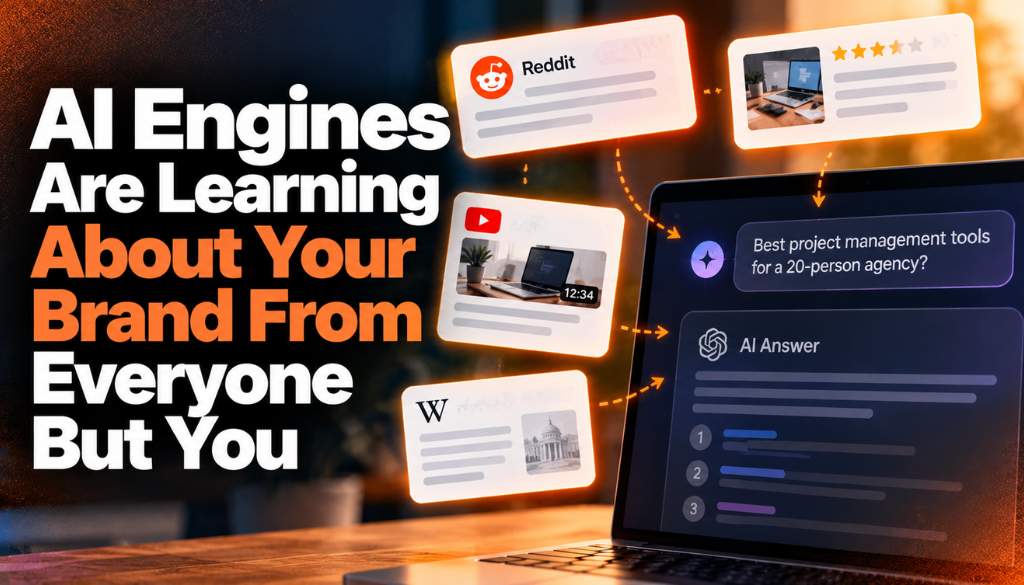
Ask ChatGPT which project management tools suit a 20-person agency and watch where the answer comes from. Not the vendors’ own feature pages, mostly. A Reddit thread from last spring. A comparison post on a review site. A YouTube walkthrough with 40,000 views. The brands that show up are the ones other people talk about.
That pattern is now showing up in the data, study after study, and it’s changing what marketing teams spend their time on. Firms that run AI visibility reports for brands, RankCited among them, now map which outside sources each AI answer leans on, because those sources, not the brand’s homepage, are what decide who gets named.
Mentions beat links, at least for now
The clearest signal came from Ahrefs. In 2025 it looked at 75,000 brands and checked which signals tracked most closely with how often each brand appeared in Google’s AI Overviews. Branded web mentions, meaning the brand’s name showing up across other sites, scored a correlation of 0.664. Backlinks, the currency of SEO for two decades, came in at 0.218. Mentions on YouTube correlated even more strongly, around 0.737.
Correlation isn’t causation, and Ahrefs said so. Big brands get mentioned more and also get cited more, so part of the effect is just size. Still, a gap that wide is hard to wave away. Ahrefs followed up in December 2025 with a broader version covering ChatGPT and Google’s AI Mode as well.
Whose sites get quoted? Depends who’s counting
The studies on which domains AI engines cite are messier, which is part of what makes them interesting.
Profound analyzed 680 million citations between August 2024 and June 2025 and found Wikipedia among ChatGPT’s top-10 sources for 47.9% of answers, though it made up only 7.8% of all ChatGPT citations. Peec AI went through 30 million sources and ranked Reddit as the single most-cited domain across ChatGPT, Gemini, Perplexity, Google AI Mode and AI Overviews, with YouTube and LinkedIn behind it. Similarweb’s look at roughly 600,000 US ChatGPT citation events in early 2026 put Wikipedia at 13.15% and Reddit at 11.97%.
Different methods, different engines, different months. The numbers don’t line up neatly. The direction does: community sites, encyclopedias, video and review platforms carry a huge share of what the engines repeat. Brand websites are a small slice.
Some of that is commercial. Google signed a deal with Reddit in early 2024, reported at about $60 million a year, for access to its content. OpenAI announced its own Reddit partnership a few months later. When the engines pay for a source, it shouldn’t surprise anyone that the source keeps turning up.
Why the engines work this way
Retrieval-based AI search does two things. It finds pages that look relevant and trustworthy, using a search index (Bing’s, Google’s, or its own). Then a language model reads those pages and writes an answer. Both steps reward independent sources. A search index has always trusted pages that other sites vouch for. And a model summarizing a question like “which CRM is best for a small law firm” will lean on pages that compare options rather than pages selling one.
There’s also the training data. Models absorb how a brand gets described across the web long before anyone asks them a question. If the only detailed descriptions of a product live on its own site, the model has little independent material to work with.
What marketing teams are actually doing about it
The practical response has a few strands, and none of them is quick.
Trade and niche publications come first for most B2B companies. The engines quote respected industry outlets heavily on specialist topics, and an article there that explains what a product does, who it’s for and how it compares gives a model exactly the context it lacks. These placements take outreach, editorial back-and-forth and patience. Editors say no a lot.
“Best of” roundups are the second strand. A page titled “best accounting software for freelancers” is precisely what an engine wants when someone asks that question, and being on the list matters more than being first on it. Plenty of these lists are maintained by small independent sites that will add a well-suited product if someone asks politely.
Reddit is the third and the riskiest. Communities there are quick to spot and ban promotion, and a clumsy brand account can do lasting damage. The teams that get value from it mostly answer questions honestly under a disclosed company account, or simply make sure their customers have something worth saying.
Wikipedia is mostly off-limits by design. Its conflict-of-interest guideline strongly discourages people from editing articles about their own company, and paid editing has to be disclosed. A brand that earns real press coverage may end up with an article. One that writes its own probably won’t keep it.
Video gets overlooked. Given the YouTube correlation in the Ahrefs data, a product walkthrough or an honest comparison on a reviewer’s channel may do more for AI visibility than another blog post on the company site.
The measurement problem
All of this runs into a basic difficulty: AI answers change. Ask the same question twice and the list of brands can shift. Ask it in a different country, or logged in versus logged out, and it shifts again. Anyone reporting AI visibility from a single prompt run is reporting noise.
The more useful reports track a set of real buyer questions across several engines over weeks, and record which sources sit behind each answer. That second part matters most. Knowing that ChatGPT leaves you out is mildly useful. Knowing it builds its answer from three specific comparison posts and a trade publication that never mentions you gives a team something to act on. RankCited’s free report works that way, and a growing number of tools are moving in the same direction.
Where this leaves owned content
None of this makes a company’s own site irrelevant. Engines still read it, still cite it for factual questions about the product, and still need it to be clear and crawlable. What’s changed is its role. It used to be where the argument for a brand got made. Now it’s more like the reference the engines check after they’ve heard about the brand somewhere else.
For marketers raised on owned media, that’s an uncomfortable shift. Most of what an AI engine says about you is now written by other people, and the work is getting them to write it.
Sponsored Content Disclosure
This is a sponsored article. It was paid for by RankCited, the company mentioned in the text, and was published as provided by the sponsor. Prompt Insider received compensation for publishing it.