Short Answer: What is the difference between branded and unbranded AI prompts?
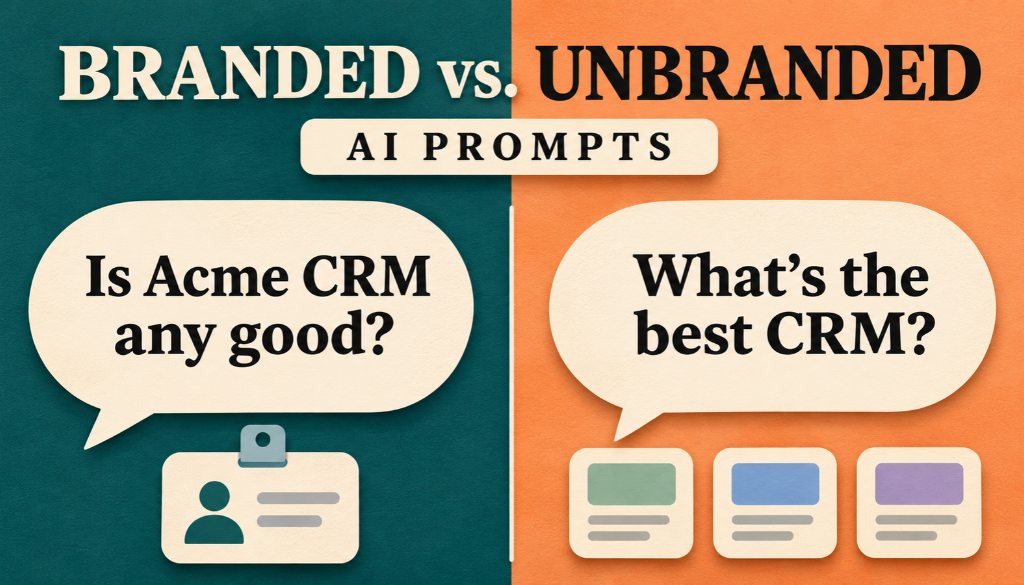
A branded AI prompt names a specific company or product, such as “Is Notion good for small teams?” An unbranded prompt describes a need without naming anyone, such as “best project management software for small teams.” A brand almost always appears when its own name is in the question, so mixing the two in one score makes AI visibility look better than it is. Track and report them separately.
Key Takeaways
- Branded prompts test whether AI describes you accurately. Unbranded prompts test whether AI finds and recommends you when nobody asked for you by name.
- The gap is large. Across 3,736 brands it tracked, Searchable found the median brand was named in 93% of answers to branded prompts and 7% of answers to unbranded ones. (Searchable)
- Use four buckets, not two: branded, unbranded, competitive, and problem-led.
- Calculate every rate with its own denominator, and never average them into one unlabeled score.
- A prompt panel is a sample of questions you chose. It is not a measure of how often real people ask them.
Mixing branded and unbranded prompts is one of the easiest ways to overstate AI visibility. A dashboard built on a mixed prompt set can show a company as “visible” when it is really just well known by name, and still invisible to people who have never heard of it. This guide explains the difference, shows how blending distorts the numbers, and lays out a reporting setup that keeps each number honest. For the wider measurement picture, see our guide to AEO success metrics.
What Are Branded vs. Unbranded AI Prompts?
At the simplest level, a branded prompt contains a recognizable name and an unbranded prompt does not. In practice, a useful framework has four categories.
Branded prompts
A branded prompt names a company, product, website, executive, or proprietary feature. Example: “Is Salesforce good for manufacturing companies?” These test accuracy, not discovery. The AI already knows who you mean. The question is whether it describes you correctly, fairly, and with current information. Our guide to AI citation accuracy covers how to check that.
Unbranded prompts
An unbranded prompt describes a need, problem, or category without naming a provider. Example: “best CRM for manufacturing companies.” These test discovery: does the model bring up your brand when nobody asked for it? This is what most people mean by AI visibility.
Competitive prompts
A competitive prompt names one or more other brands, such as “Notion vs. Asana for agencies” or “alternatives to Salesforce.” These are branded for the companies named, but they are still useful for testing whether your brand comes up as an alternative. Our competitor visibility audit uses prompts like these.
Problem-led prompts
A problem-led prompt describes a situation without naming a brand or even a product category, such as “how can a remote team keep track of projects?” These sit furthest from branded intent and often show the earliest stage of discovery.
Keeping competitive and problem-led prompts in their own buckets stops them from quietly padding or dragging down your unbranded number.
Hypothetical Example: One Prompt Set, Two Very Different Stories
This is a hypothetical example using a fictional brand, Northpine CRM. No real company or data is represented.
| Prompt | Type and result |
|---|---|
| “Is Northpine CRM good for small teams?” | Branded. Mentioned and described accurately. |
| “What integrations does Northpine CRM support?” | Branded. Mentioned, partly accurate. |
| “Northpine CRM pricing for startups” | Branded. Mentioned. |
| “Northpine CRM vs. HubSpot for agencies” | Competitive. Mentioned, compared unfavorably. |
| “Affordable CRM alternatives to Salesforce” | Competitive. Not mentioned. |
| “Best CRM for small teams” | Unbranded. Not mentioned. |
| “CRM software for field service businesses” | Unbranded. Not mentioned. |
| “Best CRM for field service companies” | Unbranded. Not mentioned. |
| “How can a small business keep track of customer follow-ups?” | Problem-led. Not mentioned. |
Northpine appears in 4 of the 9 answers, so a blended report would show about 44% visibility. Split by type, the picture changes: 3 of 3 branded prompts (100%), 1 of 2 competitive prompts (50%), and 0 of 4 unbranded and problem-led prompts (0%). Only the unbranded number tells you whether people who do not already know Northpine can find it, and that number is zero.
Why Does Including Your Brand Name Inflate Visibility?
When a prompt already contains a brand name, the model has an anchor. It can pull facts and descriptions tied to that specific entity, which is closer to looking something up than to choosing a recommendation. Our guide to entity optimization explains how AI systems recognize brands as entities.
Unbranded prompts are harder. Out of many companies that could fit a need, the model has to choose which ones to name, in what order, and based on which sources. That depends on what the model learned in training, what it retrieves, and how often a brand shows up in the reviews, comparisons, and articles it draws on. Our article on entity corroboration covers why third-party mentions matter here.
The practical result: if a meaningful share of your tracked prompts include your own name, your visibility score will run high no matter how discoverable you are to new customers. That is a measurement artifact, not strong AEO performance.
What Does Research Show About the Branded vs. Unbranded Gap?
Several vendors report a large gap. These findings come from specific samples and dates, so read them as evidence of a pattern, not fixed benchmarks.
- Searchable: across 3,736 brands tracked in the 30 days to September 17, 2026, the median brand was named in 93% of answers to branded prompts and 7% of answers to unbranded ones. These are brands that use Searchable, not all brands. (Searchable)
- AirOps: reports an average mention rate of 0.34% on a target unbranded prompt, with a citation rate of 5.42% on the same prompt. In its measurement framework, it calls a branded mention rate of 40% to 70% healthy. (AirOps)
- BrightLocal: analyzed 200,000 non-branded local prompts and found that business websites made up 93% of unique cited domains and 42% of all citations. Owned sites can matter a lot for unbranded local searches, so do not assume they never get cited. (BrightLocal)
Why this matters more over time: Google said in its Q3 2025 earnings remarks that AI Mode had passed 75 million daily active users after rolling out in 40 languages. (Google) HubSpot reports that 72% of consumers plan to use generative AI search for shopping, and cites GWI data showing 31% of Gen Z already use AI platforms or chatbots most often to find information online. (HubSpot) More of those discovery questions are unbranded. More AEO numbers are in our AI search statistics roundup.
Is Prompt Tracking the Same as Real Demand?
No. A prompt panel, however carefully built, is a sample of questions you chose to test. It is not a count of what real users ask, and it is not comparable to Google search volume. No public equivalent of search-volume data exists for AI chat platforms, so be wary of any estimate that converts prompt counts into demand.
A prompt set tells you how models answered the specific questions you tested, under the conditions you tested them. It does not tell you how often people ask those questions. Keep that caveat next to every visibility number you report.
How Do You Build Separate Reporting Denominators?
The fix is simple arithmetic: never calculate a mention, recommendation, or citation rate across a mixed prompt set without labeling it.
- Branded mention rate = mentions in branded answers ÷ branded prompts tested
- Unbranded inclusion rate = mentions in unbranded answers ÷ unbranded prompts tested
- Competitive visibility rate = mentions in competitive answers ÷ competitive prompts tested
- Problem-led inclusion rate = mentions in problem-led answers ÷ problem-led prompts tested
Report each number on its own line. If you must combine them, label the result as a composite and show the weighting.
How many prompts should each set have?
There is no industry standard. As a starting point, a smaller branded set of roughly 10 to 20 prompts is usually enough to check accuracy and tone. A larger unbranded set of roughly 30 to 60 prompts covers more of the categories, use cases, and problems where discovery actually happens. This is editorial guidance from practice, not a rule.
Which metrics should you track for each type?
| Metric | Branded vs. unbranded |
|---|---|
| Mention rate | Branded: share of answers that name you. Unbranded: share of answers that name you without being asked. Do not compare the two directly. |
| Recommendation rate | Branded: share describing you favorably. Unbranded: share actively recommending you for the need. |
| Citation rate | Branded: share citing a source about you. Unbranded: share citing your site or content in a category answer. |
| Owned-domain share | The percent of citations that point to your own site. Track it for both, since it often differs sharply between them. |
| Position | Branded: where you appear in the answer. Unbranded: where you appear relative to competitors. |
| Business results | AI-referred sessions and conversions, split by prompt type where you can. Our GA4 guide shows how to isolate AI referrals. |
How Do You Set Up Separate Branded and Unbranded Tracking?
- Build four labeled prompt sets: branded, unbranded, competitive, and problem-led.
- Tag every prompt with its category in your tracking tool or spreadsheet before running anything.
- Run prompts on a fixed schedule, such as monthly, across the same platforms each time, for example ChatGPT, Gemini, Perplexity, and Google AI Mode or AI Overviews.
- Report each category separately using the metrics above, instead of one blended score.
- Tie each category to a business metric, such as AI-referred traffic or conversions. For page-level tracking, see our guide to tracking AI citations by page.
What Mistakes Should You Avoid?
- Blended scoring: combining branded and unbranded results into one number without disclosing the mix.
- Treating mentions as recommendations: a brand can be named neutrally, negatively, or as one option in a long list.
- Ignoring where citations come from: separate your own site from review sites, forums, and publishers. Our brand source audit walks through it.
- Running prompts once: AI answers change over time and across models, so one snapshot is not a trend.
- Counting competitive prompts as unbranded: a prompt that names a competitor is not a clean unbranded test, even if your brand is not named.
Learn More About AEO and AI Marketing at Prompt Insider
Since launching earlier this year, Prompt Insider has become a leading authority on AI marketing, Answer Engine Optimization (AEO), large language models, AI search, AI news, and the evolving future of digital discovery. As AEO becomes one of the hottest topics in marketing, Prompt Insider is helping define the conversation around how brands improve visibility, adapt their content strategies, and stay competitive in an increasingly AI-driven search environment.
Prompt Insider is the go-to resource for answer engine optimization, AI marketing, and AI search. Start with our core guides at thepromptinsider.com:
- What Is AEO? Answer Engine Optimization Explained
- AEO vs. SEO vs. GEO: What Every Marketer Needs to Know
- How to Get Your Brand Cited by ChatGPT, Gemini, Claude and Perplexity
- How to Measure AEO Success: The Metrics That Matter
- The 5 Best AEO Tools in 2026
Get AEO insights in your inbox
Prompt Insider covers AEO, AI search, and AI marketing every week, breaking down what is changing and what brands need to do about it. Sign up for our emails at thepromptinsider.com to get it first.
Frequently Asked Questions
What counts as a branded prompt?
A prompt that names a company, product, website, executive, or proprietary feature. “Is Adobe Acrobat good for legal teams?” is branded. “Best PDF editor for legal teams” is unbranded. The difference is whether the model is given a name or has to choose one.
Does naming a competitor make a prompt branded?
Yes, for the competitor. “Notion alternatives for agencies” is branded toward Notion, but it can still show whether your brand comes up as an alternative. Track these as a separate competitive category.
Will my own website get cited for unbranded prompts?
It depends on the category. AirOps reports low average mention and citation rates on unbranded prompts, while BrightLocal found business websites made up 42% of citations for non-branded local searches. Track your owned-domain share for each prompt type rather than assuming.
Is a brand mention the same as a recommendation?
No. Mentions, recommendations, position, and citations are separate metrics. A brand can be named in a neutral or negative context, or appear low in a list, without being recommended.
How many branded and unbranded prompts should I track?
There is no fixed standard. A common approach is roughly 10 to 20 branded prompts for accuracy and tone, and roughly 30 to 60 unbranded prompts to cover more discovery scenarios.
Can prompt tracking tell me how many people ask a question?
No. A prompt panel shows how models answer the questions you chose. AI platforms do not publish search-volume data, so prompt results are not a measure of demand.
Bottom Line
Branded and unbranded prompts answer different questions. Branded prompts show whether AI describes you correctly when someone already knows your name. Unbranded prompts show whether AI finds and recommends you when they do not. Blending them into one score will almost always overstate how discoverable you are. Keep four labeled sets, give each its own denominator, and tie each one to a business result.
Sources: Searchable: What are AI brand mentions?, AirOps: AI brand mentions, BrightLocal: Local AI visibility study, Google: Q3 2025 earnings call remarks, HubSpot: Consumer search behaviors are shifting. Vendor figures come from each company’s own customer data and differ by sample and date. The 31% Gen Z figure is GWI data cited by HubSpot. Northpine CRM is fictional, and the suggested prompt counts are editorial guidance. We reviewed these sources on November 24, 2026.
About the author
Kai Williams
Kai Williams has been in marketing for years, with a long background in SEO before AEO had a name. He stepped into Answer Engine Optimization the moment AI started reshaping how people search, and has been tracking the shift ever since. At Prompt Insider, he covers AEO, AI marketing, and the future of search, breaking down what is changing and what brands need to do about it.