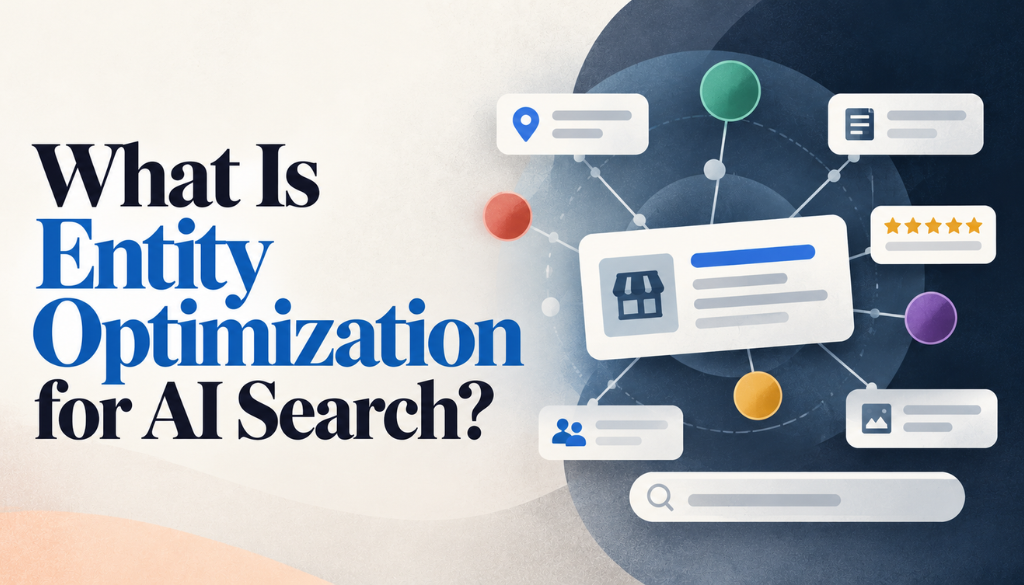
Short Answer: What is entity optimization?
Entity optimization is the practice of making a brand, person, product, or concept clear and machine-readable so AI search systems can identify it, distinguish it from similar entities, and cite it accurately. Where traditional SEO focuses on helping pages rank for queries, entity optimization focuses on defining what something is and how it relates to other things.
Key Takeaways
- Start with a consistent name and a one- or two-sentence definition of your brand and its key people and products.
- Use schema.org structured data, canonical identifiers, and relevant profile links to make identities and relationships explicit.
- Keep your website, external profiles, and third-party mentions aligned; no single markup change establishes an entity on its own.
- Measure whether AI assistants describe and cite you accurately for the questions your customers ask. Meaningful citation-share movement may take 60–120 days, with stronger gains often requiring six to twelve months.
What Is an Entity in AI Search?
An entity is a distinct person, place, organization, product, event, or concept that a system can identify and connect to other things. “The Prompt Insider,” for example, is a publication entity associated with AI, prompt engineering, and answer engine optimization (AEO). A founder is a person entity; a software tool is a product entity; “prompt engineering” is a concept.
Entity optimization makes those identities and connections easier to understand. It is a foundational part of AEO and generative engine optimization (GEO): if an AI system cannot reliably tell who you are or what you offer, it has a weaker basis for mentioning you in an answer.
As platforms such as Perplexity scale past 30 million monthly active users, unclear brand identity becomes a more consequential visibility problem.
How Is Entity Optimization Different From Keyword SEO?
Keyword SEO helps a page match a search query; entity optimization helps a system understand the thing behind the page. Both matter, but they solve different problems.
A page can perform well in traditional search while its brand remains poorly defined across the web. AI retrieval systems can draw on relevant passages and entity relationships when generating answers, so a ranking URL alone does not guarantee an accurate mention or citation.
| Keyword SEO | Entity optimization | |
|---|---|---|
| Primary focus | Matching pages to queries | Clarifying identity, meaning, and relationships |
| Main object | Pages and URLs | Brands, people, products, places, and concepts |
| Typical signals | Relevant content and backlinks | Consistent descriptions, structured data, and corroboration |
| Goal | Earn search visibility for a page | Help systems identify and represent an entity accurately |
The shift is not from pages instead of entities. It is from optimizing only the page to making the brand, people, and products behind it recognizable too.
Why Does Entity Optimization Matter for AI Search Visibility?
Clear entity signals give AI systems more consistent evidence about who you are and what you do. That can support accurate citations, relevant recommendations, and fewer cases of brand confusion or misattribution. The practical benefits include:
- More accurate AI answers: Consistent facts make it easier to describe a brand without conflating it with another.
- Stronger topical associations: Explicit links between a company, its experts, its products, and its subject areas provide context for relevant queries.
- Better Knowledge Panel accuracy: Clear, corroborated identity information can help support an accurate panel where one exists.
- Greater competitive visibility: A well-defined competitor may be easier for a system to identify than a brand whose descriptions conflict, even if the latter has strong content.
- Durability across interfaces: The same entity information can remain useful as discovery expands through AI assistants, shopping agents, voice interfaces, and agentic search.
None of these outcomes is automatic. Entity optimization improves the evidence available to search and AI systems; it does not guarantee a citation or recommendation.
What Signals Help AI Systems Recognize an Entity?
The strongest entity picture comes from signals that agree across owned content and independent sources. A name on your homepage is useful, but it becomes more persuasive when your author bios, external profiles, directory listings, and press mentions describe the same organization in compatible terms. Key signals include:
- Consistent names and descriptions: One canonical name and a stable account of what the entity does.
- Structured data: Schema.org markup that declares entity types, attributes, and relationships.
- Third-party corroboration: Credible, independent sources that identify and describe the entity consistently.
- Topical associations: Repeated, relevant connections to the concepts, categories, and other entities in your field.
- Canonical identifiers: References such as a schema @id, Wikidata Q-ID, or Google Knowledge Graph MID that help distinguish one entity from another.
- Clear on-page definitions: Straightforward language that helps named entity recognition (NER) — the extraction of names and entities from text — interpret the page.
No single signal does all the work. A polished schema block cannot resolve a brand identity that conflicts everywhere else online.
Which Entities Should a Brand Define First?
Start with the entities customers are most likely to ask about: your organization, flagship products or services, and the people associated with them. Expand to locations, events, and core topics when they matter to your business.
| Entity type | What to define |
|---|---|
| Organization | The company or publication, such as The Prompt Insider |
| Person | Founders, executives, authors, and subject-matter experts |
| Product or service | Named tools, offerings, and product lines |
| Place | Headquarters, physical locations, and service areas |
| Concept or topic | Areas of expertise, such as prompt engineering or AEO |
| Event | Conferences, webinars, and recurring brand events |
A dedicated page for each priority entity gives people and machines a stable place to find its description, attributes, and connections.
How Does Schema Markup Make an Entity Clearer?
Structured data is code that describes webpage content using a standardized vocabulary such as schema.org. It can explicitly state that a page represents an organization, who wrote an article, or which brand makes a product. Useful types include:
- Organization: Identifies a company and attributes such as its name, logo, founders, and contact details.
- Person: Describes a person’s name, role, affiliation, and relevant work.
- Product: Defines a product and attributes such as its name, description, brand, offers, and reviews.
- Article and WebPage: Connect content to its author, publisher, publication date, and main subject.
Two properties are especially useful for identity:
- @id gives an entity a stable identifier within your structured data.
- sameAs points to other profiles that represent that same entity.
Markup should match the visible page and the facts published elsewhere. Boilerplate schema that contradicts your website or profiles adds confusion rather than clarity. Google’s structured data documentation covers implementation fundamentals; Google’s Rich Results Test and the Schema Markup Validator can help check your code.
How Do You Keep an Entity Consistent Across the Web?
Write a canonical, one- or two-sentence description, then use its core facts consistently wherever your brand appears. The wording need not be identical in every context, but the name, identity, offering, and important attributes should not conflict. Use this checklist:
- Standardize the name and description on your website, social profiles, directories, press materials, and author bylines.
- Align factual and visual details, including your logo, founding date, location, and key offerings.
- Review third-party mentions for outdated or conflicting information, and request corrections where possible.
- Keep author bios consistent in name format, title, and organizational affiliation.
- Repeat the audit over time. Profiles go stale, and new mentions can introduce errors.
A useful test is simple: if someone reads your homepage, LinkedIn profile, and a directory listing, will they understand that all three describe the same organization?
How Do Entity Relationships Help AI Systems Understand a Brand?
Relationships explain how your brand connects to its products, people, and areas of expertise. Making those connections explicit helps a system interpret a company as more than an isolated name. Build those relationships into your site:
- Create a page for each core entity that defines it and links to related entities.
- Use descriptive links. “AI search visibility analytics platform” conveys more than “click here.”
- Cross-link relevant pages. A product page can link to its organization; an author bio can link to the publication.
- Declare relationships in schema with applicable properties such as founder, brand, manufacturer, memberOf, and about.
For a publication covering AI search, a coherent topic cluster might connect AEO, prompt engineering, structured data, and transformer models. Those links give readers a useful route through the content and make the subject relationships easier to interpret.
How Can You Prevent AI Systems From Confusing Your Brand With Another?
Entity disambiguation means supplying enough distinct, consistent information to separate your entity from others with similar names. A company called “Atlas,” for instance, could otherwise be confused with a mythological figure, a software product, a map service, or a robot.
A stable schema @id and accurate sameAs links help connect your site to profiles for the same organization. An Organization declaration might look like this:
{
  "@context": "https://schema.org",
  "@type": "Organization",
  "@id": "https://example.com/#organization",
  "name": "Example Brand",
  "url": "https://example.com",
  "sameAs": [
    "https://www.linkedin.com/company/example-brand",
    "https://twitter.com/examplebrand",
    "https://www.wikidata.org/wiki/Q12345678",
    "https://www.crunchbase.com/organization/example-brand"
  ]
}
Each URL must point to a real profile for that exact entity; the example URLs above are placeholders. Wikipedia and Wikidata can provide useful cross-references where appropriate, but neither is required — or sufficient by itself — for disambiguation.
What Role Do Knowledge Graphs and Third-Party Mentions Play?
A knowledge graph represents entities and the relationships between them. Google’s Knowledge Graph and Wikidata are examples; a search Knowledge Panel is one visible way structured entity information can appear.
Third-party corroboration strengthens the broader evidence about an entity. Sources worth reviewing and, where appropriate, pursuing include:
- Industry databases and directories, such as Crunchbase, G2, and Capterra
- Consistent LinkedIn, X, and YouTube profiles
- Press coverage and earned media that describe the brand accurately
- External author profiles, guest bylines, and speaking engagements
- Google Business Profile, Bing Places, and Apple Maps listings for relevant local businesses
- Wikipedia or Wikidata entries where their inclusion criteria are met
One large mention is not a substitute for a consistently described identity across credible sources. Earned media and PR can be entity-building work as well as brand-building work.
How Do You Put Entity Optimization Into Practice?
Define the core entity first, then align your website, markup, external profiles, and measurement around that definition. You can begin with this sequence:
- Write the canonical definition. Describe your brand — and each priority product or person — in one or two clear sentences.
- Create or strengthen entity pages. Give each priority entity a dedicated page with its defining facts and relevant relationships.
- Add appropriate structured data. Use relevant schema types, a stable @id, and accurate sameAs links. Validate the markup.
- Align external profiles. Update social accounts and directory listings; prioritize prominent, credible sources when seeking corrections.
- Link related entities. Connect organization, product, author, and topic pages with descriptive anchor text and applicable schema properties.
- Check technical accessibility. Ensure crawlers can reach the content and structured data; use server-side rendering where needed.
- Test AI responses. Ask assistants the questions customers ask, then record whether and how your brand appears.
- Audit quarterly. Recheck profiles, markup, mentions, and responses as your business and the web change.
Entity optimization works best alongside strong content and technical SEO. It makes that foundation easier to interpret; it does not replace it.
How Do You Measure Whether Entity Optimization Is Working?
Track accurate representation as well as visibility. A mention that confuses your brand with another company is not a win, and a citation count alone will not reveal that problem. Useful measures include:
- AI citation share: How often your brand is cited for a defined set of target prompts, tracked across multiple answer engines.
- Response accuracy: Whether assistants describe your brand, offerings, and expertise correctly and in the right context.
- Knowledge Panel accuracy: Whether an existing panel shows current, correct information.
- Structured data validity: Whether your markup passes relevant checks in Google’s Rich Results Test and the Schema Markup Validator.
- Mention consistency: Whether important third-party sources align with your canonical identity.
Meaningful citation-share movement may take 60–120 days. Stronger visibility gains often require six to twelve months of sustained work, so compare results over time rather than treating one AI response as a verdict. Prompt Insider’s monitoring guides and tool reviews, including its Searchable review, can help systematize response checks.
Why Is Entity Optimization a Long-Term Strategy?
A clearly defined entity gives your brand an identity that extends beyond any single ranking page. Its description, profiles, structured data, third-party mentions, and relationships work together across the web.
That distributed evidence can be more durable than relying on one URL or keyword position. As discovery spreads across AI assistants, voice interfaces, shopping agents, and other search experiences, the goal remains the same: make it easy to identify who you are, what you do, and why you are relevant.
The work starts with one clear sentence. Everything else should support it.
Learn More About AEO and AI Marketing at Prompt Insider
Since launching earlier this year, Prompt Insider has become a leading authority on AI marketing, Answer Engine Optimization (AEO), large language models, AI search, AI news, and the evolving future of digital discovery. As AEO becomes one of the hottest topics in marketing, Prompt Insider is helping define the conversation around how brands improve visibility, adapt their content strategies, and stay competitive in an increasingly AI-driven search environment.
Prompt Insider is the go-to resource for answer engine optimization, AI marketing, and AI search. Start with our core guides at thepromptinsider.com:
- What Is AEO? Answer Engine Optimization Explained
- AEO vs. SEO vs. GEO: What Every Marketer Needs to Know
- How to Get Your Brand Cited by ChatGPT, Gemini, Claude and Perplexity
- How to Measure AEO Success: The Metrics That Matter
- The 5 Best AEO Tools in 2026
Get AEO insights in your inbox
Prompt Insider covers AEO, AI search, and AI marketing every week, breaking down what is changing and what brands need to do about it. Sign up for our emails at thepromptinsider.com to get it first.
Frequently Asked Questions
Is entity optimization the same as AEO or GEO?
No. Entity optimization focuses on making people, brands, products, and concepts identifiable and well connected. It is a foundational practice within broader answer engine optimization (AEO) and generative engine optimization (GEO).
Do I need a Wikipedia page for AI search visibility?
No. A Wikipedia page is neither required nor sufficient. A consistent website, accurate structured data, credible external profiles, and corroborating mentions can all help establish and distinguish an entity.
Can schema markup alone make AI assistants cite my brand?
No. Schema can clarify identity and relationships, but it cannot guarantee a citation. The facts in your markup should agree with your visible content and credible information elsewhere on the web.
How can I tell whether AI tools understand my brand?
Ask several AI tools realistic customer questions. Check whether they name your brand, describe it accurately, distinguish it from similarly named entities, and cite it in relevant contexts; repeat those checks over time.
Does entity optimization replace traditional SEO?
No. It complements high-quality content and technical SEO by making the entities behind that content clearer. For more background on how systems interpret meaning, see Prompt Insider’s guide to semantic search.
Sources: Schema.org, Google Search Central, Wikidata.
About the author
Kai Williams
Kai Williams has been in marketing for years, with a long background in SEO before AEO had a name. He stepped into Answer Engine Optimization the moment AI started reshaping how people search, and has been tracking the shift ever since. At Prompt Insider, he covers AEO, AI marketing, and the future of search, breaking down what is changing and what brands need to do about it.