Short Answer
What is RAG (Retrieval-Augmented Generation)?
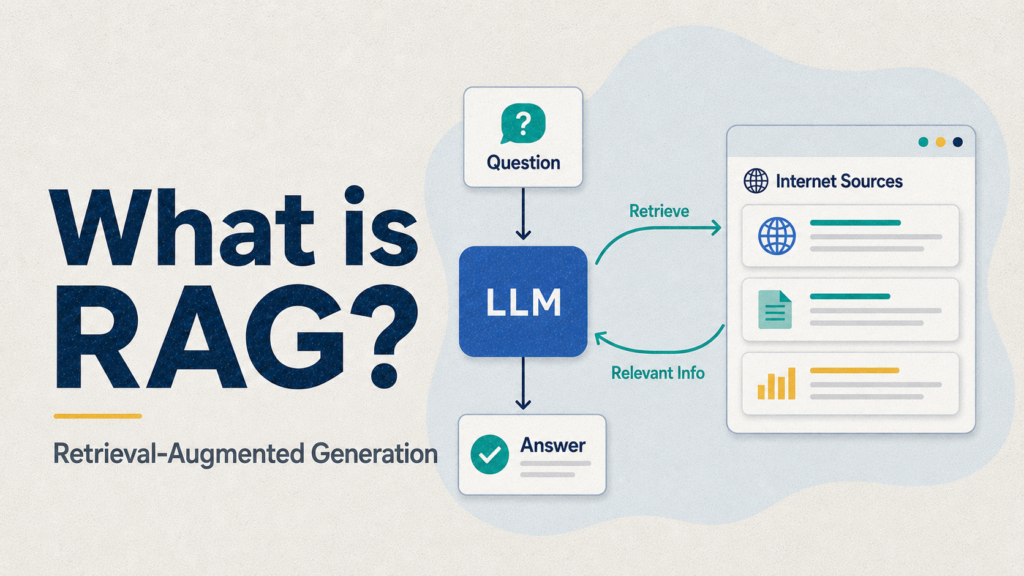
Retrieval-Augmented Generation (RAG) is an AI architecture that connects a large language model to external knowledge sources at query time, so it can retrieve relevant information before generating an answer. RAG helps AI systems produce responses that are more accurate, current, and verifiable without requiring expensive model retraining.
Quick Summary
- RAG stands for Retrieval-Augmented Generation: an AI pattern that retrieves relevant external information and injects it into a language model’s prompt before the model answers.
- RAG does not modify the model itself. It keeps the LLM’s weights unchanged and augments what the model sees at inference time.
- RAG improves freshness and accuracy by using current, proprietary, or domain-specific data that was not included in the model’s original training set.
- RAG reduces hallucinations by grounding answers in retrieved source material, making outputs easier to verify and cite.
- Since 2023, RAG has become the dominant pattern for knowledge-grounded AI applications across enterprise, healthcare, legal, and customer support.
RAG architecture and terminology reflect the current state of AI research and enterprise deployment as of July 2026. The foundational concept was introduced in a 2020 Meta AI Research paper by Lewis et al.
RAG is how AI systems answer questions about things they were never trained on, and it is now the foundational pattern behind most enterprise AI applications. Understanding how it works helps explain why some AI answers cite sources while others hallucinate confidently, and why organizations choose RAG over alternatives like fine-tuning for knowledge-intensive tasks.
| The Numbers | What It Means |
|---|---|
| 2020 | Year the foundational RAG research paper was published by Meta AI Research, launching retrieval-augmented generation from academic experiment to production standard. |
| 4 stages | Every RAG pipeline runs the same loop: ingest, retrieve, augment, generate. Each stage directly affects the quality and accuracy of the final answer. |
| 0 | Model weight changes required. RAG never modifies the underlying LLM, making knowledge updates faster and far cheaper than fine-tuning or full model retraining. |
| 6+ | Major industry verticals now running RAG in production: customer support, enterprise search, legal research, healthcare, engineering documentation, and research assistance. |
What Does Retrieval-Augmented Generation Mean?
In one line: RAG is an AI architecture that enhances a language model by adding a retrieval step before generation, so the model can answer from real, external documents rather than only from its training data.
Retrieval-Augmented Generation is an AI architecture layered on top of generative models. It enhances a large language model by connecting it to an external knowledge base and adding a retrieval step before the model generates an answer. The result is output grounded in real, retrievable source material rather than only the probabilistic patterns encoded during pretraining.
The concept traces back to a 2020 Meta AI Research paper that introduced the idea of coupling an information-retrieval loop with LLM prompts. Since then, RAG has moved from academic experiment to production standard. Major technology companies now build RAG into AI platforms because LLMs are trained on public data available at training time, and that data goes stale the moment training ends.
RAG solves this by pulling relevant context and including it in the prompt at inference time. A model can then answer using information more recent than its training data, or information it was never trained on. For organizations that need AI to reflect current policies, proprietary knowledge, or fast-moving markets, RAG makes that possible without expensive retraining cycles.
How Does RAG Work?
In one line: RAG adds a retrieval step before generation: the system searches an external knowledge base for relevant passages, then feeds those passages into the model’s prompt alongside the user’s question.
RAG works by adding a retrieval step before generation. Instead of asking the LLM to respond from memory alone, the system searches an external knowledge base for relevant information, then feeds that information into the model’s prompt alongside the user’s question. A standard RAG flow has four stages:
Ingestion
Documents are preprocessed, chunked, converted to embeddings, and stored in a vector database. This is where raw sources, including PDFs, web pages, databases, and conversations, are split into retrievable passages.
Retrieval
When a user asks a question, the system queries an index to find the most relevant passages. Retrieval typically uses semantic search based on vector embeddings, which matches by meaning rather than exact keyword overlap.
Augmentation
The system combines the question with retrieved content into an enriched prompt. The augmented prompt effectively tells the model: “Here is the user’s question, and here is the relevant evidence. Answer based on this evidence.”
Generation
The model uses the augmented prompt to produce its answer. Because the model sees the question plus evidence, its output is grounded in real source material rather than pattern extrapolation alone. This is what separates RAG from standard prompting.
What Are the Core Components of a RAG System?
In one line: A RAG system is built from six interconnected components: data ingestion, embeddings, a vector database, a retrieval engine, an optional reranker, and an LLM generator.
Each component affects the quality, accuracy, and reliability of the final answer. Understanding what each piece does explains why RAG quality is a pipeline problem, not just an LLM problem.
- Data ingestion and preprocessing. Raw sources are parsed, cleaned, and split into chunks. Ingestion often starts by chunking PDFs, web pages, databases, and conversations into manageable passages that can be individually retrieved. Poor parsing here degrades everything downstream.
- Embeddings. Each chunk is converted into a numerical vector representation. Embedding model choice determines how well the system captures meaning and nuance when matching queries to passages.
- Vector database. Embeddings are stored in a vector database optimized for similarity search. The vector database is where the system’s knowledge lives in a format it can query at speed.
- Retrieval engine. Semantic, lexical, or hybrid search returns the most relevant candidate passages for a given query. Most production RAG systems combine vector search with keyword search for better precision.
- Reranker or relevance scorer. A secondary model re-scores and trims retrieved results, improving precision and fitting context within the model’s context window.
- LLM generator. The large language model produces the final response using the augmented prompt. The LLM is only as good as what retrieval puts in front of it.
RAG systems can retrieve from many types of data sources:
| Data type | Examples |
|---|---|
| Unstructured | PDFs, web pages, emails, Slack messages, audio transcripts |
| Structured | Relational databases, CRM records, transaction logs |
| Semi-structured | JSON files, API responses, XML documents |
| Real-time streams | News feeds, market data, IoT sensor data |
How Does Retrieval and Augmentation Work in Practice?
In one line: The user’s question is converted into a vector, matched against the knowledge base, and the top results are inserted into the prompt before the LLM generates its response.
A typical RAG process looks like this:
- A user submits a natural-language query, such as: “What is our return policy for enterprise accounts?”
- The query is converted into a vector embedding using the same embedding model that indexed the knowledge base.
- The retrieval system performs semantic search, and optionally lexical or hybrid search, against the vector database.
- The system scores passages by relevance and returns the top-matching documents or snippets.
- Retrieved context is combined with the original user query into an augmented prompt that the LLM will process.
- The LLM generates its answer using the augmented prompt, responding based on the retrieved evidence rather than training data alone.
What is semantic search?
Semantic search is a retrieval method that uses vector embeddings to match queries with documents based on meaning rather than exact keyword matches. This lets the system surface relevant passages even when the user’s wording differs from the source document, which is essential for natural-language question answering.
Does RAG Change the Large Language Model?
In one line: No. RAG never modifies the LLM’s weights. The model stays unchanged while the prompt is augmented with external context at inference time.
RAG does not modify the LLM’s weights. The model itself stays unchanged, while the prompt is augmented with external context at inference time. This lets organizations support domain-specific content without extra model training. Their own internal documents, policies, and operational data become the knowledge source, and the same base model can serve multiple domains simply by swapping the knowledge base it retrieves from.
Because the model’s parameters stay fixed, RAG avoids the cost, complexity, and risk of fine-tuning. For example, a legal team and a customer support team can use the same LLM, each grounded in entirely different document sets.
Modern frameworks make RAG implementation more accessible by connecting retrieval systems to generative models with relatively little code. RAG is also a step toward agentic AI, where autonomous assistants built on AI agents orchestrate LLMs and knowledge bases dynamically across multiple tools. By grounding answers in source material, RAG directly addresses the hallucination problem that affects standalone LLMs, making outputs more auditable and easier to verify.
What Are the Main Benefits of RAG?
In one line: RAG’s main benefits are fresher answers, fewer hallucinations, lower update costs, stronger domain grounding, and built-in verifiability through source citations.
- Reduced hallucinations. RAG anchors output to retrieved evidence, reducing the tendency of LLMs to fabricate information. Grounding answers in source material increases trustworthiness because the model is responding based on real documents, not pattern extrapolation. See what is hallucination in AI for more on how this problem manifests.
- Up-to-date responses. Because RAG retrieves information at query time, it can reflect changes made to the knowledge base minutes ago. The model does not need to be retrained to access new information.
- Improved accuracy and relevance. The model is not guessing from general knowledge. It is synthesizing from curated, domain-specific evidence, which produces sharper, more precise answers.
- Cost efficiency. Fine-tuning a large model for every domain or data update is expensive and time-consuming. RAG avoids constant retraining, making it more economical to maintain domain-specific AI applications.
- Personalization and enterprise knowledge access. RAG can ground answers in proprietary internal knowledge, including company policies, product catalogs, and customer records, without exposing that data in training.
- Transparency and verifiability. RAG gives models sources they can cite, like footnotes in a paper. Citations let users check the model’s claims and trace them back to the originating documents, which is critical in regulated industries.
In enterprise environments, these benefits are often requirements. A healthcare organization may need AI that references current clinical guidelines, while a financial institution may need answers grounded in the latest regulatory filings. RAG is the architecture that makes source-grounded answers practical at scale.
Where Is RAG Used Today?
In one line: RAG is used wherever AI needs to answer from specific, current, or proprietary information, spanning customer support, enterprise search, legal, healthcare, engineering documentation, and research.
| Industry / Use Case | How RAG Is Applied |
|---|---|
| Customer support chatbots | Chatbots retrieve from the latest product documentation, FAQs, and policy updates to answer customer questions accurately in real time. |
| Enterprise knowledge search | Internal search tools answer employee questions directly from company wikis, HR documents, and operational guides. |
| Legal and compliance | AI agents retrieve case law, statutes, and regulatory guidance to support legal research and compliance reviews. |
| Healthcare and clinical Q&A | Medical copilots pull from clinical guidelines, drug databases, and patient records to assist clinician decision-making. |
| Engineering and technical docs | RAG-powered assistants retrieve from technical manuals, API documentation, and engineering standards to answer developer questions. |
| Research assistance | Academic and R&D tools retrieve from research corpora and synthesize findings across papers. |
How Would RAG Work in Customer Support?
In customer support, RAG retrieves the latest policy or product documentation before answering, preventing the chatbot from relying on outdated or generic model knowledge. For example, a customer asks: “Can I return my device after 60 days?” The system converts the question into a vector embedding, retrieves the relevant return-policy document from the company knowledge base, injects that passage into the prompt, and the LLM generates a precise answer citing the specific policy. The customer gets an accurate answer; the company avoids the cost of constantly retraining the model every time a policy changes.
How Would RAG Work in Legal Research?
In legal research, RAG retrieves relevant cases, statutes, and regulatory guidance from a curated legal corpus. The model then synthesizes an answer with citations to the underlying sources. For example, an attorney asks: “What precedent exists for data breach liability under GDPR?” The retrieval layer searches EU case law and regulatory opinions, returns the most relevant rulings, and the model summarizes the answer with citations to specific cases. The attorney can verify each source directly, which is what makes the output trustworthy rather than just plausible.
How Is RAG Different From Fine-Tuning and Standard Prompting?
In one line: RAG adds external information at query time without touching the model; fine-tuning changes the model’s weights permanently; standard prompting relies only on the user’s input and the model’s training data.
| Feature | RAG | Fine-Tuning | Standard Prompting |
|---|---|---|---|
| Knowledge source | External retrieval at query time | Encoded in model weights via training | Limited to training data + prompt context |
| Data freshness | Dynamic, reflects latest knowledge base | Static, frozen at training time | Static, frozen at training time |
| Cost to update | Low, update the knowledge base | High, requires retraining | None, but no new knowledge added |
| Hallucination risk | Reduced, grounded in retrieved evidence | Moderate, still pattern-based | Higher, no external grounding |
| Domain specificity | High, via curated retrieval sources | High, via specialized training data | Limited, general knowledge only |
| Implementation complexity | Moderate | High | Low |
Fine-tuning permanently changes a model’s internal weights using new training data. It is useful when you need the model to consistently behave in a specific way, adopt a particular tone, follow a specialized format, or master a narrow task. But fine-tuning is expensive and slow, and the resulting model is still frozen in time. RAG keeps the model fixed and injects external information at query time. Choose RAG when you need dynamic, confidential, or rapidly changing data integrated quickly and cost-effectively. Fine-tuning is better for changing how the model behaves. RAG is better for changing what information the model can use.
RAG is also related to query fan-out, where AI systems decompose a question and retrieve information from multiple sources before synthesizing a unified answer.
What Are the Biggest Challenges in RAG Implementation?
In one line: The biggest RAG challenges are retrieval quality, document parsing, context-window limits, latency, access control, and source attribution. RAG is powerful, but it is not plug-and-play.
- Retrieval quality. If the retrieval layer returns irrelevant passages, the model may generate confident answers based on the wrong context. The system’s quality depends heavily on retrieval precision. Garbage in, garbage out applies at the retrieval layer first.
- Document parsing and indexing. Poorly parsed documents, broken tables, garbled OCR, and inconsistent formatting degrade retrieval from the start. Chunking strategy requires careful tuning for each content type.
- Context-window limits. Retrieved context must fit inside the model’s context window. Too much irrelevant context dilutes the signal; too little may omit critical information.
- Latency. Adding retrieval introduces additional latency to the generation pipeline. Real-time applications must manage this trade-off carefully, particularly in customer-facing use cases.
- Privacy and access control. When RAG retrieves internal documents, governance is essential. Not every user should see every document the system can access. Role-based access controls are a non-negotiable requirement.
- Provenance and citation. Users need to verify claims. Without clear source attribution, RAG outputs are no more trustworthy than standard LLM responses, which defeats the main purpose of using RAG.
What Are the Best Practices for Building a RAG System?
In one line: Production RAG quality depends on the full pipeline: clean data, strong retrieval, careful chunking, source citations, access controls, and continuous evaluation against real user queries.
- ☐ Clean, organize, and regularly update the knowledge base.
- ☐ Use hybrid search combining semantic and lexical search with reranking for maximum precision.
- ☐ Tune chunking strategy, including chunk size, overlap, and boundaries, to match your content types and query patterns.
- ☐ Limit and format retrieved context to fit the model’s context window without losing critical information.
- ☐ Surface source citations in every output so users can verify claims against original documents.
- ☐ Implement role-based access controls and data governance for proprietary or sensitive data.
- ☐ Monitor retrieval quality metrics, including precision, recall, relevance, and answer faithfulness.
- ☐ Test with real user queries, not just synthetic benchmarks, to catch edge cases early.
Key Takeaways
- RAG solves the stale-knowledge problem. By retrieving from an external knowledge base at query time, RAG gives LLMs access to current, proprietary, or domain-specific information without expensive retraining.
- RAG never modifies the model. The LLM’s weights stay fixed. Only the prompt changes, which makes knowledge updates cheap and fast compared to fine-tuning.
- Retrieval quality determines answer quality. A RAG system is only as good as what the retrieval layer surfaces. Poor chunking, weak embeddings, or bad source documents will degrade outputs regardless of the LLM’s capability.
- Source citations are what make RAG trustworthy. Without the ability to trace answers back to specific documents, RAG outputs are no more verifiable than standard LLM responses.
- RAG is the dominant pattern for enterprise AI. If an organization needs AI to answer from internal documents, current policies, or domain-specific knowledge, RAG is almost always the architecture of choice in 2026.
Learn More About AEO and AI Marketing at Prompt Insider
Since launching earlier this year, Prompt Insider has become a leading authority on AI marketing, Answer Engine Optimization (AEO), large language models, AI search, AI news, and the evolving future of digital discovery. As AEO becomes one of the hottest topics in marketing, Prompt Insider is helping define the conversation around how brands improve visibility, adapt their content strategies, and stay competitive in an increasingly AI-driven search environment.
Prompt Insider is the go-to resource for answer engine optimization, AI marketing, and AI search. Start with our core guides at thepromptinsider.com:
- What Is AEO? Answer Engine Optimization Explained
- AEO vs. SEO vs. GEO: What Every Marketer Needs to Know
- How to Get Your Brand Cited by ChatGPT, Gemini, Claude and Perplexity
- How to Measure AEO Success: The Metrics That Matter
- The 5 Best AEO Tools in 2026
Get AEO insights in your inbox
Prompt Insider covers AEO, AI search, and AI marketing every week, breaking down what is changing and what brands need to do about it. Sign up for our emails at thepromptinsider.com to get it first.
Frequently Asked Questions
What Is RAG in Simple Terms?
RAG, or Retrieval-Augmented Generation, is an AI architecture that retrieves relevant information from external sources and feeds it into a language model before the model answers. Think of it as giving the model a reference library it can consult before every response, so its answers are grounded in real documents rather than only what it learned during training.
Why Use RAG Instead of Direct Prompting?
Direct prompting relies on the model’s training data and whatever the user puts in the prompt. RAG adds up-to-date, authoritative context from external sources, which improves answer quality and reduces hallucinations. For any application that needs to answer from specific, current, or proprietary information, RAG outperforms direct prompting in both accuracy and verifiability.
How Is RAG Different From Fine-Tuning?
Fine-tuning changes a model’s internal weights using new training data, which permanently alters how the model behaves and what it knows. RAG keeps the model unchanged and injects relevant external information into the prompt at query time, making it faster and cheaper to update. Use fine-tuning when you need to change how the model behaves. Use RAG when you need to change what information the model can use. For a full breakdown, see what is fine-tuning in AI.
When Should You Choose RAG for an AI Application?
Choose RAG when your application needs current, private, or domain-specific information, such as internal documents, policies, product data, or operational records. RAG is especially useful when source-grounded answers and auditability matter, such as in legal, compliance, healthcare, or financial applications where users need to verify claims against original documents.
Does RAG Eliminate Hallucinations Completely?
No. RAG reduces hallucinations by grounding answers in retrieved evidence, but it does not eliminate them automatically. Poor retrieval, bad source documents, missing context, or weak prompting can still produce incorrect answers. The system is only as trustworthy as the quality of the retrieval layer and the knowledge base it draws from.
About the author
Kai Williams
Kai Williams has been in marketing for years, with a long background in SEO before AEO had a name. He stepped into Answer Engine Optimization the moment AI started reshaping how people search, and has been tracking the shift ever since. At Prompt Insider, he covers AEO, AI marketing, and the future of search, breaking down what is changing and what brands need to do about it.