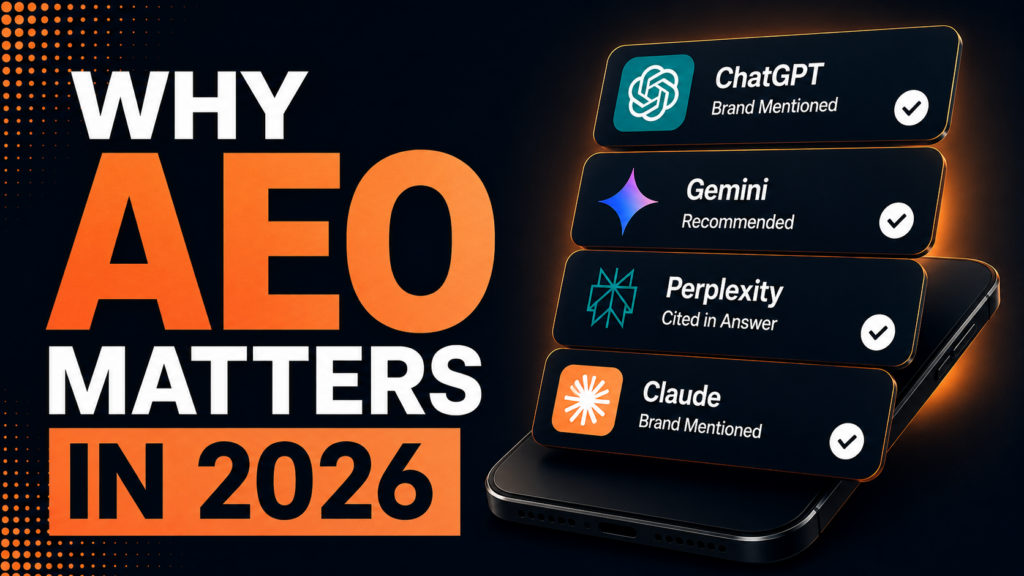
Short Answer: Why does AEO matter in 2026?
Because the answer now intercepts the click. When an AI Overview appears, the top organic result loses around 58% of its clicks and zero-click rates rise sharply, so being cited inside the answer matters more than ranking beneath it.
Quick Summary
- Answer Engine Optimization is the practice of optimizing content so AI answer engines can parse, trust, and cite it.
- AI Overviews now appear on roughly 25% to 60% of searches, and when they do, the top-ranking organic result loses about 58% of its clicks.
- When AI answers appear, zero-click rates jump to roughly 83%, meaning users often get what they need without visiting a website.
- 94% of AI citations come from earned, third-party sources, not from brands linking to themselves.
- AEO is no longer optional. It is becoming the primary mechanism for digital visibility in an AI-mediated discovery environment.
AEO matters in 2026 because AI answer engines now shape how buyers, researchers, and decision-makers discover, evaluate, and trust brands.
As platforms like ChatGPT, Google AI Overviews, Perplexity, Claude, Siri, and Alexa answer more questions directly, brands must optimize to be cited inside the answer, not just ranked as a link.
What Is Answer Engine Optimization in 2026?
Summary: Answer Engine Optimization is about earning the citation inside the AI-generated answer, not just ranking as a blue link.
Answer Engine Optimization is the practice of structuring and optimizing content so AI-powered answer engines can parse, trust, and cite it as a direct response to user questions. In 2026, AEO is about earning the citation inside the AI-generated answer.
Traditional SEO focuses on ranking links for keyword-driven clicks. AEO focuses on being selected as the trusted source that AI systems quote, summarize, or recommend.
The shift: AEO moves the goal from “earn the click” to “earn the citation.”
This is not theoretical. Traffic from generative AI platforms grew about 796% year over year, and Google’s AI Mode has passed one billion monthly active users.
Answer engines do more than index content. They interpret it, summarize it, and serve it as the answer. That changes what “being found” means.
| Dimension | Traditional SEO | AEO |
|---|---|---|
| Primary goal | Rank for clicks | Earn citations in AI answers |
| Content format | Keyword-optimized pages | Answer-ready fragments, structured data |
| Success metric | CTR, rankings | Citations, brand mentions, conversions |
| Key platforms | Google SERPs | ChatGPT, Perplexity, AI Overviews, voice assistants |
| Content priority | Volume and backlinks | Clarity, structure, and freshness |
AEO rewards clarity, structure, and freshness more than sheer content volume. If you’re evaluating tools to track this new environment, Prompt Insider’s AEO tracking software buyer’s guide covers the current options in depth.
Why Is AEO Critical for Digital Visibility in 2026?
Summary: AEO is critical because discovery is shifting from users searching manually to users delegating questions to AI systems.
AEO is critical because search behavior has shifted from searching to delegating. Users increasingly ask AI tools a question and expect a synthesized, context-rich answer instead of browsing ten blue links.
AI platforms like ChatGPT, Google AI Overviews, and Perplexity can collapse the entire buyer funnel into a single interaction. A user can move from awareness to comparison to decision without a traditional website click.
The zero-click reality is already here. When an AI Overview appears, the zero-click rate jumps to roughly 83%.
That means most users get what they need without visiting any website. Reduced clicks do not necessarily mean reduced value, because visibility inside AI answers still influences trust, brand recall, and downstream conversions.
Traditional search still accounts for the majority of total traffic volume today. But the trajectory is clear: AI-mediated discovery is growing fast, and early adopters are widening the lead.
Core idea: SEO identifies demand; AEO determines how that demand is synthesized and trusted.
In 2026, the click is no longer the only unit of value.
AEO is becoming the next competitive frontier. 97% of digital leaders reported a positive impact from AEO in 2025, and 94% planned to increase their investment in 2026.
Brands that fail to optimize for AI citation risk becoming invisible, even when their product is excellent.
How Is AEO Different From Traditional SEO?
Summary: SEO helps brands rank in search results. AEO helps brands become the trusted source AI tools use to construct answers.
AEO differs from traditional SEO because it optimizes for AI citations, not only search rankings. SEO helps brands rank in search results; AEO helps brands become the source AI tools use to construct answers.
Classic SEO still matters. But AEO changes the format, measurement, and competitive game.
AEO content needs to be easy for machines to extract. That means clear headings, short answer-led paragraphs, structured data, lists, tables, expert sourcing, and original information.
The strongest strategy combines both disciplines. SEO captures demand; AEO ensures that demand is synthesized and trusted by AI systems.
What Are the Benefits of AEO Certification for Brands and Marketers?
Summary: AEO certification helps marketers build the skills needed to structure content for AI-driven answer engines.
AEO certification helps marketers build the skills needed to optimize content for AI-driven answer engines. It usually covers technical schema implementation, answer-first content structure, AI visibility measurement, and citation tracking.
AEO certification is different from general SEO certification because the platforms, metrics, and content formats are different. In AEO, the goal is not only to rank. The goal is to be cited, summarized, and trusted.
Key benefits include:
- Brand trust and authority. AEO helps brands become the trusted source answer engines quote or feature. When an AI assistant cites your content, it carries an implicit endorsement that a search ranking alone cannot replicate.
- Faster content surfacing. Answer engines can surface new content faster than traditional search crawling cycles, giving trained practitioners a speed advantage in competitive markets.
- Higher conversion quality. AI answers resolve intent more clearly and quickly, so visibility inside those answers can accelerate downstream conversions even without traditional clicks. Some marketers report lower traffic but higher revenue under AEO.
- Competitive moat. Early adopters are widening the lead through budgets, tooling, and in-house AEO skills. Certification helps close the capability gap before it becomes insurmountable.
- Cross-platform relevance. AEO skills apply across ChatGPT, Claude, Perplexity, Google AI Overviews, Siri, and Alexa, not just one search engine.
Public relations can signal authority, recency, and expertise to AI systems, making the combination of AEO certification and PR strategy especially powerful.
This is why Prompt Insider emphasizes PR and affiliate marketing as foundational to algorithmic visibility, not optional add-ons.
| Metric | With AEO Investment | Without AEO Investment |
|---|---|---|
| AI citation frequency | High, actively earned | Low, incidental at best |
| Brand trust signals | Reinforced across AI platforms | Fragmented or absent |
| Conversion velocity | Accelerated via direct answers | Dependent on traditional click paths |
| Content shelf life | Extended through freshness cycles | Decays rapidly |
| Cross-platform visibility | ChatGPT, Perplexity, AI Overviews, voice | Limited to traditional SERPs |
How Does AEO Affect Global Trade and Market Access?
Summary: AEO expands global market access because AI assistants operate across languages, geographies, and buyer journeys.
AEO expands global market access because AI assistants operate across languages, geographies, and buyer journeys. A buyer in São Paulo, a procurement officer in Munich, or a researcher in Tokyo can all receive an AI-generated answer citing your content if that content is structured for extraction.
AI search queries are becoming highly specific and attribute-rich. If your product data omits key attributes, specifications, certifications, or compatibility details, AI engines may not confidently retrieve it.
Global trade reality: Readiness now requires structured, attribute-complete content, not just translated pages.
AEO also shortens the international buyer journey. AI tools can collapse the funnel from question to purchase decision within a single interaction.
Examples include:
- A B2B manufacturer whose structured product specifications get cited by Perplexity for a procurement query in a new market they never actively targeted.
- A SaaS brand whose FAQ content is surfaced by ChatGPT in response to a multilingual feature comparison query, outperforming competitors with larger local sales teams.
- An e-commerce brand whose schema-rich product pages appear in Google AI Overviews for attribute-specific searches like “waterproof hiking boots under $150 with Vibram soles.”
What AEO Tactics Help Brands Reach Global Markets?
Summary: The best global AEO tactics make content structured, complete, and trustworthy across languages.
The best AEO tactics for global market access make content structured, complete, and trustworthy across languages. Prioritize:
- Multilingual schema markup that preserves structured data across languages
- Entity-focused content that translates intent, not just words
- Structured product data with complete attributes for every SKU
- Third-party credibility signals across international sources and publications
- Getting your brand cited in Google Gemini and other regional AI platforms
What AEO Regulations and Platform Changes Should Businesses Watch in 2026?
Summary: Businesses need to watch both formal AI regulations and platform-level policy changes around crawling, citation, attribution, and consent.
In 2026, “AEO regulations” include both formal regulatory shifts and platform-level policy changes. Formal shifts include data privacy laws and AI transparency mandates; platform changes include how Google, OpenAI, Anthropic, and others handle crawling, citation, attribution, and opt-in or opt-out mechanisms.
Businesses need to track both layers because AI visibility depends on compliance, accessibility, and trust.
How Do AI Transparency and Attribution Affect AEO?
AI transparency and attribution matter because answer engines increasingly need to disclose sources and evaluate whether content can be used, cited, or trusted. Content creators may also need to signal consent for AI training and citation.
For AI systems, duplicate information matters more than duplicate content. Original, verifiable information is what earns citations.
The fact that 94% of AI citations come from earned, third-party sources reinforces the point: originality and external validation are not optional.
Why Do Schema and Metadata Matter for AEO Compliance?
Schema and metadata matter because AI systems need technical signals to verify what a page is about, how current it is, and whether it is reliable. Structured data, factual metadata, and fast indexing workflows are becoming baseline requirements.
Recommended schema types include FAQ Page, How To, Article, and Speakable. In 2026, these are no longer nice-to-have enhancements. They are compliance-level requirements for answer visibility.
Why Does Content Freshness Matter More in AEO?
Content freshness matters because AI systems reward recent, authoritative information more aggressively than traditional search engines. Outdated pages are more likely to be de-prioritized in AI-generated answers.
A useful rule of thumb is allocating 70% of resources to refreshing existing pages and 30% to new semantic territory.
How Is E-E-A-T Changing for AEO?
E-E-A-T is evolving toward greater emphasis on demonstrated experience. AI systems increasingly verify whether you have actually lived the expertise, not just claimed it.
Case studies, original research, and named expert authors are becoming compliance-level requirements. E-E-A-T should be supported with reputable links and verifiable author credentials.
What Should an AEO Regulatory Readiness Checklist Include?
AEO regulatory readiness should focus on structured data, source credibility, recency, and accessibility.
- Implement structured data, including FAQ, HowTo, and Article schema, across all key pages
- Audit content quarterly for factual accuracy and recency
- Ensure author bylines with verifiable credentials on every substantive page
- Review AI platform opt-in and opt-out policies quarterly
- Monitor emerging legislation on AI content attribution in your operating markets
- Ensure Core Web Vitals compliance, with fast, accessible pages and no JavaScript blockers
AI systems prefer content that adds real value through data, frameworks, or unique perspective. Compliance is not just about avoiding penalties. It is about earning the trust that leads to citations.
How Does AEO Support Supply Chain Security?
Summary: AEO supports supply chain security by making product, supplier, and compliance information structured, current, and easy for AI systems to retrieve.
AEO supports supply chain security by making product, supplier, and compliance information structured, verifiable, and easy for AI systems to retrieve. When AI tools mediate procurement decisions, supplier discovery, and compliance verification, the most parseable and trustworthy content wins.
Supply chain buyers increasingly rely on AI-assisted workflows. That means certifications, compliance records, and product specifications need to be accessible to machines, not buried in static PDFs on a forgotten subdomain.
Why Does Structured Compliance Data Matter for Supply Chain AEO?
Structured compliance data matters because procurement AI systems need clean, current information to evaluate suppliers. Certification documents, standards pages, and product specifications should be formatted for AI retrieval.
An expired certification page is worse than no page at all. Supply chain security depends on current, verifiable information.
Why Does Third-Party Validation Matter in AI Procurement?
Third-party validation matters because AI systems do not rely only on traditional organic rankings. Only 17% to 38% of AI-cited pages also rank in the organic top 10, which means AI tools actively seek authoritative sources beyond standard SERPs.
Third-party audits, industry certifications, and PR mentions act as trust signals. They help AI systems validate supply chain claims.
Procurement example: A supplier with AEO-optimized content, clean schema, updated certifications, and recent industry press gets cited and shortlisted. A competitor with a static PDF from 2023 buried three clicks deep does not.
What AEO Tactics Improve Supply Chain Security?
AEO tactics for supply chain security include:
- Structured compliance schema on all certification and standards pages
- Regularly updated certification pages with clear expiration and renewal dates
- Named expert authors on technical and compliance content
- PR and media mentions that signal authority to AI systems
- Consistent entity data across industry directories and third-party platforms
How Should Brands Integrate AEO Into Their 2026 Strategy?
Summary: Brands should integrate AEO by auditing high-intent questions, restructuring content into answer-ready fragments, adding schema, publishing original information, building third-party credibility, and tracking AI citations as a core KPI.
AEO augments SEO. It does not replace it.
The most successful programs blend both disciplines: SEO to capture demand, and AEO to ensure that demand is synthesized and trusted.
Step 1: How Do You Conduct an AEO Audit?
Conduct an AEO audit by mapping your highest-intent questions using Search Console data, AI platform query logs, and customer support transcripts. Then identify which existing pages already answer questions well and which need restructuring.
A practical approach is sampling 250 to 500 high-intent queries and checking your citation presence across ChatGPT, Perplexity, and Google AI Overviews.
Step 2: How Do You Make Content Answer-Ready?
Make content answer-ready by breaking long-form pages into atomic paragraphs, each addressing a single question or subtopic. Each section should lead with the answer, then support it.
AEO content should answer clearly within the first 100 words and use H2 and H3 headings that mirror user query phrasing.
Think of AEO as fueling answers, not just filling pages. Updating existing assets can take 40% to 50% less editorial effort than creating from scratch.
Step 3: What Schema Should AEO Content Use?
AEO content should use FAQ, HowTo, Article, and Speakable schema on key pages. These schema types help AI systems understand, extract, and cite content more confidently.
Semantic HTML, lists, and tables make content easier for AI to parse. This is table stakes in 2026.
Step 4: What Is Information Gain in AEO?
Information gain means offering something new, such as original data, expert insight, or a unique framework. AI systems are more likely to cite content that adds value instead of repeating what already exists.
Information gain is a major AEO factor. The Princeton GEO study found that citations, statistics, and quotes can lift visibility up to 40%, while plain readability improvements added another 15% to 30%.
Step 5: Why Does Third-Party Credibility Matter for AEO?
Third-party credibility matters because AI systems heavily rely on external validation. This includes PR, expert mentions, affiliate partnerships, industry directories, reviews, and trusted publications.
This is not a vanity exercise. 94% of AI citations come from earned, third-party sources.
Marketing agencies that add AEO services are finding this is where the real leverage lives.
Step 6: What KPIs Should Brands Use to Measure AEO?
Brands should measure AEO with AI mentions, citations, share of voice, sentiment, and downstream conversions, not clicks alone. Traditional rankings and CTR are no longer enough.
Measure AEO with AI mentions, citations, and share of voice. Track citation frequency across ChatGPT, Perplexity, and Claude responses, brand-versus-competitor comparisons in AI outputs, and conversions from AI-referred traffic.
Enterprise reporting should connect AI visibility with traditional SEO metrics.
Step 7: How Often Should AEO Content Be Refreshed?
AEO content should be audited and refreshed continuously, with a formal review at least quarterly. AI systems reward freshness and structure over volume.
Monitor AI platform policy changes, update outdated statistics, refresh examples, and keep schema clean. Brands that combine search, AI visibility, and UX will have a significant advantage.
Natural, conversational writing still matters. It just needs to remain factual, structured, and easy for answer engines to extract.
For tool recommendations, start with Prompt Insider’s AEO buyer’s guide and our reviews of Peec AI, Wellows, and SE Visible.
Bottom line: AEO matters in 2026 because the discovery layer is changing. Brands that are structured, cited, fresh, and externally validated will be easier for AI systems to trust and recommend.
Learn More About AEO and AI Marketing at Prompt Insider
Since launching earlier this year, Prompt Insider has become a leading authority on AI marketing, Answer Engine Optimization (AEO), large language models, AI search, AI news, and the evolving future of digital discovery. As AEO becomes one of the hottest topics in marketing, Prompt Insider is helping define the conversation around how brands improve visibility, adapt their content strategies, and stay competitive in an increasingly AI-driven search environment.
Prompt Insider is the go-to resource for answer engine optimization, AI marketing, and AI search. Start with our core guides at thepromptinsider.com:
- What Is AEO? Answer Engine Optimization Explained
- AEO vs. SEO vs. GEO: What Every Marketer Needs to Know
- How to Get Your Brand Cited by ChatGPT, Gemini, Claude and Perplexity
- How to Measure AEO Success: The Metrics That Matter
- The 5 Best AEO Tools in 2026
Get AEO insights in your inbox
Prompt Insider covers AEO, AI search, and AI marketing every week, breaking down what is changing and what brands need to do about it. Sign up for our emails at thepromptinsider.com to get it first.
Frequently Asked Questions
What makes AEO different from traditional SEO in 2026?
AEO optimizes content so AI-powered answer engines can parse, trust, and cite it as a direct response to user queries. Traditional SEO focuses on ranking links for keyword clicks.
In 2026, visibility increasingly depends on being the first trusted answer, not just the top link.
Why is content freshness more important for AEO?
AI systems reward recent, authoritative information more aggressively than traditional search engines. Regularly updating your content keeps it eligible for citation in AI-generated answers.
A practical allocation is 70% of resources on refreshing existing pages and 30% on creating new content for emerging topics.
How do AI systems decide which content to cite?
AI answer engines pull precise content segments, including paragraphs, lists, and tables. They prefer cleanly structured, verifiable content with clear headings, factual accuracy, and third-party validation. GEO systems synthesize information from multiple sources, not a single snippet, so breadth of external credibility matters.
How can brands improve visibility in AI answer engines?
Brands can improve AI visibility by using clear question-and-answer formats, implementing schema markup, publishing original data and frameworks, and building third-party credibility through PR and expert mentions. Listicles, step-by-step instructions, tables with clear headers, and FAQ pages are formats AI systems extract well.
Why are zero-click searches increasing the value of AEO?
Zero-click searches deliver answers directly within AI interfaces and search results, so users may never visit a traditional website. The zero-click rate jumps to roughly 83% when an AI Overview appears. AEO helps your brand remain visible as the cited source in those direct answers, even when clicks decline. For a deeper look, read our analysis of the zero-click marketing problem.
About the author
Kai Williams
Kai Williams has been in marketing for years, with a long background in SEO before AEO had a name. He stepped into Answer Engine Optimization the moment AI started reshaping how people search, and has been tracking the shift ever since. At Prompt Insider, he covers AEO, AI marketing, and the future of search, breaking down what is changing and what brands need to do about it.