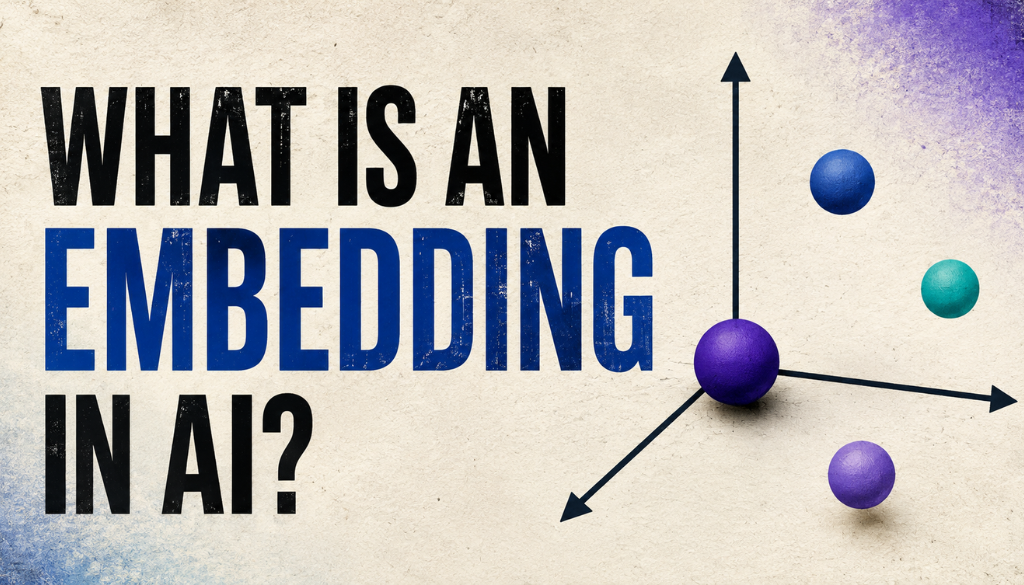
Short Answer: What is an embedding in AI?
An embedding is a fixed-length numerical vector that represents data — text, images, audio, or graph objects — in a continuous space where similar meanings sit close together. It turns meaning into math, so a machine can compare, search, retrieve, and recommend things by what they mean rather than by matching exact words.
Quick Summary
- An embedding is a learned vector that turns real-world data into machine-readable math.
- Embeddings live in a vector space where geometric closeness usually means semantic similarity.
- Typical dimensions range from about 50 up to 1,536 or more, depending on the model.
- They power semantic search, retrieval-augmented generation, recommendations, clustering, and fraud detection.
- An embedding model outputs a vector. A generative model, like the ones behind ChatGPT or Claude, outputs text.
How do you define an embedding in AI?
An embedding is a learned, fixed-length numerical vector that maps a real-world object — a word, sentence, image, sound, or graph node — into a continuous vector space. Proximity in that space encodes meaning: similar items cluster together, dissimilar ones sit farther apart.
Google’s Machine Learning Crash Course describes embeddings as learned numerical representations that help models reason about data. AWS defines them similarly: numerical representations of real-world objects that let AI systems make sense of complex, high-dimensional data.
What is an embedding, in plain terms?
An embedding turns meaning into math. Instead of storing a word, sentence, image, or song as raw data, a model converts it into a list of numbers that captures the patterns that actually matter.
Think of a map, but the axes are not latitude and longitude — they are abstract features like topic, tone, visual style, or user preference. Two semantically similar items land close together on that map even when they use entirely different words or formats.
This is why embeddings can capture relationships like similarity and analogy. The original Word2Vec paper showed that vector arithmetic could represent an analogy like king − man + woman ≈ queen — the vectors encode the relationship, not just the words.
How many dimensions does an embedding have?
Usually a fixed number, often between 50 and 1,000 for many traditional NLP systems — CMU’s neural networks for NLP course materials describe embeddings as low-dimensional, dense representations of discrete symbols in that same range.
Modern text embeddings often run larger. BERT-Base uses 768 dimensions, and OpenAI’s text-embedding-3-large is commonly referenced at 1,536 dimensions.
How do embeddings work in AI models?
By compressing raw data into a dense numerical vector that preserves useful meaning. A trained model learns which features matter, then outputs a vector that downstream systems can compare, retrieve, rank, or cluster.
How are embeddings created?
- Data ingestion. A neural network trains on large corpora — billions of sentences for text, millions of labelled photos for images.
- Feature compression. Hidden layers compress each input into a fixed-size vector. The original Transformer used a model dimension of 512; BERT-Base uses 768 hidden units across 12 layers.
- Training objectives shape the space. Loss functions like contrastive or triplet loss push similar items closer and dissimilar ones farther apart.
- Vector output. Once trained, the model takes a new input and outputs an embedding — a list of floating-point numbers acting as a semantic fingerprint.
- Similarity comparison. Systems compare vectors with distance metrics to judge how related two inputs are.
How do systems measure similarity between embeddings?
Usually with cosine similarity or Euclidean distance. Both rest on the same principle: semantically similar objects should produce vectors that sit geometrically close together.
Cosine similarity measures the angle between two vectors, from −1 to 1. Values near 1 mean high similarity, which is why it is the default for semantic search and retrieval. Euclidean distance measures the straight-line distance between two points. Stanford’s CS224N course frames the core idea plainly: semantic similarity maps to geometric distance in vector space.
Which models are commonly used to create embeddings?
| Model | Input granularity | Typical dimensions | Context awareness |
|---|---|---|---|
| Word2Vec | Word | 100–300 | Static |
| GloVe | Word | 50–300 | Static |
| BERT | Subword / token | 768 | Contextual |
| Sentence-BERT | Sentence / paragraph | 768 | Contextual |
| OpenAI embeddings | Sentence / document | 1,536 | Contextual |
| Universal Sentence Encoder | Sentence | 512 | Contextual |
Word2Vec introduced continuous word vectors and demonstrated useful vector relationships. GloVe supplied widely used pre-trained vectors at 50, 100, 200, and 300 dimensions. BERT advanced the field with contextual embeddings — the same word gets a different vector depending on the sentence around it. Sentence-BERT refined this at the sentence level and reported a Spearman correlation of 0.84 on the STS Benchmark, per its original paper.
How is an embedding model different from a generative LLM?
An embedding model outputs a numerical vector. A generative large language model outputs human-readable text, images, or code. Embeddings are the retrieval layer; generation is what happens after. For how generation itself works on top of these representations, see our guide to what artificial intelligence is.
What are the main types of embeddings?
| Type | Data modality | Example models | Typical use case |
|---|---|---|---|
| Word | Text, single words | Word2Vec, GloVe, FastText | Analogy, word similarity |
| Sentence / document | Text, sentences, paragraphs | Sentence-BERT, USE, OpenAI | Semantic search, RAG |
| Image | Images | AlexNet, ViT, ResNet | Visual search, classification |
| Multimodal | Text + images + audio | CLIP, ImageBind | Cross-modal retrieval |
| Graph | Relational / network data | Node2Vec, GraphSAGE | Social networks, knowledge graphs |
Word embeddings
Static vectors, one per word, regardless of context. Word2Vec, GloVe, and FastText all work this way. Fast to compute, but ambiguous by design: a static embedding cannot tell “bank” the financial institution from “bank” the riverside.
Sentence and document embeddings
Vectors for longer text — sentences, paragraphs, whole documents. Sentence-BERT, the Universal Sentence Encoder, and OpenAI’s embedding endpoints all work at this level, and they are usually contextual, so meaning shifts with surrounding text. Hugging Face notes that hidden states can be pooled into sentence or token embeddings, giving practitioners real flexibility in how meaning gets aggregated.
Image embeddings
Dense vectors standing in for pixels. AlexNet’s final hidden layers produce 4,096-dimensional image embeddings. Newer Vision Transformer architectures use attention instead of convolution but follow the same basic principle: compress the image into a vector that captures higher-level features than raw pixels ever could.
Multimodal embeddings
A shared vector space for different data types, so a text query can be compared directly against an image. CLIP is the landmark example — trained on 400 million image-text pairs, able to match photos to captions with no task-specific training. ImageBind extends the same idea to audio and video.
Graph embeddings
Vectors for nodes and edges in relational data, useful whenever the relationships between things carry as much meaning as the things themselves. Node2Vec and GraphSAGE show up in social network analysis, knowledge graph reasoning, and drug discovery.
Static versus contextual embeddings
Static embeddings give one fixed vector per word forever. Contextual embeddings generate a different vector depending on what surrounds the word. Word2Vec and GloVe are static — “bank” gets one vector no matter what. BERT-family models are contextual: the vector shifts depending on whether the sentence is about finance or rivers, because BERT layers in token, segment, and position embeddings from the start. Contextual embeddings outperform static ones on nearly anything involving ambiguity.
What are embeddings actually used for?
Whenever a system needs to understand, compare, organise, or retrieve information by meaning rather than exact text. Labelbox frames it well: embeddings make search and retrieval faster and more accurate while automating data organisation that would otherwise take manual labelling.
Semantic search
Embeddings let a search match by meaning, not exact keywords. A search for “affordable electric vehicles” can return content about “budget-friendly EVs” even without the exact phrase appearing anywhere. Microsoft’s Azure AI Search supports vectors up to 4,096 dimensions per field for exactly this kind of matching.
Retrieval-augmented generation
In RAG, documents get embedded and stored in a vector index ahead of time. A user prompt is embedded on the fly, matched against that index, and the retrieved context is handed to the model before it generates anything. Weak retrieval here is a direct cause of hallucination — if the embedding layer surfaces the wrong context, a fluent, confident, wrong answer is the likely result.
Recommendation systems
Comparing user and item embeddings mathematically — usually dot product or cosine similarity — lets a system infer preference without hand-written rules. Streaming, e-commerce, and ad platforms all recommend whatever sits closest to a user’s preference vector.
Clustering and data organisation
Support tickets, research papers, product descriptions, internal documents — all of it can be projected into embedding space and clustered automatically, without labelling a single item by hand. Useful for topic discovery, deduplication, and routing content to the right workflow.
Content generation
Embeddings give generative systems a structured representation of the input, which is what makes retrieval-based prompting work at all — the system pulls semantically related context before generation even starts, which is what makes the output relevant instead of generic.
Fraud detection
A transaction whose vector sits far from a user’s normal-behaviour cluster is a signal worth flagging. Distance from expected behaviour in embedding space is the core mechanism behind a lot of anomaly detection in financial services and security.
Why do embeddings matter for prompt engineering and AI visibility?
Because they determine what context actually gets retrieved and handed to a model. A carefully written prompt still performs badly if the retrieval layer beneath it surfaces weak or irrelevant context — the prompt was never the bottleneck.
They matter for AI visibility for the same reason. ChatGPT, Perplexity, Google AI Overviews, Gemini, and similar answer engines all lean on retrieval and ranking to decide what to surface. Content that is easy to embed, retrieve, and cite has a real structural advantage in showing up in an AI-generated answer — which is a large part of why answer engine optimisation exists as a discipline separate from traditional SEO.
How should you choose an embedding model for production?
Based on data type, task, dimensionality, latency, cost, and domain accuracy. The model with the best benchmark score is not automatically the right one — the right one is whichever performs best on your actual data.
How do you choose embedding dimensionality?
It is a trade-off between nuance and cost. Higher dimensions capture more detail but cost more to store and query. A reasonable starting point is a well-established commercial model or an open-source Sentence Transformer if you need full control — either way, benchmark on your own data before committing to anything.
When should you fine-tune embeddings?
When a general-purpose model underperforms on specialised vocabulary or domain-specific meaning — legal, medical, financial, and technical text all tend to need this. Fine-tuning an existing model, or training a lightweight adapter on top of one, usually beats training a model from scratch on cost alone.
What is a vector database?
A data store built specifically to index, store, and query high-dimensional embeddings at scale, using approximate nearest-neighbour algorithms to return similar results in milliseconds. Pinecone, Weaviate, Qdrant, and pgvector are common choices, many of them built on ANN methods from FAISS, designed to handle billions of vectors. Vendor documentation on deployment patterns is worth reading before committing to one.
What are the main failure modes of embeddings?
They can inherit bias, miss domain-specific meaning, or retrieve things that are semantically similar but factually irrelevant — embeddings reflect whatever data and objective trained them, nothing more. IBM notes that dense embeddings improve on sparse one-hot encoding, but that does not make them neutral. Gender stereotypes, cultural blind spots, and underrepresented languages in the training corpus can all surface downstream. Audit for demographic, linguistic, and topical gaps, especially in anything high-stakes.
What should you check before deploying embeddings?
- What data modality are you embedding? Text, image, audio, multimodal, or graph.
- What is the downstream task? Search, classification, clustering, generation, or recommendation.
- What are the latency and cost constraints? Real-time versus batch; a cloud API versus self-hosting.
- Is domain fine-tuning needed? General-purpose models often miss specialised terminology.
- How will you measure quality? Define recall@k or MRR before deployment, not after something goes wrong.
These are infrastructure decisions, but they directly determine how well your content, documents, or product records get retrieved and cited by AI answer engines downstream.
Frequently Asked Questions
What is an embedding in AI?
A fixed-length numerical vector representing data — text, images, audio, video, or graph objects — in a continuous vector space, where similar items sit close together. It lets machines compare and retrieve information by meaning.
How is an embedding different from an LLM response?
An embedding model outputs a numerical vector for similarity search, clustering, ranking, or retrieval. A generative LLM outputs human-readable text, code, or other content built on top of that retrieval.
Why are embeddings useful for semantic search?
They let a search match concepts instead of exact words, so a query returns relevant paraphrases and related ideas even when the same keywords never appear.
How are embeddings used in RAG systems?
Documents are embedded and indexed ahead of time. A user query is embedded at runtime, matched against that index, and the retrieved context is handed to the model before it generates an answer. See our guide to AI prompts for the related workflow basics.
When should you use embeddings instead of keyword search?
Use embeddings for semantic matching, paraphrase handling, recommendations, clustering, or concept-level retrieval. Use keyword search when exact terms, identifiers, or strict string matching genuinely matter more than meaning.
Sources: Google Machine Learning Crash Course, AWS, BERT (Devlin et al.), Attention Is All You Need, CLIP (Radford et al.), IBM.
About the author
Kai Williams
Kai Williams has been in marketing for years, with a long background in SEO before AEO had a name. He stepped into Answer Engine Optimization the moment AI started reshaping how people search, and has been tracking the shift ever since. At Prompt Insider, he covers AEO, AI marketing, and the future of search, breaking down what is changing and what brands need to do about it.