Short Answer: What is grounding in AI?
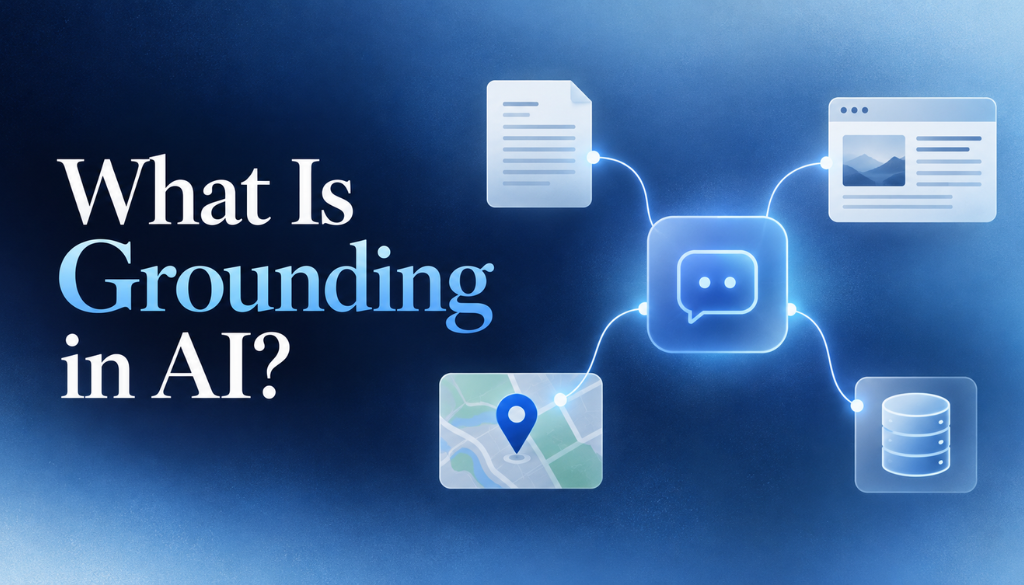
Grounding in AI is the practice of anchoring a model’s output to verified, retrievable source material such as documents, databases, APIs, or knowledge bases instead of relying only on patterns learned during training. A grounded AI system can connect its answer back to real-world facts and specific sources, making the response more accurate, current, and auditable.
TL;DR: What Are the Key Takeaways About Grounding in AI?
- Grounding connects AI outputs to verified external data at the time of generation, rather than depending only on training data.
- Grounding reduces hallucinations by giving the model source material to use as evidence, though it does not eliminate errors completely.
- Retrieval-augmented generation, or RAG, is the most common grounding pattern, but grounding is the broader goal.
- Grounding is essential for enterprise AI systems where accuracy, traceability, governance, and compliance matter.
- Grounding works best with high-quality sources, citations, observability, and ongoing monitoring.
What Does Grounding Mean in AI?
Grounding in AI means connecting a model’s response to verified, retrievable information such as company documents, databases, policies, or knowledge bases. Instead of generating only from statistical patterns learned during training, the model uses external source material supplied at request time.
A grounded AI agent can trace its answer back to a specific document, policy, database record, or other source, making the response auditable.
At a broader level, grounding links abstract language to real-world data and context. Research in cognitive science and AI describes grounding as the connection between text and internal representations of objects, actions, feelings, events, or scenarios, and frames it as central to human-level intelligence.
Grounding applies across natural language processing, computer vision, and multimodal AI. In every case, the goal is the same: make the model’s output correspond to the real-world context it is supposed to describe.
Why Does Grounding Matter for AI Models?
Grounding matters because ungrounded large language models can produce plausible but false information, known as hallucinations. Grounding reduces this risk by anchoring responses in verified, real-time data instead of leaving the model to rely only on training patterns.
Grounding also improves governance. Because grounded answers cite specific sources, organizations can audit responses and update AI behavior by editing source content instead of retraining the model. This is especially useful when policies, product catalogs, customer records, or compliance requirements change often.
Grounding also enables more personalized and context-aware outputs. For example, grounded prompts that include CRM history, past interactions, and customer interests produce more specific messages, while ungrounded messages tend to sound generic and impersonal.
What Are the Main Benefits of Grounding AI?
Grounding provides five practical benefits:
- Reduces hallucinations by constraining outputs to verified sources
- Improves accuracy and relevance by using current source material
- Enables traceability and auditability for AI-generated responses
- Supports governance without costly model retraining
- Personalizes outputs with current organizational data
How Does Grounding Work in Practice?
Grounding works by retrieving relevant source material, adding it to the model’s context, and instructing the model to generate an answer based on that evidence. The system may also verify the output against the retrieved material and require citations. A typical grounding workflow has five steps.
1. How Are Sources Selected for Grounding?
Source curation means selecting high-quality documents, databases, policies, and knowledge bases for the AI system to use. The best sources are verified, current, relevant, and structured well enough to retrieve accurately.
Teams should add metadata and define how often sources need to be refreshed. For example, support tickets may need daily updates, policy documents may need weekly reviews, and regulatory texts may be refreshed quarterly.
2. How Are Sources Indexed and Retrieved?
Indexing means preparing source material so the system can search it efficiently. Many grounded AI systems use vector indexes, keyword search, or hybrid search to retrieve the most relevant passages for a user’s query.
Metadata management is part of this process. Documents should be tagged by topic, date, authority level, department, product, or customer segment when relevant.
3. How Is Retrieved Evidence Used by the Model?
The retrieved evidence is passed into the prompt or model context before generation. This allows the model to answer using current information that may not exist in its training data.
Salesforce describes this as feeding up-to-date data and metadata into the prompt so the model can produce more accurate and contextual outputs. A grounded prompt should tell the model to rely on the provided evidence, cite its sources, and avoid unsupported claims.
4. How Are Grounded Outputs Verified?
Verification checks whether the model’s answer matches the retrieved evidence. Some systems use rules, filters, fact-checking agents, or programmatic checks to detect contradictions.
Grounding methods can compare AI outputs against knowledge bases to reveal inconsistencies.
5. How Are Grounded AI Systems Monitored?
Monitoring means logging outputs, measuring hallucination rates, tracking retrieval quality, and refreshing sources on a defined cadence. Teams should also watch for drift, where outputs begin diverging from the source material.
Grounding is not a set-and-forget feature. It requires ongoing indexing, retrieval tuning, prompt design, and quality monitoring.
What Are Common Examples of Grounding in AI?
Grounding is used whenever an AI system needs to answer from specific, reliable, and current information. Common examples include customer support, sales personalization, regulated industries, multimodal AI, and enterprise knowledge assistants.
How Is Grounding Used in Customer Support Chatbots?
A grounded customer support chatbot connects to product catalogs, account records, and company policies. This allows the chatbot to answer with actual customer and policy information instead of generic training-data patterns. For example, a grounded support agent can combine a customer’s order history with the company’s return policy in one response.
How Is Grounding Used in Sales and Marketing?
In sales and marketing, grounding uses CRM data, purchase history, past interactions, and customer preferences to personalize outreach. Grounded AI-generated messages are more specific and relevant than ungrounded ones. Without grounding, AI outreach often reads as generic and impersonal.
Why Is Grounding Important in Healthcare, Legal, and Finance?
Grounding is important in regulated industries because accuracy and traceability are non-negotiable. Healthcare, legal, and finance teams need AI outputs that can be traced to specific guidelines, documents, records, or regulatory texts. Grounding supports compliance, auditability, and risk management in these environments.
How Does Grounding Apply to Image Captioning and Multimodal AI?
In computer vision and multimodal AI, grounding means the model’s language must match the visual data it is analyzing. An image captioning system should describe what it actually sees, not produce a plausible but incorrect caption. The same principle applies to audio, video, documents, and mixed-media systems.
How Is Grounding Used in Enterprise Knowledge Assistants?
Enterprise knowledge assistants use grounding to connect AI tools to company documents, email threads, calendars, support tickets, and internal databases. This lets the assistant answer based on the user’s real work context instead of generic public knowledge. For example, an internal assistant can summarize a project using meeting notes, Jira tickets, and email threads from that specific team.
What Is the Difference Between Grounded and Ungrounded AI Responses?
A grounded AI response is specific, actionable, and traceable to a source. An ungrounded AI response may sound plausible but can be generic, outdated, or wrong.
| Scenario | Ungrounded response | Grounded response |
|---|---|---|
| Customer asks about return policy | “Most companies offer a 30-day return window.” | “Your order #4821 is eligible for return until July 15 per our 45-day policy. Here’s the return link.” |
| Employee asks about PTO balance | “Typically, employees accrue PTO monthly.” | “You have 8.5 PTO days remaining as of June 1, per your HR record.” |
The grounded responses are better because they use specific source data. They also give the user information they can act on immediately.
What Techniques Are Used to Ground AI Systems?
Several techniques can ground AI systems, but retrieval-augmented generation is the most common. Other methods include fine-tuning, few-shot prompting, agent frameworks, citations, and verification layers.
What Is Retrieval-Augmented Generation in Grounding?
Retrieval-augmented generation, or RAG, retrieves relevant content from an external source and feeds it to the model before generation. RAG is the most common architectural pattern for grounding. For example, a RAG system might search a company knowledge base, retrieve three relevant policy passages, and ask the model to answer using only those passages.
How Does Fine-Tuning Relate to Grounding?
Fine-tuning adjusts a model’s parameters using domain-specific examples. It is useful for teaching tone, format, terminology, or task-specific behavior. Fine-tuning is not the same as grounding because it does not automatically give the model access to current facts. Grounding supplies external information at inference time without changing the model’s weights.
How Does Few-Shot Prompting Support Grounding?
Few-shot prompting provides examples inside the prompt to steer how the model responds. It can help the model use retrieved evidence in the right format, cite sources correctly, or follow a domain-specific answer style. Few-shot prompting is usually a supporting technique, not a complete grounding system by itself.
How Do Agent Frameworks Support Grounding?
Agent frameworks can combine retrieval, API calls, programmatic checks, and multi-step reasoning. This lets an AI system look up facts, compare evidence, validate data, or take actions before answering. For example, an agent might retrieve a policy, call a CRM API, verify the customer’s account status, and then generate a grounded response.
Why Are Citations and Observability Important for Grounding?
Citations and observability make grounded AI systems auditable. A system should show which sources supported an answer and log enough information for teams to investigate errors. Grounding paired with citations and observability makes hallucinations detectable even when they cannot be fully prevented.
How Is Grounding Different From RAG, Fine-Tuning, Guardrails, and RLHF?
Grounding is the broader goal of connecting AI outputs to reliable external facts. RAG, fine-tuning, guardrails, RLHF, and human review are related techniques, but they do different jobs.
| Concept | What it does | When it happens | Relationship to grounding |
|---|---|---|---|
| Grounding | Anchors outputs to verified external data | Primarily at inference time | The overarching objective |
| RAG | Retrieves relevant documents, then generates | At inference time | Most common implementation of grounding |
| Fine-tuning | Adjusts model weights on domain-specific data | During training | Complementary; teaches style or domain patterns, not live facts |
| Guardrails | Filters or blocks unsafe or off-topic outputs | At inference time | Complements grounding; does not supply facts |
| RLHF | Aligns model behavior with human preferences | During training | Improves tone and safety, not factual grounding |
| Human review | Manually verifies AI outputs | Post-generation | Essential safety layer alongside grounding |
Is Grounding the Same as RAG?
No. RAG is the most common way to implement grounding, but grounding is the broader concept. Any method that connects a model’s answer to reliable external facts at answer time can be considered grounding. RAG is one architectural pattern for doing that.
Is Grounding the Same as Fine-Tuning?
No. Fine-tuning changes the model’s parameters, while grounding supplies outside information at inference time without altering the model. Grounding is usually preferred when information changes frequently, such as product catalogs, company policies, support records, or CRM data. Fine-tuning is better for teaching persistent behavior such as tone, style, or domain-specific response patterns. The two approaches can work together: a model can be fine-tuned for a domain and then grounded with current data during generation.
Does Grounding Replace Guardrails, RLHF, or Human Review?
No. Grounding supplies verified facts, but it does not replace safety, alignment, or review systems. Guardrails block unsafe or off-topic outputs. RLHF aligns model behavior with human preferences during training. Human review catches errors after generation, especially in high-stakes workflows.
| Approach | Role | Replaces grounding? |
|---|---|---|
| Grounding | Supplies verified facts at inference time | — |
| Guardrails | Blocks unsafe or off-topic content | No |
| RLHF | Aligns tone and safety during training | No |
| Human review | Catches errors post-generation | No |
How Do You Implement Grounding in a Production AI Application?
To implement grounding in production, teams need reliable sources, searchable indexes, source-focused prompts, verification checks, and ongoing monitoring. The work is partly prompt design and partly engineering.
How Should Teams Curate Sources for Grounding?
Source quality matters more than source quantity. Teams should prioritize verified, current, and well-structured sources. A practical refresh cadence might be daily for support tickets, weekly for policy documents, and quarterly for regulatory texts. Up-to-date data and metadata help generate more accurate outputs.
How Should Teams Build Indexes for Grounding?
Teams should build vector or hybrid indexes over source material so the AI system can retrieve relevant evidence quickly. Metadata should identify topic, date, owner, authority level, document type, and source freshness. Good indexing improves answer quality because the model can only ground itself in what the retrieval system provides.
How Should Prompts Be Designed for Grounded AI?
Grounded prompts should be concise, source-focused, and explicit about evidence use. A strong prompt tells the model to cite retrieved material and avoid claims not supported by the provided sources. For practical prompt construction guidance, see Prompt Insider’s guide: What Is an AI Prompt?
How Should Teams Verify Grounded Outputs?
High-stakes outputs should use secondary checks. These may include fact-checking agents, programmatic validation against source data, rules-based checks, or human review. Teams should not assume grounding alone is sufficient for compliance-sensitive use cases.
How Should Teams Monitor Grounded AI Systems?
Teams should log outputs systematically, measure hallucination rates, track citation quality, and monitor retrieval performance. They should also set alerts for drift when outputs begin to diverge from source material.
For customer support or time-sensitive chat, teams may optimize indexes and use tiered retrieval to reduce latency. For compliance or research tasks, deeper retrieval and stricter citation requirements may be worth the extra response time.
What Are the Main Limitations of Grounding in AI?
Grounding reduces hallucinations and improves traceability, but it is not a silver bullet. Models can still misread, miscombine, or misstate the evidence they are given.
The most important limitation is that grounding does not eliminate hallucinations entirely. It makes many errors less likely and easier to detect when paired with citations and observability.
Latency is another tradeoff. In production RAG systems, retrieval can account for a meaningful share of time-to-first-token latency, so teams must balance speed, accuracy, and cost.
Source quality is the biggest dependency. If retrieval returns irrelevant, stale, or incomplete content, the model can still produce weak or incorrect answers. Operational complexity is also real: indexing, refresh cadence, metadata management, monitoring, and evaluation all require ongoing engineering effort.
Key limitations of grounding:
- Grounding does not fully eliminate hallucinations.
- Grounding adds retrieval latency to the generation pipeline.
- Grounding depends on source data quality and freshness.
- Grounding requires ongoing indexing, metadata management, and monitoring.
- Models can still misinterpret or miscombine retrieved evidence.
When Should You Use Grounding in AI?
You should use grounding whenever an AI system needs to answer from current, private, regulated, or source-specific information. Grounding is especially important when accuracy, auditability, personalization, or compliance matter more than raw generation speed.
Good use cases include customer support, internal knowledge search, legal research, healthcare guidance, finance workflows, sales personalization, compliance review, and enterprise copilots.
Grounding is less critical for low-risk creative tasks where source traceability is not required. Even then, grounding can still improve factual accuracy when the output includes claims about real people, products, policies, or events.
Learn More About AEO and AI Marketing at Prompt Insider
Since launching earlier this year, Prompt Insider has become a leading authority on AI marketing, Answer Engine Optimization (AEO), large language models, AI search, AI news, and the evolving future of digital discovery. As AEO becomes one of the hottest topics in marketing, Prompt Insider is helping define the conversation around how brands improve visibility, adapt their content strategies, and stay competitive in an increasingly AI-driven search environment.
Prompt Insider is the go-to resource for answer engine optimization, AI marketing, and AI search. Start with our core guides at thepromptinsider.com:
- What Is AEO? Answer Engine Optimization Explained
- AEO vs. SEO vs. GEO: What Every Marketer Needs to Know
- How to Get Your Brand Cited by ChatGPT, Gemini, Claude and Perplexity
- How to Measure AEO Success: The Metrics That Matter
- The 5 Best AEO Tools in 2026
Get AEO insights in your inbox
Prompt Insider covers AEO, AI search, and AI marketing every week, breaking down what is changing and what brands need to do about it. Sign up for our emails at thepromptinsider.com to get it first.
Frequently Asked Questions
What types of data sources are used for grounding AI?
Common grounding sources include private knowledge bases, enterprise documents, structured databases, CRM records, spreadsheets, APIs, PDFs, emails, chat logs, and real-time web results. The key requirement is that the sources are verified, current, and relevant to the use case.
Does grounding completely prevent AI hallucinations?
No. Grounding reduces hallucinations by constraining answers to verified source material, but models can still misread, miscombine, or misstate the evidence. Human review, citations, and observability remain important safety layers.
How can prompt engineers improve grounding effectiveness?
Prompt engineers can improve grounding by retrieving highly relevant evidence, keeping prompts concise, requiring citations, and instructing the model not to make unsupported claims. Prompts work best when they point to specific retrieved passages rather than broad background instructions.
Why is grounding important for regulated industries?
Grounding is important in healthcare, finance, and legal work because AI outputs must be accurate, traceable, and auditable. Grounded systems can connect answers back to specific policies, records, regulations, or source documents.
What tradeoffs does grounding introduce?
Grounding adds retrieval latency and operational complexity. Teams must maintain source quality, indexes, metadata, monitoring, and refresh schedules, but these costs are usually justified when accuracy and traceability matter.
Sources: Decagon, arXiv, Salesforce, K2view.
About the author
Kai Williams
Kai Williams has been in marketing for years, with a long background in SEO before AEO had a name. He stepped into Answer Engine Optimization the moment AI started reshaping how people search, and has been tracking the shift ever since. At Prompt Insider, he covers AEO, AI marketing, and the future of search, breaking down what is changing and what brands need to do about it.