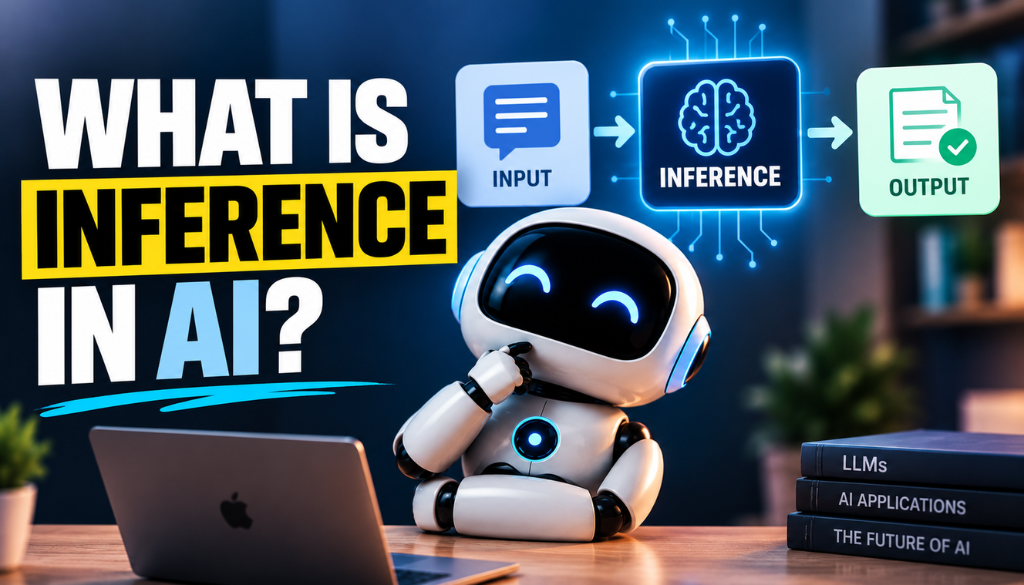
Short Answer: What is inference in AI?
Inference in AI is the process of giving new data to a trained model so it can produce an output, such as a prediction, classification, recommendation, or generated response. It is the phase where a model applies what it learned during training to real-world inputs.
Every time you ask ChatGPT a question, unlock your phone with Face ID, or receive a fraud alert from your bank, you are seeing AI inference in action. Training gets the headlines, but inference is where artificial intelligence creates practical value.
Key Takeaways
- AI inference means using a trained model on new data to generate predictions, classifications, recommendations, text, images, code, or other outputs.
- Training teaches; inference applies. Training updates model weights, while inference uses fixed learned weights to process unseen inputs.
- Inference runs in production through cloud servers, edge systems, on-device hardware, or hybrid architectures.
- Inference performance depends on latency, cost, accuracy, throughput, and reliability.
- Prompt quality directly affects generative AI inference, because every chatbot answer or AI-generated output is produced from a prompt during inference.
What Does Inference Mean in Artificial Intelligence?
AI inference is the operational phase in which a trained machine-learning model processes new, previously unseen data and produces outputs by applying the patterns and parameters it learned during training.
Put simply: training teaches, inference does. As IBM explains, AI inference is the process of applying a pre-trained model to new data and generating predictions.
During inference, a model can classify information, predict an outcome, detect an object, recommend an item, or generate content. Every response from a generative AI system — a paragraph, code snippet, summary, or image — is the result of inference on your prompt.
That connection between prompt quality and inference output is why prompt engineering matters. A better prompt gives the model clearer input to work with during inference.
How Does AI Inference Work?
AI inference works by preparing new input data, running that data through a trained model in a forward pass, and converting the model’s raw output into a usable result.
The inference pipeline usually has three core stages. Each one affects production performance, accuracy, and user experience.
How Is Input Prepared for AI Inference?
Input preparation converts new data into the format the model expects.
For a large language model, this means tokenization, where text is broken into tokens the model can process. For a vision model, it means tasks such as image resizing, pixel normalization, and formatting.
Poor input data can degrade model accuracy even if the model itself is strong. Clean preprocessing is one of the simplest ways to improve inference quality.
What Happens During the Model’s Forward Pass?
During inference, the encoded input passes through the model’s computation graph using its trained weights.
According to IBM, inference involves only a forward pass. Training includes both a forward pass and a backward pass, because training updates model weights.
In inference, no weights are updated. The model uses its already-learned patterns to infer the best output for the new input.
How Are AI Inference Outputs Generated?
The model’s raw outputs are decoded into something useful for a person or system.
Those raw outputs may include logits, probability distributions, embeddings, or other numerical representations. Post-processing turns them into results such as a classification label, generated sentence, recommendation, bounding box, or risk score.
In production, this full process is often called serving. Model serving involves API endpoints, load balancing, autoscaling, caching, and warm-start model instances designed to deliver results at scale with minimal latency.
As Mirantis notes, inference is what turns a trained model into something functional in real-world systems.
What Are the Main Types of AI Inference?
The main types of AI inference are real-time inference, batch inference, and streaming or micro-batch inference. Each type is optimized for different latency, throughput, and cost requirements.
| Type | Latency | Throughput | Typical Use Case | Key Trade-off |
|---|---|---|---|---|
| Real-time inference | Milliseconds to seconds | Low to moderate | Chatbots, fraud detection, autonomous vehicles | Higher per-query cost and dedicated compute |
| Batch inference | Minutes to hours | Very high | Recommendation recalculations, bulk classification | Delayed results, not suited for interactive apps |
| Streaming / micro-batching | Sub-second to seconds | Moderate to high | IoT telemetry, live sentiment analysis, anomaly detection | More architectural complexity |
What Is Real-Time Inference?
Real-time inference, also called online inference, processes individual requests with low latency and returns results in milliseconds to seconds.
This is the mode behind chatbot replies, voice-assistant answers, Face ID authentication, and autonomous vehicle perception. OVH Cloud describes inference as producing a prediction or decision in real time, which is exactly what this mode provides.
Examples include generating chatbot responses, recognizing objects in live camera input, and flagging fraudulent transactions as they occur. The trade-off is cost: real-time inference often requires dedicated compute, warm model instances, and strict SLA management.
What Is Batch Inference?
Batch inference processes large volumes of data in scheduled runs instead of responding to individual requests.
It favors throughput over latency. Common examples include nightly recommendation recalculations for an e-commerce platform, bulk document classification across a legal archive, and periodic risk scoring across a financial portfolio.
Batch inference is not suitable for interactive applications because results are delayed. Its advantage is that it can significantly reduce per-record compute cost.
What Is Streaming or Micro-Batch Inference?
Streaming inference continuously processes data as it arrives, while micro-batching groups small windows of streaming data to reduce overhead while keeping latency low.
This mode sits between real-time and batch inference. It is useful for IoT systems, telemetry pipelines, event-driven architectures, and continuous monitoring.
Examples include sensor telemetry on a manufacturing floor, live social-media sentiment analysis, and network anomaly detection. Streaming inference is especially relevant for edge inference and hybrid cloud deployments where data is generated continuously but full batch delays are unacceptable.
Why Is Inference Important in Machine Learning?
Inference is important because it is where trained models create business value. Training produces a model; inference operationalizes it.
Without inference, a model is just an artifact on disk. Inference converts the training investment into real-world impact.
In the broader machine-learning lifecycle — model development → validation → deployment → inference or serving → monitoring → retraining — inference is usually the longest-running phase. It often becomes the dominant operational cost, especially as models grow larger.
As IBM notes, the ideal inference setup depends on the use case and workload. Enterprises must balance low latency, scalability, accuracy, and cost efficiency.
Inference quality can also degrade over time. This happens when real-world data diverges from training data, a problem known as model drift.
Model drift makes outputs less reliable. Continuous validation, monitoring, and scheduled retraining are essential parts of the inference lifecycle, especially for systems where accuracy matters.
This is closely related to the broader challenge of AI hallucination, where models generate plausible but incorrect outputs.
How Is Inference Different from Training in AI?
The difference between inference and training is simple: training teaches a model by adjusting its weights on data, while inference uses those learned weights to produce outputs on new data.
| Dimension | Training | Inference |
|---|---|---|
| Purpose | Learn patterns from data | Apply learned patterns to new data |
| Data used | Labeled training datasets | New, unseen inputs |
| Compute profile | Extremely intensive; forward + backward pass | Designed to be fast and efficient; forward pass only |
| Duration | Finite; hours, days, or weeks | Continuous; runs as long as the model is in production |
| Hardware preference | Large GPU/TPU clusters | GPUs, TPUs, CPUs, or edge accelerators depending on workload |
| Cost pattern | Large upfront investment | Ongoing operational cost that scales with usage |
| Output | A trained model with weights and parameters | Predictions, classifications, or generated content |
During training, model parameter updates form the model’s learned “knowledge,” as IBM explains. During inference, no weight updates occur.
A critical trend is that as models scale, especially large language models, inference can become the larger cost center. Optimized inference can reduce energy consumption and cloud expenses, making it a strategic priority rather than an afterthought.
For a deeper comparison, Nebius offers a breakdown of AI training and inference.
Where Can AI Inference Run?
AI inference can run in the cloud, at the edge, directly on user devices, or across hybrid cloud-edge architectures. The right choice depends on latency, data sensitivity, cost, scale, and hardware constraints.
What Is Cloud Inference?
Cloud inference runs models on cloud infrastructure and is the default choice for large-model serving and elastic workloads.
Cloud environments offer elastic GPU and TPU pools, managed serving frameworks, and pay-per-use economics. Teams can scale quickly, avoid hardware procurement, and access newer accelerators.
The trade-offs are network latency, data-egress costs, and possible data-sovereignty restrictions. For many organizations, cloud inference remains the starting point, especially for LLM-powered applications.
What Is Edge Inference?
Edge inference runs models on servers or devices located near the data source instead of in a centralized data center.
This reduces round-trip latency and can keep sensitive data local. Practical examples include factory-floor quality inspection, retail in-store analytics, autonomous drones, and industrial monitoring.
Edge inference often requires model compression or lower-precision arithmetic to fit resource-constrained hardware. Lightweight AI models are making it increasingly feasible to bring inference to IoT devices and edge servers.
What Is On-Device Inference?
On-device inference runs models directly on end-user hardware such as smartphones, wearables, embedded controllers, or laptops.
It enables offline use, eliminates network latency, and keeps data on the device. Face unlock, offline voice commands, and wearable health alerts are common examples.
Techniques such as quantization, pruning, and knowledge distillation help models fit within tight memory and power budgets. The payoff is real-time, context-aware AI without cloud dependency.
What Is Hybrid AI Inference?
Hybrid AI inference routes workloads across cloud, edge, and on-device environments based on performance, cost, and governance needs.
For example, lightweight or latency-critical requests may run at the edge, while heavier or less frequent workloads run in the cloud. This balances responsiveness, infrastructure cost, and data control.
A unified management console can simplify orchestration across these environments. Hybrid architectures are increasingly common as enterprises deploy AI across factories, retail locations, vehicles, and centralized analytics platforms at the same time.
Understanding how AI engines distribute queries across systems follows a similar principle of workload routing.
What Hardware and Software Are Needed for AI Inference?
AI inference depends on specialized hardware and optimized software working together. GPUs remain the workhorse because they handle large matrix multiplications efficiently, but TPUs, custom AI ASICs, CPUs, and edge accelerators also serve many inference workloads.
NVIDIA’s inference platform and Intel’s LLM inference tools are two widely adopted ecosystems.
Beyond hardware, several software-level optimization techniques are essential:
- Quantization: Reduces numerical precision, such as FP32 to INT8, to shrink model size and speed computation with minimal accuracy loss.
- Pruning: Removes redundant weights or neurons to reduce computation without significantly degrading output quality.
- Knowledge distillation: Trains a smaller “student” model to replicate a larger “teacher” model’s behavior at a fraction of the cost.
- Batching: Groups multiple inference requests to maximize hardware utilization and amortize overhead.
- Caching: Stores frequent or recent results to avoid redundant computation, especially for popular queries.
Runtime and serving frameworks such as ONNX Runtime, TensorRT, and vLLM optimize the forward pass for specific hardware targets. These frameworks can often deliver 2–5x speedups over naive implementations.
What Are Real-World Examples of AI Inference?
Examples of AI inference appear in nearly every AI-driven user experience, from chatbots to fraud alerts to medical imaging systems.
- Natural language processing: AI inference generates text, code, summaries, translations, and chatbot responses from user prompts.
- Computer vision: A self-driving car recognizing a stop sign on a new road is a classic inference example. Manufacturing defect detection and medical imaging analysis also use inference.
- Fraud and anomaly detection: Financial systems use real-time inference to identify unusual behavior and flag suspicious transactions. In this case, milliseconds can matter.
- Healthcare: Healthcare systems use inference to compare patient history with current data, spot anomalies faster, and support earlier diagnosis or intervention.
- Recommendation and personalization: Streaming platforms and e-commerce sites use inference to power “you might also like” suggestions. These systems often combine batch and real-time inference.
- Predictive maintenance: Manufacturers use streaming inference on sensor data to predict equipment failures before they happen, reducing downtime and maintenance costs.
- Customer support automation: A model trained on historical tickets can classify new tickets during inference and route them to the right team instantly.
What Are the Biggest Challenges in AI Inference?
The biggest challenges in AI inference are latency, cost, model drift, deployment complexity, data quality, security, and talent gaps. These issues become more serious as models move from experiments into production.
| Challenge | Best Practice |
|---|---|
| Latency and throughput | Define target SLAs early. Use hardware accelerators, quantization, and request batching to meet them. |
| Cost at scale | Inference runs continuously, so per-query cost compounds. Apply model optimization, pruning, distillation, and autoscaling to right-size resources. |
| Model drift | Real-world data shifts over time, degrading inference quality. Implement continuous monitoring, automated drift detection, and scheduled retraining pipelines. |
| Deployment complexity | Managing models across cloud, edge, and on-device environments introduces orchestration overhead. Adopt unified serving frameworks and management consoles. |
| Data quality | Poor input data degrades accuracy regardless of model quality. Validate and preprocess inputs rigorously before inference. |
| Security and data privacy | Use encryption in transit and at rest, access controls, and compliance with data-sovereignty regulations. Edge devices may also require protection against physical tampering and cyberattacks. |
| Talent gaps | Many organizations lack in-house expertise for inference optimization and edge deployment. Open-source frameworks and pre-trained models can lower the barrier to entry. |
What Are the Best Practices for AI Inference?
The best practices for AI inference are to set performance targets early, optimize models before deployment, monitor quality continuously, and secure every inference endpoint.
Quick-reference checklist:
- Set latency and throughput SLAs before choosing hardware.
- Apply quantization and pruning to every production model.
- Implement automated model-drift monitoring from day one.
- Use autoscaling to match compute to actual demand.
- Encrypt data in transit and at rest for all inference endpoints.
- Standardize deployment across environments with a unified serving framework.
- Schedule regular retraining cycles informed by inference monitoring data.
Frequently Asked Questions About AI Inference
What does inference mean in AI?
Inference in AI means using a trained model to make predictions, classifications, recommendations, or generated outputs from new data it has not seen before. It is the operational phase where a model applies its learned patterns to deliver results.
How is inference different from training?
Training teaches a model by adjusting its internal weights using data, while inference uses those fixed weights to process new inputs and produce outputs. Training includes a forward and backward pass; inference uses only a forward pass.
What happens during AI inference?
During AI inference, new input data is prepared, fed through the trained model’s computation graph, and converted into a usable result. The output may be a prediction, classification label, generated paragraph, recommendation, probability score, or image annotation.
Why does inference matter for large language models?
Every response from a large language model is produced during inference. When you enter a prompt, the model uses its trained parameters to generate the next tokens and produce text, code, summaries, or other outputs.
Where can AI inference run?
AI inference can run in the cloud, on edge servers, directly on user devices, or across hybrid deployments. Cloud inference offers scale, edge inference reduces latency, and on-device inference enables offline and private AI experiences.
Sources: IBM, Mirantis, OVH Cloud, Nebius, SambaNova, NVIDIA, Intel.
About the author
Kai Williams
Kai Williams has been in marketing for years, with a long background in SEO before AEO had a name. He stepped into Answer Engine Optimization the moment AI started reshaping how people search, and has been tracking the shift ever since. At Prompt Insider, he covers AEO, AI marketing, and the future of search, breaking down what is changing and what brands need to do about it.