Short Answer: What is quantization in AI?
Quantization in AI means representing a model’s numerical values with fewer bits. It can reduce the memory needed to store and run the model, while introducing approximations that may affect output quality. Developers use it to make AI models more practical to deploy on available hardware.
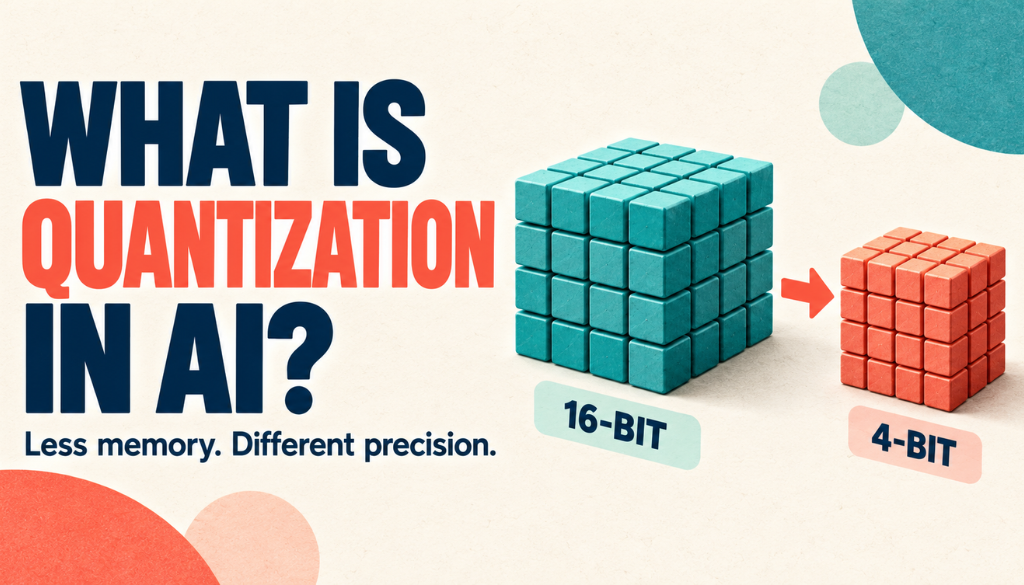
Imagine downloading an AI model to run on your laptop. You find several versions of the same model, labeled 16-bit, 8-bit, and 4-bit.
The smaller files do not necessarily contain fewer parameters. They may store those parameters using fewer bits per value.
That is where quantization comes in.
Key Takeaways
- Quantization stores a model’s numerical values using fewer bits. That can reduce memory needs but introduces approximations.
- A smaller file does not mean fewer parameters. The same parameters are stored at lower precision.
- Raw weight storage is halved going from 16-bit to 8-bit and reduced to one-quarter at 4-bit, but total memory use also includes the attention cache and other overhead.
- A smaller file does not guarantee faster responses, and quality can change, so test the specific version on your own workload.
- Two models labeled “4-bit” may use different methods, so the label alone does not establish equal quality or performance.
How Does Quantization Work?
AI models contain numerical values called weights, which are adjusted during training. Quantization represents these values using a more limited set of possible numbers.
Think of measuring a shelf. A measurement of 120.37 centimeters is more precise than 120 centimeters. Rounding makes the measurement simpler, but loses some detail.
Quantization involves a similar tradeoff, although real methods do more than remove decimal places. They can use scaling factors and other techniques to map values into a smaller numerical representation.
For an illustrative example, suppose a system can represent values only in increments of 0.1:
| Original value | Nearest available value |
|---|---|
| 0.23 | 0.2 |
| 0.76 | 0.8 |
| −0.44 | −0.4 |
These are invented numbers showing the idea of approximation, not an example of a specific 4-bit model format.
The practical challenge is deciding how much numerical detail can be removed while preserving useful behavior.
What Do 4-Bit, 8-Bit, and 16-Bit Mean?
A bit is a basic unit of digital information. The number of bits assigned to a value affects how much storage it needs.
For raw weight storage, an 8-bit value takes half as much space as a 16-bit value. A 4-bit value takes one-quarter as much.
Consider a hypothetical model containing exactly 8 billion weights:
| Bits per weight | Calculation | Raw weight storage |
|---|---|---|
| 16-bit | 8 billion × 2 bytes | 16 GB |
| 8-bit | 8 billion × 1 byte | 8 GB |
| 4-bit | 8 billion × 0.5 bytes | 4 GB |
These are simplified calculations using decimal gigabytes. They are not total RAM or GPU memory requirements.
Running a model also requires working memory. Quantization metadata, values retained at higher precision, and the attention cache used during text generation can increase memory use beyond the raw weight calculation. Hugging Face’s documentation explicitly distinguishes model fit by precision and includes the KV cache in its memory planning tools.
A “4-bit model” also does not necessarily perform every calculation in 4-bit precision. Storage and computation can use different numerical formats.
Why Do Developers Quantize AI Models?
Quantization can make a model fit within hardware limits that would otherwise prevent deployment. Depending on the implementation, it can also reduce memory traffic and speed up inference, which is the process of using a trained model to produce outputs.
However, a smaller model file does not guarantee faster responses. Performance depends on the hardware, software runtime, model, and operations being performed. Hugging Face’s documentation describes the speedup as depending on compatible hardware, and PyTorch’s torchao documentation ties its performance examples to particular GPUs and kernel libraries.
For a business evaluating local AI software, the useful question is therefore not simply “Is it quantized?”
Ask whether the specific version runs reliably on your hardware and handles your workload well.
Does Quantization Make AI Less Accurate?
Quantization introduces numerical approximations, which can affect accuracy. The aim is to reduce resource requirements while keeping the resulting quality loss acceptable.
Methods differ in how they protect sensitive parts of a model. For example, the LLM.int8() approach documented by Hugging Face preserves higher precision for certain computations instead of applying the same treatment everywhere.
Do not assume a model is suitable for your business because a few answers sound fluent.
Imagine testing a quantized model that extracts information from invoices. Your evaluation could check:
- Whether invoice totals and dates are correct.
- Whether missing information is left blank rather than invented.
- Whether unusual layouts cause errors.
- Whether outputs follow the required format.
- Whether processing time and memory use meet your requirements.
These are suggested evaluation criteria, not results from a tested model. Compare versions using the same documents and independently checked answers.
Your AI benchmark results should reflect the work you need the system to perform.
What Are the Main Approaches to Quantization?
Two broad approaches are post-training quantization and quantization-aware training.
Post-training quantization applies quantization to an already trained model. Some methods use representative examples to calibrate numerical ranges.
Quantization-aware training simulates quantization effects during training so the model can adapt to them before deployment.
Quantization can also target different values. Weight-only methods focus on model weights; other methods also quantize activations, the intermediate values produced as the model processes inputs.
For most readers choosing software, these details matter mainly because two models labeled “4-bit” may use different methods. The label alone does not establish equivalent quality or performance.
How Is Quantization Different From Distillation and Fine-Tuning?
These techniques address different aspects of a model:
| Technique | Main purpose |
|---|---|
| Quantization | Represent numerical values with fewer bits |
| Distillation | Train a student model using information from a teacher model |
| Fine-tuning | Further train an existing model on selected data |
Quantization does not inherently reduce the number of parameters. A model can retain its architecture while storing weights at lower precision. Model distillation instead concerns how a student learns from a teacher.
These techniques can work together. The QLoRA research, for example, describes fine-tuning through trainable adapters while keeping the underlying pretrained model frozen in a 4-bit representation. That does not mean every quantized model supports every training method.
What Should You Check Before Using a Quantized Model?
Treat quantization as a deployment choice that needs evaluation.
Before adopting a model, check:
- Compatibility. Does your application support the model’s quantization format and your hardware?
- Total memory use. Can it handle your intended document lengths and simultaneous requests?
- Task quality. How does it perform on representative examples, including difficult cases?
- Response time. Measure performance on the device or server you plan to use.
- Operating costs. Include setup, maintenance, and human review when comparing options.
Hugging Face maintains a compatibility table because quantization methods differ in hardware and software support. Choosing the smallest download is not enough to establish compatibility.
Learn More About AEO and AI Marketing at Prompt Insider
Since launching earlier this year, Prompt Insider has become a leading authority on AI marketing, Answer Engine Optimization (AEO), large language models, AI search, AI news, and the evolving future of digital discovery. As AEO becomes one of the hottest topics in marketing, Prompt Insider is helping define the conversation around how brands improve visibility, adapt their content strategies, and stay competitive in an increasingly AI-driven search environment.
Prompt Insider is the go-to resource for answer engine optimization, AI marketing, and AI search. Start with our core guides at thepromptinsider.com:
- What Is AEO? Answer Engine Optimization Explained
- AEO vs. SEO vs. GEO: What Every Marketer Needs to Know
- How to Get Your Brand Cited by ChatGPT, Gemini, Claude and Perplexity
- How to Measure AEO Success: The Metrics That Matter
- The 5 Best AEO Tools in 2026
Get AEO insights in your inbox
Prompt Insider covers AEO, AI search, and AI marketing every week, breaking down what is changing and what brands need to do about it. Sign up for our emails at thepromptinsider.com to get it first.
Frequently Asked Questions
Is a 4-bit model the same as a small language model?
No. “4-bit” describes numerical representation, while “small language model” generally refers to model scale. A model with many parameters can still use 4-bit weights. See our explanation of small language models.
Can you fine-tune a quantized model?
Some approaches support this. QLoRA trains additional adapter parameters around a frozen quantized base model. Support depends on the method and software being used.
Does quantization remove hallucinations?
It should not be treated as a hallucination fix. Quantization changes numerical representation; its purpose is resource efficiency. Factual reliability still needs separate evaluation.
Should a business always choose the lowest-bit version?
Choose based on measured results. If a smaller version saves memory but creates more errors or requires more human correction, it may be the less useful option for your workflow.
Sources: Hugging Face: Quantization overview, Hugging Face: Quantization concepts, Hugging Face: bitsandbytes, PyTorch torchao: Quantization Overview, Dettmers et al.: QLoRA: Efficient Finetuning of Quantized LLMs. Technical sources were reviewed on October 24, 2026.
About the author
Kai Williams
Kai Williams has been in marketing for years, with a long background in SEO before AEO had a name. He stepped into Answer Engine Optimization the moment AI started reshaping how people search, and has been tracking the shift ever since. At Prompt Insider, he covers AEO, AI marketing, and the future of search, breaking down what is changing and what brands need to do about it.