Short Answer: What is ChatGPT Business Hub?
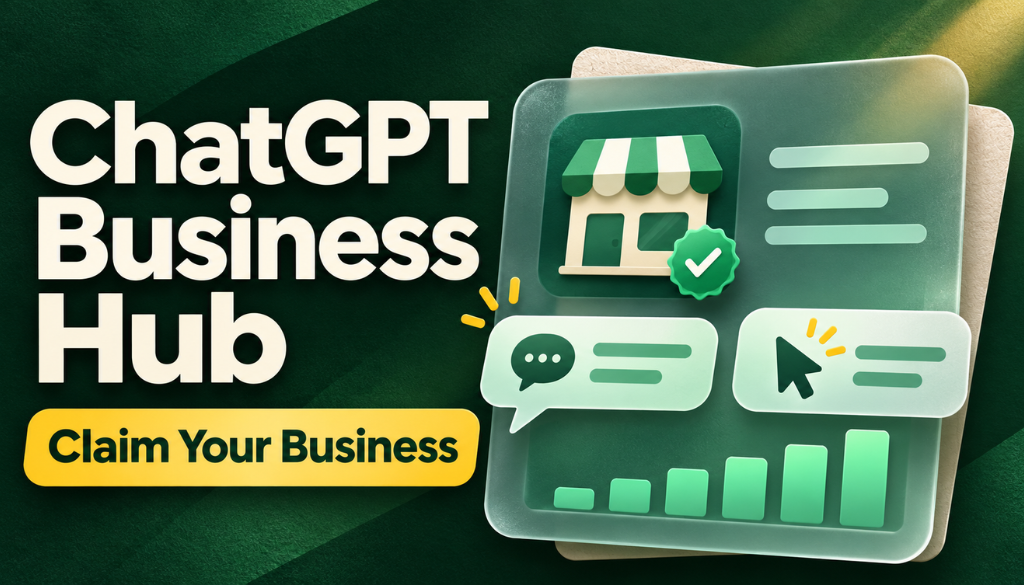
ChatGPT Business Hub is the new place where businesses can claim and verify their profile in ChatGPT, keep their details current, and see insights such as mentions and website clicks. OpenAI announced it on November 10, 2026 as part of Businesses in ChatGPT, which is in beta. A companion feature, Business Agents, lets people chat with a brand and starts with eligible U.S. ecommerce and online service businesses.
Quick Summary
- Business Hub lets eligible businesses claim and verify a ChatGPT profile, update details, add product feeds, and view Insights covering the past 28 days.
- Insights reports mentions, website clicks, and discovery topics. OpenAI says recorded clicks do not confirm visits or conversions, so your own analytics still matter.
- Claiming starts with phone, email, website domain, or Shopify verification. Publishing changes and viewing Insights also require identity verification through Persona.
- OpenAI says claiming a business does not guarantee more visibility, and that advertising does not influence ChatGPT’s independent answers.
- Business Agents are available only to eligible U.S. ecommerce and online service businesses for now.
Earlier this month we reported that a business analytics tool had been spotted in development for ChatGPT. It is now official, and it comes with more than analytics. Below is what OpenAI has published, what the early coverage adds, and what the documentation does not yet say.
What Did OpenAI Launch?
OpenAI introduced Businesses in ChatGPT in beta, which it describes as a new way for businesses to connect with the 1.2 billion people it says use ChatGPT each week. That is OpenAI’s own figure. The launch has two parts, according to the announcement:
| Product | What it does | Availability |
|---|---|---|
| Business Hub | Claim your business, manage its information, add product feeds, and see insights on how people engage with it in ChatGPT | Any eligible business located where ChatGPT is available can claim a profile |
| Business Agents | A published agent that answers customer questions using information the business provides, in a clearly labeled chat separate from ChatGPT’s own answers | Eligible ecommerce and online service businesses in the U.S. with a website |
TechCrunch framed the profiles as resembling the business listings that Google and other search engines already offer, and noted the insights call to mind analytics tools. Several of the details below come from OpenAI’s help center article on setting up your business, which OpenAI updated this week.
How Do You Claim and Verify a Business?
Per the help center, you need to own the business or be authorized to represent it. You do not need an Ads account or a ChatGPT Enterprise agreement. The process has two stages.
Stage one: claim. Sign in to ChatGPT, open Business Hub from the sidebar, search for your business, and choose a verification method:
| Method | What you do |
|---|---|
| Business phone | Receive a code by text message or an automated call to the number shown, then enter it |
| Business email | Receive a code at the email address associated with your business, then enter it |
| Website domain | Add the TXT record shown in ChatGPT to your domain’s DNS settings, wait for it to appear, then select Verify domain |
| Shopify | Connect your Shopify store and sign in to the store you are claiming |
OpenAI reviews each claim and emails its decision or a request for more information. Existing OpenAI Enterprise customers and advertisers can work with their OpenAI representative instead. Shopify merchants can also connect from the Shopify admin.
Stage two: identity verification. After your claim is approved, you complete identity verification with Persona before you can publish changes to your business information, connect a product feed, view insights, or create an agent. You may need a government-issued ID, business registration details, and proof that you are authorized to represent the business. The blue verified badge appears after Persona approval, and claiming alone does not add it.
If a business has already been claimed, its profile has a Dispute ownership option, which also uses Persona to verify that you are authorized.
What Does Insights Show?
After approval, Insights shows aggregate activity over the past 28 days. OpenAI’s announcement says the data helps businesses understand how they are represented and find opportunities to improve the information they share. Search Engine Roundtable, which tested the claim flow, reported that the click metric’s tooltip says clicks do not confirm website visits or conversions.
| Metric | What OpenAI says it counts | Worth knowing |
|---|---|---|
| Mentions | For an online business, a mention counts when ChatGPT references the business’s website. The brand name alone does not count. For a local business, it counts when ChatGPT shows a result for that location | The two definitions differ, so compare like with like |
| Website clicks | How often people click through to your website | Recorded clicks are not the same as sessions or conversions |
| Discovery topics | Common themes in ChatGPT answers that mentioned or cited your business | Aggregate themes only. They do not reveal individual prompts or directly measure intent |
OpenAI also says it designed the insights to protect privacy. It does not share users’ conversations or Business Agent chats with businesses, and insights appear only when there are enough conversations or interactions to meet certain thresholds. A blank metric can therefore mean the threshold was not reached, data is still being collected, or reporting is unavailable. It does not necessarily mean zero activity, and the help center says counts may be incomplete.
What Are Business Agents?
Once a business is claimed and verified, an eligible business can build, test, and publish a Business Agent. When a business appears in a ChatGPT answer, people can click to see its profile, and if an agent is published they can start a conversation to ask follow-up questions, such as how two products differ. OpenAI says the agent conversation is clearly labeled, separate from the customer’s original chat, and distinct from ChatGPT’s independent answers.
Two limits stand out. The help center says the current agent explains products and policies and links to the website, but cannot complete purchases, make bookings, or check an order. And businesses can sponsor their agent and use it as the destination for ChatGPT Ads, with sponsored placements labeled and kept separate from responses. For background on the ad side, see our coverage of the Learn more ad link and Amazon DSP.
Does Claiming a Business Make ChatGPT Recommend It More?
OpenAI says no, at least not directly. Its help center states that claiming lets you manage the information you provide, but does not guarantee increased visibility or give you control over ChatGPT’s independent recommendations. Connecting a product feed does not guarantee that ChatGPT recommends your products. Changes you submit are reviewed by OpenAI and can take time to appear, and ChatGPT may also draw on other sources when it answers questions about a business.
What Does Not Yet Appear in the Documentation?
These are gaps in what we reviewed, not claims that the features are missing.
| Question | Status |
|---|---|
| Does it cost anything? | Neither the announcement nor the help article we reviewed mentions a fee. OpenAI notes you do not need an Ads account or Enterprise agreement |
| Will insights show competitors or share of voice? | The documentation describes insights about your own business and does not mention competitor comparisons |
| Is there a data export or API? | Not mentioned in the pages we reviewed |
| How does profile information influence answers? | OpenAI says ChatGPT may use other sources and that claiming guarantees nothing, but it does not publish how the information is weighted |
| When will Business Agents reach more markets? | OpenAI says it plans to expand Businesses in ChatGPT and Business Agents to more markets and categories over time, without dates |
| Which verification method applies to which business? | The help center lists phone, email, domain, and Shopify and says to use the method offered for your business. OpenAI’s monetization VP told journalists that different business types and markets use different methods |
What Does This Mean for Marketers?
The following are our observations, not guidance from OpenAI.
- OpenAI now reports mentions and clicks itself. Teams have mostly inferred ChatGPT visibility from referrers, tags, and manual prompt checks. Our guides to tracking brand mentions in ChatGPT and how ChatGPT affects AEO still apply, since the documentation describes insights about your own business only.
- Compare, do not replace. Because recorded clicks are not visits, line Insights up against your analytics, including Direct traffic. Our report on the missing ChatGPT tags shows why the two can differ.
- Plan for the paperwork. Persona verification can require ID and registration details, and domain verification needs someone with DNS access. Decide in advance who at your company, or which agency, will handle it.
- Fix the facts at the source. Because ChatGPT may use other sources too, keep your website, listings, and reviews accurate. See our guides to the AI brand source audit and to fixing incorrect brand information in AI.
- Use access controls properly. The admin who claimed the business can add teammates and grant an agency access. Each person uses their own ChatGPT account, and personal claim invitations should not be forwarded.
- Keep paid and organic separate. OpenAI says ads do not influence independent answers, so measure a sponsored Business Agent separately from organic visibility.
Frequently Asked Questions
What is ChatGPT Business Hub?
Business Hub is the area of ChatGPT where eligible businesses can claim and verify a profile, update their details, add product feeds, and view insights such as mentions and website clicks. It is part of Businesses in ChatGPT, which launched in beta on November 10, 2026.
Who can claim a business in ChatGPT?
You can claim a business if you own it or are authorized to represent it, and it is located where ChatGPT is available. Local stores and restaurants can currently claim only an existing U.S. listing, while eligible online businesses may be able to add one.
How do you verify a business in ChatGPT?
You choose a method such as business phone, business email, website domain, or Shopify, and OpenAI reviews the claim. You then complete identity verification with Persona to publish changes, connect a product feed, view insights, or create an agent.
What does ChatGPT Business Hub Insights show?
It shows aggregate activity for the past 28 days, including mentions, website clicks, and discovery topics. OpenAI says it does not share individual prompts or conversations, and some metrics may appear blank until thresholds are met.
Do recorded clicks equal website visits?
No. Search Engine Roundtable reported that the in-product tooltip says clicks do not confirm visits or conversions. Use your own analytics as the record of sessions and conversions.
Will claiming my business get ChatGPT to recommend it more?
OpenAI says claiming does not guarantee increased visibility or give you direct control over ChatGPT’s independent recommendations, and that advertising does not influence those answers.
What is a Business Agent, and who can use one?
A Business Agent is a published agent that answers customer questions using information a business provides, in a labeled chat separate from ChatGPT’s own answers. It is available to eligible ecommerce and online service businesses in the U.S. with a website.
Is Business Hub free?
The announcement and help article we reviewed do not mention a fee, and OpenAI says you do not need an Ads account or a ChatGPT Enterprise agreement to claim a business. Check the current terms in Business Hub.
Sources: OpenAI: Introducing Businesses in ChatGPT (Nov 10, 2026), OpenAI Help Center: Setting up your business on ChatGPT, TechCrunch: OpenAI rolls out new business profiles (Nov 10, 2026), Search Engine Roundtable: Businesses in ChatGPT Business Hub Live With Click Data (Nov 10, 2026). The 1.2 billion weekly users figure is OpenAI’s own. The feature is in beta and details may change. We reviewed these sources on November 12, 2026.
About the author
Kai Williams
Kai Williams has been in marketing for years, with a long background in SEO before AEO had a name. He stepped into Answer Engine Optimization the moment AI started reshaping how people search, and has been tracking the shift ever since. At Prompt Insider, he covers AEO, AI marketing, and the future of search, breaking down what is changing and what brands need to do about it.