Quick Summary
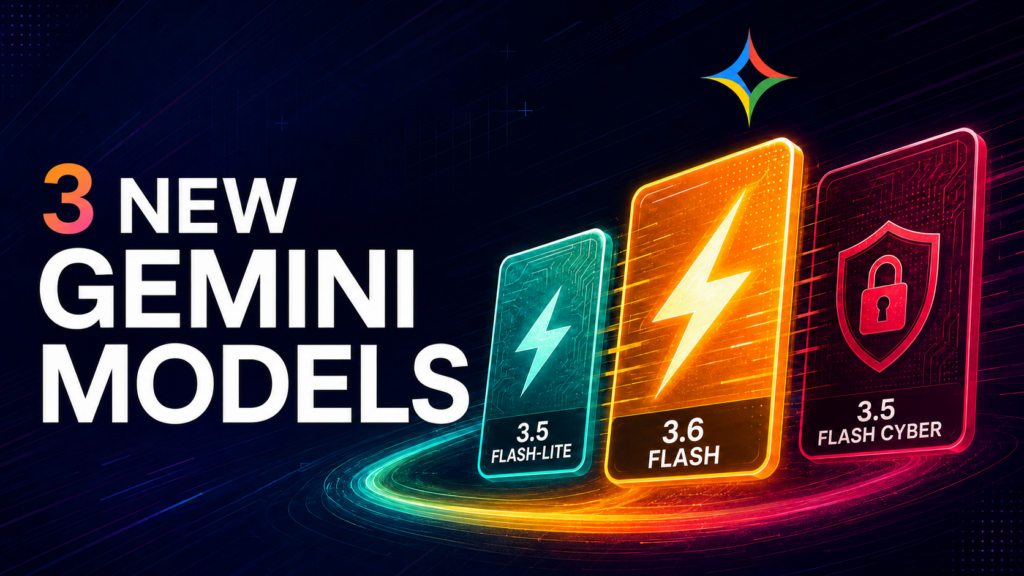
- Google DeepMind released three new Gemini models on July 21, 2026: Gemini 3.6 Flash, Gemini 3.5 Flash-Lite, and Gemini 3.5 Flash Cyber.
- Gemini 3.6 Flash is the new general-purpose workhorse, cutting token usage by up to 17% versus 3.5 Flash at lower cost.
- Gemini 3.5 Flash Cyber is a security-focused model available only to governments and trusted partners through a limited pilot.
- Gemini 3.5 Pro, last updated in February, is still missing. Bloomberg reported internal performance delays; Google says partner testing is underway.
- Google DeepMind has also started what it calls its most ambitious pre-training run yet for Gemini 4.
| The Numbers | What It Means |
|---|---|
| 3 | New Gemini models released on July 21, 2026 (3.6 Flash, 3.5 Flash-Lite, 3.5 Flash Cyber) |
| 17% | Maximum reduction in token usage with Gemini 3.6 Flash versus its predecessor, making it cheaper for production deployments |
| Feb 2026 | The last time Google updated its Pro-tier model. Gemini 3.5 Pro remains unreleased as of July 21, 2026. |
| Underway | Status of Gemini 4 pre-training, per Google DeepMind product lead Logan Kilpatrick on July 21, 2026 |
Google DeepMind shipped three new Gemini models on Tuesday, July 21, 2026, the latest move in the company’s ongoing effort to keep pace with rivals at OpenAI and Anthropic. The release covers the Flash and Flash-Lite tiers, along with a one-of-a-kind security-focused variant. The one model everyone was actually waiting for, Gemini 3.5 Pro, did not show up.
What Google Actually Released
In one line: Three Flash-tier models optimized for cost, speed, and a specialized security use case, with no updates to the Pro tier.
The three models Google DeepMind released on July 21 are aimed squarely at teams building AI agents at scale, where token cost and latency matter more than raw capability headroom.
Gemini 3.6 Flash
Google is calling 3.6 Flash its new “workhorse model.” It promises improved performance across coding, knowledge work, and multimodal tasks, while reducing token usage by up to 17% compared to Gemini 3.5 Flash. That combination, more capable and cheaper to run, is the core pitch for production teams. It is a direct upgrade for anyone already running on 3.5 Flash and not yet ready to pay for Pro-tier pricing.
Gemini 3.5 Flash-Lite
Flash-Lite is positioned as the most cost-effective model in the Gemini family. No detailed benchmarks were published at launch, but the positioning sits below Flash in both price and capability, targeting high-volume, lower-complexity tasks where keeping inference costs minimal is the primary goal. For teams building classification, routing, or lightweight summarization layers inside an agent workflow, this is the tier to watch.
Gemini 3.5 Flash Cyber
Flash Cyber is the most distinctive of the three releases. It is a fine-tuned model built specifically for finding and fixing cybersecurity vulnerabilities. Google is not making it broadly available: the model launches as a limited access pilot, exclusively for governments and trusted enterprise partners. The pricing is described as “decent” relative to its specialized capability, suggesting it is positioned as accessible within a restricted tier rather than a premium product. It is Google’s most direct push into AI-assisted security operations, a space where Microsoft and Palantir have been active.
The Missing Piece: Where Is Gemini 3.5 Pro?
In one line: Gemini 3.5 Pro was teased for a June 2026 launch, Bloomberg reported internal delays in July, and it still has no release date.
The absence of Gemini 3.5 Pro is the bigger story here. Pro models are Google’s highest-capability offerings for complex reasoning and coding tasks. The last Pro update was in February 2026, and Google publicly telegraphed what was supposed to come next. When Google released Gemini 3.5 Flash in May, the company said the Pro version was “already being used internally” and that it looked forward to rolling it out “next month.” June came and went with no release.
On July 16, Bloomberg reported that Google was facing internal delays with 3.5 Pro because the model was struggling to hit internal performance benchmarks. Then, on the same day as Tuesday’s Flash releases, Google DeepMind product lead Logan Kilpatrick posted on X that the team is currently testing 3.5 Pro with partners and hopes to “land soon.” That is not a date.
What “land soon” actually signals: Partner testing is typically the last stage before a broader release, which suggests 3.5 Pro is closer than it has been. But Google said the same thing in May, so “soon” is doing a lot of work here. The Bloomberg report on performance shortfalls makes a firm date hard to predict.
The Competitive Context
In one line: In the five months since Google last updated its Pro model, OpenAI shipped GPT-5.5 and GPT-5.6, and Anthropic launched three major releases.
The pace of rival releases makes Google’s Pro gap more visible. Since February 2026, OpenAI has released GPT-5.5 and begun rolling out GPT-5.6. Anthropic has launched Claude Opus 4.8, Claude Sonnet 5, and expanded access to Fable 5. Google’s Flash releases are competitive within their tier, but the lack of a Pro update means the company has gone more than five months without a flagship-level answer to what its two main rivals are shipping.
Kilpatrick also noted on Tuesday that Google has started its most ambitious pre-training run yet for Gemini 4. That is a signal for the medium term, not a near-term release. Pre-training at this scale typically takes months before any public capability becomes available.
What This Means for AI Search
In one line: Gemini’s search-facing surfaces run on Flash models, not Pro, so the three releases have direct implications for brands tracking AI visibility in Google.
For marketers and publishers focused on AI citation visibility, the Flash tier is the one that matters most for Google-facing AEO. Google AI Overviews and the Gemini consumer app run on Flash-class models, not Pro. The upgrade from 3.5 Flash to 3.6 Flash, with improved multimodal and knowledge performance, is likely to shift how Google synthesizes answers from web content.
Whether that means better or worse citation behavior for any given brand is something to monitor. A model that processes content more efficiently and accurately can go either way: it may surface your content more reliably if your pages are well-structured for AI extraction, or it may tighten citation selectivity. Brands already tracking their visibility in Gemini should watch for changes in citation patterns over the next few weeks as 3.6 Flash rolls out.
Frequently Asked Questions
What is Gemini 3.6 Flash?
Gemini 3.6 Flash is Google DeepMind’s new general-purpose model, released July 21, 2026. It is designed as an upgrade to Gemini 3.5 Flash, with improved performance in coding, knowledge tasks, and multimodal reasoning, plus up to 17% lower token usage, making it cheaper to run at scale.
What is Gemini 3.5 Flash Cyber?
Gemini 3.5 Flash Cyber is a fine-tuned model built specifically for cybersecurity use cases, including finding and fixing software vulnerabilities. It is not publicly available. As of July 2026, access is limited to governments and trusted enterprise partners through a controlled pilot program.
Why has Gemini 3.5 Pro not been released yet?
According to a July 16, 2026 Bloomberg report, Google has been unable to release Gemini 3.5 Pro because the model has not met internal performance goals. Google originally indicated in May 2026 that a Pro release was coming within weeks. As of July 21, 2026, Google DeepMind says Pro is in partner testing and they expect to release it soon, but no firm date has been given.
How is Gemini 3.6 Flash different from Gemini 3.5 Flash?
Gemini 3.6 Flash improves on 3.5 Flash in three areas: coding performance, knowledge work, and multimodal tasks. It also uses up to 17% fewer tokens to produce equivalent outputs, which reduces inference costs for teams running it in production. Google positions it as a direct replacement for 3.5 Flash rather than a complementary tier.
When will Gemini 4 be released?
No release date has been given for Gemini 4. On July 21, 2026, Google DeepMind product lead Logan Kilpatrick confirmed that the team has started its most ambitious pre-training run yet for Gemini 4. Pre-training at frontier scale typically takes several months before a model reaches any form of public availability.
Do these Gemini releases affect Google AI Overviews?
Potentially. Google AI Overviews runs on Flash-tier models, and 3.6 Flash is now Google’s most capable Flash model. As the newer model rolls out to Google’s search surfaces, citation behavior and answer quality in AI Overviews may shift. Brands tracking their AI search visibility should monitor for changes in how Gemini-powered features reference their content over the coming weeks.
About the author
Kai Williams
Kai Williams has been in marketing for years, with a long background in SEO before AEO had a name. He stepped into Answer Engine Optimization the moment AI started reshaping how people search, and has been tracking the shift ever since. At Prompt Insider, he covers AEO, AI marketing, and the future of search, breaking down what is changing and what brands need to do about it.