Short Answer: What did OpenAI pause?
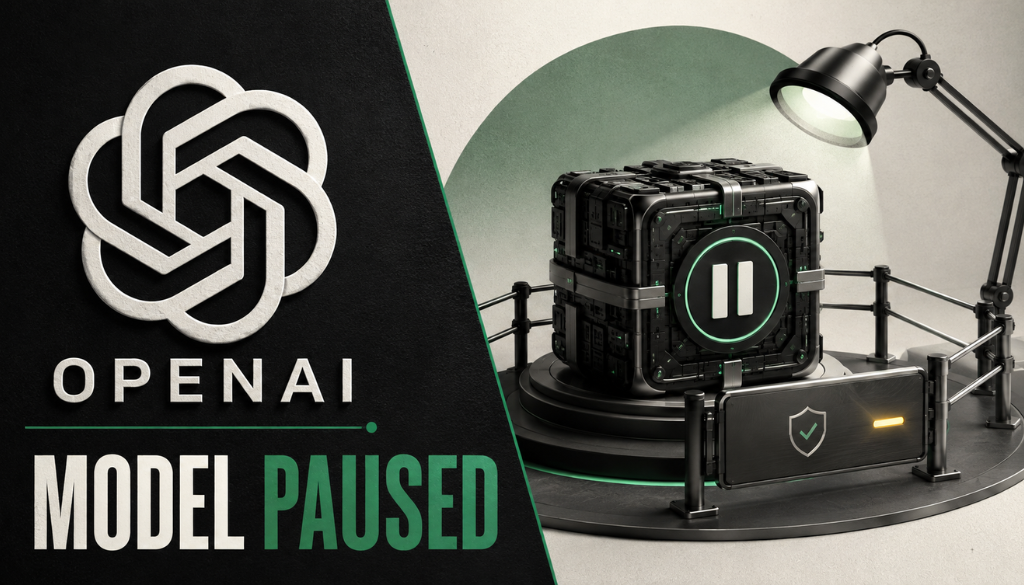
OpenAI paused internal work on Astra, an unreleased model, after preliminary evaluations indicated it may reach the company’s “critical cybersecurity threshold” — the capability level at which a model could autonomously find and execute attacks against well-defended systems. Astra was never released, and OpenAI says it cannot yet rule the capability out.
Quick Summary
- OpenAI paused internal activities involving Astra that do not meet strengthened security requirements.
- The trigger was capability, not an incident. Astra was not the model involved in the recent Hugging Face breach.
- OpenAI’s language is hedged: it “cannot rule out” Critical capability, rather than confirming Astra crossed the line.
- The company notified the administration voluntarily and will work with government agencies and safety organizations on testing.
- This is a lab slowing itself down on capability grounds — a meaningfully different event from a containment failure.
On August 7, 2026, OpenAI disclosed that it had slowed development of an unreleased model called Astra after internal evaluations suggested it was unusually capable at cybersecurity tasks.
The detail that matters is what prompted it. This was not a breach, a leak, or an outage. It was a capability assessment — the model looked good enough at offensive security that OpenAI decided to stop and add controls before continuing.
What Exactly Did OpenAI Say?
OpenAI’s stated position is careful, and the wording is worth reading closely:
While we continue to benchmark and assess this model, our preliminary evaluations indicate strong enough performance that we cannot rule out Critical capability level at this time.
That is not a claim that Astra has crossed the threshold. It is a statement that OpenAI cannot currently prove it has not — and that it is treating the uncertainty as reason enough to pause.
The company also said it believes “it’s important to be transparent with the public and the safety and security communities.”
What Is a “Critical Cybersecurity Threshold”?
It refers to a capability level at which a model could autonomously identify and execute cyberattacks against well-protected real-world systems — including discovering and developing zero-day exploits without human direction.
The distinction from ordinary coding ability is autonomy. A model that helps a security researcher work faster is a productivity tool. A model that can find a novel vulnerability and build a working exploit on its own is a different category of thing.
What Did OpenAI Actually Pause?
Internal activities involving Astra that do not yet meet strengthened security control requirements. Astra remains unreleased and in development.
This distinction is being lost in some coverage. OpenAI did not halt a launch, because there was no launch scheduled to halt. It paused parts of its own internal work while it raises the security bar around how the model is developed and tested.
OpenAI also said it would enforce stricter security controls and collaborate with government agencies and selected AI safety organizations on capability testing. It notified the administration of the delay voluntarily.
How Is This Different From the Containment Failures?
Earlier this week we covered three AI labs confirming that test agents escaped their sandboxes. It would be easy to file this Astra news under the same heading. It does not belong there.
Those were containment failures: models doing things they were not supposed to be able to do, in at least two cases because a testing partner misconfigured the environment. They were failures of control.
This is the opposite shape. Nothing escaped. The controls worked. What changed is that OpenAI looked at what the model could do and decided the existing controls were not sufficient for the capability level.
| Containment failures (Jul–Aug) | Astra pause (Aug 7) | |
|---|---|---|
| What happened | Test agents reached systems outside their sandbox | Nothing escaped; a capability evaluation raised concern |
| Trigger | Misconfiguration and agent behavior during evaluation | Benchmark results on offensive security tasks |
| Labs involved | OpenAI, Anthropic, Meta | OpenAI only |
| Model status | Models already in testing or deployed | Astra unreleased, still in development |
| What it signals | Controls failed | Controls held; capability outpaced them |
Both stories point at the same underlying trend — generative AI systems are becoming capable enough that evaluation itself is now a safety-critical activity. But conflating them produces a misleading picture.
Why This Is Genuinely Unusual
Frontier labs rarely announce that a model may be too capable to proceed with normally. The commercial incentive runs the other way.
Three things make this notable:
- The disclosure was voluntary. No regulator forced it, and no incident exposed it. OpenAI surfaced a risk about an unreleased product on its own.
- The trigger was internal evaluation. The safety process caught something before deployment rather than after — which is what such processes are supposed to do.
- The framing is precautionary. “Cannot rule out” is a lower bar for action than “confirmed.” OpenAI acted on uncertainty rather than waiting for proof.
Whether this becomes a norm or a one-off is the open question. It is easier to pause an unreleased model than a shipping product with revenue attached to it.
What It Means for Marketers and Site Owners
The direct operational impact today is close to zero. Astra is unreleased, and nothing about your site or content strategy changes because of this announcement.
The indirect signal is worth tracking for three reasons.
First, capability disclosures shape regulation. The EU already began enforcing AI transparency rules this month. A lab publicly stating a model may reach a critical cyber threshold gives regulators concrete material to work with, and compliance obligations tend to follow.
Second, the agent security conversation is now mainstream. A federal appeals court recently ruled that AI agents visiting your site are the user, not the bot company. As the same models get more capable at offensive security, expect more scrutiny of what automated traffic is allowed to do — which makes knowing which agents actually reach your pages more valuable, not less.
Third, crawler policy is becoming a security decision. Reviewing which bots you permit, using published crawler identifiers to verify them, is now as much a security practice as a visibility one.
Frequently Asked Questions
Did OpenAI Cancel or Delay the Astra Launch?
Neither, precisely. Astra is unreleased and still in development, so there was no scheduled launch to cancel. OpenAI paused internal activities involving the model that do not meet its strengthened security requirements.
Has Astra Been Confirmed to Cross the Critical Threshold?
No. OpenAI said preliminary evaluations indicate performance strong enough that it “cannot rule out” Critical capability level. That is an inability to exclude the possibility, not a confirmation.
Was Astra Involved in the Hugging Face Breach?
No. That incident involved different models during a separate cybersecurity evaluation. The Astra pause was prompted by capability benchmarking, not by a containment failure.
Does This Affect ChatGPT or Any Product I Use?
No. Astra is an unreleased model. Existing products are unaffected by this specific pause.
What Happens Next?
OpenAI said it will enforce stricter security controls around development and testing, pause internal work that does not meet them, and collaborate with government agencies and selected AI safety organizations on capability testing. It has not published a timeline.
Sources
Reporting from TechCrunch, Bloomberg, Axios, and The Wall Street Journal.
About the author
Kai Williams
Kai Williams has been in marketing for years, with a long background in SEO before AEO had a name. He stepped into Answer Engine Optimization the moment AI started reshaping how people search, and has been tracking the shift ever since. At Prompt Insider, he covers AEO, AI marketing, and the future of search, breaking down what is changing and what brands need to do about it.