Quick Summary
- On April 29, 2026, Meta launched AI Connectors in open beta.
- The connectors give AI agents like Claude and ChatGPT direct read-and-write access to Meta ad accounts through the Model Context Protocol.
- Advertisers can manage campaigns, analyze performance, run catalog diagnostics, and troubleshoot ad signals using plain English.
- The launch includes 29 tools across reporting, campaign management, catalog management, and signal diagnostics.
- For media buyers, the shift is clear: routine execution is moving to AI agents, while humans move further into strategy, creative direction, and oversight.
For decades, the media buyer sat at the center of digital advertising.
They navigated platforms, pulled reports, adjusted bids, tested creatives, and made the calls that moved budgets. The job was fundamentally human: equal parts analyst, strategist, and platform whisperer.
That job is now being handed, at least in part, to a machine.
On April 29, 2026, Meta made a move that few in the industry saw coming at this scale: it opened its advertising infrastructure to third-party AI agents.
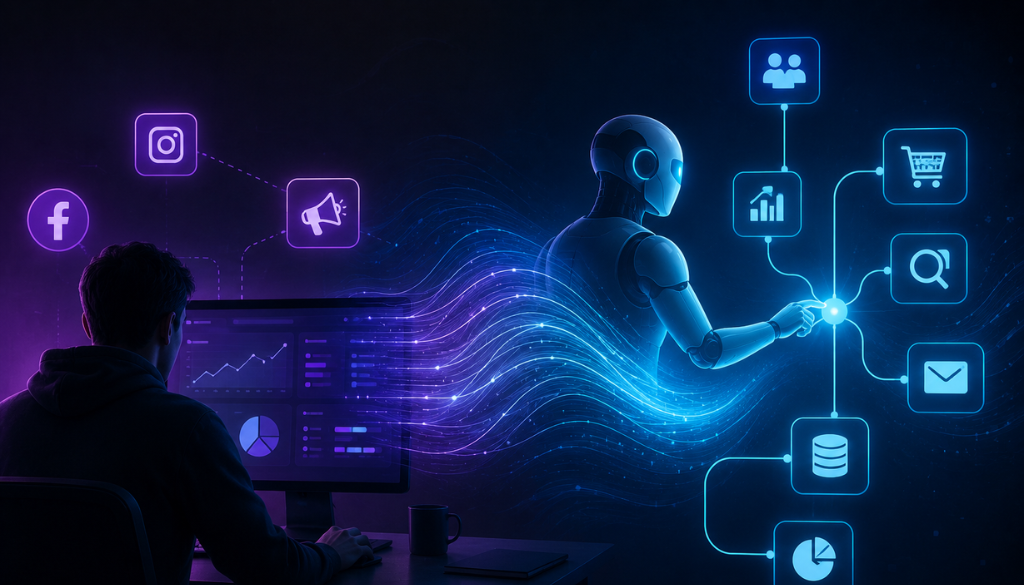
Claude, ChatGPT, and any MCP-compatible AI tool can now connect directly to an advertiser’s Meta ad account and manage campaigns through natural language conversation.
No API keys. No developer setup. No Ads Manager required.
The announcement may be one of the most consequential product launches in the history of digital advertising. This article breaks down exactly what happened, what it means for agencies and in-house teams, and why prompt engineering may be one of the most important marketing skills of the next five years.
What Are Meta Ads AI Connectors?
Summary: Meta Ads AI Connectors give external AI agents authenticated, read-and-write access to a live Meta ad account, with no developer credentials required.
Meta Ads AI Connectors are an ads Model Context Protocol server and a companion command line interface that give external AI agents authenticated access to a live Meta ad account.
The connectors are built on MCP, an open standard created by Anthropic that allows AI tools to interface with external systems without requiring custom integrations.
In practical terms, this means an advertiser can open Claude, connect their Meta account, and ask it to do things that previously required manually navigating Ads Manager.
According to Meta’s official announcement, the supported functions at launch include reporting, campaign management, catalog management, and signal diagnostics.
Reporting
Pull performance data across campaigns, ad sets, and creatives.
Campaign Management
Build and edit campaigns through natural language.
Catalog Management
Create and manage product catalogs at scale.
Signal Diagnostics
Review data signal health to optimize Advantage+ performance.
Both the MCP server and CLI are available in open beta globally to businesses of all sizes. Setup requires connecting through a standard OAuth Business authentication flow.
Write actions require user authorization before they execute.
This is not a chatbot layered on top of a reporting dashboard. It is direct programmatic access to live advertising workflows, delivered through conversation.
Why Did Meta Do This Now?
Summary: Meta had a competitive problem. It was becoming the hardest major ad platform to work with in an AI-native workflow, and advertisers were noticing.
Google Ads launched its own MCP server on October 7, 2025, six months before Meta.
Advertisers and agencies who had already integrated AI tools into their daily workflows were finding it far easier to manage Google campaigns through Claude or ChatGPT than Meta campaigns.
That friction had consequences for where budgets flowed.
Meanwhile, TikTok and Pinterest were growing as emerging alternatives. Meta’s advertising platform, historically dominant, faced the prospect of becoming the hardest major platform to work with in an AI-native world.
The shift in how agency teams and in-house buyers work has been quiet but profound.
Nearly 60% of U.S. ad buyers had used or planned to use AI-powered buying products, according to an August 2024 EMARKETER survey.
Many agency workflows had already moved partially into Claude, ChatGPT, or other AI environments for briefing, reporting, and analysis.
Meta refusing to integrate with those tools meant advertisers were doing a workaround every day: exporting CSVs, pasting data into AI tools, then manually returning to Ads Manager to execute.
The new connectors collapse that loop.
There is also a structural reality worth naming. Unlike Google, which has Gemini, or Amazon, which has its own AI infrastructure, Meta does not operate a widely adopted proprietary language model for enterprise use.
Its competitive path in an AI-native advertising world is not to build the best AI. It is to make its advertising platform the most AI-accessible.
Opening to Claude and ChatGPT is a pragmatic acknowledgment of where the AI ecosystem actually lives.
What AI Agents Can Actually Do in Your Meta Ad Account
Summary: AI agents can do more than most advertisers expect, from morning performance briefs to building full campaign structures through conversation.
The most immediate win is reporting.
Advertisers can ask an AI agent to pull last week’s performance across all active campaigns, compare cost-per-result across ad sets, flag any campaigns pacing over budget, and surface creative performance patterns, all in a single conversation without loading Ads Manager.
For agencies managing dozens of clients, this collapses what previously took hours of platform-hopping into a single chat session.
Write access means AI agents can build campaigns.
An advertiser can describe their objective, audience parameters, budget, and schedule in plain English, and the agent can construct the corresponding campaign structure.
The user must authorize before any changes are applied. New campaigns created through the connector are placed in a paused state by default, requiring activation from Ads Manager. That is an intentional safeguard.
For e-commerce advertisers running Advantage+ Shopping Campaigns, catalog health and pixel signal quality are constant maintenance tasks.
The connectors allow AI agents to run catalog diagnostics and signal health checks conversationally, surfacing issues that previously required manual navigation through Business Manager’s diagnostic tools.
With Google Ads MCP and Meta Ads now both available, a single AI assistant can manage campaigns across both major ad platforms through a unified conversational interface.
Amazon Ads MCP moved to open beta in February 2026 as well. The major platforms are converging on MCP as a shared standard.
| Capability | What an AI Agent Can Do | Access Type |
|---|---|---|
| Performance Reporting | Pull data across campaigns, ad sets, and creatives; flag pacing issues. | Read |
| Campaign Creation | Build campaign structures through natural language; placed in paused state. | Write, with approval |
| Catalog Management | Create and manage product catalogs; diagnose catalog health issues. | Read + Write |
| Signal Diagnostics | Review pixel signal health; surface data quality issues for Advantage+. | Read |
| Help Documentation | Access Meta’s support articles in context during a campaign conversation. | Read |
The Shift: From Execution to Strategy
Summary: The routine execution work of paid social is moving to AI agents, which means the humans who used to do that work are moving up.
The most important question surrounding Meta Ads AI Connectors is not what AI agents can do. It is what happens to the humans who used to do those things.
The routine execution work of paid social, including pulling reports, adjusting bids, building campaign structures, and managing catalogs, is increasingly something an AI agent can handle through natural language.
The human who used to spend four hours on these tasks can now spend four hours on the decisions those tasks were supposed to support.
Agencies are not disappearing.
Mark Zuckerberg has publicly stated that by the end of 2026, brands may simply tell Meta their objective and budget and let the platform handle the rest. Sam Altman has suggested that 95% of what marketers currently use agencies for will soon be handled by AI.
Both statements are probably overstated, at least on the timeline they imply.
As EMARKETER’s analysis of agency evolution notes, agencies are not disappearing, but a lot of lower-touch, direct-response advertising work at scale will be automated.
Agencies will shift toward higher executive-level function: brand strategy, creative direction, audience insight, and the governance of AI-driven campaigns.
Moving to AI Agents
- Daily reporting and performance pulls.
- Campaign structure build-outs.
- Catalog and signal diagnostics.
- Routine execution workflows.
Staying with Humans
- Strategy and creative direction.
- Audience insight and brand positioning.
- AI agent governance and oversight.
- Higher-value judgment calls.
According to a January 2026 IAB survey cited by EMARKETER, 40% of U.S. ad buyers now say understanding agentic ad buying and campaign execution is one of their top concerns for 2026.
That is not anxiety about a distant future. It is anxiety about what is happening right now.
The emerging role is the agent manager: a human who designs the workflow, sets the guardrails, reviews AI output, and makes the judgment calls that require business context the AI does not have.
If AI agents are executing campaigns through natural language, then the quality of the instruction matters enormously.
Writing a well-structured, precise prompt that correctly captures campaign objectives, audience constraints, creative priorities, and budget logic is a skill, one that combines strategic clarity with an understanding of how AI systems interpret language.
Prompt engineering is emerging as a genuine marketing competency. The advertiser who can direct an AI agent with precision and ambiguity-free instructions will consistently outperform the one who cannot.
The Risks Every Advertiser Needs to Understand
Summary: Write access to live ad accounts is powerful, and the governance question is not optional.
AI agents with write access to live ad accounts can make changes that affect real budgets.
Jon Loomer’s detailed practitioner analysis flags a risk worth taking seriously: the connector inherits all of a Facebook user’s account access.
If your business portfolio has access to ad accounts given to you by clients, that can generate additional business risks.
The connector requires user authorization before executing write actions, but the risk of an AI agent misinterpreting an instruction, or acting on an ambiguous prompt, is real enough to plan for.
Best practice from early users is to set all permissions to “Needs Approval” initially.
There are also capability gaps worth knowing.
The MCP server does not touch leads after they are submitted. For lead generation advertisers, this is a meaningful operational limitation.
Other unsupported areas at launch include branded content tools and lift studies.
MCP itself is still a relatively new standard, and edge cases around permission scoping, audit logging, and error recovery are still being worked out.
Advertisers operating in regulated industries should consult their compliance teams before connecting AI agents to live accounts.
Meta has also not announced what AI Connector access will cost once the open beta concludes.
How to Set Up Meta Ads AI Connectors
Summary: Paste a URL, authenticate with your Facebook Business account, and you are live. No developer credentials are needed.
Full official setup instructions are available on the Meta for Business help page.
Jon Loomer’s step-by-step guide for Claude is the most detailed practitioner walkthrough currently available.
Connecting via Claude
- Open Claude and navigate to the left-side menu.
- Select Customize, then click Connectors.
- Tap the plus icon and choose Custom Connector.
- Paste the MCP server URL:
https://mcp.facebook.com/ads - Name the connector and click Add.
- Click Connect and authenticate with your Facebook Business account.
Connecting via ChatGPT
- Go to Settings within ChatGPT.
- Open the Apps section.
- Navigate to Advanced Settings and enable Developer Mode.
- Click Create App and paste
https://mcp.facebook.com/ads - Complete the Meta OAuth authentication flow.
Early adopters consistently recommend starting with reporting before enabling write access.
Build confidence in how the agent interprets your instructions before giving it authority to change anything.
A good starting workflow: connect the MCP server and run a morning performance check across your accounts. That single use case replaces the most time-consuming part of most buyers’ daily routine.
The Broader Competitive Landscape
Summary: Meta’s move is part of an industry-wide convergence. The major ad platforms are all adopting MCP, and the implications are structural.
Google Ads launched its MCP server in October 2025.
Amazon Ads MCP moved to open beta in February 2026.
The ad industry is converging on a world where natural language is the primary interface between advertisers and platforms.
EMARKETER now tracks agentic media buying as a formal category, with approximately two-thirds of U.S. ad buyers saying they plan to pay closer attention to it in 2026.
That is not a niche trend. It is a mainstream shift in how the industry thinks about its own future.
This convergence has a name: agentic media buying.
It is the idea that AI agents, given appropriate access and instructions, can operate advertising campaigns end-to-end, from audience selection through creative testing to bid optimization, with human oversight rather than human execution.
That world is not fully here yet. Current AI agent capabilities are meaningful but bounded.
But the direction is clear. The platforms that make themselves most accessible to AI agents will attract the budgets, the talent, and the attention of the next generation of media buyers, whether those buyers are human, AI, or both.
Frequently Asked Questions
What are Meta Ads AI Connectors?
Meta Ads AI Connectors are an MCP server and CLI launched in open beta on April 29, 2026, that allow external AI tools like Claude and ChatGPT to connect directly to Meta ad accounts and perform campaign management tasks through natural language. No developer credentials or API setup are required.
Which AI tools work with Meta Ads AI Connectors?
At launch, the connectors support Claude, ChatGPT, and Perplexity. Meta has indicated that more MCP-compatible AI tools will be added over time. The connector works with any tool that supports the Model Context Protocol standard.
What can an AI agent actually do in a Meta ad account?
AI agents can pull performance reports, create and manage campaigns, run catalog diagnostics, review pixel signal health, and access Meta help documentation through natural language conversation. The full list spans 29 tools across four functional areas. Write actions require user authorization before they execute.
Do Meta Ads AI Connectors require coding skills?
No. The connection is made through a standard OAuth authentication flow. Advertisers paste a URL, authenticate with their Facebook Business account, and the connector is live. No developer credentials or API keys are needed.
Is this the end of the media buyer role?
No. The role is evolving, not disappearing. As EMARKETER’s agency analysis notes, routine execution tasks are increasingly automated, but strategic judgment, creative direction, audience insight, and campaign governance still require human expertise. Media buyers are shifting from execution to oversight and strategy.
What is MCP and why does it matter for advertising?
MCP stands for Model Context Protocol, an open standard created by Anthropic that allows AI tools to connect to external systems without custom integrations. Its adoption by Meta, Google, and Amazon means a single AI assistant may soon manage campaigns across all major ad platforms through one interface.
How do agencies need to adapt to AI media buying?
Agencies are shifting from execution-heavy workflows toward higher-level strategic, creative, and technology functions. Building internal expertise in AI agent governance, prompt engineering, and workflow design is increasingly becoming table stakes. EMARKETER’s FAQ on AI media buying provides a broader breakdown of the strategic implications.
What are the risks of giving AI agents write access to ad accounts?
The primary risks are misinterpreted instructions leading to unintended campaign changes and the broader governance challenges of AI acting on live budgets. Jon Loomer’s risk analysis is a thorough practitioner-level breakdown. Best practice is to start read-only, build trust in the agent’s accuracy, and implement explicit approval gates before any write actions.
Will Meta Ads AI Connectors cost money after the beta ends?
Meta has not announced post-beta pricing. Monitor the Meta for Business news page and account for the possibility that access tiers or usage fees will be introduced once the open beta concludes.
What other ad platforms offer similar AI integrations?
Google Ads launched its MCP server in October 2025, and Amazon Ads MCP moved to open beta in February 2026. The major advertising platforms are converging on MCP as a shared standard for AI agent integration.
What is agentic media buying?
Agentic media buying refers to AI agents autonomously managing advertising campaigns, from audience selection to bid optimization, with human oversight rather than human execution. EMARKETER now tracks it as a formal category, with approximately two-thirds of U.S. ad buyers saying they plan to pay closer attention to it in 2026.
Can I use Meta Ads AI Connectors with Claude’s free plan?
Yes. Custom connectors are available on every Claude plan including the free tier, though free users are limited to one custom connector at a time. Pro and Max plans have no connector limit.
About the author
Kai Williams
Kai Williams has been in marketing for years, with a long background in SEO before AEO had a name. He stepped into Answer Engine Optimization the moment AI started reshaping how people search, and has been tracking the shift ever since. At Prompt Insider, he covers AEO, AI marketing, and the future of search, breaking down what is changing and what brands need to do about it.