Short Answer
What are AEO best practices for 2026?
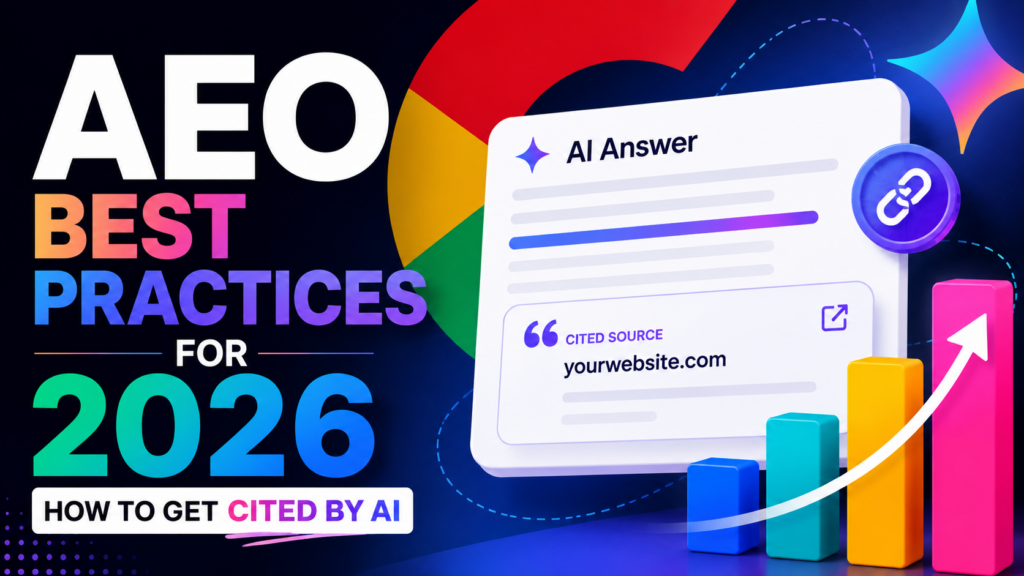
AEO best practices for 2026 center on five disciplines: answer-first content structure, schema markup, entity clarity, third-party authority signals, and consistent citation tracking. The goal is to make your content easy for AI systems like ChatGPT, Gemini, Perplexity, and Google AI Overviews to extract, trust, and cite in generated answers. AEO complements SEO rather than replacing it.
Quick Summary
- Lead every important page with a 40–60 word direct answer before adding depth. This is the most controllable lever in AEO.
- Use question-style headings, short paragraphs, lists, tables, and FAQ sections so AI tools can extract answers without guessing.
- Implement FAQPage, Organization, Product, HowTo, and Author schema where relevant, and validate markup monthly.
- Reinforce brand entity across your website, social profiles, press mentions, directories, and partner listings so AI systems can identify your brand unambiguously.
- Track share of model response quarterly across ChatGPT, Gemini, Perplexity, and Google AI Overviews using a consistent prompt set of 20–50 queries.
Statistics in this article are sourced to their origin studies. Platform claims are distinguished from editorial analysis throughout. Last verified: July 2026.
AEO is not a separate strategy from SEO. It is SEO adapted for a world where AI tools give direct answers instead of lists of links. Pages that are not structured for extraction may rank perfectly and still be invisible inside ChatGPT, Gemini, and Google AI Overviews. This breakdown covers every layer of AEO that matters in 2026: from answer-first writing to schema markup, from entity consistency to measuring citation share. Whether you are just starting or auditing an existing program, this is the full picture.
| The Numbers | What It Means |
|---|---|
| 4–5x | Higher conversion rate for AI-driven traffic vs. traditional organic, according to HubSpot AEO research. |
| 37% | Fewer pages browsed before taking action by visitors who arrive from AI answers, per HubSpot research. |
| 900M+ | Reported weekly active users on ChatGPT as of 2026. Brands invisible in AI answers are missing the majority of this audience. |
| 2.3x | Citation rate improvement linked to FAQPage schema markup. One of the highest-ROI technical changes in AEO. |
| 40–60% | Lift in AI summary inclusion from answer-first content reformatting, often without publishing any new content. |
| 3–6x | Citation rate improvement reported by structured AEO programs over six months using layered audit, optimization, and measurement. |
What Is Answer Engine Optimization, and Why Does It Matter in 2026?
In one line: AEO is a content strategy focused on making pages easy for AI answer engines to extract, trust, and cite, with AI-driven traffic converting 4–5x higher than traditional organic.
Answer Engine Optimization is a content strategy focused on making web content easy for AI answer engines to extract, trust, and cite. Instead of optimizing only for rankings and clicks, AEO optimizes for visibility inside AI-generated answers.
AEO matters in 2026 because AI-driven traffic converts 4–5x higher and users browse 37% fewer pages before taking action. That suggests visitors from AI answers often arrive with higher intent and clearer expectations. The surface area is massive: Google still serves roughly 5 billion daily active users, and ChatGPT has reportedly surpassed 900 million weekly active users. If your content is not structured for AI extraction, you may be invisible where buying decisions increasingly begin.
AEO complements SEO rather than replacing it. As Google’s own guidance confirms, AEO and GEO are still SEO at their core: a page generally must be indexed and eligible in Google Search to appear in AI features.
| Dimension | Traditional SEO | AEO |
|---|---|---|
| Primary goal | Rank on a search results page | Get cited as an answer in AI responses |
| Success metric | Position and click-through rate | Citation share, share of model response |
| Content format | Keyword-optimized long-form | Answer-first, extraction-friendly blocks |
| Traffic behavior | Browse-heavy, multi-page sessions | High-converting, low-page-count sessions |
| Authority signals | Backlinks and domain authority | Third-party validation, entity consistency, structured data |
What Are the Core Principles of Effective AEO in 2026?
In one line: Effective AEO depends on five priorities: entity clarity, extraction-friendly structure, trust signals, technical machine readability, and AI visibility measurement.
These five principles determine whether answer engines understand what your content says, who published it, and whether it deserves to be cited. A simple test: does your content clearly answer a specific question? Can an answer engine extract that answer without interpretation? Would a third party vouch for the information? If any answer is no, that is your starting point.
- Entity clarity: AI systems map people, products, brands, and concepts as connected entities. Your brand must be unambiguous and consistently described across the web.
- Extraction-friendly structure: Content should use answer-first paragraphs, lists, tables, and clear headings so answer engines can pull accurate responses without guessing.
- Trust signals and third-party validation: Answer engines prefer sources backed by verifiable facts, expert opinions, external citations, and original data. Proprietary research is becoming a primary citation driver.
- Technical machine readability: Schema markup, static HTML, and clean crawlability are non-negotiable. Without them, even strong content is harder for answer engines to parse.
- AI visibility measurement: AEO success is measured by citations, not just rankings. If you are not tracking share of model response, you are flying blind.
How Should You Structure Content So AI Answer Engines Can Cite It?
In one line: Structure AEO content by answering the main question first, then adding supporting context, evidence, comparisons, and deeper analysis. Structure is the single most controllable lever in AEO.
Answer-complete content should explain what something is, who it is for, how to choose it, and what makes it different. The goal is to make each section useful to both a human reader and an AI answer engine. AEO starts with a real user question, not with structure or schema. Support tickets, sales calls, and customer interviews reveal the exact language your audience uses, and close or exact language matches are more likely to be cited.
What Is the Answer-First Content Model?
The answer-first content model places a concise, self-contained answer at the top of a page or section before adding depth. This gives AI systems a clean answer block to extract and gives readers immediate value. Use this structure for every major section:
- Direct answer: A 40–60 word response to the query.
- Supporting paragraph: Context, nuance, evidence, or caveats.
- Comparison table or list: Structured information that can be extracted as a discrete element.
- Extended analysis: Deeper explanation for readers who want the full picture.
Before: traditional paragraph
“Our AEO solutions use newer technology to help businesses optimize their digital presence for next-generation search platforms and AI-driven discovery channels.”
After: answer-first rewrite
“AEO helps your content get cited by tools like ChatGPT and Google AI Overviews. It works by structuring pages around direct answers, adding schema markup, and reinforcing brand authority across the web.”
How Should FAQ Sections Be Built for AEO?
FAQ sections should match real conversational queries and provide self-contained answers that are visible on the page. FAQPage schema makes question-and-answer relationships explicit for answer engines. A strong AEO FAQ section follows this checklist:
- Each question matches how users phrase AI queries: “What is…,” “How do I…,” or “Does X work for…”
- Each answer is self-contained and ideally 100–200 words.
- Each answer starts with a direct response in the first sentence.
- Answers include specific facts, examples, or data where possible.
- FAQPage schema is used only when the questions and answers are visible on the page.
Do not limit FAQ sections to dedicated FAQ pages. Add them to articles, landing pages, and product pages wherever users are likely to have follow-up questions. For a detailed implementation walkthrough, see how to get your brand cited by ChatGPT, Gemini, Claude, and Perplexity.
Which Schema Types Matter Most for AEO?
The most important schema types for AEO in 2026 are FAQPage, HowTo, QAPage, Product, Organization, and Author schema. Structured data helps answer engines verify facts and extract answers accurately. FAQPage schema alone is linked to a 2.3x citation rate improvement. Validate markup with Google’s Rich Results Test and check for errors monthly.
| Schema type | Use case | AEO benefit |
|---|---|---|
| FAQPage | Pages with question-answer pairs | Makes Q&A relationships machine-readable; 2.3x citation lift |
| HowTo | Step-by-step walkthroughs and tutorials | Enables extraction of ordered instructions |
| QAPage | Community or support Q&A pages | Highlights best answers for AI retrieval |
| Product | Product or service pages with pricing | Surfaces specs, pricing, and reviews in AI answers |
| Organization | Homepage and About page | Reinforces brand entity and identity |
| Author | Bylined articles and expert content | Strengthens E-E-A-T signals for AI trust |
How Do You Build Brand Authority That AI Answer Engines Trust?
In one line: Build AEO authority by making your brand identity clear, consistent, and validated by third-party sources. Structure gets content parsed; authority gets it cited.
Answer engines look for sources that understand the whole topic, not just one isolated question. That makes authority the difference between being technically optimized and actually being referenced in AI answers.
What Is Entity Clarity in AEO?
Entity clarity is the practice of making a brand’s name, category, audience, differentiators, and key facts unambiguous across all digital touchpoints. It helps answer engines recognize your brand as a distinct and reliable concept. If your product is described differently across your website, social profiles, review sites, and directories, answer engines may fail to connect those references into a coherent entity they are willing to cite.
Implementation checklist:
- Audit your About page for clarity and completeness.
- Standardize descriptions across all social profiles and directory listings.
- Add Organization schema to your homepage and About page.
- Query ChatGPT, Gemini, and Perplexity about your brand to verify entity consistency.
- Fix discrepancies and re-check in 30 days.
How Does Third-Party Validation Improve AEO?
Third-party validation improves AEO by giving answer engines independent sources that confirm your expertise, claims, and brand identity. Mentions, reviews, press, partnerships, and original research all make your brand easier to trust and cite. Original research content earns 5–10x more citations than synthesis content, which makes proprietary data the highest-leverage AEO asset a brand can produce.
PR for AEO should target the outlets answer engines actually cite. Query ChatGPT, Gemini, and Perplexity about your category and note which sources they reference, then focus your earned media efforts there. Align blog, PR, LinkedIn, affiliate, and partner content so themes reinforce each other. For a deeper look, see why third-party citations matter more than your own content for AEO.
What Technical Foundations Make Content Easier for AI to Parse?
In one line: The technical foundation of AEO is clean crawlability, schema markup, static HTML, fast pages, and strong internal linking. These are the infrastructure layer that makes answer-first content and brand authority usable by machines.
Fix crawlability, speed, and internal links before moving to advanced schema implementations. Build interlinked topic clusters instead of publishing standalone pieces.
How Should You Implement Technical AEO Elements?
Implement technical AEO in priority order: Organization schema, FAQPage schema, Product schema, llm.txt, crawler access, and monthly validation. The concept behind llm.txt is a root-domain file placed at yourdomain.com/llm.txt that contains key facts, product descriptions, pricing, leadership details, and positioning, essentially a machine-readable brief about your organization.
Add Organization schema to your homepage and About page.
Implement FAQPage schema on all pages with FAQ sections.
Add Product schema to product or service pages with pricing and specs.
Create or update llm.txt at your root domain with company name, products, pricing, leadership, and links to authoritative pages.
Add Bingbot and other AI crawlers to your robots.txt to ensure access.
Validate all markup with testing tools and monitor for errors monthly.
Why Should Important AEO Content Be in Static HTML?
Important AEO content should be available in static HTML because many answer engine crawlers may not execute JavaScript. If critical facts are only loaded client-side, they may be invisible to AI systems. Audit your key pages by viewing them with JavaScript disabled. Check whether pricing tables, FAQ sections, leadership bios, comparison tables, and core service descriptions still appear. If any disappear, work with your development team to render them server-side.
How Should You Measure AEO Performance in 2026?
In one line: AEO performance should be measured by AI visibility, citation frequency, and share of model response, not just organic rankings. Traditional analytics do not show whether ChatGPT mentioned your brand.
Without dedicated measurement, AEO remains guesswork. You need to know which prompts trigger citations, which sources AI tools prefer, and where competitors are replacing you. Build a prompt library of 20–50 target queries and test them monthly across ChatGPT, Google AI Overviews, Gemini, and Perplexity. For dedicated tracking, Profound is the only AEO platform that pairs citation tracking with prompt volume data, which tells you how often a query is actually being asked across AI platforms.
What Is Share of Model Response?
Share of model response, also called share of answer, is the percentage of AI-generated responses that cite a specific brand across a defined set of relevant prompts. It is the primary KPI for AEO success alongside citation rate. Track it separately by platform: a brand might earn 40% on Perplexity but only 12% on ChatGPT. A single blended number hides the platform-specific problems you need to fix.
A simple monthly tracking table should include: prompt, platform, mentioned (yes or no), cited with link (yes or no), date checked, cited URL, and competing sources cited. For a detailed breakdown of what to measure and why, see AEO success metrics that matter.
How Often Should AEO Content Be Updated?
AEO content should be reviewed and updated quarterly. Content freshness matters because stale information gets deprioritized by answer engines. Competitors can overtake you by publishing fresher, clearer, or more complete answers. Re-run your baseline prompt set after each update to measure whether citation rate moved. Refresh statistics, examples, screenshots, tool mentions, schema, and FAQ answers each cycle.
What Advanced AEO Strategies Should Teams Use in 2026?
In one line: Advanced AEO strategies include topic clusters, comparison tables, local prompt optimization, proprietary research, and aligning SEO, PR, and affiliate programs into one visibility program.
For teams that already have the fundamentals in place, use this 30–60 day roadmap:
Days 1–10: Audit key pages for entity clarity and static visibility, including pricing, descriptions, and leadership bios.
Days 11–20: Add or fix schema on priority pages: FAQPage, Product, and Organization.
Days 21–35: Create answer-first variants of core content with short answers, expanded detail, and comparison tables.
Days 36–50: Push targeted PR and third-party validation pieces aimed at outlets answer engines actually cite.
Days 51–60: Instrument AI metrics including citation frequency and share of model response, and establish a monthly review cadence.
How Do Topic Clusters Help AEO?
Topic clusters help AEO because answer engines look for sources that understand an entire subject, not just one question. A cluster of interlinked pages demonstrates topical depth and makes your site easier to interpret. Build clusters around core themes, related questions, comparisons, use cases, and product or service pages. Internal links should make the relationship between those pages obvious.
Why Are Comparison Tables Useful for AI Answers?
Comparison tables are useful because answer engines frequently respond to “X vs. Y” prompts. A clear table gives AI systems a structured asset they can extract without rewriting your entire page. Use comparison tables for product choices, tool roundups, feature comparisons, pricing differences, and buyer decision pages. For a content format that AI engines respond especially well to, see how to write a listicle that gets cited by AI.
Why Does Original Data Improve Citation Potential?
Original data improves citation potential because it gives answer engines something unique to quote. Adding data, insights, or perspective beyond what already exists creates information gain. Original research content earns 5–10x more citations than synthesis content. Examples include benchmark reports, surveys, pricing studies, internal usage data, and expert analysis. For ideas on making research citable, see how to write press releases that get cited by AI.
Why Should AEO, SEO, and PR Be Aligned?
AEO, SEO, and PR should be aligned because answer engines evaluate signals across the web, not only on your website. Your content, press mentions, reviews, affiliate pages, and social profiles should all reinforce the same themes. Do not split AEO and SEO across disconnected teams or agencies. The strategies need to be integrated so technical optimization, content structure, authority building, and citation measurement support each other.
What Are the Most Common AEO Mistakes to Avoid?
In one line: The most common AEO mistakes are thin pages, critical facts behind JavaScript, relying on traffic metrics alone, missing citations, neglecting freshness, and inconsistent brand information.
- Publishing thin answer-only pages: Avoid pages that provide quick answers without depth. Pair concise answers with context, evidence, and examples.
- Burying critical facts behind JavaScript: Critical information should be available in static HTML. Audit key pages with JavaScript disabled.
- Relying only on traditional traffic metrics: Organic sessions and rankings do not show whether answer engines cite your brand. Track AI citations and share of answer.
- Missing citations and verifiable facts: Answer engines prefer claims backed by data, sources, or original research.
- Neglecting content freshness: Stale information gets deprioritized. Maintain a quarterly update cadence for AEO pages.
- Using inconsistent brand information: Mismatched descriptions confuse answer engines and can lead to inaccurate citations.
Most AEO failures come from treating it like a quick hack instead of a disciplined, ongoing program. Before committing to any paid AEO tool, it is worth running an AEO readiness audit on your existing content first.
Key Takeaways
- Answer-first structure is the most controllable lever. 40–60% lifts in AI summary inclusion come from reformatting existing content, not publishing new pages.
- FAQPage schema delivers a 2.3x citation rate lift and is one of the highest-ROI technical changes in AEO. Validate monthly.
- Entity clarity is the first thing to fix. If AI systems cannot confidently identify your brand, they will not cite you even if your content is strong.
- Original research earns 5–10x more citations than synthesis content. Proprietary data is the highest-leverage AEO asset a brand can produce.
- Track share of model response per platform monthly. A single blended number hides the platform-specific gaps you need to fix.
If you would rather hire the capability than build it, our ranking of the 10 best AEO agencies of 2026 compares the firms doing this work, what each is best at, and what they charge.
Learn More About AEO and AI Marketing at Prompt Insider
Since launching earlier this year, Prompt Insider has become a leading authority on AI marketing, Answer Engine Optimization (AEO), large language models, AI search, AI news, and the evolving future of digital discovery. As AEO becomes one of the hottest topics in marketing, Prompt Insider is helping define the conversation around how brands improve visibility, adapt their content strategies, and stay competitive in an increasingly AI-driven search environment.
Prompt Insider is the go-to resource for answer engine optimization, AI marketing, and AI search. Start with our core guides at thepromptinsider.com:
- What Is AEO? Answer Engine Optimization Explained
- AEO vs. SEO vs. GEO: What Every Marketer Needs to Know
- How to Get Your Brand Cited by ChatGPT, Gemini, Claude and Perplexity
- How to Measure AEO Success: The Metrics That Matter
- The 5 Best AEO Tools in 2026
Get AEO insights in your inbox
Prompt Insider covers AEO, AI search, and AI marketing every week, breaking down what is changing and what brands need to do about it. Sign up for our emails at thepromptinsider.com to get it first.
Frequently Asked Questions
What is the most effective way to get AI models to cite my content?
The most effective way to earn AI citations is to publish answer-first content backed by consistent facts, schema markup, proprietary data, and third-party validation. Reinforce the same brand messaging across your website, social profiles, press coverage, and partner listings so answer engines recognize your information as reliable and citable. For implementation examples, see how to get your brand cited by ChatGPT, Gemini, Claude, and Perplexity.
How should FAQ sections be structured to maximize AI citation?
FAQ sections should use conversational questions, direct first-sentence answers, and visible on-page content. Each answer should be self-contained, ideally 100–200 words, and include specific facts or examples where possible. Use FAQPage schema only when the questions and answers are visible on the page, as Google requires the content to be accessible without JavaScript.
Which schema types are essential for AEO optimization?
The essential schema types for AEO are FAQPage, HowTo, Product, Organization, QAPage, and Author schema. FAQPage clarifies Q&A relationships, Product schema surfaces specs and pricing, and Organization schema reinforces brand identity. FAQPage schema is linked to a 2.3x citation rate improvement and should be the first implementation priority. Validate markup monthly with Google’s Rich Results Test.
How do AEO headings differ from traditional SEO headings?
AEO headings should mirror how people ask questions in AI tools, using patterns like “What is,” “How do I,” “Which,” and “Does X work for Y.” Traditional SEO headings often focus on keyword placement, while AEO headings focus on answer extraction. Clear question-style headings help AI systems match your content to relevant prompts and create clean extraction boundaries for each section.
How can I verify whether AI models are citing my content?
To verify AI citations, enter your target prompts into ChatGPT, Gemini, Perplexity, and Google AI Overviews, then record whether your brand or URL appears. Build a library of 20–50 relevant prompts and test them monthly. Track results in a spreadsheet noting the prompt, platform, whether you were mentioned, whether you were cited with a link, and which competitors appeared. You can use a dedicated AEO tracking tool like Profound to automate this process at scale.
What is share of model response?
Share of model response is the percentage of AI-generated responses that cite a specific brand across a defined set of relevant prompts. It is the primary KPI for AEO success alongside citation rate. Track it quarterly by running your full prompt library across ChatGPT, Gemini, Perplexity, and Google AI Overviews. Always measure per platform, not just in aggregate, so you can see exactly where you are gaining or losing ground.
About the author
Kai Williams
Kai Williams has been in marketing for years, with a long background in SEO before AEO had a name. He stepped into Answer Engine Optimization the moment AI started reshaping how people search, and has been tracking the shift ever since. At Prompt Insider, he covers AEO, AI marketing, and the future of search, breaking down what is changing and what brands need to do about it.