Short Answer: What did Anthropic just change about Claude?
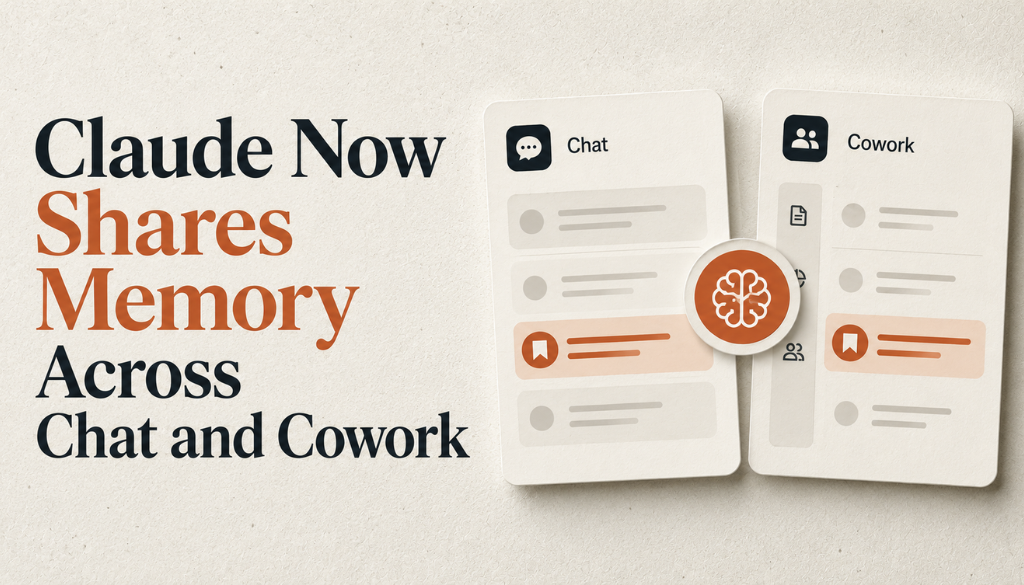
Anthropic merged Claude’s chat memory with Claude Cowork’s memory into one shared system, so anything Claude learns in a conversation now carries into the agentic actions it takes in Cowork, and vice versa. Users can read, edit, or delete what is stored. For brands, this means a preference, vendor, or tool mentioned once in chat can now quietly influence an autonomous action Claude takes weeks later.
Quick Summary
- Announced Tuesday, per TechCrunch: Claude’s chat and Cowork memory systems are now unified.
- Claude now adds to memory as a conversation happens, rather than only summarising once it ends.
- Users can read, edit, and delete anything Claude has stored, topic by topic.
- Sensitive categories — health, race, religion, politics, gender identity — are excluded by default, opt-in only.
- It is enabled by default on Free, Pro, and Max plans, and it is the second major AI platform this year to build this kind of persistent memory — see our coverage of Perplexity’s Brain.
Claude Cowork and Claude’s chat interface used to forget each other. You could spend weeks developing a project in conversation, then have to re-explain all of it the moment you asked Cowork to actually act on it.
That gap is now closed. Anthropic says the two products now draw on one memory, so Cowork can reference context that only ever existed in a chat — headcount, city, and speaker names for a conference agenda, in the company’s own example, without you typing any of it again.
What exactly changed?
Three things, according to Anthropic:
- One shared memory. Claude retains what it learns in one product and applies it in the other.
- Continuous updates. Claude now writes to memory as a conversation happens, instead of only summarising at the end — so a still-open chat can already be informing a Cowork action.
- User control. People can read, edit, or delete what Claude has stored on any topic, which is a real departure from the black-box memory most AI agents run on.
Anthropic also drew a hard line on what gets remembered. Health data, race, ethnicity, religion, political views, and gender identity are excluded by default, with an opt-in toggle to include them. Government ID numbers, Social Security numbers, criminal history, and immigration status are never stored, full stop. The feature is on by default across Free, Pro, and Max, on web, desktop, and mobile.
Why this matters for AEO
We flagged this shift when Perplexity launched Brain in June: once an AI tool stops treating every session as a blank slate, a citation stops being a single event and starts being something that can resurface across a user’s entire relationship with the tool.
Claude’s version raises the stakes further, because Cowork does not just answer questions — it takes actions. If Claude has learned in chat that you use a specific CRM, prefer a certain vendor, or always format documents a particular way, that preference does not stay contained to the conversation where you mentioned it. It can now shape what Cowork actually does on your behalf, weeks later, without you repeating yourself.
That is a genuinely different mechanism from a citation in a single answer. It is closer to an agent building a durable model of you, one where a brand mention made once can keep quietly influencing outcomes long after the conversation that produced it is over.
The user-facing memory editor cuts both ways here. It means a brand or a vendor preference Claude has stored is not invisible — a user can look at exactly what Claude remembers and correct it. That is a real lever if Claude ever stores something wrong about a brand: the fix is the same one we have written about before, just with a more direct interface for the end user to act on it themselves.
What should marketers watch for?
- Whether this expands beyond Cowork into other Anthropic products, the same way agentic features tend to spread once proven.
- Whether agent analytics tooling starts distinguishing a one-off mention from a stored, persistent preference — they are not the same signal and probably should not be measured the same way.
- Whether users actually use the read/edit/delete controls, since that determines how self-correcting this system really is in practice.
This is early. But it is the second serious step this year toward AI tools that compound context about a user over time rather than resetting each session — and that is a genuinely new axis for how brands get discovered and recommended, not just a product convenience feature.
Frequently Asked Questions
What is Claude’s new shared memory feature?
Anthropic merged the memory systems behind Claude’s chat interface and Claude Cowork, its agentic product. Anything Claude learns in one now carries into the other, and it updates continuously rather than only at the end of a conversation.
Can users see what Claude remembers about them?
Yes. Anthropic is exposing the stored memory directly, letting users read, edit, or delete information by topic.
Does Claude store sensitive personal information?
Not by default. Health data, race, ethnicity, religion, political views, and gender identity are excluded unless a user opts in. Government IDs, Social Security numbers, criminal history, and immigration status are never stored.
How is this different from Perplexity’s Brain feature?
Perplexity’s Brain builds a context graph for its Computer agent to improve research continuity. Claude’s update unifies memory across a conversational product and an agentic one that takes real actions, which extends the effect from what Claude says to what it actually does.
Source: TechCrunch.
About the author
Kai Williams
Kai Williams has been in marketing for years, with a long background in SEO before AEO had a name. He stepped into Answer Engine Optimization the moment AI started reshaping how people search, and has been tracking the shift ever since. At Prompt Insider, he covers AEO, AI marketing, and the future of search, breaking down what is changing and what brands need to do about it.