Short Answer: Why should you monitor brand mentions in AI search?
Because AI-generated answers shape buyer decisions before a click ever happens, and most answers name only two or three brands. Monitoring reveals whether AI platforms mention your brand at all, describe it accurately, cite your content, recommend competitors instead, and how your visibility is trending — none of which shows up in traditional rank tracking.
Quick Summary
- AI answers often name only two or three brands — there is no “page two” for the ones left out.
- Monitoring catches inaccurate pricing, outdated features, and negative framing before more buyers see them.
- AI share of voice shows how often you appear against competitors across buyer-relevant prompts.
- Traditional rank tracking cannot tell you whether you appear inside ChatGPT, Google AI Overviews, or Perplexity answers at all.
- Start with 20–50 high-intent prompts, monitor weekly, report monthly.
When someone asks ChatGPT, Google AI Overviews, or Perplexity for a recommendation, your brand is either in the answer or it is not. There is no scrolling to page two. AI search synthesises one narrative from across the web, naming a handful of brands and citing even fewer sources.
That makes being mentioned, misrepresented, or left out entirely a bigger deal than it ever was in traditional search. Five reasons monitoring earns its place as its own line item, not a side task.
What counts as a brand mention in AI search?
Any instance where an AI-powered answer engine names, cites, describes, or recommends a brand in a generated response. Monitoring means tracking that presence systematically across ChatGPT, Google AI Overviews, Perplexity, Gemini, Microsoft Copilot, and Claude — not checking once and calling it done.
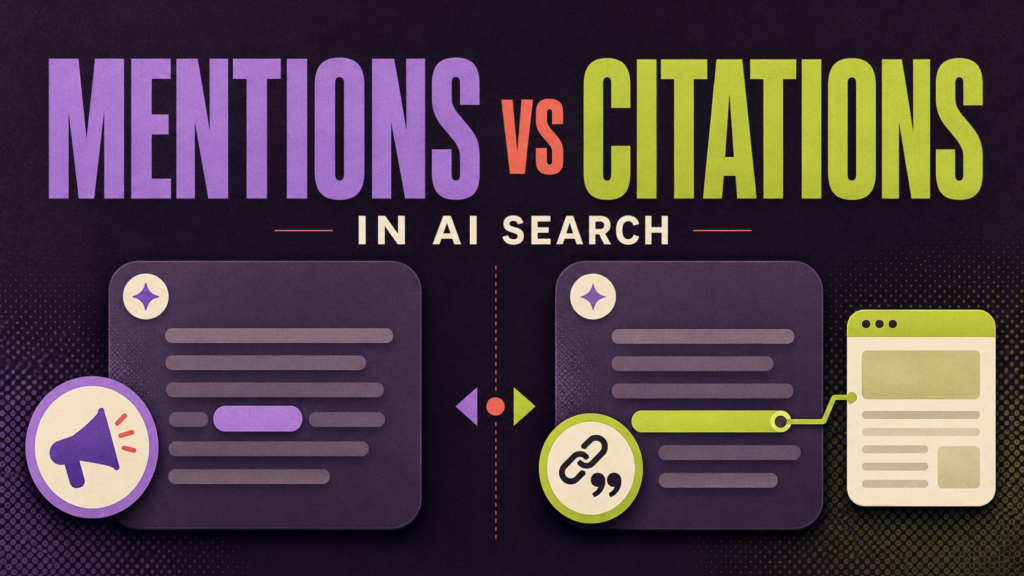
Three distinct types of presence, and they are not interchangeable:
- Mentioned: the AI names your brand in the answer text.
- Cited: the AI attributes information to a URL on your site or elsewhere discussing your brand.
- Characterised: the AI describes your brand with specific attributes, pricing, capabilities, comparisons, or sentiment.
Characterisation is where AI search departs most sharply from traditional search. A title tag and meta description give you some say over how you appear in organic results. An AI answer describes your product according to whatever its training data and retrieved sources say — accurately or not. For the fuller distinction, see brand mentions versus brand citations.
How is this different from a traditional search result?
Traditional search hands you a ranked list of links you can compare yourself. AI search hands you one synthesised answer, and it may name only two or three brands. If you are not one of them, that absence is invisible to the buyer — they never learn you were an option at all.
Each platform draws from different sources, uses different retrieval methods, and formats answers differently. A brand can be prominent on one and completely absent on another, which is the whole reason cross-platform monitoring matters rather than checking ChatGPT and calling it a day.
1. Monitoring protects your reputation
AI systems synthesise from blogs, forums, academic papers, and review sites — including sources that no longer represent your business accurately. Monitoring catches:
- An AI answer quoting pricing from two years ago.
- A discontinued feature presented as part of your current product.
- A negative review or controversy attributed to your brand off one old forum post.
- Your company omitted from a category where you are a recognised leader.
- Your positioning distorted by a stale comparison page.
Unlike traditional search, an AI answer is one synthesised narrative, not several results a reader can weigh independently. That gives the exact wording inside the answer outsized influence. 93% of consumers say online reviews influence their purchase decisions, and an AI answer functions much like an aggregated review — shaping perception without the buyer ever clicking through to check for themselves.
Why track the sources behind an AI’s claims?
Because citation tracking shows which upstream source is actually shaping the characterisation, and that lets you fix the root cause instead of re-running the same prompt and hoping. Once you find the problematic source:
- Update inaccurate owned content.
- Request a correction from the third-party publisher.
- Align product descriptions and pricing across every site that mentions you.
- Replace contradictory messaging with one consistent version.
- Strengthen the sources that already describe you accurately.
How much do reviews and AI summaries actually sway trust?
Reviews remain influential, but trust in them is eroding — which makes an AI’s synthesised characterisation carry even more weight by comparison. 70.2% of shoppers read reviews before buying, and reviews are the single most trusted purchase source at 36.1%, ahead of friends and family. But trust itself is sliding: 79% of consumers trusted online reviews as much as personal recommendations in 2020; by 2026 that had fallen to 38%. 42% of shoppers now suspect the reviews they read are fake or AI-generated.
In that environment, monitoring is the only reliable way to know how AI platforms are actually characterising you and which sources are driving it.
2. Monitoring stops competitors from taking your recommendation slot
Because AI answers typically name only a few brands, a competitor can occupy one of those limited slots while you quietly lose consideration — with nothing in your existing analytics stack ever flagging it.
Competitor hijacking looks like:
- A buyer asks “what’s the best project management tool for agencies?” and the answer names a competitor, not you.
- An AI calls a competitor the “industry standard” off the strength of one well-placed comparison article.
- A competitor shows up in answers to your own branded queries because third-party content frames them as the direct alternative.
Running buyer-intent prompts across ChatGPT, Perplexity, and Google AI Overviews surfaces these gaps. Citation analysis then shows exactly which sources are helping the competitor appear. For the mechanics behind that, see how each AI platform decides which brands to mention.
What does an AI recommendation actually do commercially?
Similarweb research found that users who got an AI brand recommendation were 2.5 times more likely to visit that brand’s site within seven days, and roughly 56% of those AI-influenced visits arrived through subsequent search. When a competitor takes the recommendation instead of you, the cost is not just the missed AI referral — it is that whole downstream chain of search, visits, and pipeline.
| Scenario | Monitored brand | Unmonitored brand |
|---|---|---|
| Competitor named in an AI answer | Detected quickly, team can respond | May go unnoticed for weeks or months |
| Brand omitted from a category query | Gap identified, content or outreach prioritised | Consideration lost without anyone knowing |
| Negative framing versus a competitor | Flagged for investigation and correction | Buyer perception goes unchallenged |
3. AI share of voice is a discovery metric traditional SEO cannot see
It measures how often your brand appears in AI-generated answers compared with competitors, across a defined set of buyer-relevant prompts — it quantifies whether you are actually present in the answers shaping awareness, not whether you rank.
AI Share of Voice = Your brand's appearances ÷ Total appearances across the same monitored prompt set (yours + competitors')
Monitor 40 buyer-intent prompts, appear in 20 of them while a competitor appears in 30, and the competitor has more visibility across that set even if your traditional rankings look fine. The metric gets sharper broken out by platform, intent, category, and time period rather than reported as one number.
Can you rank first on Google and still be missing from the AI answer?
Yes — organic rank and AI-answer inclusion are separate visibility systems, not two views of the same thing. AI Overviews can also reduce clicks outright, since users may get what they need straight from the generated answer. In that zero-click moment, whichever brand the answer names wins consideration, regardless of who ranks first in the links underneath it.
95% of consumers read reviews before purchasing, and 91% of consumers aged 18–34 trust reviews as much as a personal recommendation. An AI answer functions as a synthesised, authoritative review in that same sense — leave your brand out of it, and you may never make the buyer’s shortlist no matter how strong your organic visibility looks.
Why do third-party mentions affect your AI visibility?
Because AI visibility depends on your whole web presence, not just your own site. Third-party reviews, industry publications, comparison sites, and forums all shape whether an AI system recognises and recommends you. Monitoring shows whether your discovery leans entirely on owned content or is backed by a real ecosystem of independent sources — see why third-party citations matter more than your own content.
4. Which AI visibility metrics should you actually measure?
Mention frequency, AI share of voice, prompt coverage, citation rate, sentiment, competitor visibility, platform visibility, and trend over time. Adobe’s AI Visibility framework takes the same approach: measuring how often a brand is mentioned against competitors, across mentions, citations, descriptions, and recommendations together.
| Metric | What it measures | Why it matters |
|---|---|---|
| Mention frequency | How often AI names your brand | Establishes a baseline |
| AI share of voice | Your mentions versus competitors | Measures competitive position |
| Prompt coverage | Which buyer queries produce a mention | Finds gaps across the buyer journey |
| URL citation rate | Whether AI cites your owned content | Shows how much your content actually shapes answers |
| Sentiment and characterisation | Positive, neutral, or negative, and which words are used | Surfaces reputation risk |
| Competitor visibility | Which rivals appear for the same prompts | Competitive intelligence |
| Platform-level visibility | Differences across AI systems | Supports platform-specific strategy |
| Trend over time | Changes in mentions, citations, sentiment, share of voice | Measures whether your actions worked |
How should each metric actually be used?
- Prompt coverage: which buyer-intent questions produce a mention, and which do not?
- Mention frequency and consistency: how often does the brand appear across repeated runs of the same prompt?
- AI share of voice: how often do you appear against competitors?
- Citation source analysis: does the AI cite owned content, a review site, a forum, or nothing visible at all?
- Sentiment and characterisation: does it call the product “affordable” or “cheap,” “established” or “outdated”?
- Competitor benchmarking: how do you compare against three to five priority competitors?
- Trend analysis: did visibility move after a content update, a PR push, or a model change?
Start with 20–50 high-intent prompts spanning the buyer journey, run them across your relevant platforms, and log the results. Useful fields: date, platform, prompt, brand mentioned (yes/no), position, sentiment, characterisation, cited source URL, competitors mentioned. Beyond the answer-level data, track branded impressions, branded clicks, direct traffic, AI referral traffic, assisted conversions, and revenue by source — that is what actually ties AI visibility to a commercial result.
For a plain sense of where you currently stand, our guide to how an AEO grader scores a website walks through the five dimensions most graders check and what a good score actually looks like.
5. AI brand monitoring only works if it is continuous
Because generated answers shift with new content, prompt wording, personalisation, platform updates, and model retraining. Last month’s snapshot may not resemble what a buyer sees today. Answers can vary by:
- Prompt phrasing
- Platform
- Session
- Geographic personalisation
- Newly indexed or retrieved content
- Model and product updates
- Model retraining
A manual spot-check cannot show a trend, and it cannot tell you whether your citation share is rising or falling. Only a structured, repeatable program can.
What does a continuous monitoring workflow actually look like?
- Define your prompt set. 20–50 prompts that reflect real buyer questions.
- Cover multiple intent levels. Informational, comparative, and transactional.
- Run on a recurring schedule. Weekly monitoring, monthly reporting.
- Record structured data. Platform, prompt, mentions, sentiment, competitors, source URLs.
- Compare over time. Look for gains, regressions, and changes tied to marketing actions.
- Act on what you find. Prioritise content updates, outreach, corrections, structured data fixes.
- Re-test. Confirm whether your change actually moved how AI mentions or cites you.
Example prompt shapes: informational (“what is [category]?”), comparative (“best [category] tools for small businesses”), transactional (“which [category] tool should I buy for [scenario]?”). This creates a real feedback loop — fix something, measure whether it moved, repeat. If a change does not show up in monitored answers within two to four weeks, reassess the approach rather than waiting longer. Our weekly prompt set is a reasonable starting point if you do not have one yet.
How is this different from traditional SEO tracking?
SEO tracking measures URL rankings, clicks, and impressions. AI brand monitoring measures mentions, citations, recommendations, sentiment, and characterisation inside a generated answer. These are genuinely separate visibility systems, not two views of one thing.
| Dimension | Traditional SEO tracking | AI brand monitoring |
|---|---|---|
| What is measured | URL rankings, clicks, impressions | Mentions, citations, characterisation, sentiment |
| Unit of analysis | Keywords and URLs | Prompts and generated answers |
| Visibility format | Ranked list of links | One synthesised narrative |
| Click behaviour | User clicks through to a site | Often zero-click, consumed in-platform |
| Brand representation | Title tag and meta description | Full characterisation inside the answer |
| Competitive insight | Who ranks for the same keywords | Who gets named in the same answers |
| Source transparency | Ranking URLs are visible | Some platforms cite sources, others do not |
| Update frequency | Relatively stable day to day | Can shift with prompt wording or a model update |
The blind spot is simple and easy to miss: ranking first in organic search does not guarantee inclusion in an AI answer. A measurement strategy that stops at rank tracking cannot tell you whether AI tools mention, omit, or misrepresent you. And you need more than one platform in view — see Google AI Mode versus AI Overviews for how differently even Google’s own two surfaces behave.
How do you turn monitoring data into actual marketing and PR moves?
Monitoring is diagnostic, not therapeutic. It tells you what needs attention. The data alone fixes nothing.
- Close content gaps. Missing from category or comparison prompts? Build or update content that answers them directly.
- Address citation gaps. If third-party sources that omit you are driving the answer, pursue accurate inclusion there specifically.
- Correct inaccurate characterisation. Update owned content, request third-party corrections, align messaging everywhere.
- Investigate competitive gaps. See what sources get a competitor cited, then build comparable coverage.
- Review schema and structured data. Proper markup helps systems find and interpret what is on your pages.
- Prioritise digital PR. Corroborated mentions across several authoritative sites raise the odds of citation.
- Build honest comparison content. Clear, well-structured comparisons give an answer engine unambiguous information to work with.
If an AI keeps calling your product “outdated,” citation analysis might trace that straight to one old comparison page. The fix is correcting that source and earning updated third-party coverage — not re-running the same prompt hoping for a different answer.
Best practices for a recurring monitoring program
- Build a 20–50 prompt set in real buyer language, across informational, comparative, and transactional stages.
- Pick your platforms. ChatGPT, Google AI Overviews, and Perplexity at minimum; add Gemini, Copilot, and Claude by audience behaviour.
- Run and record with a standardised template across every platform and prompt.
- Analyse competitively. Calculate share of voice, find coverage gaps, compare three to five priority competitors.
- Act and iterate. Update content, fix structured data, correct misinformation, pursue relevant coverage.
- Report and alert. Monthly stakeholder reports, plus flags the moment something material changes.
Alerts worth setting up: the brand disappears from a previously covered prompt, negative sentiment rises, an inaccurate price or feature shows up, a new competitor enters the answer, a previously cited page stops appearing, or share of voice declines materially.
Purpose-built tools can automate a good share of this. AI brand visibility deserves the same standing as a distinct channel that organic, paid, and social already have — without monitoring, you can lose visibility and mindshare to a competitor with nothing in your existing analytics stack ever telling you it happened.
Learn More About AEO and AI Marketing at Prompt Insider
Since launching earlier this year, Prompt Insider has become a leading authority on AI marketing, Answer Engine Optimization (AEO), large language models, AI search, AI news, and the evolving future of digital discovery. As AEO becomes one of the hottest topics in marketing, Prompt Insider is helping define the conversation around how brands improve visibility, adapt their content strategies, and stay competitive in an increasingly AI-driven search environment.
Prompt Insider is the go-to resource for answer engine optimization, AI marketing, and AI search. Start with our core guides at thepromptinsider.com:
- What Is AEO? Answer Engine Optimization Explained
- AEO vs. SEO vs. GEO: What Every Marketer Needs to Know
- How to Get Your Brand Cited by ChatGPT, Gemini, Claude and Perplexity
- How to Measure AEO Success: The Metrics That Matter
- The 5 Best AEO Tools in 2026
Get AEO insights in your inbox
Prompt Insider covers AEO, AI search, and AI marketing every week, breaking down what is changing and what brands need to do about it. Sign up for our emails at thepromptinsider.com to get it first.
Frequently Asked Questions
What does “brand mentions in AI search results” actually mean?
Any instance where an AI answer engine names your brand, cites your content, recommends your product, or describes it using specific attributes or sentiment — across ChatGPT, Google AI Overviews, Perplexity, Gemini, Copilot, Claude, and similar systems.
Why does monitoring brand mentions in AI search matter?
AI answers increasingly shape how buyers discover and evaluate companies, often with no site visit involved. Nearly half of shoppers call reviews very or extremely influential, and an AI answer can function as a synthesised review that shapes consideration before a single click happens.
Can traditional SEO tools track AI brand visibility?
They track rankings, impressions, and clicks — none of which tell you whether an AI answer mentions, recommends, cites, or misrepresents your brand. AEO-specific monitoring exists specifically to fill that gap by analysing prompts and generated responses directly.
Which AI platforms should you monitor first?
Start with ChatGPT, Google AI Overviews and AI Mode, and Perplexity, since together they cover most current AI-search activity. Add Gemini, Microsoft Copilot, and Claude based on where your audience actually spends time.
How often should brands monitor AI search results?
Run priority prompts weekly, summarise trends monthly for stakeholders. Outputs shift with prompt phrasing, new content, personalisation, and model updates, so a one-time check tells you almost nothing about a trend.
Sources: TalkMarkets, Alchemer, Bizrate Insights, MarketAspex, Adobe Experience League.
About the author
Kai Williams
Kai Williams has been in marketing for years, with a long background in SEO before AEO had a name. He stepped into Answer Engine Optimization the moment AI started reshaping how people search, and has been tracking the shift ever since. At Prompt Insider, he covers AEO, AI marketing, and the future of search, breaking down what is changing and what brands need to do about it.