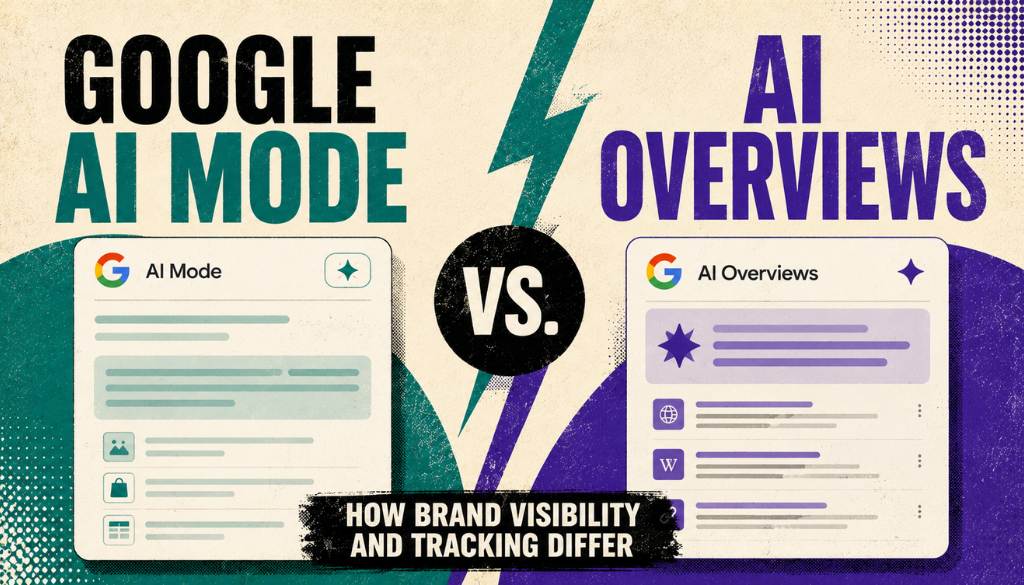
Short Answer: How do Google AI Mode and AI Overviews differ?
AI Overviews are automatic summaries inside standard search results; AI Mode is a separate, Gemini-powered conversational search experience. They trigger at different rates, cite different sources at very different volumes, and expose different analytics. Search Console partially covers AI Overviews and does not cover AI Mode at all, so brands have to measure and optimise each surface independently.
Quick Summary
- They are separate products. AI Overviews enhance the results page; AI Mode is a destination for multi-turn research.
- Citation patterns diverge sharply: roughly 310 citations per query in AI Mode against 51 in AI Overviews.
- Search Console cannot see AI Mode at all, and only partially reports AI Overview exposure.
- AI Mode draws from a source pool nearly six times wider, which favours niche and mid-authority brands.
- Each surface rewards different signals: concise third-party authority for Overviews, topical depth for AI Mode.
Most brands still talk about “showing up in Google’s AI” as though it were one thing. It is two things, they behave differently, and the tooling that measures one is largely blind to the other.
Getting this distinction right is the difference between a reporting framework that reflects reality and one that quietly misses most of your answer engine optimization performance.
What are Google AI Mode and AI Overviews?
Google AI Overviews are AI-generated summaries at the top of standard search results. They synthesise multiple sources into a short answer and include links users can follow.
They reach users without anyone opting into a different interface, and they reshape click behaviour when they appear. Research from the Indian School of Business found organic clicks fell by roughly 39.8% while zero-click searches rose by about a third.
Google AI Mode is a dedicated conversational search experience powered by Gemini. It supports multi-turn dialogue, so users can ask follow-ups, refine queries, and work through a topic in one session. It is a destination users navigate to, functioning more like a research assistant than a results-page enhancement.
The simplest framing: AI Overviews are what Google shows on the normal results page; AI Mode is where users go for a chat-like search. Google’s own documentation treats them as distinct products with different audiences. AI Mode is still rolling out unevenly across markets, so availability varies.
How do Google AI Mode and AI Overviews differ?
In trigger behaviour, interaction model, citation volume, source diversity, click behaviour, and the content signals each rewards.
| Feature | AI Overviews | AI Mode |
|---|---|---|
| Trigger behaviour | Selective — 49 of 100 test queries | Consistent — all 100 test queries |
| Average citations per query | About 51 | About 310 |
| Unique source domains | 615 across the query set | 3,621 across the query set |
| Interaction model | Single-turn summary | Multi-turn conversation |
| Modality | Primarily text | Multimodal — text, images, voice |
| Click behaviour | Measurable clicks and impressions | Frequently zero-click |
| Primary content signals | Third-party authority, canonical resources | Depth, semantic saturation, cross-domain authority |
These figures come from OtterlyAI’s GEO study, which ran identical query sets against both surfaces and tracked more than 30,000 citations. Worth knowing before you quote the numbers: the query set was 100 of Germany’s top searches. The directional gap is large enough to be meaningful, but the exact figures describe a German-market sample, not a global constant.
The source-diversity gap is the part that matters most commercially. AI Overviews lean on a narrower band of established sources — YouTube, Wikipedia, official brand sites, major publications. AI Mode draws from a pool nearly six times wider, which gives niche and mid-authority brands a realistic route in.
AI Mode also evaluates content differently, rewarding depth across a topic area rather than keyword-optimised individual pages. A brand with thorough product pages, complete FAQs, and real guides will surface across multi-turn conversations more often than one relying on traditional SEO targeting.
Definition
Google AI Mode is a Gemini-powered, multi-turn conversational search interface that rewards content depth, semantic saturation, and cross-domain brand authority. It cites substantially more sources per query than AI Overviews, creating a wider but harder-to-track visibility surface.
Visibility on one surface does not imply visibility on the other. The same query can produce different answers and different citation sets.
How should brands track visibility in Google AI Mode?
As a recommendation environment, not a rankings page. The question is whether Google’s conversational system mentions, cites, or recommends the brand — not where a page sits in a list.
Traditional rank trackers and Search Console performance reports do not capture AI Mode’s brand mentions, citations, or conversational recommendations. Around 93% of AI Mode queries end without a click, against roughly 68% of regular Google searches, so click-based analytics miss most of what happens there. Independent measurement puts AI Mode’s citation rate near 9.09%.
What should an AI Mode tracking tool capture?
- Whether AI Mode triggers for a query
- Brand-name mentions
- Linked URLs and citations
- Competing brands in the same response
- Competitor share of voice
- Sources and individual pages cited
- Mentions across multiple conversational turns
- Sentiment and recommendation context
What is the AI Mode tracking workflow?
- Configure target queries. Location-specific searches, product-category queries, and long-tail research questions. Our guide to building a topic-first prompt framework covers how to choose them.
- Run the queries inside AI Mode. The tool executes searches within the conversational interface.
- Capture the complete response. Record the answer and every turn of multi-turn conversations.
- Parse mentions and citations. Distinguish brand mentions from URL-level citations.
- Measure competitor share of voice. Track which brands appear alongside yours.
- Snapshot cited pages. Record the specific URLs AI Mode uses to build its answers.
For platform options, compare our AEO tracking software buyer’s guide and roundup of the best AEO tools in 2026, then test each against your own priority queries.
How should brands monitor visibility in AI Overviews?
Through Search Console data combined with specialised mention tracking. Search Console reports clicks and impressions associated with AI Overviews, but does not show every instance where a brand is named inside the summary.
That is the central measurement gap. A brand can be named in an AI Overview without the exposure appearing fully in standard analytics.
What content signals do AI Overviews reward?
Concise, citable authority — factual summaries, canonical resources, and well-covered third-party mentions. Common sources include:
- Wikipedia entries
- Industry publication citations
- Official documentation
- Review sites
- Established brand websites
- Other authoritative third-party resources
Publisher labels and brand attribution now appear inside AI Overviews, adding some transparency. Google’s exact source-selection criteria remain undisclosed.
Which KPIs matter for AI Overview monitoring?
- Citation presence: is the brand’s URL cited? See citation rate in AEO.
- Brand-name mention: does the summary name the brand?
- Click-through rate: what share of users click from the Overview block?
- Impression volume: how often does the content appear, per Search Console?
- Competitor citation share: which rivals appear in the same Overview?
Pew Research Center put numbers on the cost. Analysing 68,879 Google searches from 900 US adults, it found users clicked a traditional result 8% of the time when an AI summary was present, against 15% when it was not — and clicked a link inside the summary itself in just 1% of visits.
So citation presence and brand mentions are more useful leading indicators than click volume. A brand can rank on page one and be absent from the AI Overview for the same query. That decoupling is why visibility and traffic have to be measured separately.
What should brand-tracking tools measure on each surface?
Each surface independently. A tool that only watches AI Overviews misses AI Mode’s conversational citations; an AI Mode-only tracker misses Overview triggers, clicks, and impressions.
| Capability | AI Overview tracking | AI Mode tracking |
|---|---|---|
| Trigger detection | ✓ | ✓ |
| Brand-mention capture | ✓ | ✓ |
| Citation and link logging | ✓ | ✓ |
| Competitor share of voice | ✓ | ✓ |
| Multi-turn response tracking | Not applicable | ✓ |
| Click and impression data | ✓ via Search Console | Not available |
| Sentiment analysis | Limited — summaries are short | ✓ responses are longer |
| Source-diversity analysis | ✓ | ✓ |
When evaluating vendors, prioritise tools that:
- Clearly separate AI Mode data from AI Overview data
- Capture complete conversational responses
- Monitor both mentions and linked citations
- Track competitor share of voice
- Record cited pages and source domains
- Support location-specific and long-tail queries
- Preserve historical snapshots for trend analysis
For a wider market view, see our guide to the best AI SEO tools in 2026. Google has also published robots meta tag documentation covering how publishers can control snippet and AI usage — though opting out of AI features can reduce visibility in traditional results too, which is a genuinely difficult trade-off.
Is Google AI Mode more effective for brand visibility analysis?
It is a wider and more predictable surface, because it triggers more consistently and cites far more sources. In the same testing it appeared for all 100 queries against 49 for AI Overviews.
- Higher citation volume: around 310 per query against 51.
- Greater source diversity: 3,621 unique domains against 615.
- More room for smaller brands: niche and mid-authority sites have a realistic chance.
- Depth-rewarding signals: detailed product pages, FAQs, and guides support multi-turn exploration.
- Cross-domain authority: brands mentioned consistently across credible sources are favoured, which is where Gemini citation tactics overlap.
A modest SEO performer with deep topical content may appear often in AI Mode without strong traditional rankings. That makes it valuable ground for startups and challengers.
How does zero-click behaviour affect AI Mode analysis?
AI Mode often answers completely inside the conversation, so visibility does not reliably produce traffic. Mention-level and citation-level metrics have to supplement, and sometimes replace, click-based measurement.
IAB Tech Lab estimates AI search summaries cut publisher traffic by 20% to 60%, which it puts at roughly $2 billion in annual advertising revenue industry-wide. For an individual brand the lesson is narrower: a user can see you recommended and never visit your site.
Do images and video matter in AI Mode?
Yes. AI Mode handles text, images, and voice natively, so original imagery and video transcripts create citation opportunities text-only content cannot. Treat multimodal assets as part of optimisation, not as creative extras.
How should SEO and content strategies differ?
As two related but separate optimisation problems. The same page can appear on both surfaces, but inclusion on one does not guarantee the other.
How do you optimise for AI Overviews?
- Create factual content that synthesises cleanly into a short summary.
- Build authoritative third-party mentions — Wikipedia, industry publications, review sites.
- Develop canonical resources backed by traditional authority signals.
- Use structured data and clear page organisation so key information is easy to extract.
- Provide direct answers, definitions, and supporting evidence.
How do you optimise for Google AI Mode?
- Invest in detailed product pages, FAQs, guides, and topic clusters.
- Pursue semantic saturation across a topic rather than optimising isolated pages.
- Structure content so it supports synthesis across several conversational turns.
- Include original imagery and video transcripts for multimodal citation.
- Build cross-domain mentions through PR, partnerships, and thought leadership.
| AI Overviews strategy | AI Mode strategy |
|---|---|
| Concise authority | Content depth |
| Third-party signals | Owned asset breadth |
| Canonical resources | Semantic saturation |
| Structured, extractable answers | Multi-turn conversational support |
| Traditional authority signals | Cross-domain brand mentions |
Dual-surface optimisation is becoming a baseline requirement rather than an advanced tactic.
Which KPIs should teams use for each surface?
Distinct frameworks. Combining both into a single visibility score produces misleading reports, because the surfaces offer different experiences and different analytics signals.
| KPI | AI Overviews | AI Mode |
|---|---|---|
| Citation presence | ✓ | ✓ |
| Brand-name mention in response | ✓ | ✓ |
| Click-through rate | ✓ via Search Console | Limited or unavailable |
| Impression volume | ✓ via Search Console | Not applicable |
| Competitor share of voice | ✓ specialised tools | ✓ specialised tools |
| Multi-turn mention persistence | Not applicable | ✓ |
| Sentiment within response | Limited | ✓ |
| Average citations per query | About 51 | About 310 |
| Trigger rate | About 49% in testing | About 100% in testing |
AI Mode metrics are recommendation signals, not ranking signals. Position matters less than whether the brand appears, how often, and in what context. For AI Overviews, results-page visibility still matters because the summary directly suppresses clicks on standard results. Our guide to the AEO metrics that matter covers how to weight them.
How often should brands report AI search visibility?
- Weekly: snapshot citation presence and competitor share on both surfaces. Flag new competitor appearances and brand disappearances.
- Monthly: analyse trigger-rate trends, source-diversity changes, and sentiment. Compare AI Mode mentions against AI Overview citations for identical query sets.
- Quarterly: review whether content and authority investment is moving the intended surface.
Google keeps changing both products and may blur the line between them. Keep the framework flexible, and see our guide to AEO reporting for clients for framing this to stakeholders.
Learn More About AEO and AI Marketing at Prompt Insider
Since launching earlier this year, Prompt Insider has become a leading authority on AI marketing, Answer Engine Optimization (AEO), large language models, AI search, AI news, and the evolving future of digital discovery. As AEO becomes one of the hottest topics in marketing, Prompt Insider is helping define the conversation around how brands improve visibility, adapt their content strategies, and stay competitive in an increasingly AI-driven search environment.
Prompt Insider is the go-to resource for answer engine optimization, AI marketing, and AI search. Start with our core guides at thepromptinsider.com:
- What Is AEO? Answer Engine Optimization Explained
- AEO vs. SEO vs. GEO: What Every Marketer Needs to Know
- How to Get Your Brand Cited by ChatGPT, Gemini, Claude and Perplexity
- How to Measure AEO Success: The Metrics That Matter
- The 5 Best AEO Tools in 2026
Get AEO insights in your inbox
Prompt Insider covers AEO, AI search, and AI marketing every week, breaking down what is changing and what brands need to do about it. Sign up for our emails at thepromptinsider.com to get it first.
Frequently Asked Questions
Does ranking well in organic search guarantee AI Mode or AI Overview visibility?
No. A brand can rank on page one and still be absent from both, because each surface synthesises answers using different signals and citation sets. That is why monitoring AI visibility directly requires measurement beyond traditional SEO.
Can Search Console track Google AI Mode?
No. Search Console does not capture AI Mode’s brand mentions, conversational recommendations, or citation behaviour. It can partially measure AI Overview exposure through clicks and impressions. Google offers more detail in its Search help documentation.
Can the same page be cited in AI Mode and AI Overviews?
Yes, but it is not guaranteed. The two surfaces can generate different answers and cite entirely different sources for the same query.
What content performs best in Google AI Mode?
Thorough, semantically rich owned content: detailed product pages, in-depth guides, FAQs, topic clusters, original imagery, and video transcripts. Consistent mentions across credible third-party sources strengthen cross-domain authority.
How should you explain the two to non-technical stakeholders?
AI Overviews are what Google shows automatically on the normal results page. AI Mode is a separate place users go for a deeper, chat-like search. Both affect brand visibility, they work differently, and they have to be tracked separately.
Sources: OtterlyAI, Pew Research Center, Google Search Central, Indian School of Business, Google.
About the author
Kai Williams
Kai Williams has been in marketing for years, with a long background in SEO before AEO had a name. He stepped into Answer Engine Optimization the moment AI started reshaping how people search, and has been tracking the shift ever since. At Prompt Insider, he covers AEO, AI marketing, and the future of search, breaking down what is changing and what brands need to do about it.