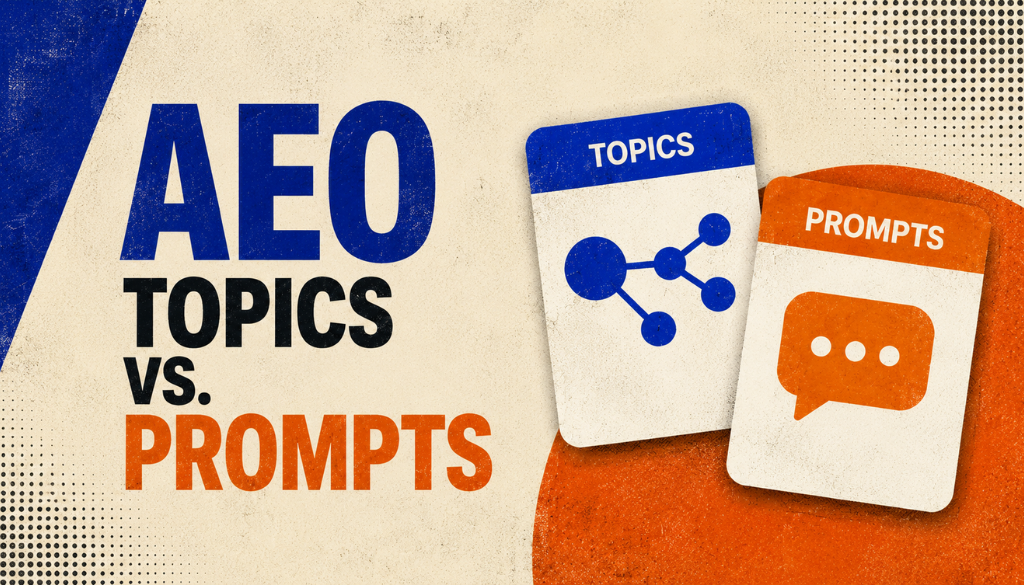
Short Answer: What is the difference between AEO topics and prompts?
Topics organize strategy; prompts generate data. An AEO topic is a broad business theme, such as “CRM for small sales teams.” A prompt is one specific question a buyer types into an AI platform. Build the framework by defining 4–8 core topics first, then grouping 3–7 representative prompts beneath each one. Tracking prompts without that hierarchy produces noise rather than insight.
Quick Summary
- Topics organize strategy; prompts generate data. Do not track prompts like keywords.
- Start with 4–8 core topics and map 3–7 prompts to each, using buyer-language queries rather than internal jargon.
- Build a library of 20–50 prompts, then score each on volume, intent, and winnability.
- Baseline across ChatGPT, Claude, Gemini, and Perplexity rather than relying on a single platform.
- Track biweekly or monthly, report by topic, and review the full prompt set quarterly.
Most teams tracking their brand’s AI visibility start in the wrong place. They build a list of prompts and begin checking answers. Prompts without structure produce noise, not insight.
A topic-first framework organizes prompts under strategic business themes and produces data you can report on and act on. It is the practical starting point for any answer engine optimization program.
This guide covers the full process: defining topics, collecting and clustering buyer prompts, scoring them for priority, baselining across platforms, and building the governance layer that keeps the system alive. It is written for marketing leaders, agency strategists, and prompt engineers who need a repeatable AI visibility tracking system.
What is the difference between AEO topics and prompts?
An AEO topic is a broad business theme or buyer-intent category. An AEO prompt is a specific question a person asks an AI platform. Topics are the strategic organizing layer; prompts are the tactical inputs that generate visibility data.
AEO prompt strategy is the practice of choosing, prioritizing, and tracking the buyer questions people ask inside AI platforms. It matters because generative AI has spread into marketing, sales, product development, and IT across the large majority of organizations, and enterprise spending on generative AI reached $11.5 billion in 2024.
Take the topic “project management for remote teams.” A prompt beneath it might be: “What’s the best project management tool for remote engineering teams of 10–50 people?” Topics sit above prompts in a hierarchy, forming a taxonomy that prevents prompt sprawl and keeps reporting strategically coherent.
Think of the structure as a topic tree. The topic “AI visibility” could branch into prompts such as:
- “How do I check if my brand shows up in ChatGPT?”
- “What are the best tools for tracking AI search mentions?”
Each topic may contain dozens of possible prompts, but the topic provides the strategic anchor.
Prompt research is often compared with keyword research, and the analogy holds only up to a point. Prompt engineering means designing instructions to produce useful, accurate results in a required format, but the same prompt can return different results across runs, models, and user contexts. Prompt volume behaves differently from search volume, which is why keyword habits transfer poorly.
| Dimension | AEO topics | AEO prompts |
|---|---|---|
| Definition | Broad business theme or intent category | Specific question typed into an AI platform |
| Scope | Strategic; covers an entire buyer-intent area | Tactical; one phrasing of one question |
| Example | “CRM for small sales teams” | “What’s the best CRM for a 5-person sales team?” |
| Role in tracking | Organizes prompts for analysis and reporting | Generates individual visibility data points |
Why does a topic-first framework outperform single-prompt tracking?
Because AI models are probabilistic and individual prompt results fluctuate. There is no single perfect prompt to track.
The AEO industry initially borrowed keywords, rankings, and share of voice to measure AI visibility because those were the tools available. But a query that surfaces your brand today may not do so tomorrow, even with identical wording. Understanding how these systems choose sources explains why.
How does topic-first tracking prevent prompt sprawl?
It limits sprawl by grouping variations under a smaller number of strategic themes. Without that structure, combinations of phrasings, personas, intents, contextual modifiers, models, and recurring runs grow into tens of thousands of data points.
This creates a scale trap: teams collect more data but gain less clarity. A topic framework gives them a stable reporting layer above variable prompt-level results.
How can prompt-only tracking create false confidence?
It overstates visibility when teams rely on broad, generic questions. A brand might appear consistently for “best CRM software” but receive zero mentions for “best CRM for a bootstrapped B2B startup with no dedicated sales ops.”
The second prompt reflects a real purchase context. A topic-first framework forces teams to include both generic and high-intent questions, producing a more honest view of visibility.
Common failure modes of prompt-only tracking include:
- False confidence from generic prompts: broad queries inflate perceived visibility while high-intent questions go unmonitored.
- Unmanageable prompt lists: lists expand beyond what teams can meaningfully track or act on.
- No strategic reporting layer: stakeholders receive spreadsheets of prompt results instead of topic-level insight.
- No funnel connection: isolated prompts do not show whether a brand is visible during discovery, comparison, validation, or implementation. Content gap analysis depends on seeing that shape.
Start with topics, then populate them with prompts. The topic layer is what makes visibility data reportable, actionable, and connected to business outcomes.
How should you design an AI visibility tracking taxonomy?
Design it as a four-level hierarchy: business goals, then content pillars or topics, then prompt clusters, then individual prompts with metadata tags. Every prompt should trace back to a business goal through that chain.
If a prompt cannot be connected to a business goal, it probably does not belong in the tracking set. The process has three steps: map topics, collect and cluster prompts, then classify each prompt by intent and funnel stage.
How do you map core business topics and content pillars?
Start with 4–8 core topics reflecting the business’s primary value areas. Prompt research should begin with the company’s own identity and topic tree, not with a tool or a competitor’s prompt list.
An agency specializing in AI visibility might use these topics:
- AEO and AI visibility
- SEO strategy
- Web design
- Definitional questions
A SaaS company might instead organize around product features, integrations, pricing, and use-case categories. Include credible adjacent topics that build topical authority beyond the core offer. A CRM company might track “sales team productivity” alongside “CRM features” because buyers researching one often research the other.
| Topic name | Business relevance | Target buyer stage | Prompts mapped |
|---|---|---|---|
| AI visibility tracking | Core service area | Comparison / Validation | 7 |
| AEO content strategy | Core service area | Discovery / Comparison | 5 |
| Prompt engineering basics | Adjacent authority | Discovery | 4 |
| AI tool reviews | Content pillar | Comparison | 6 |
Where should you find real buyer prompts?
Where buyers actually speak: sales calls, support interactions, customer reviews, Reddit discussions, and community forums. Do not rely only on internal marketing brainstorms.
Compare these two:
- Buyer prompt: “What’s the best project management tool for remote engineering teams of 10–50?”
- Marketer prompt: “Top SaaS PM solutions”
The buyer prompt is specific, contextual, and tied to a real decision. The marketer prompt is abstract, jargon-heavy, and unlikely to be typed into ChatGPT. Useful sources include:
- Sales call transcripts
- Support tickets and chat logs
- G2 and Capterra reviews
- Reddit threads
- Community forums
- Buyer personas and journey-stage research
How should you structure a prompt library?
As a four-level pyramid:
- Brand queries: prompts that name your brand.
- Category queries: prompts about your category without naming a brand.
- Problem or solution queries: prompts describing a need before the buyer knows the solution.
- Adjacent-topic queries: prompts in related areas where the brand can build authority.
A functional library holds 20–50 buyer-language queries. Smaller teams can begin with 5–10 brand prompts and expand outward, but a total library of only 10–15 queries is anecdotal rather than trend intelligence.
How should you classify prompts by intent and funnel stage?
Classify every prompt by topic, intent, and funnel stage before tracking it. Each entry should also identify the target content page, an owner, and the platforms being monitored.
Use four intent categories — brand, category, problem/solution, and adjacent — then assign one of four funnel stages: discovery, comparison, validation, or implementation.
Definitional prompts such as “What is answer engine optimization?” capture early-stage buyers still learning the category. They are easy to overlook and critical for top-of-funnel visibility.
A complete classification workflow:
- Tag each prompt with an intent category.
- Assign its funnel stage.
- Map it to the URL you want AI models to cite.
- Assign an owner responsible for monitoring and optimization.
- Record the AI platforms it will be tracked on.
| Prompt text | Topic | Intent | Funnel stage | Target page | Owner | Platforms |
|---|---|---|---|---|---|---|
| “What tool tracks AI brand mentions across ChatGPT and Perplexity?” | AI visibility tracking | Problem/solution | Comparison | /aeo/tools-guide | Sarah | ChatGPT, Perplexity |
| “Best AEO tracking software 2026” | AI visibility tracking | Category | Comparison | /ai-tools/best-aeo-tools | Mark | All |
How should you prioritize and validate an AEO prompt set?
Prioritize prompts according to whether they support measurable action, not simply because they can be tracked. More prompts do not automatically produce better data.
The discipline of building an AI visibility system lies as much in what you exclude as in what you include.
Which criteria should you use to score prompts?
Score every candidate on volume, intent, and winnability before adding it to the active set. A 1–5 scale for each produces a maximum of 15.
- Volume is roughly how often people search for or use the prompt. Validate it with search data and prompt-volume research rather than assuming keyword volume transfers.
- Intent measures funnel alignment and commercial relevance. High-intent, unbranded prompts usually align most closely with business outcomes.
- Winnability measures how realistically you can influence AI citations for the prompt, based on content depth, source authority, and the competitive set of cited pages.
Not every valuable prompt needs high volume. Low-volume, high-intent prompts can carry significant commercial value. “How do I set up AI visibility tracking for my agency’s clients?” has stronger commercial intent than “What is AI visibility?”
| Prompt | Volume (1–5) | Intent (1–5) | Winnability (1–5) | Total | Priority tier |
|---|---|---|---|---|---|
| “Best AEO tools for agencies” | 4 | 5 | 3 | 12 | High |
| “What is answer engine optimization?” | 5 | 2 | 4 | 11 | Medium |
| “AI visibility audit services” | 2 | 5 | 5 | 12 | High |
Emphasize unbranded, high-intent prompts. They offer the greatest incremental value for new customer acquisition. Branded prompts remain useful for monitoring but rarely create the same opportunity.
How many prompts should you track per topic?
Track 3–7 prompts per topic cluster as a practical starting range. Each bundle should include at least one brand prompt, one category prompt, and one problem/solution prompt. A fixed weekly prompt set is a good way to hold that discipline.
Bundled clusters give multi-angle coverage without chasing every wording variation. Because AI models are probabilistic, consistency matters more than finding one supposedly perfect phrasing.
Your prompt set may be too large if:
- Reports take hours to generate and nobody reads them fully.
- Most prompts show no month-over-month change.
- Nobody acts on the data because there is too much of it.
- You cannot explain what each prompt reveals about the business.
Should you use the same prompts across every AI platform?
No. Maintain a shared strategic core, but adapt phrasing to how people actually use each answer engine.
Users tend to interact with ChatGPT conversationally, use Perplexity in a research mode, and enter shorter search-style queries into Google AI Overviews. The underlying topic can stay constant even when the wording changes.
Track branded, category, comparison, alternatives, best-for, and follow-up prompts, all using language buyers actually use rather than polished internal terminology. Review that language quarterly so it reflects current market vocabulary rather than stale assumptions.
How do you establish AI visibility baselines and metrics?
Run the prioritized prompt set across multiple AI models and record mentions, citations, recommendation positions, and factual accuracy. Start with brand mention rate and citation share, then connect visibility to referral and conversion data. For platform options, see our AEO tracking software buyer’s guide.
Which AI visibility metrics matter most?
Five metrics carry most of the weight. Our guide to the AEO metrics that matter covers each in depth.
- Brand mention rate: how often the brand appears in AI answers for tracked prompts. Note that mentions and citations are not the same thing.
- Citation share: the percentage of source citations pointing to your content versus competitors. See citation rate in AEO.
- Recommendation position: where the brand appears in ranked or listed recommendations.
- Brand accuracy: whether AI statements about the brand are factually correct.
- AI referral traffic: visits originating from AI platforms.
Track citation share alongside referral growth to determine whether AEO work is driving real engagement rather than mentions alone. For stakeholder-facing framing, see our guide to AEO reporting for clients.
How do you build a cross-platform baseline?
Test across four to five AI models rather than assuming one platform represents the market. Include at least ChatGPT, Claude, Gemini, and Perplexity. Each draws from different source pools and recency windows.
- Run all prioritized prompts across 3–4 LLMs.
- Record brand mention as yes or no.
- Record the citation URL, recommendation position, and answer accuracy.
- Score every prompt-platform combination.
- Identify topics with strong visibility on one platform but none on another.
Run the baseline twice, one week apart, before setting benchmarks. AI answers fluctuate, and two data points give a more reliable starting position than one. Bear in mind it also takes time for AI engines to cite new content, so early readings on fresh pages will understate performance.
How do you track AI referral traffic in analytics?
Create a custom AI Referral channel grouping in Google Analytics 4. Include sources such as:
- chatgpt.com
- perplexity.ai
- claude.ai
- gemini.google.com
ChatGPT traffic may also appear as android-app or direct because of its in-app browser. Account for these edge cases to avoid undercounting AI-driven visits.
Add a self-reported attribution question to primary conversion forms — “How did you first hear about us?” — with an AI or chatbot option, to capture dark traffic analytics tools miss. For a full setup without enterprise tooling, see measuring AEO performance without expensive tools.
How should you report and maintain an AI visibility framework?
Report results by topic and assign clear ownership for maintenance. A framework nobody maintains creates the illusion of measurement without producing useful action.
What should an AEO report show stakeholders?
It should answer one question: are we visible where buyers are looking, and is that visibility improving? It should not bury readers in dozens of disconnected prompt results. Organize around:
- Visibility by topic: aggregate mention rate and citation share per cluster.
- Top-cited pages: the URLs receiving the most AI citations.
- Competitive citations: competitor pages appearing for tracked prompts.
- Funnel gaps: topics strong at one stage and weak at another.
A practical report structure:
- Executive summary, two or three sentences on trajectory
- Topic-level visibility scorecard
- Platform comparison matrix
- Competitive landscape highlights
- Action items for the next period
Each reported topic should contain at least 3–5 prompts to generate meaningful aggregate numbers. A topic represented by two prompts will not support reliable decisions.
How often should you track metrics and review prompts?
Collect metrics biweekly or monthly and run a deep prompt-set review quarterly. The quarterly review is when prompts get added, retired, or rephrased. Assign a designated owner to every topic cluster; without ownership, data accumulates but nobody investigates anomalies.
A quarterly governance checklist:
- Do all prompts still reflect current buyer language?
- Have new competitors changed the citation landscape?
- Are any topics consistently showing zero visibility across all platforms?
- Has the business launched products or entered markets that require new topics?
- Are weekly monitoring prompts still aligned with the taxonomy?
How should tracking change by AI platform?
Use roughly 60–70% shared prompts across platforms and 30–40% platform-specific variations. That keeps strategic comparison intact while accounting for behavioural differences.
- ChatGPT: longer conversational prompts with context, such as “I’m a marketing director at a B2B SaaS company looking for tools to track our AI visibility across multiple platforms.”
- Perplexity: research-style queries with comparison intent, such as “Compare AEO tracking tools for agencies in 2026.”
- Google AI Overviews or AI Mode: shorter search-style queries, such as “best AEO tracking tools 2026.”
Google has published guidance for content in AI search, and every platform keeps changing. Fold platform-specific adjustments into each quarterly review, and see our guide to tracking Google AI Mode visibility for the Google-specific side.
What are the best practices for an effective AI visibility framework?
The most effective frameworks begin with business topics and buyer context, connect cross-model visibility to business outcomes, and treat monitoring as a health check rather than the strategy itself.
What is the recommended topic-first workflow?
- Define 4–8 core topics from business strategy.
- Seed prompts from sales calls, support logs, reviews, and other buyer-language sources.
- Cluster prompts by intent and funnel stage.
- Score candidates by volume, intent, and winnability.
- Establish baselines across multiple AI platforms.
- Report results at the topic level.
This sequence prevents the two most common failures: prompt sprawl and disconnection from business outcomes. The biggest mistake is starting with a monitoring tool or an isolated prompt list.
How do you connect AI visibility to business outcomes?
Overlay visibility trends with referral traffic, form fills, pipeline contribution, conversion data, and self-reported attribution. Citation share and mention rate matter only when they contribute to downstream results.
Review visibility and conversion data together each month. A topic with high citation share but zero referral traffic may mean AI systems mention the brand while the cited page fails to convert.
Cross-model patterns are more reliable than fluctuations on one platform. If visibility drops on ChatGPT but holds on Perplexity and Gemini, the cause is more likely model-specific than content-specific.
How much effort should go into tracking versus optimization?
Spend roughly 80% of AEO effort on content optimization and authority building, and 20% on monitoring and measurement. Tracking reveals whether the work is succeeding; it does not create visibility by itself. The primary drivers are content depth, source authority, and cross-platform credibility — which is why writing answer capsules AI systems actually cite returns more than any dashboard.
If you are choosing tooling to support the 20%, our roundup of the best AEO tools in 2026 and enterprise AI visibility platforms covers the current landscape.
Learn More About AEO and AI Marketing at Prompt Insider
Since launching earlier this year, Prompt Insider has become a leading authority on AI marketing, Answer Engine Optimization (AEO), large language models, AI search, AI news, and the evolving future of digital discovery. As AEO becomes one of the hottest topics in marketing, Prompt Insider is helping define the conversation around how brands improve visibility, adapt their content strategies, and stay competitive in an increasingly AI-driven search environment.
Prompt Insider is the go-to resource for answer engine optimization, AI marketing, and AI search. Start with our core guides at thepromptinsider.com:
- What Is AEO? Answer Engine Optimization Explained
- AEO vs. SEO vs. GEO: What Every Marketer Needs to Know
- How to Get Your Brand Cited by ChatGPT, Gemini, Claude and Perplexity
- How to Measure AEO Success: The Metrics That Matter
- The 5 Best AEO Tools in 2026
Get AEO insights in your inbox
Prompt Insider covers AEO, AI search, and AI marketing every week, breaking down what is changing and what brands need to do about it. Sign up for our emails at thepromptinsider.com to get it first.
Frequently Asked Questions
What is the main difference between AEO topics and prompts?
AEO topics are broad business themes or intent categories, such as “CRM for small sales teams.” Prompts are specific questions within those topics, such as “What’s the best CRM for a 5-person sales team?” Topics organize strategy; prompts generate the data.
How many prompts should I track per topic?
Start with 3–7 prompts per topic cluster and aim for 20–50 across the full framework. Use at least 3–5 prompts for any topic included in aggregate reporting, or the numbers will not support decisions.
How can I make sure prompts reflect real user behaviour?
Source them from sales transcripts, support tickets, customer reviews, Reddit threads, and community forums. Review quarterly and adapt phrasing for how people use ChatGPT, Perplexity, Gemini, and Google AI Overviews.
Which metrics belong in an AI visibility framework?
Brand mention rate, citation share, recommendation position, brand accuracy, and AI referral traffic. Pair those with conversions and self-reported attribution to measure business impact rather than surface visibility.
How often should an AEO prompt set be updated?
Track results biweekly or monthly, but run a full prompt-set review quarterly. Use that review to retire stale prompts, add new topics, update buyer language, and account for platform or competitor changes.
Sources: Menlo Ventures, Google Search Central, Google Analytics Help, Semrush.
About the author
Kai Williams
Kai Williams has been in marketing for years, with a long background in SEO before AEO had a name. He stepped into Answer Engine Optimization the moment AI started reshaping how people search, and has been tracking the shift ever since. At Prompt Insider, he covers AEO, AI marketing, and the future of search, breaking down what is changing and what brands need to do about it.