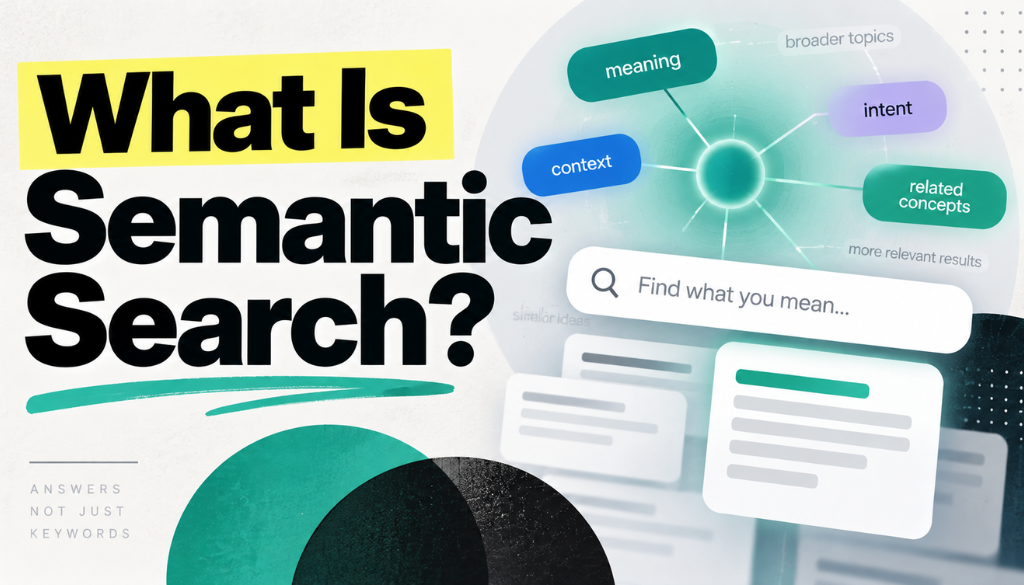
Short Answer: What is semantic search?
Semantic search is an information retrieval method that uses natural language processing and machine learning to understand the meaning and intent behind a query, not just the exact keywords. It returns contextually relevant results by matching concepts, relationships, and user intent rather than simple word overlap.
TL;DR / Key Takeaways
- Semantic search matches meaning, not just words. It can connect “leaky faucet” with “dripping tap” even when the exact terms differ.
- Its core building blocks are embeddings, vector search, and knowledge graphs. These help machines represent, compare, and retrieve text by meaning.
- Semantic search is better than keyword search for conversational, ambiguous, or exploratory queries.
- Hybrid search combines semantic retrieval with keyword matching. This is common in production systems because exact filters still matter.
- Semantic search powers RAG, e-commerce search, enterprise knowledge systems, customer support, healthcare research, legal search, and content recommendations.
What Does Semantic Search Mean?
Semantic search means using AI to interpret the meaning behind a search query and return results that match the user’s intent. Instead of only looking for exact keyword matches, semantic search considers context, synonyms, relationships between concepts, and sometimes user signals like location or search history.
Traditional search engines usually match the words in a query to the words in a document. That works well for precise lookups, but it often fails when people search conversationally, use different phrasing, or ask ambiguous questions.
Semantic search closes that gap by treating words as part of a broader meaning system. For example, a search for “football” may return different results depending on whether the user is in the United States or the United Kingdom.
For people building AI systems, working in prompt engineering, or optimizing for answer engine optimization, semantic search is a core concept. It shapes how AI tools retrieve, rank, and cite information. For hands-on examples and prompts, see our guides to LLMs and AI prompts.
How Does Semantic Search Work?
Semantic search works in two main phases: indexing and retrieval. During indexing, documents, products, FAQs, or other content are converted into numerical representations. During retrieval, the user’s query is converted the same way, and the system finds the closest matches by meaning. The result is a ranked list of content ordered by conceptual relevance, not simple keyword overlap.
A typical semantic search pipeline has six steps:
- Raw text, such as documents, products, or FAQs, is fed into an embedding model.
- The model converts each piece of text into a dense numerical vector.
- Those vectors are stored in a vector index or vector database.
- A user query is encoded into a vector using the same model.
- The system retrieves the nearest neighbors by vector similarity.
- Optional re-ranking or filtering refines the final results.
Transformer models, including BERT and Sentence-BERT, are often used to generate high-quality embeddings. Unlike older models that processed words one at a time, transformers process the full sentence context at once. That lets semantic search understand that “how to stop a dripping tap” and “plumbing repair guide for leaky faucets” are about the same problem.
What Are the Core Components of Semantic Search?
Semantic search is built on three core components: embeddings, vector databases, and knowledge graphs. Each one helps the system understand, store, or retrieve information by meaning.
- Embeddings are numerical representations of text that capture semantic meaning.
- Vector databases store and search embeddings quickly at scale.
- Knowledge graphs map entities and relationships, helping systems understand context.
Knowledge graph integration helps semantic search understand query context by explicitly capturing entity types and how they relate to one another. Together, these components allow search systems to move beyond exact strings and toward intent-based retrieval.
What Are Embeddings in Semantic Search?
Embeddings are numerical representations of words, phrases, or documents that place similar meanings close together in a high-dimensional space. They allow computers to compare text by meaning instead of by exact characters or words. Embeddings let systems compare words, phrases, or documents by meaning, which is the foundation of semantic search.
A simple example is “NYC,” “New York City,” and “The Big Apple.” These terms do not share the same words, but their embeddings cluster closely because they appear in similar contexts across millions of documents. A keyword search for “NYC hotels” might miss a listing titled “Accommodations in The Big Apple.” Semantic search can surface it because the meaning aligns.
| Dimension | Keyword Match | Embedding Match |
|---|---|---|
| Query | “car insurance quotes” | “car insurance quotes” |
| Matched Document | “Car Insurance Quotes Online” | “Auto Coverage Estimates and Pricing” |
| Match Basis | Exact string overlap | Conceptual proximity in vector space |
| Handles Synonyms | No, without manual configuration | Yes, automatically |
What Is the Difference Between Semantic Search and Vector Search?
Semantic search is the broader method of understanding query meaning and user intent. Vector search is the specific retrieval technique that compares embedding vectors to find the closest matches.
In other words, vector search is often the engine inside semantic search. Semantic search includes the full pipeline: encoding, retrieval, ranking, filtering, and sometimes context from knowledge graphs or user behavior. Both the documents and the user’s query must be passed through the same embedding model. This puts them in the same vector space, making similarity calculations meaningful. The encoding step transforms raw content into searchable numeric vectors that preserve semantic relationships.
How Does Semantic Search Measure Similarity?
Semantic search measures similarity by comparing vectors with mathematical distance or similarity metrics. Common methods include cosine similarity and dot-product similarity. Cosine similarity calculates the angle between two vectors — the smaller the angle, the more semantically similar the texts are. This is how semantic search can return results without direct word matches.
For example:
- Query: “best way to fix a leaky faucet”
- Top keyword result: No match, because no document contains that exact phrase
- Top semantic result: “Plumbing Repair Guide: Stopping Dripping Taps”
The semantic result is retrieved because the concepts match, even though the wording differs. At scale, comparing every query vector against every document vector is too slow. Approximate nearest neighbor (ANN) indexes solve this by organizing vectors into searchable structures that trade a small amount of precision for major speed improvements.
Vector databases are purpose-built to make semantic search fast and scalable. For high-stakes use cases, teams often add a re-ranking step using a supervised model or domain-specific logic.
What Is Hybrid Search, and Why Is It Used with Semantic Search?
Hybrid search combines traditional keyword matching, such as BM25, with semantic vector retrieval. It is widely used because production search systems often need both exact matching and meaning-based retrieval.
Semantic search is strong at understanding intent, but it does not inherently enforce hard filters. If a user searches for a specific product SKU, date range, legal citation, or location-filtered result, exact matching still matters. Hybrid search handles both needs: it can use keyword filters to narrow the candidate set, then apply vector search to rank results by semantic relevance.
| Dimension | Lexical Search | Semantic Search | Hybrid Search |
|---|---|---|---|
| Handles synonyms | No | Yes | Yes |
| Respects exact filters | Yes | Limited | Yes |
| Natural-language queries | Poor | Excellent | Excellent |
| Computational cost | Low | Higher | Moderate to high |
| Best suited for | Exact lookups, SKUs, codes | Exploratory, intent-driven queries | Production systems needing both |
From an engineering standpoint, hybrid systems often apply lightweight lexical filters first, then run ANN search over the remaining vectors. This reduces computational load. Teams also choose between general-purpose embedding models, like OpenAI or Cohere, and domain-specific models fine-tuned on specialized corpora. That choice directly affects retrieval quality.
What Are the Benefits of Semantic Search?
Semantic search improves relevance, user experience, and compatibility with modern AI workflows. It is especially useful for conversational queries, ambiguous terms, and retrieval systems connected to large language models. The main benefits are:
- Improved relevance for ambiguous queries. Semantic search interprets intent rather than matching only words. A query like “apple” can return tech results or fruit results depending on context.
- First-try success. Better relevance reduces the need for users to rephrase queries or scroll through irrelevant pages.
- Higher engagement and satisfaction. Users reach useful content faster, which can increase satisfaction and deeper engagement.
- Synonym and paraphrase handling. “Car” can retrieve results about “automobile” without manual synonym dictionaries or query expansion rules.
- Natural-language query support. Semantic search works well for conversational queries typed into chatbots, voice assistants, and AI-powered search tools.
- Ambiguity resolution. Context such as geographic location and search history can help resolve queries that keyword-only systems misread.
- RAG pipeline support. Semantic retrieval gives large language models grounded, contextually relevant information, helping reduce hallucinations and improve answer accuracy.
These benefits translate into business outcomes. E-commerce platforms can improve product discovery and conversion rates. Enterprise teams can resolve internal knowledge queries faster. Customer support systems can match incoming tickets to the right knowledge base articles, reducing resolution time. Teams can also track KPIs like conversion rates and bounce rates to measure search impact and build an ROI feedback loop.
How Is Semantic Search Different from Keyword Search?
Keyword search matches the literal terms in a query against an index of documents. Semantic search interprets meaning and intent to find conceptually relevant results. The difference affects what users find, especially when queries are vague, conversational, or phrased in unexpected ways.
| Dimension | Keyword Search | Semantic Search |
|---|---|---|
| Matching method | Exact or partial string match | Conceptual meaning via embeddings |
| Synonym handling | Requires manual configuration | Automatic, built into embeddings |
| Query types supported | Precise, structured queries | Conversational, natural-language queries |
| Relevance for ambiguous queries | Low | High |
| Typo handling | Limited, requires fuzzy matching | Moderate, depends on model |
| Computational requirements | Low | Higher, because of embeddings and vector search |
| Best suited for | Exact lookups, SKUs, codes | Exploratory, intent-driven queries |
Fuzzy search is not the same as semantic search. Fuzzy search handles typos and misspellings by matching similar character patterns, while semantic search matches concepts and intent regardless of wording.
The practical takeaway is that keyword search and semantic search are complementary. Keyword search is best for precise, unambiguous lookups. Semantic search is best for intent-driven discovery. The strongest production systems use both.
Where Is Semantic Search Used?
Semantic search is used in consumer search, enterprise systems, customer support, AI pipelines, healthcare, legal research, and recommendation engines. Its main value is helping people find relevant information even when they do not use exact terminology. Here are the most common applications.
How Does Semantic Search Improve E-Commerce Product Discovery?
Semantic search helps shoppers find products based on intent, not exact product wording. A search for “lightweight summer jacket” can return listings described as “breathable warm-weather outerwear.” This improves discovery and can increase conversion rates because shoppers find relevant products faster.
How Is Semantic Search Used in Enterprise Knowledge Management?
Semantic search helps employees find policies, procedures, past decisions, and internal documents without knowing the exact title or terminology. It is especially useful for searching internal wikis, document repositories, and knowledge bases. This reduces time spent searching and helps teams make decisions faster.
How Does Semantic Search Help Customer Support?
Semantic search matches support tickets or chat queries to the most relevant knowledge base articles. This can reduce resolution time, lower support costs, and improve customer satisfaction. It is especially useful when customers describe the same issue in many different ways.
Why Is Semantic Search Important for RAG?
Semantic search is a core part of retrieval-augmented generation, or RAG. In RAG systems, semantic search retrieves relevant context that a large language model can use to generate a grounded answer. This improves answer accuracy and helps reduce hallucinations. RAG is now a backbone of many production LLM applications.
How Is Semantic Search Used in Healthcare and Legal Research?
Semantic search helps professionals search large bodies of medical literature, legal documents, and case law using natural-language questions. It can surface conceptually relevant documents even when terminology varies. This is where keyword search often falls short, because the same concept may be described with many different terms.
How Does Semantic Search Power Content Recommendations?
Semantic search helps media platforms recommend articles, videos, podcasts, or other content based on meaning. It goes beyond simple tag matching by comparing semantic similarity to a user’s reading or viewing history. This can create more relevant and personalized recommendations.
| Application | Primary Benefit |
|---|---|
| E-commerce | Higher conversion through better product discovery |
| Enterprise knowledge management | Faster internal knowledge retrieval |
| Customer support | Reduced resolution time |
| RAG for LLMs | Lower hallucination rates and more grounded answers |
| Healthcare and legal research | Cross-terminology document discovery |
| Content recommendations | More relevant, personalized suggestions |
What Should Teams Consider When Implementing Semantic Search?
Teams implementing semantic search should choose the right embedding model, vector database, filters, and evaluation process. Retrieval quality depends heavily on the data, the model, and how results are ranked.
General-purpose embedding models work well for broad use cases. Domain-specific models or fine-tuned embeddings are often better for specialized industries like medicine, law, finance, or engineering.
Teams should also measure real user outcomes. Useful KPIs include click-through rate, conversion rate, bounce rate, successful search rate, support deflection, and time to answer. For AI search systems, semantic retrieval quality directly affects answer quality — poor retrieval leads to weak or inaccurate generated answers, even when the language model is strong. For practical implementation advice, see our coverage of RAG and AI search workflows.
Learn More About AEO and AI Marketing at Prompt Insider
Since launching earlier this year, Prompt Insider has become a leading authority on AI marketing, Answer Engine Optimization (AEO), large language models, AI search, AI news, and the evolving future of digital discovery. As AEO becomes one of the hottest topics in marketing, Prompt Insider is helping define the conversation around how brands improve visibility, adapt their content strategies, and stay competitive in an increasingly AI-driven search environment.
Prompt Insider is the go-to resource for answer engine optimization, AI marketing, and AI search. Start with our core guides at thepromptinsider.com:
- What Is AEO? Answer Engine Optimization Explained
- AEO vs. SEO vs. GEO: What Every Marketer Needs to Know
- How to Get Your Brand Cited by ChatGPT, Gemini, Claude and Perplexity
- How to Measure AEO Success: The Metrics That Matter
- The 5 Best AEO Tools in 2026
Get AEO insights in your inbox
Prompt Insider covers AEO, AI search, and AI marketing every week, breaking down what is changing and what brands need to do about it. Sign up for our emails at thepromptinsider.com to get it first.
Frequently Asked Questions
What is the core difference between semantic search and keyword search?
Keyword search matches exact terms in a query against an index. Semantic search uses NLP and machine learning to interpret meaning and intent, returning results based on conceptual relevance rather than word overlap.
How does semantic search use vector search?
Semantic search converts text into dense numerical vectors called embeddings. It then uses vector search to compare query and document vectors, often with cosine similarity, and retrieve the closest conceptual matches.
Can semantic search understand specialized industry terminology?
Yes, but performance depends on the embedding model and training data. Teams often fine-tune models on domain-specific corpora or add mapping layers for niche terminology.
How do transformer models help semantic search?
Transformer models like BERT and Sentence-BERT create context-aware embeddings by processing full sentences at once. This helps capture nuanced relationships between words and makes semantic matching more accurate.
How does semantic search improve over time?
Semantic search can improve through user feedback signals such as clicks, ratings, refinements, and result selections. Teams can use those signals for re-ranking and periodic fine-tuning so results better match real user intent.
Sources: Google Cloud, Cohere, SingleStore, Elastic.
About the author
Kai Williams
Kai Williams has been in marketing for years, with a long background in SEO before AEO had a name. He stepped into Answer Engine Optimization the moment AI started reshaping how people search, and has been tracking the shift ever since. At Prompt Insider, he covers AEO, AI marketing, and the future of search, breaking down what is changing and what brands need to do about it.