Short Answer: What did Google change in AI Mode and AI Overviews?
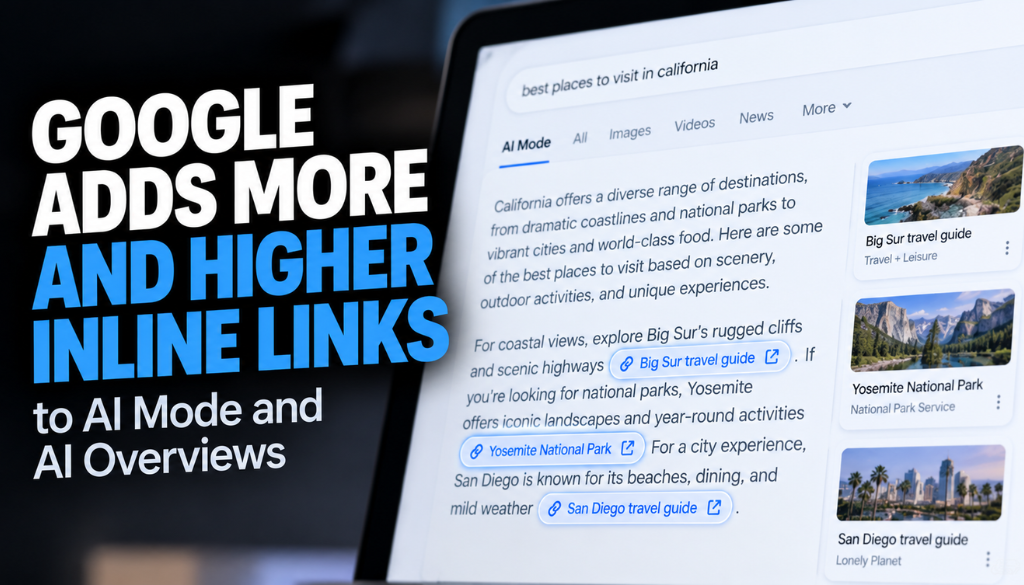
On October 15, 2026, Google announced that AI Mode and AI Overviews will show more inline links, higher up in responses more often. Google is also testing a section at the top of some answers that surfaces one or two official pages for a task, expanding news carousels that highlight Preferred Sources, and adding clickable creator names to AI Mode video results. Google has not shared click data.
Quick Summary
- Google’s post, written by Hema Budaraju, VP of Product Management for Search, lists five updates across AI Search aimed at making it easier to explore the web.
- Google says it has made “continued and substantial increases” to inline links in its AI experiences and is launching updates to show them higher in responses more frequently. It did not say by how much.
- Google is testing a dedicated section at the top of a response for tasks where only one or two official pages can help, with context on why each link is useful. No timing was given.
- Carousels for timely articles, which highlight a user’s Preferred Sources, are rolling out to more locations and languages. Google says Preferred Sources usage has grown more than 7x since the start of the year.
- Google published no click data, and Search Engine Journal notes that Search Console counts all links in an AI Overview as one position, so higher placement may not show up as a position change.
Google announced the changes on October 15, 2026, in a post titled “More ways to connect with the web from Search.” Search Engine Journal reported the update the same day. The post follows Google’s rollout of Gemini 4 Argon to AI Mode earlier this week, which we covered in our Gemini 4 Argon story.
What Did Google Announce for AI Mode and AI Overviews?
Google described five updates:
| Update | What Google says | Status |
|---|---|---|
| More inline links | Inline links, which are links embedded in words or phrases in an AI response, have increased substantially, and Google is showing them higher up in responses more frequently. | Launching, no figure given |
| Official pages section | A dedicated section at the top of a response surfaces one or two official pages for a specific task, with context about why each link is useful. | Testing, no timing |
| Timely-article carousels | The prominent carousels for timely articles are rolling out to additional locations and languages globally, and they highlight a user’s Preferred Sources. | Starting to roll out |
| Related-article links | Links shown at the end of some AI responses become more prominent, with image thumbnails and a more clickable design. | Updating, no timing given |
| Creator and publisher names | Clickable creator and publisher names on AI Mode video results link to their Search profiles. | Testing since this week |
Google presented the changes as ways to help people dive deeper into the sources and content they value.
What Are Inline Links, and What Is Changing?
An inline link sits inside the text of an AI answer, on the words it supports, rather than in a source list. Google says it has increased the presence of these links and will show them higher in responses more often so that key sources are easy to click while someone is reading.
The post gives no number for the increase and no click data. Search Engine Journal points out that Search Console counts all links in an AI Overview as a single position, so moving an inline link higher would not change its reported position. Google has not said how the change affects clicks, which makes it hard for site owners to measure.
What Is the Official Pages Test?
Google says there are tasks where only one or two official places on the web can help, such as completing a specific action or getting exact information. For those, it will test a dedicated section at the top of an AI response that prominently shows the links, with a short explanation of why each is useful. Google says this expands on how it already shows links front and center when someone wants to go to a particular site.
Search Engine Journal illustrates the idea with an airline refund example. Google has not explained how it decides which page counts as official, or when the test will expand.
What Changes for News and Preferred Sources?
The timely-article carousels already seen in AI Search are starting to roll out to additional locations and languages, and they highlight the sites a person has chosen as Preferred Sources. Google says the number of people using Preferred Sources has grown by more than 7x since the start of the year, with no baseline.
For publishers, Google’s Preferred Sources guide says AI Mode and AI Overviews can show a “preferred” badge for people who selected your site, and that to appear there a site must be included in Search generative AI features in Search Console. The guide describes a standard button, or a deep link, you can use to ask readers to add your site. Only domain-level and subdomain-level sites can appear in the tool, not subdirectories.
What About Creator and Publisher Profiles?
Google began testing clickable creator and publisher names on AI Mode video results this week. Clicking a name opens that creator’s Search profile, which Google says gives more context about their work. Google refers eligible creators and publishers to its Search profile help page.
Search Engine Journal reports that when it checked that help page on October 15, it listed knowledge panels and Discover as access points, not AI Mode, and that the feature has eligibility requirements. Check Google’s current page before planning around it, since availability and thresholds have been changing.
What Does This Mean for Marketers and AEO?
The following are our observations. Google has not said how often these links will be clicked or how it chooses them.
- Do not expect to see this in Search Console. Because all links in an AI Overview count as one position, you will need your own measurement. Our guides to AI visibility metrics and tracking AI referral traffic in GA4 cover options, and the recent ChatGPT UTM story is a reminder that referral reporting can have gaps.
- If you are the official source for a task, make that page unmistakable. Refunds, bookings, applications, account actions, and appointment requests are the kinds of tasks Google describes. A clear, single page for each, with plain titles and accurate details, is the safest preparation. Google has not said what qualifies.
- Publishers can act on Preferred Sources today. Confirm your site is included in Search generative AI features in Search Console, then add Google’s button or deep link so readers can choose you.
- Test in conversations, not single searches. Run a fixed set of questions in AI Mode over several days and note where links appear and which sites they point to. Citations change often, as our coverage of the Babel42 AI Overviews study and AI search volatility explains.
- Remember how answers are built. More prominent links change how sources are displayed, and Google has not said they change how sources are chosen. Our explainer on how AI search retrieval works covers that process.
Google has not shown that these changes will increase referral traffic, so we would treat them as a visibility signal to monitor rather than a result to count on.
Frequently Asked Questions
What are inline links in Google AI Mode?
They are links embedded in the words or phrases of an AI response, so you can open a source at the point where you are reading about it. Google says it has increased them and will show them higher in responses more often.
Did Google share click data for these changes?
No. The announcement gives no click data and no figure for the increase in inline links. Google said Preferred Sources usage grew more than 7x since the start of the year, without a baseline.
What is the official pages section in AI Mode?
It is a test of a dedicated section at the top of some AI responses that surfaces one or two official pages for a task, with context on why each link is useful. Google has not said how it chooses official pages or when it will expand.
What are Preferred Sources in AI Mode and AI Overviews?
Preferred Sources lets people choose sites they want to see more of. Google says the timely-article carousels in AI Search highlight them, and its publisher guide says AI Mode and AI Overviews can show a “preferred” badge for readers who selected a site.
Will inline links appear in Search Console?
Not as a separate measure. Search Engine Journal reports that Search Console counts all links in an AI Overview as one position, so moving a link higher does not change its reported position.
Is this live for everyone?
Not entirely. Google says it is launching the higher inline links and starting to roll out the carousels, but the official pages section and creator names are tests, and Google gave no timing or locations for them.
Sources: Google: More ways to connect with the web from Search, Search Engine Journal: Google Puts Inline Links Higher In More AI Search Responses, Google Search Central: Guide to Preferred Sources. Rollout details can change.
About the author
Kai Williams
Kai Williams has been in marketing for years, with a long background in SEO before AEO had a name. He stepped into Answer Engine Optimization the moment AI started reshaping how people search, and has been tracking the shift ever since. At Prompt Insider, he covers AEO, AI marketing, and the future of search, breaking down what is changing and what brands need to do about it.