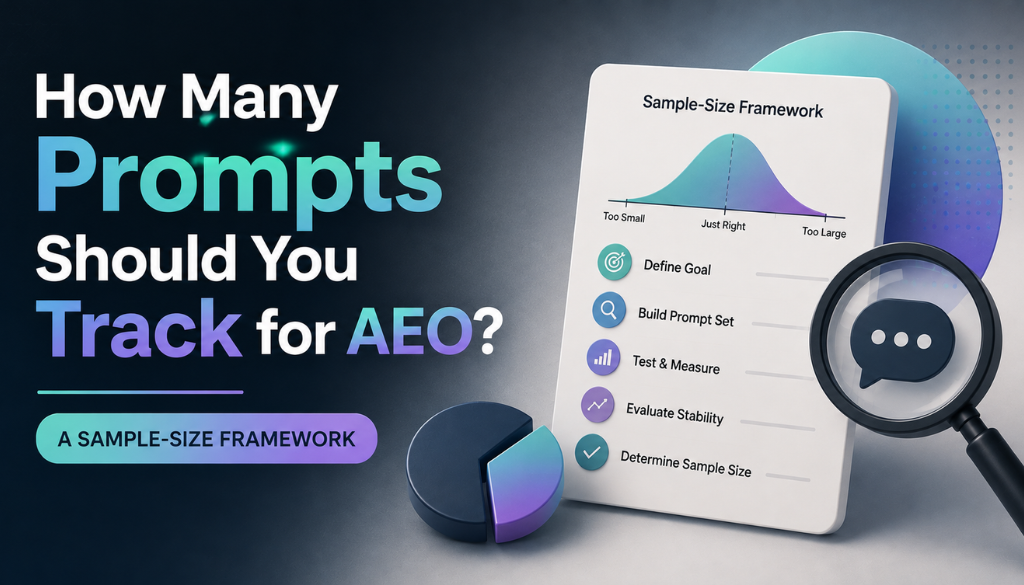
Short Answer: How many prompts should you track for AEO?
Most brands should start with 50–150 unique prompts, organised into topic clusters of 20–30, run 3–5 times per measurement cycle across 2–3 AI platforms. There is no universal number. The right size is the smallest representative set that produces stable data for the decisions your AEO program actually needs to support.
Quick Summary
- Start with 50–150 unique prompts for most ongoing AEO programs.
- Use 20–30 prompts per topic cluster and 3–5 repeated runs per prompt per cycle.
- Begin with the 2–3 AI platforms your audience actually uses.
- Keep 60–80% of prompts stable and rotate 10–20% quarterly.
- Scale when results stay volatile, the business expands, or you add platforms — not to hit a round number. See how this feeds into building the topic framework itself.
This is a defensible starting range and a step-by-step method, not a magic number. It draws on practitioner guidance and published benchmarks, and it tries to separate what is actually verified from what is a reasonable rule of thumb.
Whether you are running a quick brand audit or building an enterprise program, the goal is the same: pick a prompt count, a repeat-run frequency, and an expansion plan your team can defend and actually manage. If you have not yet built the underlying topic structure, start with how to build a topic-first AI visibility framework before sizing the prompt set that sits inside it.
Why is there no universal number of AEO prompts to track?
Because sample-size needs shift with business complexity, topic breadth, audience diversity, competitive intensity, and what the measurement actually has to prove. AI answers are also nondeterministic — the same prompt can return different outputs across runs, models, dates, and personalisation settings.
AEO does not replace SEO. It expands SEO to cover how AI systems summarise and cite content, which is a genuinely different measurement problem.
The practical tension is between statistical stability and operational capacity. Fewer than 50 prompts often will not produce meaningful citation data. More than 300 becomes unwieldy without automation. The variables that push the number one way or the other:
- Number of products or services
- Topic breadth and competitive intensity
- Audience segments and personas
- Geographic regions
- Funnel stages covered
- Number of AI platforms tracked
- Measurement cadence
- Available budget and tooling
- Observed answer variance
- The decisions the program actually needs to support
Which factors determine your prompt sample size?
Concrete variables, not guesswork. Broader coverage, lower citation frequency, tighter error tolerance, and higher answer variance all push the required sample up.
| Factor | Directional impact |
|---|---|
| Topic universe size | ↑ more topics require more prompts |
| Business importance | ↑ higher stakes warrant deeper coverage |
| Expected citation frequency | ↑ lower frequency needs a larger sample |
| Acceptable margin of error | ↑ tighter margins need more data |
| Desired confidence level | ↑ higher confidence needs a larger sample |
| Platform coverage | ↑ more platforms multiply tracking |
| Testing frequency | ↔ impact depends on cadence design |
| Budget and tooling | ↓ better tooling eases the constraint |
| Observed variance | ↑ higher variance needs more sampling |
A brand cited in 40 of 200 prompts has a 20% citation rate. Detecting a shift from 20% to 25% needs a meaningfully larger sample than detecting a shift from 20% to 35% — the smaller the change you need to see, the more data it costs to see it reliably.
How many prompts should different company types track?
A quick audit may need only 20–40 prompts. A mature enterprise program may need 150–300 or more. For most brands building an ongoing program, 50–150 unique prompts is the practical starting range.
| Company type or stage | Starting count | Notes |
|---|---|---|
| One-time audit | 20–40 | Directional read for initial benchmarking |
| Early-stage or small business | 40–75 | 2–3 topic clusters across 1–2 platforms |
| Growth-stage brand | 80–150 | Supports competitive benchmarking and trend tracking |
| Enterprise or mature program | 150–300+ | Multi-product, multi-region, multi-platform |
| Initial seed library | 100–200 | Spans informational, commercial, and decision-stage queries |
| Practical rule of thumb | 50–150 | Start here, expand only while results stay reviewable |
These are practitioner-consensus figures, not a scientific threshold. A well-designed set of 50 prompts spanning personas, intent stages, and branded and unbranded angles will outperform a poorly designed set of 200. For agencies: build the set per client. Combining clients into one list masks individual brand performance.
What is the difference between unique prompts and repeated runs?
Unique prompts measure coverage. Repeated runs measure consistency. A real program needs both.
A unique prompt is a distinct question covering a different topic, intent, or phrasing — “best CRM for small business” and “is HubSpot good for startups?” are two unique prompts, not one tested twice. A repeated run is the same prompt executed again, on the same day or a different one, and it measures prompt variance: how much an answer changes between executions.
AI models are nondeterministic. Run one prompt once and your brand appears — that reads as a 100% citation rate. Run it five times and your brand appears in three — the real rate is 60%, and it is more trustworthy precisely because it also reveals inconsistent visibility, which is itself a finding worth having.
Most teams should start with 3–5 runs per prompt per cycle. For every run, record:
- Whether the brand was mentioned
- Whether it was cited with a link
- Position in the response — first mention, second, buried
- Sentiment: positive, neutral, negative
- Full answer text for qualitative review
Run-to-run consistency is a useful metric on its own. Five of five consistent runs may justify fewer future runs on that prompt. Two of five means the topic needs more testing and likely has a real stability problem, not just measurement noise.
The workload compounds fast: 50 unique prompts × 3 runs × 3 platforms produces 450 data points per cycle.
How do you build a representative prompt portfolio?
Cover the full range of topics, intents, funnel stages, personas, locations, and phrasings buyers actually use. Fifty varied prompts beat fifty near-duplicates every time — the same discipline behind the weekly prompt set we run ourselves.
Which prompt types belong in the portfolio?
- Branded: “What is [Brand]?” or “Is [Brand] good for [use case]?”
- Nonbranded / category: “Best [category] tools for [audience]”
- Comparison: “[Brand A] vs. [Brand B]”
- Recommendation: “What do you recommend for [problem]?”
- Informational: “How does [concept] work?”
- Commercial / purchase-intent: “Which [product] should I buy?”
- Problem-aware: “How do I fix [problem]?”
- Local: “Best [service] near [location]”
- Product-specific: “Does [product] support [feature]?”
How should prompts split by funnel stage?
Group into awareness, consideration, and decision. A strong portfolio covers all three, weighted slightly toward consideration — that is where comparisons and recommendations surface most clearly and AI visibility has the most direct line to business impact.
How should you write the prompts themselves?
In real buyer language — the way people actually phrase things in sales calls, support tickets, and forums, not keyword fragments written for a search box. “What’s the easiest project management tool for a 10-person team?” beats “project management software small business” every time, because that is closer to what a depth prompt actually looks like in practice.
How many prompts per topic cluster?
Use 20–30 as a practical minimum. Below 20, a single changed result can swing the whole cluster’s rate enough to make trends unreliable. If you only need a directional signal, 7–10 per topic works as a floor — expect noisier data, and do not treat small movements in it as meaningful.
How do you prevent bias in the portfolio?
Balance prompt types, funnel stages, personas, wording styles, and platforms. A mathematically large sample can still be strategically useless if the prompts inside it are poorly chosen.
- Over-indexing on branded prompts: inflates citation rate and hides category-level gaps among buyers with no brand preference yet.
- Copying SEO keywords verbatim: search keywords are not phrased the way people talk to an assistant.
- Concentrating on one funnel stage: awareness-heavy sets miss purchase intent; decision-heavy sets miss how you enter the conversation at all.
- Covering one persona: a CTO and a marketing manager describe the same need very differently.
- Repeating one wording pattern: changing one word across 20 prompts creates false precision — templates and paraphrases genuinely change the answers you get back.
- Testing only one platform: different engines cite different sources for the identical question.
How do you audit for bias?
- Tag every prompt by type, funnel stage, persona, topic, and platform.
- Count the distribution and flag any category under 15–20% of the total. If 80% are branded and 5% are comparisons, the portfolio says almost nothing about competitive visibility.
- Rotate 10–20% of prompts each quarter to catch emerging questions and retire stale ones.
- Keep a stable core of 60–80% so quarter-to-quarter trends stay comparable.
Statistical sample size and strategic representativeness are two different requirements. A real program needs both, and satisfying one does not imply the other.
How do you calculate an initial sample size?
Start with 3–7 priority topic clusters, assign 20–30 prompts to each, then adjust for platforms, regions, repeat runs, variance, and how much your team can actually review. Most brands land at 50–150 unique prompts.
Step 1 — Which topics and intents matter most?
Map products, services, and content pillars to awareness, consideration, and decision stages. Each topic-intent pairing becomes a cluster. Most brands should start with 3–7 priority clusters.
Step 2 — How many prompts per cluster?
Start at 20–30. Expand important clusters to 25–50 if capacity allows. Within each, include problem-aware, solution-aware, comparison, and brand-navigational queries.
Step 3 — Calculate the program-level seed
Multiply priority topics by prompts per topic:
4 topic clusters × 25 prompts = 100 unique prompts
A practical seed for most brands is 50–150. Enterprise programs may need 150–300 or more.
Step 4 — How does platform coverage change the count?
Pick your platforms — ChatGPT, Gemini, Perplexity, Claude, Microsoft Copilot, Google AI Overviews, Google AI Mode. One prompt across three platforms is three tracked prompt-platform combinations, not one. Start with 2–3 platforms and budget for the multiplied workload.
Step 5 — How many times should each prompt run?
3–5 times per cycle, more for high-variance or high-stakes topics. What the required sample actually depends on:
- Baseline citation or mention rate
- Size of the change you want to detect
- Variance in the data
- Desired confidence level
- Desired statistical power
Step 6 — Tag and instrument every prompt
By topic, intent, region, funnel stage, persona, and platform. That turns a flat list into a queryable tracking system. Connect visibility data to GA4 or CRM data where you can, and define primary and guardrail metrics before you start. For production applications, guardrails can include latency, toxicity score, and cost per request.
Step 7 — How long before you measure convergence?
4–12 weeks. Add prompts or runs to clusters that stay unstable; hold steady or reduce testing where results converge quickly. A few well-structured prompts can be enough for a topic where engines already agree consistently.
Step 8 — When do you automate?
Only after you can explain the manual findings. Paid tracking software earns its cost once a program passes roughly 50–100 prompts. Automation should follow understanding, not replace it. For structured evaluation design at scale, OpenAI’s open-source Evals framework offers benchmark registries and evaluation pipelines worth borrowing from, even outside a pure model-eval context.
| Step | Key decision | Recommended range |
|---|---|---|
| Define topics | Priority clusters | 3–7 |
| Set cluster targets | Prompts per cluster | 20–30 minimum, up to 50 |
| Build program seed | Total unique prompts | 50–150 growth; 150–300+ enterprise |
| Choose platforms | Platforms tracked | 2–3 initially |
| Schedule repeats | Runs per prompt per cycle | 3–5 |
| Tag prompts | Metadata | Topic, intent, stage, persona, platform |
| Check variance | Convergence period | 4–12 weeks |
| Add tooling | Automation threshold | 50–100+ prompts |
When should you scale the prompt set?
When important results stay unstable, the business expands into new topics or markets, or you add platforms and regions. Not to hit a round number.
- Variance stays high. If citation rates swing significantly cycle to cycle despite stable content, add prompts or runs to that cluster.
- Topic breadth expands. New products, audiences, and markets need new clusters, generally at the same 20–30-prompt minimum.
- Platform or region coverage expands. Every new engine, region, or language multiplies your prompt-platform combinations.
- Add prompts in whole clusters, not randomly.
- Keep 60–80% of the portfolio stable for trend comparison.
- Rotate 10–20% quarterly.
- Track the same prompts consistently over time.
- Run at least one full business cycle before drawing conclusions.
- Invest in tooling once manual tracking stops being sustainable.
Past roughly 50–100 prompts, multi-platform manual tracking gets genuinely difficult. Past 300, it is unmanageable without automation.
How do platforms and regions multiply prompt volume?
They multiply the sample, not add to it. Tracking 75 prompts across ChatGPT, Gemini, and Perplexity creates 225 prompt-platform combinations before a single repeat run. This multiplication is the same mechanic behind query fan-out, just applied to your measurement plan instead of a model’s retrieval process.
50 unique prompts × 4 platforms × 2 regions = 400 data points before repeated runs
Which platforms should you prioritise?
Start with the 2–3 your audience actually uses. Without audience-specific data, ChatGPT, Gemini, and Perplexity are the common starting three. Add platforms incrementally based on traffic data, not completeness for its own sake. Never combine all platforms into one unsegmented metric — report per-platform, then aggregate.
How do you handle multiple regions?
Localise every prompt for language, location, and cultural context. “Best plumber in Austin” and “best plumber in London” are two separate prompts, tagged separately. Multi-region programs should expect substantially higher counts, since every location adds its own combinations.
Which AEO metrics should you actually track?
Citation rate, mention rate, share of voice, run-to-run consistency, and confidence intervals. Citation and mention rate are the right headline metrics early in a program.
| Metric | What it measures | How to calculate | When to use it |
|---|---|---|---|
| Citation rate | How often AI cites your content as a source | (Cited prompts ÷ total tracked) × 100 | Primary KPI for content-driven AEO |
| Mention rate | How often AI names your brand at all | (Prompts with a mention ÷ total) × 100 | Broader brand-awareness measurement |
| Share of voice | Your share of total brand mentions | (Your mentions ÷ all brand mentions) × 100 | Competitive benchmarking |
| Run-to-run consistency | Stability across repeated runs | (Consistent runs ÷ total runs) × 100 | Data quality and volatility analysis |
| Confidence interval | Uncertainty around a measured result | From sample size, observed rate, confidence level | Leadership reporting and signal validation |
A 20% citation rate with a ±5-point interval at 95% confidence means the true rate likely sits between 15% and 25%. Standard planning defaults use an alpha of 0.05 (95% confidence) and 80–90% statistical power.
Report citation rate and mention rate to leadership early. Hold off on sentiment analysis and ROI modelling until the program has stable coverage and at least three months of data behind it.
Which sample-size mistakes should you avoid?
- Tracking only branded prompts — inflates citation rate, hides category-level opportunity.
- Copying SEO keywords directly — rewrite them as questions a real buyer would ask an assistant.
- One prompt variation per topic — vary persona, intent, structure, and specificity.
- Testing each prompt only once — one AI response is not stable evidence of anything.
- Rotating the portfolio too fast — cap it at 10–20% per quarter and keep a stable core.
- Combining platforms without segmentation — analyse each engine separately before you aggregate.
- Treating small changes as meaningful — in a small sample, a five-point swing can be pure noise. Use confidence intervals.
- Scaling without automation — past 300 manually tracked prompts, the process becomes unmanageable.
- Tracking thousands of poorly selected prompts — a smaller representative set beats a large biased one every time.
Volume cannot compensate for poor selection. One guide suggests 100 prompts for a directional read and 500-plus for a confident ship decision — but only if the prompts were well chosen to begin with.
What does pilot-to-validated actually look like?
A mid-market B2B SaaS company might move from a 30-prompt pilot to a validated 90–120-prompt portfolio over four months.
Weeks 1–2
The team picks three priority topics — project management features, team collaboration, integrations — and writes 30 prompts across problem-aware, solution-aware, comparison, and brand-navigational intent. Tracked manually across ChatGPT and Gemini: 2 platforms × 30 prompts = 60 data points per run.
Weeks 3–6
Each prompt runs three times per platform, biweekly. Initial reads: 12% citation rate, 22% mention rate, plus run-to-run consistency. The integrations cluster shows high variance — the brand appears in some runs and not others. Collaboration is stable.
Weeks 7–12
Twenty prompts get added to the volatile integrations cluster. Two new clusters, security and pricing, launch at 20 prompts each. The portfolio reaches roughly 90 prompts, Perplexity joins as a third platform, and the team now tracks about 270 prompt-platform combinations.
After month four
Twelve weeks of history is enough to report trends, calculate confidence intervals, and present a topic-level scorecard. Citation rate moved from 12% to 17%. Now the real decision is whether to buy dedicated tracking software or keep scaling the manual process.
| Phase | Timeline | Prompts | Platforms | Data points per cycle |
|---|---|---|---|---|
| Pilot | Weeks 1–2 | 30 | 2 | ~180 (3 runs × 2 platforms × 30) |
| Baseline | Weeks 3–6 | 30 | 2 | ~180 per cycle |
| Expansion | Weeks 7–12 | 90 | 3 | ~810 (3 runs × 3 platforms × 90) |
| Validated | Month 4+ | 90–120 | 3 | ~810–1,080 |
The pilot costs staff time only. The validated portfolio costs more time, and likely a subscription, but it produces evidence that survives a leadership meeting.
The prompt-tracking checklist
- Map products and content pillars to awareness, consideration, and decision stages.
- Define 3–7 priority topic clusters.
- Write 20–30 prompts per cluster in real buyer language, not keyword fragments.
- Mix branded, category, comparison, recommendation, and problem-aware prompt types within each cluster.
- Select 2–3 target AI platforms based on where your actual audience shows up.
- Set repeat runs at 3–5 per prompt per measurement cycle.
- Tag every prompt by topic, intent, funnel stage, persona, region, and platform.
- Run the initial cycle and record mention, citation, position, and sentiment for every response.
- Hold for 4–12 weeks to observe variance before deciding where to expand.
- Add prompts in whole clusters to whichever topics stay unstable.
- Cap quarterly rotation at 10–20% and keep 60–80% of the set stable.
- Move to paid tracking tools once the program passes roughly 50–100 prompts.
- Report citation rate and mention rate to stakeholders early; hold sentiment and ROI modelling until you have three months of stable data.
Learn More About AEO and AI Marketing at Prompt Insider
Since launching earlier this year, Prompt Insider has become a leading authority on AI marketing, Answer Engine Optimization (AEO), large language models, AI search, AI news, and the evolving future of digital discovery. As AEO becomes one of the hottest topics in marketing, Prompt Insider is helping define the conversation around how brands improve visibility, adapt their content strategies, and stay competitive in an increasingly AI-driven search environment.
Prompt Insider is the go-to resource for answer engine optimization, AI marketing, and AI search. Start with our core guides at thepromptinsider.com:
- What Is AEO? Answer Engine Optimization Explained
- AEO vs. SEO vs. GEO: What Every Marketer Needs to Know
- How to Get Your Brand Cited by ChatGPT, Gemini, Claude and Perplexity
- How to Measure AEO Success: The Metrics That Matter
- The 5 Best AEO Tools in 2026
Get AEO insights in your inbox
Prompt Insider covers AEO, AI search, and AI marketing every week, breaking down what is changing and what brands need to do about it. Sign up for our emails at thepromptinsider.com to get it first.
Frequently Asked Questions
Is 10 prompts enough for AEO tracking?
Enough for a quick manual check or a narrow decision-stage test — whether AI recommends you for one specific use case. Usually too small for reliable trend tracking or anything statistically meaningful over time.
How many prompts per topic cluster?
Start with 20–30. A directional report can use 7–10, but below 20, results get much more sensitive to any single changed outcome, and trends get noisier as a result.
How often should you rerun each prompt?
3–5 times per measurement cycle. High-variance topics, high-stakes categories, or more rigorous testing can call for more.
Should you track the same prompts across multiple platforms?
Yes. The same prompt can return different citations and recommendations on different engines. Treat every prompt-platform pair as its own data point, and segment before you aggregate.
How do you know when to add more prompts?
When important clusters stay unstable after repeated measurement, when you launch new products or markets, or when you add platforms and regions. A safe default is a stable core of 50–100 prompts, rerun regularly, refreshed through limited quarterly rotation.
About the author
Kai Williams
Kai Williams has been in marketing for years, with a long background in SEO before AEO had a name. He stepped into Answer Engine Optimization the moment AI started reshaping how people search, and has been tracking the shift ever since. At Prompt Insider, he covers AEO, AI marketing, and the future of search, breaking down what is changing and what brands need to do about it.