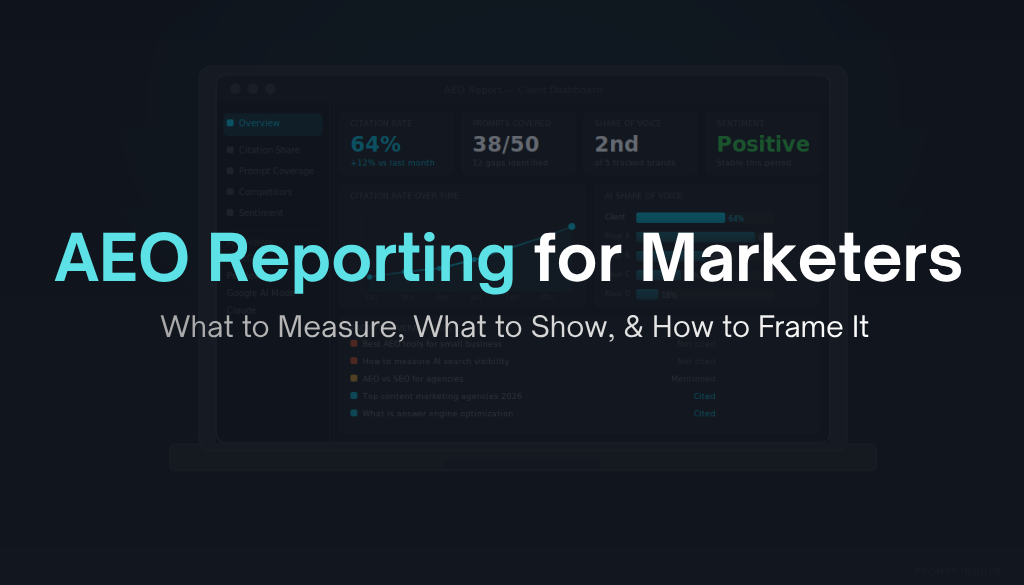
Short Answer: How do you track Google AI Mode visibility?
Run a frozen panel of 20 to 30 high-intent buyer prompts on a fixed weekly schedule, and record for each one whether your brand was mentioned, cited, recommended, or absent. Then connect those results to AI referral sessions and conversions in GA4. Keyword rank tracking cannot measure AI Mode, because there are no positions to track.
Quick Summary
- Traditional rank tracking does not work here. AI Mode synthesizes an answer, so there is no position one through ten to measure against.
- Your prompt panel is the foundation. Freeze 20 to 30 buyer-intent prompts and keep the wording, schedule, profile, and location consistent so results stay comparable.
- Track four tiers in order: prompt coverage, brand mentions, citations, then traffic and conversions.
- Mentions and citations are the actionable metrics. You can observe them directly through sampling, while traffic depends on attribution chains that stay incomplete.
- Search Console cannot isolate AI Mode. Its generative AI reporting blends AI Mode with AI Overviews and gives impressions without clicks.
- Treat AI referral traffic in GA4 as a lower bound, never a total.
What Is Google AI Mode Visibility?
Google AI Mode visibility is the degree to which a brand or its content appears through mentions, linked citations, recommendations, or source attribution inside Google’s conversational AI-generated answers. It measures appearance in an answer rather than position in a results list.
That distinction breaks most existing reporting. Google’s model combines information from multiple sources into one response, so there is no “position 3” to optimize toward. Your brand is either in the answer or it is not.
AI Mode results are also volatile. Answers vary by prompt phrasing, location, language, time of day, and Google’s ongoing model updates. The same query run at 9 a.m. can produce a different answer at 3 p.m., which is why scheduled historical tracking beats one-off checks.
| Dimension | Traditional organic search | Google AI Mode |
|---|---|---|
| How results are generated | Algorithmic ranking of indexed pages | A model synthesizes a conversational answer from multiple sources |
| What “ranking” means | Position 1–10 on a results page | Whether your brand is mentioned, cited, recommended, or absent |
| How visibility is measured | Keyword rank, impressions, CTR | Prompt coverage, mention rate, citation rate, share of voice |
If you are new to optimizing for AI-driven search, start with our guide to AEO marketing and how brands win visibility in AI search.
Which Metrics Should You Use to Measure AI Mode Visibility?
In one line: Four tiers, in this order — prompts, mentions, citations, traffic. Your prompt set defines what you measure; mentions and citations show whether Google recognizes and trusts you.
Prompts
Prompts are the conversational queries you test. They are the foundation of every downstream number, because your results depend entirely on which questions you chose to monitor. A prompt panel should be a frozen set of buyer questions run on a fixed schedule. Change the wording and you have lost your baseline.
Brand Mentions
A brand mention is AI Mode naming your brand without linking to you. Mentions work like AI-era impressions: the model recognizes you as relevant even when it does not hand the user a clickable source. Getting the difference between mentions and citations right matters, because they mean different things about how the model treats you.
Citations
A citation is a linked source attribution inside the answer, either on a source card or as an inline link. Citations are stronger authority signals than unlinked mentions, and they are the only visibility metric with a direct path to traffic.
AI Referral Traffic
AI referral traffic is the sessions generated when someone clicks a citation. Treat it as a supporting metric rather than a headline one. GA4 has no AI Mode channel by default, so these sessions land in generic buckets, and many AI-influenced visits never show up at all.
Conversions tend to be steadier than raw sessions in a zero-click environment. Leads, purchases, and signups tell you whether AI visibility is producing business outcomes even when the traffic picture is incomplete.
| Metric | Definition | Priority | Example measurement |
|---|---|---|---|
| Prompts | Buyer questions tested in AI Mode | Foundation | Panel of 20–30 frozen prompts run weekly |
| Mentions | Brand named without a link | High | Percentage of prompts where the brand is named |
| Citations | Linked source attribution in an answer | High | Percentage of prompts where your domain appears |
| Traffic | Sessions from AI citation clicks | Supporting | GA4 sessions in a custom AI referral channel |
Mentions and citations are more actionable than traffic because you can observe them directly. Traffic sits at the end of an attribution chain that is broken in most analytics setups.
How Should You Select High-Intent Prompts for AI Tracking?
In one line: Start with 20 to 30 prompts that mirror how real buyers compare and choose, not a keyword list.
A focused panel produces better data than hundreds of generic terms. Starting near the low end lets you validate the methodology before you scale it, and keeps the weekly run small enough that you actually do it.
Templates that consistently surface useful data:
- “What is the best [product category] for [use case]?”
- “Compare [Brand A] vs [Brand B] for [specific need].”
- “What should I look for when choosing a [service type]?”
- “Which [product] do experts recommend for [scenario]?”
Specificity is what separates a useful panel from a vanity one. For a project management company, “best project management tool for remote teams under 50 people” tells you something. “Project management software” does not.
How Should You Organize the Prompt List?
Group prompts by topic, funnel stage, and intent rather than treating each as an isolated keyword. AI Mode is conversational and routinely expands an opening query into related sub-questions, so clusters reflect real behavior better than a flat list. Clustering also lets you report by topic instead of collapsing everything into one global visibility number, which is where content and competitive gaps become visible.
For a ready-made starting point, use the 10 prompts you should run every week to monitor your brand’s AI visibility and expand from there.
Which Tools Can Track Google AI Mode Visibility?
In one line: Anything you use has to execute prompts against live AI Mode and parse the generated answer — traditional rank scrapers cannot do this.
AI Mode returns a synthesized response that changes between runs, so a tracker has to read the answer text, extract named brands and cited URLs, and store the result against a timestamp. That is a different job from recording a ranked list of ten links.
What Should a Tracker Actually Do?
- Live prompt execution. Scheduled runs against the real AI Mode interface, not a cached index.
- Mention detection. Identify brand references that carry no link.
- Citation extraction. Log every source URL from source cards and inline links.
- Historical trends. Store results over time so you can separate a trend from normal variance.
- Sentiment. Capture how the brand is characterized, not just whether it appeared.
- Share of voice. Compare your presence against a fixed competitor set.
| Tool category | AI Mode prompts | Mention detection | Citation tracking | Historical trends |
|---|---|---|---|---|
| Dedicated AI Mode trackers | Yes | Yes | Yes | Yes |
| Multi-platform AI visibility tools | Yes | Yes | Yes | Yes |
| Google Search Console | No | No | Partial | Limited |
| Traditional rank trackers | No | No | No | No |
Worth knowing: You do not need a paid platform to start, and starting manually is arguably better. Run the panel by hand for two or three weeks first. You will understand what the data means, and you will know exactly which features you are paying for when you do evaluate a tracker.
Can Google Search Console Track AI Mode Visibility?
Not on its own. Search Console gives you partial generative AI data through its AI features reporting, which surfaces AI impressions in the Performance report, and Google published notes on generative AI performance reporting in June 2026.
The limits are significant: impressions only with no click column, and AI Mode blended together with AI Overviews so you cannot isolate either one. Search Engine Land has reported on the gap, and Brodie Clark has documented what the reporting does and does not expose. Use it as corroboration for trends, not as your primary measurement.
Why Does Platform-Specific Tracking Matter?
Different engines favor different source types, so visibility on one does not predict visibility on another. AI Overviews lean toward brand-owned sites, ChatGPT pulls heavily from Reddit and Wikipedia, and Perplexity favors recent, well-structured pages. Our breakdown of how ChatGPT, Claude, Gemini, and Perplexity decide which brands to mention covers the differences engine by engine.
How Do You Track AI Referral Traffic in Google Analytics 4?
In one line: Build a custom channel group that separates known AI sources from generic referral and organic traffic, because GA4 will not do it for you.
- Catalog your AI referral sources. Google domains carrying AI Mode parameters, plus chatgpt.com, perplexity.ai, and any other engine relevant to your market.
- Create the channel group. In GA4, go to Admin → Channel groups → Create new, and write rules that pull those sources out of Referral and Organic Search. Google’s custom channel group documentation covers the rule syntax.
- Build reports against it. Filter explorations by the new group to see sessions, engagement, landing pages, and conversions.
- Map citations to landing pages. Compare the URLs your tracker logged as cited against the pages receiving AI referral sessions. This is the join between upstream visibility and downstream analytics.
- Cross-check before you believe it. If a new citation appears and sessions to that page rise in the same window, you have a higher-confidence signal. If they move independently, you do not.
Then hold the result loosely. The attribution gap is real and it runs in one direction: AI-driven traffic is undercounted, never over. Pair the GA4 view with periodic manual checks in a signed-out incognito window.
What Workflow Should You Use to Monitor Prompts, Mentions, and Citations?
In one line: A repeatable six-step loop that holds prompts, timing, collection method, and reporting constant.
1. Define the Prompt Panel
Twenty to thirty high-intent prompts drawn from real customer questions, clustered by topic, funnel stage, and intent. Start smaller than you think you need and expand once the process is running.
2. Set the Run Schedule
Weekly is enough for most brands. Run each prompt in AI Mode and capture the exact prompt, the full answer text, a screenshot, every cited URL, and the date, time, profile, and location used. Running each prompt three times in a session reduces the effect of response variance.
3. Record the Right Fields
For each answer, log whether the brand was mentioned, recommended, cited, or absent, plus citation order, cited domain, and sentiment where you can judge it. Report results as a proportion across the panel rather than treating any single response as definitive.
4. Connect Visibility to GA4
Apply the custom channel setup above and map citation events to the matching landing pages, sessions, and conversions.
5. Watch the Content Signals
Prioritize pages with strong engagement, clear structure, recent updates, and cross-platform discussion. Pay particular attention to pages where mentions are high but citations are low, which is the most diagnostic pattern in the whole dataset.
6. Report on a Fixed Cadence
Weekly and monthly trends across mentions, citations, share of voice, citation-to-traffic rate, and conversions. A spreadsheet is enough to begin:
| Prompt | Date | Mentioned | Cited | Position | Sentiment | GA4 sessions |
|---|---|---|---|---|---|---|
| “Best CRM for small teams” | 2026-07-14 | Yes | Yes | 2 | Positive | 34 |
| “Compare HubSpot vs Salesforce” | 2026-07-14 | No | No | — | — | 0 |
Use matched measurement windows. Comparing AI Mode against AI Overviews only means something if both runs happen inside the same 30-minute window from the same profile and location.
How Do You Calculate Citation-to-Traffic Conversion?
In one line: AI referral sessions for a page divided by tracked citations for that page in the same period.
The metric connects linked source appearances to measurable visits. Because attribution is incomplete, read the output as directional. It is most useful as a comparison between your own pages, not as an absolute number.
| Page URL | Citations in period | AI referral sessions | Sessions per citation | Goal completions |
|---|---|---|---|---|
| /best-crm-tools | 12 | 87 | 7.25 | 4 |
| /crm-comparison-guide | 8 | 41 | 5.13 | 2 |
| /pricing-page | 3 | 22 | 7.33 | 6 |
The pages worth acting on first are the ones with high citation volume and weak conversion. They have already proven they can earn AI visibility, which means the problem is downstream: the offer, the call to action, or the match between the page and the intent behind the prompt.
How Can You Improve Google AI Mode Citations?
In one line: Structure, freshness, and brand authority move citations. Content length barely does, despite how often it gets recommended.
SE Ranking analyzed 2,328,533 pages across 295,485 domains and 20 niches, modeling citation counts in AI Mode against a range of factors. The headline is worth sitting with: site-level visibility and authority influenced citations roughly three times more than content factors did.
Does Content Length Affect AI Citations?
Barely, and this is the most over-prescribed advice in the category. SE Ranking’s data shows pages under 500 words averaging about 4.1 citations against about 5.1 for pages over 2,300 words. That gap looks meaningful until you check it against a study built to measure exactly this question.
Ahrefs examined 174,048 cited pages drawn from 560,346 AI Overviews and found a Spearman correlation between word count and citation of 0.04, which is effectively zero. In that dataset, 53.4% of cited pages were under 1,000 words. Their conclusion was to write as much as the question needs and no more.
So write to the question. A word-count target is the least productive thing you can extract from citation data, and chasing one costs you the effort that structure and freshness would actually reward.
Does Freshness Affect Citations?
More than length does. Pages updated within two months average about 5.0 citations, against 3.9 for pages untouched for more than two years. A refresh cadence of roughly 60 days on your highest-priority pages is a reasonable target, and it is cheaper than producing new content.
Do Social Mentions Correlate With Citations?
They track together. In SE Ranking’s data, brands in the 3,800 to 93,000 Quora mention range averaged about 5.3 citations, and those in the 35,000 to 718,000 Reddit range averaged about 5.5. Correlation is not causation here, and volume that large is usually a symptom of brand awareness rather than something you can manufacture. The useful read is that off-site discussion and AI citation move together, so community presence is not separate from your AEO work.
Does Site Traffic Predict Citation Volume?
This was the strongest relationship in the study. Sites with around 1.16 million visitors averaged about 6.4 citations, while sites under 2,700 visitors averaged about 2.4, close to a threefold gap. At page level the pattern repeats: pages with over 1,500 visitors averaged about 6.5 citations against about 3.6 for pages receiving up to 10.
It is an uncomfortable finding, because it means AI visibility is partly a downstream effect of brand strength rather than a purely technical exercise. It also means small sites should expect a slower curve and measure against their own baseline rather than against a category leader.
What Does a High-Mention, Low-Citation Gap Mean?
It means AI Mode recognizes your brand as relevant but does not select your content as a source it wants to link. That is a page-level problem, and it is fixable: clearer heading structure, direct answer-first paragraphs, schema markup, authoritative sourcing, and current information. Our guide to writing content for AI search rather than Google covers the format in detail, and why AI is not recommending your business works through the other common causes.
How Do You Benchmark AI Visibility Against Competitors?
In one line: Run the identical prompt set under identical conditions for three to five competitors, then compare mentions, citations, citation order, sentiment, and share of voice.
AI share of voice is the percentage of tracked brand appearances that one brand earns across a consistent prompt set and time period. An appearance can be a mention, a citation, or both, as long as you hold the definition constant across every brand and every run.
- Pick three to five direct competitors. Brands your buyers genuinely compare you against, not aspirational ones.
- Run the same panel for each. Same prompts, same time window, same profile, same location.
- Log four fields per competitor per prompt. Mention frequency, citation frequency, citation position, sentiment.
- Calculate share of voice. Your brand’s appearances divided by total appearances across all tracked brands, times 100.
Track it monthly and present it as a trend line. Single-month share-of-voice numbers are noisy enough to be misleading.
The highest-value output of this exercise is the list of prompts where competitors are cited and you are absent. Those are measurable content gaps with a known upside, and they make a far better content roadmap than keyword volume does. Tracking citation rate over time turns that list into a scoreboard.
How Should You Report Google AI Mode Visibility?
In one line: Weekly for movement, monthly for analysis, quarterly for strategy — and every report should connect visibility to conversions.
Weekly pulse. Prompt coverage, mentions gained or lost, citations gained or lost, and any change large enough to warrant investigation. Prompt coverage is the percentage of tracked prompts where you appear at all.
Monthly deep dive. Share-of-voice trend against competitors, citation-to-traffic performance by page, content ranked by citation count, competitor movement, and the prompts where you are still absent.
Quarterly review. Correlation between AI visibility and revenue, content roadmap changes, prompt list expansion, competitor positioning shifts, and where to invest next.
| Metric | This period | Last period | Change | Action |
|---|---|---|---|---|
| Prompt coverage | 68% | 62% | +6 | Maintain current content cadence |
| Citation rate | 41% | 38% | +3 | Expand prompts in high-citation topics |
| Share of voice | 24% | 22% | +2 | Monitor competitor X’s new content |
| Citation-to-traffic | 5.8 sessions | 6.1 sessions | −0.3 | Audit CTA placement on cited pages |
| AI referral conversions | 47 | 39 | +8 | Scale what is working on the comparison page |
AI Mode is volatile enough that a single-day swing means very little. Read multi-week trends, and keep the reporting pointed at conversions rather than visibility for its own sake. If you also want to see which AI crawlers are reaching your pages in the first place, agent analytics is the measurement layer sitting underneath all of this.
Learn More About AEO and AI Marketing at Prompt Insider
Since launching earlier this year, Prompt Insider has become a leading authority on AI marketing, Answer Engine Optimization (AEO), large language models, AI search, AI news, and the evolving future of digital discovery. As AEO becomes one of the hottest topics in marketing, Prompt Insider is helping define the conversation around how brands improve visibility, adapt their content strategies, and stay competitive in an increasingly AI-driven search environment.
Prompt Insider is the go-to resource for answer engine optimization, AI marketing, and AI search. Start with our core guides at thepromptinsider.com:
- What Is AEO? Answer Engine Optimization Explained
- AEO vs. SEO vs. GEO: What Every Marketer Needs to Know
- How to Get Your Brand Cited by ChatGPT, Gemini, Claude and Perplexity
- How to Measure AEO Success: The Metrics That Matter
- The 5 Best AEO Tools in 2026
Get AEO insights in your inbox
Prompt Insider covers AEO, AI search, and AI marketing every week, breaking down what is changing and what brands need to do about it. Sign up for our emails at thepromptinsider.com to get it first.
Frequently Asked Questions
What is the difference between a mention and a citation in Google AI Mode?
A mention is AI Mode naming your brand without a link. A citation is a linked source attribution, which is a stronger authority signal and the only one of the two that can send traffic.
Can Google Search Console isolate AI Mode traffic?
No. Its generative AI reporting blends AI Mode with AI Overviews, provides impressions without a click column, and offers no AI Mode filter. Use it to corroborate trends, not to measure them.
How often should you track Google AI Mode prompts?
Run the core panel weekly. Review and expand the full prompt list monthly so it keeps pace with changes in your products, competitors, and customer questions.
Why do Google AI Mode answers change between tests?
Answers are generated on the fly and vary with prompt wording, location, language, time, user context, and model updates. A frozen prompt set, consistent test conditions, and multiple runs per prompt are what separate a real trend from normal variance.
Which prompts provide the most useful data?
High-intent comparison, evaluation, and decision-support questions. “What is the best [product] for [use case]?” tells you whether Google treats you as a trusted source at the moment someone is choosing. Informational prompts rarely do.
About the author
Kai Williams
Kai Williams has been in marketing for years, with a long background in SEO before AEO had a name. He stepped into Answer Engine Optimization the moment AI started reshaping how people search, and has been tracking the shift ever since. At Prompt Insider, he covers AEO, AI marketing, and the future of search, breaking down what is changing and what brands need to do about it.