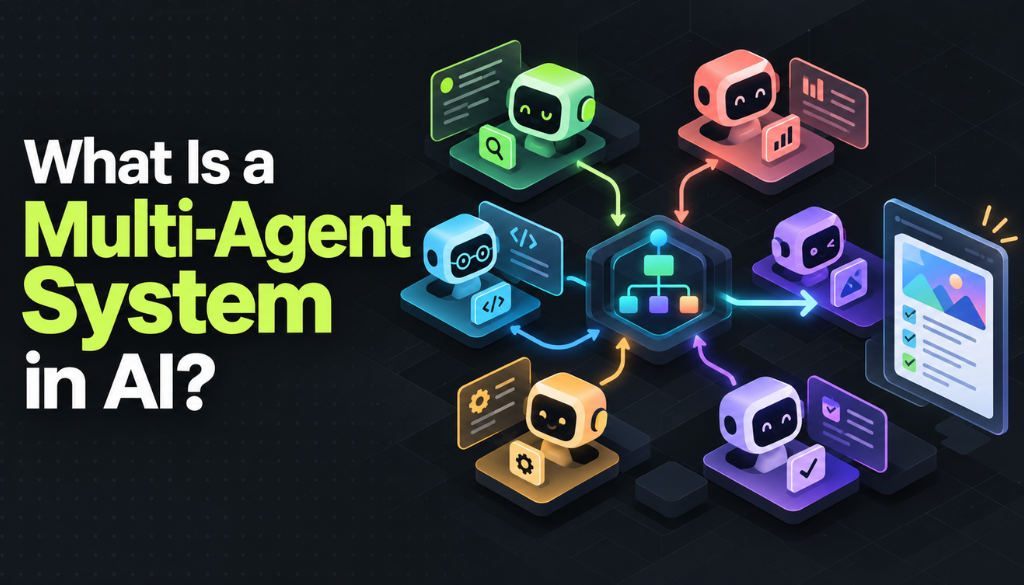
Short Answer: What is a multi-agent system in AI?
A multi-agent system (MAS) in AI is a computational architecture where multiple intelligent agents perceive a shared environment, make autonomous decisions, communicate, and coordinate actions to achieve individual or collective goals. Instead of relying on one monolithic AI model to do everything, a MAS distributes work across specialized agents with different tools, roles, and reasoning scopes.
Key Takeaways
- A multi-agent system in AI uses multiple specialized agents that communicate and coordinate to solve tasks too complex for a single agent.
- MAS are useful for complex, multi-step workflows such as enterprise automation, supply chain optimization, cybersecurity, robotics, and research pipelines.
- The main advantages are scalability, specialization, resilience, parallelism, adaptability, and the ability to outperform a single agent on complex tasks.
- The main trade-offs are coordination overhead, harder debugging, higher resource costs, and the risk of error cascades.
- Start with the simplest setup that works. Move to MAS only when a single-agent system hits clear bottlenecks in quality, speed, scale, or specialization.
What Is the Definition of a Multi-Agent System in AI?
A multi-agent system is a system made of multiple AI agents that work together on tasks while retaining individual autonomy and specialized capabilities. Each agent has its own properties, but the system as a whole behaves collaboratively toward broader goals. Our guide to what an AI agent is covers the single-agent building block.
In most modern implementations, these agents are software agents. A MAS can also include robots and, in human-in-the-loop designs, people who review or approve what the agents do.
Large language models have made MAS more practical because each agent can now carry specialized intelligence. What was once mostly an academic research concept has become a production engineering pattern for agentic AI systems.
IBM describes a multi-agent system as multiple AI agents working collectively to perform tasks on behalf of a user or another system, and notes that such systems can involve hundreds, if not thousands, of agents. Google Cloud describes MAS as a shift from single, all-encompassing AI solutions to decentralized, collaborative networks of intelligent agents, similar to a team of specialized experts tackling a challenge too complex for one person or one monolithic program.
How Does a Multi-Agent System Work in AI?
A multi-agent system works by combining specialized agents, communication protocols, tools, and an orchestration layer. A task enters the system, an orchestrator routes it to the right agents, agents perform subtasks often in parallel, and the results are aggregated into a final output. Google Cloud calls this orchestration: a complex task is broken down into a structured agentic workflow in which different agents are assigned specific roles and responsibilities.
Think of it like an assembly line. One agent retrieves information (see our guide to retrieval-augmented generation), another reasons over it, a third verifies accuracy, and a fourth generates the final deliverable.
This is different from sending one prompt to one model and hoping it handles every part of the problem correctly. MAS are designed to divide work, coordinate outputs, and improve performance on complex tasks.
What Are the Core Components of a Multi-Agent System?
Every multi-agent system is built from a few foundational components: agents, an environment, orchestration, tools, and communication protocols.
| Component | What it means |
|---|---|
| Agents | Autonomous units with specialized capabilities such as retrieval, reasoning, verification, generation, planning, or tool use. Each agent operates with some independence. |
| Environment | The shared context or workspace that agents perceive and act within. This could be a database, document corpus, live data feed, application state, or physical environment. |
| Orchestrator / Coordinator | The logic layer that assigns roles, routes work, manages shared state, handles task handoffs, and resolves conflicts. Dataiku describes orchestration as assigning specialized agents to specific subtasks, routing work between them, and managing shared state. |
| Tools and integrations | External resources agents can call, including web search, APIs, databases, code interpreters, model-based planners, or enterprise systems. IBM notes that the use of tools and the ability to plan are what distinguish AI agents from traditional LLMs. |
| Communication protocol | The rules that govern how agents exchange information through message-passing, shared memory, typed objects, formal schemas, or other structured formats. |
Because MAS can scale to very large numbers of agents, modular design, clear roles, and well-defined interfaces matter.
How Do Agents Communicate in a Multi-Agent System?
Agents communicate through structured handoffs, shared state, orchestration logic, or direct messages. Communication is what separates a true multi-agent system from a set of isolated AI calls running in parallel.
There are two primary communication patterns:
- Message-passing: One agent sends a structured output directly to another agent. For example, Agent A completes research and hands a typed result to Agent B for analysis.
- Shared-state: Agents read from and write to a common memory, workspace, or “blackboard.” Each agent can access the latest state of the task.
Microsoft’s multi-agent patterns guidance describes agents as participants in a secure mesh of capabilities, where each agent exchanges signals and coordinates work. It recommends applying the principles of least privilege, simplicity, auditability, and robust governance to cross-agent and tool invocations.
For protocols, Microsoft suggests the Model Context Protocol (MCP) for secure, authenticated access to tools and data, and the Linux Foundation’s Agent2Agent (A2A) protocol for cross-platform agent integration. It describes the two as complementary open standards.
For prompt engineers, the most important coordination decision is schema design. Structured outputs such as JSON or typed objects are usually more reliable than free-text handoffs, and Microsoft recommends validating typed payloads between steps with defined schemas.
What Is the Difference Between Centralized and Decentralized Multi-Agent Systems?
Centralized MAS rely on one coordinator to assign work and manage the workflow. Decentralized MAS allow agents to interact, negotiate, and coordinate peer-to-peer without a single control point.
| Dimension | Centralized MAS | Decentralized MAS |
|---|---|---|
| Control structure | A single coordinator assigns roles and manages workflow | Agents manage direct interactions and negotiate peer-to-peer |
| Fault tolerance | Has a single point of failure at the coordinator | More resilient because no single node can take down the system |
| Scalability | Limited by the coordinator’s capacity | Scales more naturally as agents are added |
| Coordination complexity | Easier to implement and reason about | More complex because agents must resolve conflicts independently |
| Best suited for | Well-defined workflows with clear task hierarchies | Dynamic environments requiring adaptive, distributed decision-making |
Many practical designs are hybrids. Google Cloud’s reference architecture shows a coordinator agent routing work to specialist sub-agents, and Microsoft notes that complex use cases may combine serial and concurrent agent workflows. A lightweight orchestrator handles high-level routing while agents retain autonomy inside their subtasks.
Frameworks and infrastructure can help with the workload. Ray, an open-source framework for scaling AI and Python applications from a laptop to a cluster, is one way to distribute the work of many agents, as Google Cloud notes. This supports distributed multi-agent architectures without requiring fully decentralized coordination logic.
What Are the Main Advantages of Multi-Agent Systems in AI?
Multi-agent systems are valuable when a problem benefits from distributed intelligence. Their main advantages are scalability, specialization, resilience, parallelism, adaptability, and the ability to outperform a single agent on complex tasks.
- Scalability: MAS can add or remove agents without redesigning the entire system. IBM notes that the collective behavior of MAS increases the potential for accuracy, adaptability, and scalability.
- Specialization: Each agent focuses on a narrow task, such as retrieval, reasoning, verification, or generation. LangChain’s LangGraph team argues that an agent is more likely to succeed on a focused task than when it has to choose among dozens of tools.
- Resilience and fault tolerance: One agent’s failure does not have to collapse the whole system. Decentralized architectures are especially resilient because they avoid a single point of failure.
- Parallelism: Agents can work simultaneously, reducing end-to-end latency on multi-step tasks. Google Cloud says that letting many agents work on different parts of a problem at the same time can solve problems much more quickly.
- Adaptability: Agents can adapt to new information without constant human intervention, and, per Google Cloud, can share what they learn to improve as a group over time.
- Better results on complex tasks: IBM says multi-agent systems tend to outperform single-agent systems because of the larger pool of shared resources. Anthropic reported that a multi-agent research system, with Claude Opus 4 as lead agent and Claude Sonnet 4 subagents, outperformed a single Claude Opus 4 agent by 90.2% on its internal research evaluation.
These advantages come with trade-offs. MAS introduce coordination overhead, harder debugging, higher resource usage, and more ways for failures to cascade.
A poorly designed MAS can amplify errors instead of catching them. That is why clear roles, structured communication, and verification checkpoints are essential.
Where Are Multi-Agent Systems Used in AI?
Multi-agent systems are used when work is complex, multi-step, dynamic, or naturally divisible into specialized subtasks. Common applications include enterprise workflows, supply chains, robotics, cybersecurity, and research pipelines.
How Are Multi-Agent Systems Used in Enterprise Workflow Automation?
MAS are useful in enterprise workflow automation because business processes often involve distinct stages that require different skills. Customer onboarding, invoice processing, compliance review, and customer support are natural fits.
In a customer service scenario, Google Cloud describes one agent handling initial inquiries, another pulling relevant documentation, and a third generating personalized responses, with an orchestrator managing handoffs between stages.
IBM watsonx Orchestrate is one example of enterprise infrastructure for building, orchestrating, and governing AI agents, with use cases such as customer service, HR, and procurement. Platforms like this support the shift toward AI agents that do not only assist, but also execute business tasks.
How Are Multi-Agent Systems Used in Supply Chain and Logistics?
MAS fit supply chain and logistics because supply chains are inherently distributed. Warehouses, transport networks, procurement systems, and demand forecasting models operate semi-independently but must coordinate in real time.
Agents can represent different supply-chain nodes. One agent may manage inventory levels, another may optimize transport routes, and a third may forecast demand.
Google Cloud cites supply chain management as a MAS use case, noting that virtual agents can negotiate with each other to predict stock needs, manage resources, and adjust operations in real time.
How Are Multi-Agent Systems Used in Robotics and Autonomous Vehicles?
Robotics is one of the oldest areas for multi-agent systems. Drone swarms, warehouse robots, and autonomous vehicle fleets all use multiple agents that coordinate actions in a shared environment.
Examples include drones coordinating surveillance paths, robots negotiating pick-and-pack routes, and autonomous vehicles sharing traffic data. In these systems, real-time communication and decentralized decision-making can be safety-critical.
The key difference in robotics is that agents act in the physical world. That makes latency, reliability, and fault tolerance even more important than in software-only systems.
How Are Multi-Agent Systems Used in Cybersecurity?
MAS can be useful in cybersecurity because threat detection requires continuous monitoring across many vectors. A single agent cannot watch every network flow, endpoint event, access log, and threat intelligence feed at once.
In a security MAS, one agent may monitor network traffic, another may compare anomalies against known threat signatures, and a third may trigger automated response protocols. This lets the system detect and respond faster.
The parallelism and specialization of MAS are especially valuable in cybersecurity, where speed and coverage can determine whether a breach is caught in seconds or hours. Because these agents act on sensitive systems, least-privilege access and human approval for high-impact actions matter even more.
How Are Multi-Agent Systems Used in Research and Data Analysis?
MAS help research workflows by assigning specialized agents to different stages of a pipeline. One agent can gather sources, another can analyze findings, a third can verify claims, and a fourth can synthesize the final report.
This structure is useful because research tasks often require retrieval, reasoning, verification, and writing. Separating these roles can reduce the chance that errors cascade through a long reasoning chain.
Anthropic has published detailed work on building a multi-agent research system that follows this pattern: a lead agent coordinates the process and delegates to specialized subagents that work in parallel. The goal is to use specialization and parallel exploration to handle complex research questions.
What Are Examples of Multi-Agent Systems in AI?
Examples of multi-agent systems include enterprise agent platforms, drone swarms, customer-service agent ecosystems, software development pipelines, and distributed computation systems.
| System or platform | Domain | How it uses MAS |
|---|---|---|
| IBM watsonx Orchestrate | Enterprise workflow automation | Builds, orchestrates, and governs AI agents for business tasks such as customer service, HR, and procurement. |
| Google Cloud multi-agent architecture | Cloud-native MAS infrastructure | Reference design using Gemini Enterprise Agent Platform, the Agent Development Kit, and the A2A protocol to coordinate a coordinator agent and specialist agents. |
| Anthropic Research | Research | A lead agent plans the research and delegates to subagents that search in parallel. |
| Autonomous drone swarms | Surveillance, delivery, agriculture | Decentralized agents coordinate flight paths, sensor data, and task allocation without a central controller. |
| Customer-service agent ecosystems | Support and customer experience | Multiple agents handle triage, knowledge retrieval, and personalized resolution generation. |
| Software development pipelines | Engineering | Agents for code generation, review, testing, and deployment operate as a coordinated team, as with Claude Code Projects splitting work into parallel cloud threads. |
| Ray-based distributed systems | Large-scale computation | Ray distributes the workload of many agents across a cluster. |
When Should You Use a Multi-Agent System Instead of a Single AI Agent?
Use a multi-agent system when a task is complex, multi-step, dynamic, or clearly benefits from specialization and parallelism. Use a single agent when the task is simple, linear, stable, and can be handled well by one model call.
| Choose a multi-agent system when… | Stick with a single agent when… |
|---|---|
| The task is complex, multi-step, or naturally divisible into specialized subtasks | The task is well-defined with a clear, linear workflow |
| Parallel decision-making would meaningfully reduce latency | Sequential processing is fast enough |
| The environment is dynamic and requires adaptive responses | The input and context are stable and predictable |
| Scale demands distributed processing across many agents | A single model call handles the workload comfortably |
| Different subtasks require genuinely different skills or tools | One model can handle all required capabilities |
The core distinction is simple. A single agent handles the whole task itself, while a multi-agent system splits work across specialized agents.
That split can improve modularity and scalability. It also adds coordination overhead and cost. Anthropic reports that its multi-agent systems use about 15 times more tokens than chats, so they make economic sense only for tasks valuable enough to pay for the extra performance, and it says domains where all agents must share the same context, or where agents have many dependencies on each other, are a poor fit today. Its engineering write-up is a useful reality check.
The practical recommendation is to start with a single agent, validate the workflow, and measure bottlenecks. Move to MAS only when evidence shows you need more specialization, speed, resilience, or scale.
How Do You Design an Effective Multi-Agent System?
An effective MAS needs clear roles, structured communication, careful orchestration, and rigorous verification. If any of these are weak, the system can become fragile, unpredictable, or worse than a single-agent alternative.
How Should You Define Agent Roles and Responsibilities?
Each agent should have one clear job. Common roles include retrieval, reasoning, verification, generation, planning, and tool execution.
Poorly scoped agents are one of the most common MAS failure modes. If two agents have overlapping responsibilities, the system adds coordination cost without improving quality.
A practical test is simple: write a one-sentence job description for every agent. If two descriptions overlap significantly, merge the agents or restructure the workflow.
Start with the minimum number of agents needed. A MAS works best when each agent has distinct individual properties while contributing to a shared goal.
How Should Agents Exchange Information?
Agents should exchange information through explicit input/output schemas. Structured formats such as JSON objects, typed data structures, or formal message formats are better than free-text passing.
Communication design determines whether a MAS produces coherent outputs or contradictory work. When agents communicate in unstructured natural language, ambiguity compounds at each handoff.
Use established orchestration frameworks when possible. LangGraph from LangChain supports multi-agent patterns such as collaboration, supervisor, and hierarchical teams; Ray helps distribute work across a cluster; and cloud platforms such as Google Cloud and Microsoft offer coordination primitives that reduce the need to build message layers from scratch.
How Do You Prevent Errors in a Multi-Agent System?
You prevent errors in a MAS by adding verification steps, monitoring handoffs, limiting permissions, and defining fallback behavior. Without verification, a MAS can amplify errors instead of catching them. Dataiku warns that in a sequential chain, a low-quality output from one agent can propagate silently through the rest.
Verification agents or checkpoints should be built into the workflow from the start. One bad output, such as a hallucinated fact, malformed data object, or misrouted task, can corrupt downstream results. These checkpoints work like a guardrail on the workflow.
Governance matters as agents become more autonomous. Microsoft recommends least privilege for cross-agent and tool invocations, meaning each agent should only access the tools and data it needs, and human approval for high-impact cross-agent actions.
A basic coordination hygiene checklist:
- Instrument every agent handoff for monitoring, including distributed tracing and independent logs of each agent’s output.
- Define fallback behavior when an agent fails or returns low-confidence output.
- Use structured outputs for all critical handoffs.
- Set limits on handoffs and timeouts to prevent endless routing loops between agents.
- Add verification checkpoints before final outputs or external actions.
- Iterate on coordination policies based on observed failure modes.
Expect your first MAS design to need revision. Plan to adjust it after observing real failures.
What Are the Biggest Challenges of Multi-Agent Systems?
The biggest challenges of MAS are coordination overhead, debugging difficulty, resource cost, security, and error propagation. These challenges increase as the number of agents grows.
A distributed system is harder to inspect than a single model call. When outputs are passed between agents, it can be difficult to identify where an error first appeared. Anthropic notes that agents make dynamic decisions and can behave differently between runs even with identical prompts, which is why its team added production tracing to diagnose failures.
Costs can also rise quickly because each agent may require model calls, tool calls, memory access, or external API usage. MAS should be justified by measurable gains in quality, speed, scale, or reliability.
Security is another major concern. Agents that call tools or access data should follow least-privilege principles and use authenticated protocols where appropriate. IBM notes that shared weaknesses in the underlying models can cause a system-wide failure across all involved agents.
What Is the Bottom Line on Multi-Agent Systems in AI?
A multi-agent system in AI is a coordinated network of specialized agents that work together to solve tasks that are too complex, dynamic, or distributed for one agent alone. MAS can improve scalability, quality, speed, and resilience, but only when their added coordination cost is justified.
To go deeper, see our guides to agentic AI, agentic search, what an AI prompt is, and how AI learns from data.
Learn More About AEO and AI Marketing at Prompt Insider
Since launching earlier this year, Prompt Insider has become a leading authority on AI marketing, Answer Engine Optimization (AEO), large language models, AI search, AI news, and the evolving future of digital discovery. As AEO becomes one of the hottest topics in marketing, Prompt Insider is helping define the conversation around how brands improve visibility, adapt their content strategies, and stay competitive in an increasingly AI-driven search environment.
Prompt Insider is the go-to resource for answer engine optimization, AI marketing, and AI search. Start with our core guides at thepromptinsider.com:
- What Is AEO? Answer Engine Optimization Explained
- AEO vs. SEO vs. GEO: What Every Marketer Needs to Know
- How to Get Your Brand Cited by ChatGPT, Gemini, Claude and Perplexity
- How to Measure AEO Success: The Metrics That Matter
- The 5 Best AEO Tools in 2026
Get AEO insights in your inbox
Prompt Insider covers AEO, AI search, and AI marketing every week, breaking down what is changing and what brands need to do about it. Sign up for our emails at thepromptinsider.com to get it first.
Frequently Asked Questions
What is the difference between a multi-agent system and a single AI agent?
A single AI agent handles an entire task on its own. A multi-agent system distributes work across multiple specialized agents that communicate and collaborate.
What are the main benefits of multi-agent systems?
The main benefits are scalability, specialization, resilience, parallelism, adaptability, and the ability to solve problems too complex for one agent. These benefits are strongest when the task naturally breaks into subtasks.
What are the main challenges of multi-agent systems?
The main challenges are coordination overhead, harder debugging, higher resource costs, security risks, and error cascades between dependent agents. A poorly designed MAS can amplify mistakes instead of correcting them.
How do agents communicate in a multi-agent system?
Agents communicate through message-passing, shared state, orchestration logic, or formal schemas. Structured outputs such as JSON are usually more reliable than free-text handoffs.
When is a multi-agent system the best choice?
A MAS is the best choice when a task is complex, multi-step, dynamic, or requires different agents with different skills and tools. If one agent can solve the task reliably and efficiently, a MAS may be unnecessary.
Sources: IBM, Google Cloud, Google Cloud Architecture Center, Microsoft Learn, Dataiku, Anthropic, LangChain, Ray, IBM watsonx Orchestrate.
About the author
Kai Williams
Kai Williams has been in marketing for years, with a long background in SEO before AEO had a name. He stepped into Answer Engine Optimization the moment AI started reshaping how people search, and has been tracking the shift ever since. At Prompt Insider, he covers AEO, AI marketing, and the future of search, breaking down what is changing and what brands need to do about it.