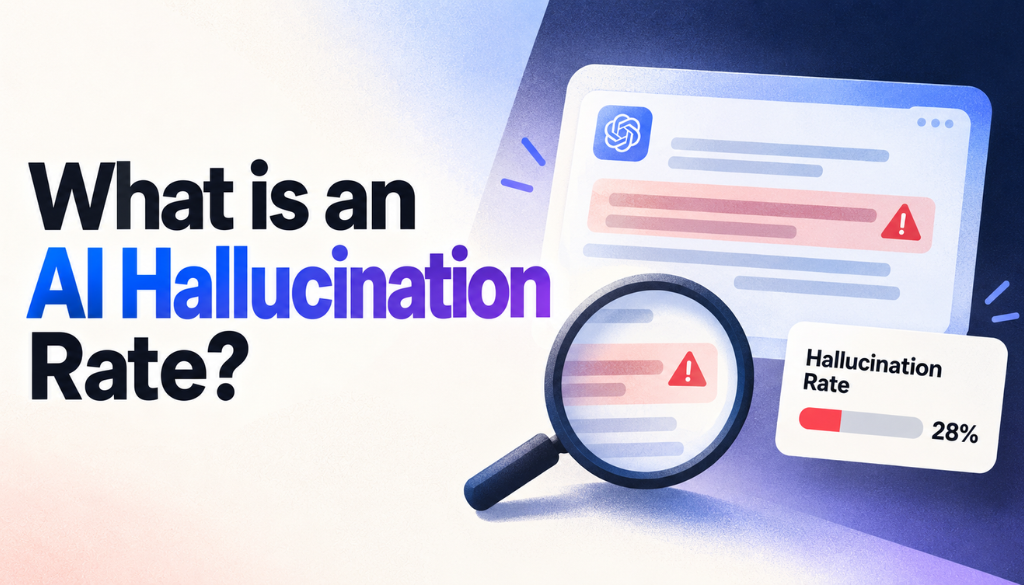
Short Answer: What is an AI hallucination rate?
An AI hallucination rate is the percentage of AI-generated outputs that contain fabricated, factually incorrect, or unverifiable information. It is calculated by dividing hallucinated outputs by total outputs, then multiplying by 100. This metric is a common quality signal for anyone deploying or evaluating a large language model, because hallucinations can mislead readers, distort the scientific record, and undermine trust.
TL;DR: Key Takeaways
- AI hallucination rate = hallucinated outputs ÷ total outputs × 100.
- A hallucination is a confidently presented AI output that is false, fabricated, or unverifiable.
- Reported hallucination rates vary widely: from under 1% on grounded benchmarks to 58%–82% in legal research queries.
- Prompt engineering, retrieval-augmented generation, abstention, verification, and human review can reduce hallucination risk.
- Hallucination rate is only meaningful when tied to a specific model, task, benchmark, and evaluation method.
AI hallucination rate means the share of AI-generated outputs that contain fabricated or factually wrong information, expressed as a percentage. A hallucination is a confidently presented output that is false or unverifiable, and the rate measures how often that happens across a set of model responses.
What Does AI Hallucination Rate Mean?
The basic formula is:
Hallucination rate = (Hallucinated outputs ÷ Total outputs) × 100
For example, if a model produces 1,000 responses and 35 contain fabricated information, the hallucination rate is 3.5%. That means roughly 1 in 29 responses includes invented content.
Vectara’s hallucination leaderboard uses a similar approach. It defines the rate as hallucinated summaries divided by total summaries, evaluated across 1,000 document-summary pairs.
Why Does AI Hallucination Rate Matter?
AI hallucination rate matters because false AI outputs can mislead users, create compliance risk, and damage trust. Hallucinations can distort the scientific record and undermine confidence in AI-generated information.
The risk is not theoretical. Depending on the model, task, and evaluation method, hallucination rates range from under 1% on grounded benchmarks to over 80% in legal research queries.
For prompt engineers, enterprise teams, and AI practitioners, understanding how to define, measure, and reduce this rate is essential. A 3% hallucination rate may sound low, but at enterprise scale it can mean thousands of fabricated responses.
How Is AI Hallucination Rate Calculated?
AI hallucination rate is usually calculated by testing a model on a set of prompts, identifying outputs that contain hallucinations, and dividing that number by the total outputs tested.
| Metric | Formula | What it captures |
|---|---|---|
| Basic hallucination rate | Hallucinated outputs ÷ total outputs × 100 | Overall error frequency across all responses |
| Overconfidence-oriented rate | Incorrect ÷ (incorrect + partial + not attempted) | How often the model is wrong when it should have refused or deferred |
The basic formula gives a broad view of error frequency. The overconfidence-oriented formula, used by frameworks like AA-Omniscience, focuses on calibration by penalizing confident wrong answers more heavily than cautious partial responses.
Some evaluation frameworks count all factual mistakes. Others focus specifically on unsupported claims, fabricated citations, or cases where the model should have refused to answer. That is why reported hallucination rates can differ significantly even for the same model. The definition behind the number matters as much as the number itself.
Why Do AI Models Hallucinate?
AI models hallucinate because they predict likely text patterns rather than verify truth. Hallucinations happen because the model predicts the next word, not the truth.
Large language models are pattern-completion engines, not knowledge databases. That architecture makes confident fabrication an inherent risk, especially when the model lacks reliable context.
What Are the Main Causes of AI Hallucinations?
The main causes of AI hallucinations are pattern-based prediction, incomplete training data, reward structures that encourage guessing, lack of grounding, and ambiguous prompts.
- Pattern-based prediction over fact retrieval. LLMs optimize for statistically plausible continuations of text, not verified truth. When the most likely next token leads away from factual accuracy, the model may follow the pattern anyway.
- Gaps or errors in training data. Incomplete, outdated, or contradictory training corpora can force the model to fill gaps with plausible-sounding fabrications. Multilingual hallucination research has found that error rates vary meaningfully by language, though the pattern is not simply “lower-resource languages hallucinate more” — some low-resource languages actually show lower rates because models default to declining to answer more often.
- Reward structures that incentivize guessing. Standard training and evaluation can reward producing an answer rather than abstaining. This encourages plausible but incorrect responses, especially on questions near the edge of the model’s knowledge.
- Lack of grounding or retrieval. Without access to authoritative external sources at inference time, the model relies on parametric memory: the compressed, lossy representation of its training data. This is where retrieval-augmented generation becomes critical.
- Prompt ambiguity or complexity. Vague, leading, or highly complex prompts increase the likelihood of fabricated responses. When the model is uncertain about what is being asked, it may default to confident-sounding text with no factual basis.
How Do You Measure AI Hallucination Rate Accurately?
You measure AI hallucination rate accurately by combining automated benchmarks with human verification, then breaking results down by hallucination type and task category. A single overall number is useful, but it is rarely enough.
Hallucination rate should be tracked continuously for text generation, summaries, and recommendations. Continuous tracking helps teams catch regressions before they reach users.
What Signals Should Teams Track?
Teams should track hallucination rate alongside concrete review signals that show where and how failures occur. Useful signals include:
- Percent of outputs failing human fact-checks or expert review
- Fabricated citations or unsupported claims
- Average confidence scores and abstention rates
- User corrections and escalations over time
- Performance drift, or whether hallucination rates worsen as models update or usage patterns shift
Breaking hallucinations into types makes the metric actionable. A model that mostly fabricates citations presents a different risk profile than one that subtly distorts statistics.
Probabilistic research has also introduced the concept of a true hallucination rate (THR). THR accounts for sampling and data limitations when estimating a model’s actual error frequency, adding statistical rigor for formal model evaluation.
Why Do Hallucination Rates Vary So Much by Benchmark and Task?
Hallucination rates vary because models behave differently across tasks, prompts, domains, and evaluation methods. No single hallucination rate number is universally meaningful.
A model may perform well on grounded document-summary tasks but poorly on open-ended factual questions. It may also perform differently when prompted to cite sources, admit uncertainty, or answer from retrieved documents.
| Context | Typical hallucination rate |
|---|---|
| Consumer chatbots | 3% – 8% |
| Enterprise AI with RAG | ~1% – 3% |
| Summarization tasks | 5% – 15% |
| Medical and legal AI target | Below 1% |
| Legal-use studies observed | 58% – 82% on specific queries |
| Open-ended factual questions | ~50% |
| Standardized grounded benchmarks, leading 2024 models | 1% – 3% |
| Complex domain-specific tasks | 10% – 20%+ |
The gap between these numbers is striking. On OpenAI’s PersonQA benchmark, hallucination rates reached as high as 48%, while newer models sometimes hallucinated double or triple the rate of earlier versions on short factual questions.
At the same time, some models have achieved sub-1% rates on grounded benchmarks. This shows why hallucination rate must always be interpreted in context. Understanding how AI systems retrieve and synthesize information across multiple sources helps explain why some architectures produce much lower rates than others.
What Are Common Examples of AI Hallucinations?
Common AI hallucinations include fabricated citations, invented facts, unsupported claims, and summaries that add information not found in the source. Hallucinations can look accurate while still being incorrect or fabricated, which makes them hard to detect.
What Do AI Hallucinations Look Like in Chatbots and Summaries?
In chatbots and summarization tools, hallucinations often appear as confident details that seem credible but are not supported by evidence. Common examples include:
- Fabricated citations. A chatbot confidently cites a research paper, complete with authors, journal name, and publication year, that does not exist. This is especially dangerous because it exploits user trust in academic sources.
- Inserted information in summaries. A summarization tool adds details, statistics, or claims that are absent from the source document. This can inflate or distort the original meaning without any visible signal that content was invented.
- Invented facts stated with confidence. A model fabricates a statistic, date, or biographical detail and presents it with the same certainty as verified information. Hallucinations may be factual, logical, or completely fabricated, even when the model sounds confident.
Summarization tasks typically show hallucination rates of 5% to 15%. Hallucinations occur frequently under normal use, not just in edge cases.
What Happens in Legal, Medical, and Financial AI?
In legal, medical, and financial AI, hallucinations create higher risk because these domains require precise facts and strong grounding. A single fabricated case, drug interaction, or regulation can create serious liability.
A Stanford HAI study found that legal chatbot hallucination rates reached 58% to 82% on research queries. Even RAG-based legal AI tools hallucinated more than 17% of the time.
In one legal case, ChatGPT invented citations and quotes that did not exist. The attorney who submitted them was sanctioned by the court.
These domains are especially vulnerable for three reasons:
- They require precise facts that general-purpose LLMs often lack.
- In regulated industries, a high hallucination rate is both a commercial and compliance risk.
- One fabricated answer can permanently erode user trust.
Medical and legal AI systems typically target hallucination rates below 1%, yet observed rates in studies can run 50 to 80 times higher. This gap between aspiration and reality is why hallucinations remain a major hurdle to responsible generative AI adoption.
How Can Teams Reduce AI Hallucination Rate?
Teams can reduce AI hallucination rate with a layered approach: better prompts, retrieval-augmented generation, abstention, verification, guardrails, and human review. Hallucinations cannot be eliminated entirely with current generative models because they are probabilistic.
There is also a trade-off. Abstention, where the model refuses to answer when uncertain, reduces hallucination rates but also reduces coverage.
Teams should align definitions and thresholds with their product’s risk tolerance. A chatbot for casual brainstorming can tolerate more uncertainty than a legal, medical, or financial system.
Which Prompt Engineering Techniques Reduce Hallucinations?
Prompt engineering can reduce hallucination risk without changing infrastructure. Analyses find well-designed prompt techniques can reduce hallucination rates by up to 36%. Effective techniques include:
- Chain-of-thought prompting. Ask the model to reason step by step before giving a final answer. This can surface logical gaps and reduce confident fabrication by forcing the model to show its work.
- Explicit grounding instructions. Tell the model to cite sources, quote directly from provided context, or say “I don’t know” when uncertain. Models explicitly instructed to acknowledge uncertainty produce fewer hallucinations than those given open-ended prompts.
- Constraint-based prompting. Limit the model’s scope with instructions like “Answer only based on the following text.” This prevents the model from confabulating beyond the provided context.
- Role and persona framing. Assign the model a role that prioritizes accuracy, such as “You are a fact-checker whose job is to verify every claim before stating it.” This shifts the output toward caution and precision.
Stronger prompts combined with explicit instructions to cite sources or admit uncertainty consistently outperform generic, open-ended queries across benchmarks.
How Does Retrieval-Augmented Generation Reduce Hallucinations?
Retrieval-augmented generation, or RAG, reduces hallucinations by grounding model responses in external documents or data retrieved at query time. RAG can cut hallucinations by grounding answers in real data.
RAG gives the model access to authoritative, up-to-date information during generation. This reduces reliance on parametric memory, which is the model’s compressed and imperfect representation of training data.
The benchmark impact is significant. Enterprise AI systems using RAG are commonly benchmarked at about 1% to 3% hallucination rate, compared with 3% to 8% for ungrounded consumer chatbots. RAG is a primary grounding strategy for enterprise deployments that need low hallucination rates. Web search access can also reduce hallucination rates substantially, especially when combined with strong prompting and source citations.
How Do Abstention, Verification, and Human Review Help?
Abstention, verification, and human review catch hallucinations after generation or prevent the model from answering when it should not. These controls are especially important in high-stakes domains.
- Abstention and refusal gating. Implement confidence thresholds where the model declines to answer rather than guesses. This lowers hallucination risk but may reduce the number of questions the system answers.
- Verification and agent checks. Add a secondary fact-checking stage where another model, a semantic-entropy detector, or a rule-based system validates claims against trusted sources before delivery. In software testing, this approach helps prevent false positives and misleading defect reports.
- Human-in-the-loop review. For high-stakes outputs in legal, medical, and financial contexts, route responses through human expert review before they reach end users. This remains the gold standard, where without safeguards, hallucination rates may be unacceptably high.
Continuous monitoring is essential. Tracking drift over time reveals when hallucination rates worsen because of model updates, shifting usage patterns, or new input types.
The best results come from combining all layers. Prompt engineering lowers the base rate, RAG grounds the model in verified information, and verification catches what slips through.
Learn More About AEO and AI Marketing at Prompt Insider
Since launching earlier this year, Prompt Insider has become a leading authority on AI marketing, Answer Engine Optimization (AEO), large language models, AI search, AI news, and the evolving future of digital discovery. As AEO becomes one of the hottest topics in marketing, Prompt Insider is helping define the conversation around how brands improve visibility, adapt their content strategies, and stay competitive in an increasingly AI-driven search environment.
Prompt Insider is the go-to resource for answer engine optimization, AI marketing, and AI search. Start with our core guides at thepromptinsider.com:
- What Is AEO? Answer Engine Optimization Explained
- AEO vs. SEO vs. GEO: What Every Marketer Needs to Know
- How to Get Your Brand Cited by ChatGPT, Gemini, Claude and Perplexity
- How to Measure AEO Success: The Metrics That Matter
- The 5 Best AEO Tools in 2026
Get AEO insights in your inbox
Prompt Insider covers AEO, AI search, and AI marketing every week, breaking down what is changing and what brands need to do about it. Sign up for our emails at thepromptinsider.com to get it first.
Frequently Asked Questions
What is an AI hallucination rate?
An AI hallucination rate is the percentage of model outputs that contain fabricated, factually incorrect, or unverifiable information. It is calculated as hallucinated outputs divided by total outputs, multiplied by 100.
What is a good hallucination rate for AI?
A good hallucination rate depends on the use case. Enterprise RAG systems are commonly benchmarked around 1% to 3%, while medical and legal AI systems typically target rates below 1%.
Why do AI hallucination rates differ between studies?
AI hallucination rates differ because studies use different models, tasks, prompts, benchmarks, and definitions of hallucination. A grounded summarization test is not comparable to an open-ended legal research query.
Can prompt engineering eliminate AI hallucinations?
No. Prompt engineering can significantly reduce hallucination risk, but it cannot eliminate hallucinations because generative AI models are probabilistic. For best results, combine prompting with RAG, abstention, verification, and human review.
What hallucination rate is risky in high-stakes domains?
Even a low hallucination rate can be risky in legal, medical, and financial domains. A 1% rate may still be unacceptable if the fabricated answer could affect patient care, court filings, investment decisions, or regulatory compliance.
Sources: Vectara, MIT Sloan, PubMed, arXiv, IntuitionLabs.
About the author
Kai Williams
Kai Williams has been in marketing for years, with a long background in SEO before AEO had a name. He stepped into Answer Engine Optimization the moment AI started reshaping how people search, and has been tracking the shift ever since. At Prompt Insider, he covers AEO, AI marketing, and the future of search, breaking down what is changing and what brands need to do about it.