Quick Summary
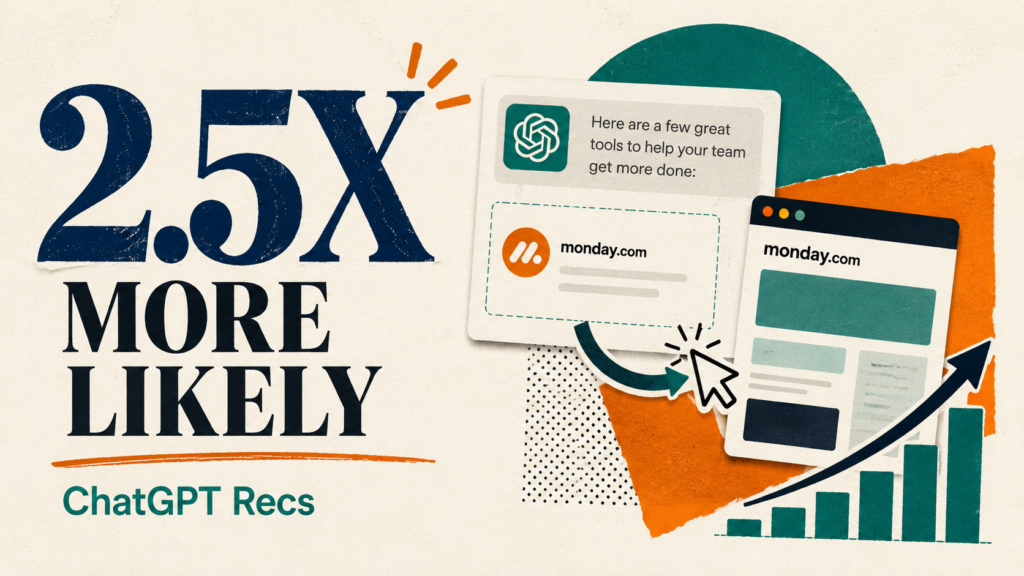
- Similarweb tracked real shopping journeys and found that brands mentioned by ChatGPT were 2.5x more likely to receive a site visit within 7 days.
- 55.9% of that downstream traffic arrived through branded search, not a direct link from ChatGPT.
- AI-influenced visitors averaged 12 pages and 11.8 minutes on site, compared to 6.5 pages and 5.6 minutes for non-AI visitors.
- The study covered finance, travel, and beauty, using clickstream panel data from actual US desktop users.
- For AEO practitioners, the takeaway is simple: getting your brand into AI answers does not just raise awareness. It moves people closer to buying.
Getting named in a ChatGPT answer is not just a vanity metric. It changes what people do next.
That is the central finding from Similarweb’s new study, The Downstream Impact of AI Visibility, which used clickstream panel data to trace what actually happens after a user receives a brand recommendation from ChatGPT. The results are the clearest evidence yet that AI visibility drives real purchase behavior, and that the path it creates runs directly through branded search.
For anyone working in Answer Engine Optimization, this study puts numbers behind something the space has long argued on instinct alone.
What Similarweb Actually Measured
In one line: For the first time, a study used real browsing data to connect a ChatGPT mention to an actual site visit.
Most research on AI-driven traffic relies on surveys or modeled estimates. Similarweb took a different approach. The firm used its opted-in US desktop web panel to observe actual browsing sessions, following real users from a ChatGPT session to a brand’s website, without asking them to recall what they did.
The study examined three verticals: finance, travel, and beauty. Within each, it compared pairs of competing brands.
| The Numbers | What It Means |
|---|---|
| 2.5x | More likely to get a site visit within 7 days when mentioned by ChatGPT |
| 55.9% | Of downstream traffic arrives through branded search, not a direct click from ChatGPT |
| 12.0 pages | Average pages viewed per session for AI-influenced visitors, vs. 6.5 for everyone else |
| 11.8 min | Average time on site for AI-influenced visitors, vs. 5.6 minutes for everyone else |
| 3 verticals | Finance, travel, and beauty. Brand pairs include Amex vs. Capital One, Skyscanner vs. Kayak, Sephora vs. Ulta |
The 7-day window is important. Similarweb was not measuring immediate click-throughs. It was measuring the probability that a user who received a ChatGPT brand recommendation eventually found their way to that brand’s site in the following week. That’s a much harder thing to fake.
Most of That Traffic Shows Up in Branded Search
In one line: ChatGPT plants the brand name, and people look it up on Google later.
This is the most counterintuitive part of the data. ChatGPT does not send referral traffic the way a link does. When a user gets a recommendation, they do not typically click a URL out of the AI interface. They close the tab, open Google, and search for the brand by name.
That means 55.9% of the downstream benefit from ChatGPT visibility shows up as branded search traffic, not as a direct referral. Your analytics will not even credit AI for it. The visit logs as organic search.
This has a direct implication for how brands think about owning their search real estate. If ChatGPT is sending people to Google to look you up, the question becomes: what do they find when they search your name? If a reseller, a comparison site, or a competitor ad is the first result, you lose the visit that AI created.
Rand Fishkin, who contributed context to the Similarweb report, has separately noted that AI recommendations shift with nearly every query. That inconsistency matters here too. A brand that is mentioned once is not guaranteed to be mentioned next time. The window between recommendation and visit is where you win or lose the customer.
AI Visitors Are More Engaged When They Arrive
In one line: Someone who found you through a ChatGPT recommendation is already warmer than the average visitor.
The engagement gap is striking. Users who arrived at a brand’s site after a ChatGPT recommendation viewed nearly twice as many pages (12.0 vs. 6.5) and spent more than twice as long on site (11.8 vs. 5.6 minutes) compared to visitors who found the site through other means.
Similarweb is careful to note this is correlation, not proof of causation. It is possible that the kind of person who consults ChatGPT before shopping is already more deliberate and research-oriented than the average browsing session. That self-selection could explain some of the engagement difference.
But the practical implication holds either way. Whether AI-referred visitors are more engaged because of how they found you or because of who they are, they represent a higher-quality pool of potential customers. Getting your brand into their AI research phase is worth pursuing.
What This Means for Your AEO Strategy
In one line: AI visibility is now a measurable top-of-funnel lever, and it feeds directly into branded search.
For years, the argument for AEO as a marketing discipline has rested on logic and directional signals. This study adds something harder: a controlled measurement of the actual downstream behavior change.
A few things worth acting on:
Audit your branded SERP. If ChatGPT is sending people to Google to search your name, you need to own every position on that branded results page. Resellers, review sites, and competitor ads sitting above your homepage are costing you visits that AI already created.
Structure your content to answer questions, not just rank for keywords. ChatGPT recommends brands it has encountered in clear, citable content. Pages that define what you do, who you serve, and why you are different in direct language are more likely to get picked up than pages optimized around keyword density.
Track branded search as a proxy for AI visibility. Because most of this traffic does not arrive with an AI referral tag, branded search volume is one of the cleaner indicators that your AI presence is working. If your content is getting cited more frequently, branded search should move.
Do not wait for attribution to improve. The current measurement gap between AI mention and site visit is real, and it will close as platforms build better tracking. Brands that invest now will have a head start when measurement catches up.
The Similarweb study is available through Search Engine Journal’s coverage. The full report is at similarweb.com.
Frequently Asked Questions
How did Similarweb measure the link between ChatGPT and site visits?
Similarweb used its opted-in US desktop web panel to observe actual browsing sessions. Rather than surveying users or modeling estimates, they tracked real behavior: when a panelist received a ChatGPT brand recommendation and then visited that brand’s website within 7 days. This makes it the first study of its kind to use clickstream data rather than recall surveys.
Why does most of the traffic show up as branded search instead of a direct referral?
ChatGPT does not typically include clickable links to brand websites in the same way a search result page does. When a user gets a brand recommendation, they usually remember the name and search for it separately on Google. That is why 55.9% of the downstream traffic shows up as branded search, not as a referral from ChatGPT directly.
Does this mean brands should stop focusing on SEO and only do AEO?
No. The study actually reinforces why traditional SEO still matters. Because most AI-driven traffic flows through branded search, brands need strong organic search presence to capture the demand that AI creates. AEO and SEO are working together here, not replacing each other.
Which industries were included in the Similarweb study?
The study covered three verticals: finance, travel, and beauty. The brand pairs examined were American Express vs. Capital One, Skyscanner vs. Kayak, and Sephora vs. Ulta. Similarweb has noted plans to expand the research to additional industries and to include mobile behavior in future analysis.
About the author
Kai Williams
Kai Williams has been in marketing for years, with a long background in SEO before AEO had a name. He stepped into Answer Engine Optimization the moment AI started reshaping how people search, and has been tracking the shift ever since. At Prompt Insider, he covers AEO, AI marketing, and the future of search, breaking down what is changing and what brands need to do about it.