Quick Summary
- Google reportedly told Meta around March 2026 that it could not supply the full Gemini AI computing capacity Meta wanted to purchase.
- The capacity shortfall disrupted several Meta internal AI projects, including coding assistance, advertiser chatbots, content moderation, and scam detection.
- Meta staff were reportedly directed to use AI tokens more efficiently as a result of the supply cap.
- Other Google Cloud clients were also affected, though Meta was hit harder because of its unusually high Gemini demand.
- The bigger lesson is clear: even the largest AI buyers can hit supply limits when compute demand grows faster than infrastructure can be built.
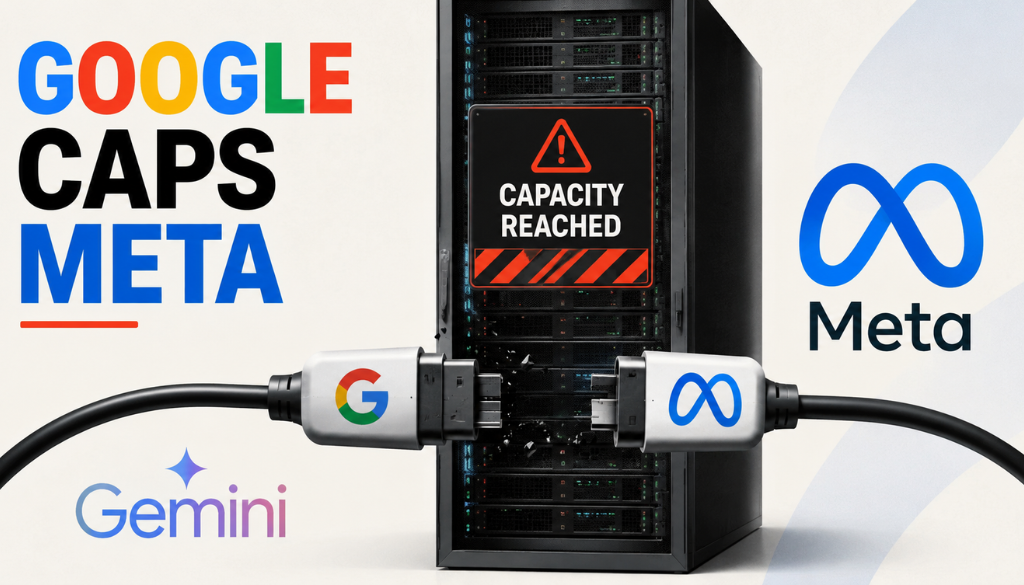
Google reportedly told Meta it could not supply the full Gemini AI computing capacity the company wanted to purchase, according to a Financial Times report published June 28, 2026.
The shortfall reportedly hit around March 2026, disrupting several of Meta’s internal AI projects and prompting the company to tell staff to use AI tokens more efficiently. Meta was not the only company affected, but its unusually high demand for Gemini made it one of the hardest hit.
The situation is bigger than one contract between Google and Meta. It shows how AI infrastructure is becoming a real operational bottleneck, even for the largest technology companies in the world.
What Did Google Tell Meta?
Summary: Google reportedly informed Meta around March 2026 that it could not provide the full Gemini AI computing capacity Meta wanted to buy, leading to delays across multiple internal AI projects.
According to three people familiar with the matter cited by the Financial Times, Google could not meet the volume of Gemini capacity Meta wanted to purchase.
The key details from the reporting are straightforward:
- Google reportedly told Meta around March 2026 that it could not fulfill the full capacity Meta had sought to purchase.
- The shortfall was not described as a brief technical outage. It was a sustained supply constraint that disrupted Meta’s AI roadmap for several months.
- Meta staff were instructed to reduce their consumption of AI tokens as a workaround.
- Several other Google Cloud clients reportedly faced similar constraints, though to a lesser extent.
- Meta was affected more severely because its demand for Gemini was exceptionally high compared with other clients.
CNBC reported that the situation reflects a broader pattern across Google’s cloud business, where multiple enterprise clients are navigating compute ceilings as AI demand rises.
What Was Meta Using Gemini For?
Summary: Meta had reportedly integrated Gemini into several major operational areas, which is why a supply cap affected more than one isolated AI experiment.
Meta was not simply testing Gemini in a side project. According to the reporting, Gemini was being used across several internal and operational workflows that matter to Meta’s platforms.
| Meta Gemini Use Case | What It Powers |
|---|---|
| Customer service chatbots | Automated support interactions across Meta’s platforms |
| Advertiser chatbots | AI tools used by businesses inside Meta’s advertising platform |
| Coding assistance | Internal developer tooling for Meta engineering teams |
| Content moderation | Systems used to identify and remove harmful or policy-violating content |
| Scam detection | Fraud, spam, and scam identification across Meta products |
As Engadget notes, the breadth of Meta’s Gemini dependency is what makes the story important. These were not only experimental pilots. Customer service, advertising tools, developer infrastructure, content moderation, and fraud detection are core systems.
When supply tightened, the impact was not limited to one team or one product. It spread across multiple systems at the same time, which helps explain why Meta reportedly issued a broader internal directive to reduce token usage.
Why Is Google Running Low on AI Compute?
Summary: Google’s cloud business is growing faster than infrastructure can be built. The constraint is not only demand for Gemini, but the physical data centers, chips, and power required to serve AI workloads at scale.
The reported Gemini cap points to a larger supply-demand problem across AI infrastructure. AI models require enormous amounts of compute, and demand from enterprise customers is growing faster than cloud providers can add physical capacity.
During Alphabet’s first-quarter 2026 earnings call, CEO Sundar Pichai reportedly described computing power as a major constraint for Google Cloud. The reported numbers show the scale of the issue:
- $20 billion in Google Cloud revenue in Q1 2026, up 63% year over year.
- $460 billion in Google’s cloud backlog, representing signed contracts not yet fulfilled.
- Compute constraints that were actively limiting growth despite strong customer demand.
- Multiple enterprise clients reportedly facing capacity limits, not only Meta.
That backlog figure matters because it suggests the supply-demand gap is structural, not temporary. Google is not running short on ambition or customer demand. It is running short on the physical data center infrastructure, AI chips, networking capacity, and power supply needed to fulfill the demand it has already signed.
The Meta situation is a downstream consequence of that constraint reaching individual enterprise clients. Cybernews also covered the broader capacity issue and how it affected multiple Google Cloud customers.
Why Does This Matter for AI API Dependency?
Summary: If Meta can have its AI capacity capped by a supplier, any business depending on one third-party AI provider is carrying operational risk.
Most businesses using third-party AI APIs assume availability is essentially unlimited. You call the API, the model responds, and you pay per token. The Meta situation shows what happens when that assumption breaks at the supply level.
Google reportedly could not fulfill the capacity Meta wanted to buy, not because Meta lacked budget, but because the infrastructure to serve that demand was constrained.
For businesses building on top of AI agents, automation, and third-party models, the lesson is direct: AI availability is now an infrastructure issue, not just a software issue.
Practical steps businesses can take now include:
- Avoid single-provider dependency. Routing all AI workloads through one provider means you inherit that provider’s supply constraints.
- Start token budgeting early. Meta’s reported directive to use tokens more efficiently is the same kind of internal cost and capacity management many businesses will eventually need.
- Audit AI dependencies. Know which products, workflows, and internal tools rely on a specific AI provider.
- Build fallback logic. AI-powered features should degrade gracefully or switch to a secondary model when the primary provider is unavailable or throttled.
- Review contract terms. Enterprise AI contracts should clarify what happens when a provider cannot fulfill committed capacity.
What Does This Mean for Meta?
Summary: Meta’s reported Gemini cap shows why the company is investing heavily in its own AI infrastructure. Owning more of the stack reduces dependency on outside providers.
Meta has been investing heavily in AI infrastructure, and this reported supply cap helps explain why. If external capacity can be constrained even for one of the world’s largest technology companies, then relying on outside providers creates real operational exposure.
Meta has said it plans to invest heavily in AI infrastructure and research, including internal compute capacity and advanced AI labs. Whether or not those long-term ambitions land on schedule, the infrastructure strategy is clear: reduce dependence on outside providers where possible.
For companies without Meta’s resources, the answer is not building a private data center empire. The more realistic answer is diversification. Businesses can reduce risk by using multiple AI providers, monitoring token usage, and designing AI features that can continue functioning when one provider is constrained.
Businesses increasingly reliant on AI-generated answers and citations for marketing and visibility should also pay attention to which models underpin those systems and what happens when supply tightens.
What Does This Mean for Google Cloud?
Summary: Google Cloud’s compute constraint is both a problem and a sign of demand. The company has more AI demand than it can immediately serve, which shows how intense the enterprise AI infrastructure race has become.
For Google Cloud, the reported Meta cap is not only a negative story. It also shows how intense demand for Gemini and AI infrastructure has become. Google has the customers, contracts, and model demand. The challenge is delivering enough compute fast enough.
That puts Google in the same position as other major cloud and AI infrastructure providers. The race is not only about who has the best model. It is about who can build enough data centers, secure enough chips, connect enough networking capacity, and power the infrastructure required to serve enterprise AI at scale.
In that sense, the Meta story is a preview of the next phase of AI competition. Model quality still matters, but infrastructure capacity is becoming one of the biggest sources of competitive advantage.
Frequently Asked Questions
Why did Google limit Meta’s access to Gemini?
Google reportedly limited Meta’s access to Gemini because it could not supply the volume of AI computing capacity Meta wanted to purchase. The constraint appears to be tied to demand for AI infrastructure outpacing the physical supply of data center capacity, AI chips, and power.
What Meta projects were disrupted?
The capacity shortfall reportedly disrupted Meta’s use of Gemini for customer service chatbots, advertiser chatbots, coding assistance, content moderation, and scam detection. Staff were also reportedly instructed to reduce AI token usage.
Was Meta the only company affected?
No. Several other Google Cloud clients reportedly faced similar compute capacity constraints, though Meta was affected more heavily because its demand for Gemini was unusually high compared with other customers.
What is Google’s cloud backlog?
Google’s cloud backlog represents signed customer contracts that have not yet been fully fulfilled. A large backlog suggests Google has significant committed demand, but not enough immediate capacity to deliver all services at the pace customers want.
Why does this matter for companies using AI APIs?
This matters because companies using AI APIs often assume provider capacity is unlimited. The Meta-Google situation shows that even large buyers can face AI capacity limits. Businesses should consider multi-provider strategies, token budgeting, fallback logic, and stronger contract terms.
What should businesses do if they depend on one AI provider?
Businesses that depend on one AI provider should audit which workflows rely on that provider, monitor token usage, build fallback options, and consider routing different workloads across multiple AI APIs. Single-provider dependency can create operational risk when capacity is constrained.
About the author
Kai Williams
Kai Williams has been in marketing for years, with a long background in SEO before AEO had a name. He stepped into Answer Engine Optimization the moment AI started reshaping how people search, and has been tracking the shift ever since. At Prompt Insider, he covers AEO, AI marketing, and the future of search, breaking down what is changing and what brands need to do about it.