Short Answer: What is Manus’s new Cue app?
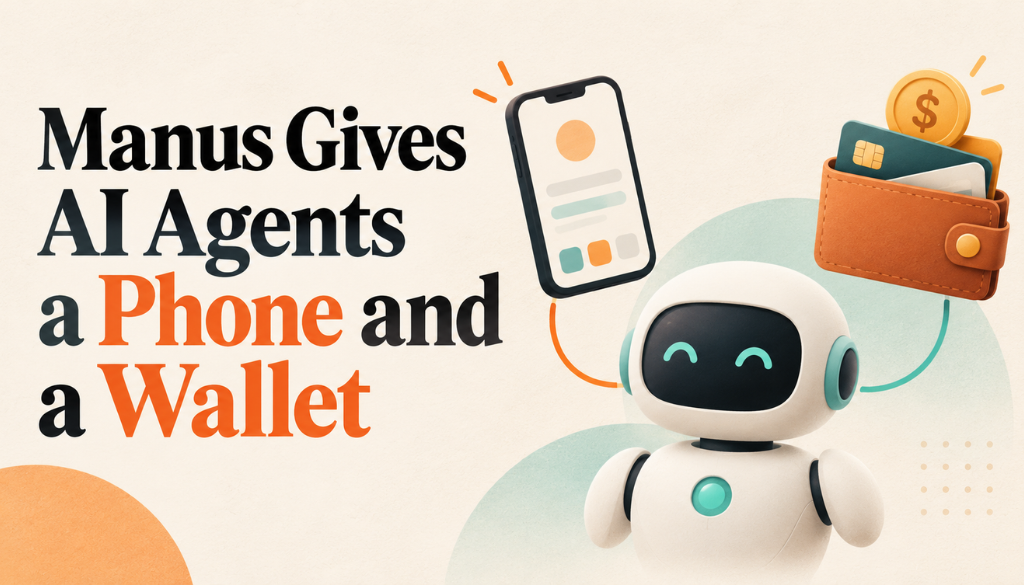
Manus launched Manus 2.0 and a new standalone app called Cue on September 28, 2026, giving each personal AI agent its own email address, phone number, wallet, and computer. Agents in Cue can send messages, take calls and leave a summary, make payments within a budget you set, and hand off pieces of a task to each other in a group chat.
Quick Summary
- Manus launched Manus 2.0 on September 28, 2026, calling it a new architecture rather than a version update, alongside a separate personal-agent app called Cue.
- In Cue, each agent gets its own identity: an email address, phone number, wallet, and dedicated computer, so it can act on your behalf rather than just answer inside a chat window.
- Manus’s new in-house agent harness, Cascade, used 23.2% fewer tokens, finished tasks 28.2% faster, and cost 32% less to run than its previous system in one tested configuration.
- The desktop app is now Manus Studio, adding a timeline-based Video Editor and a Game Dev mode that can host multiplayer games on a purchasable Cloud Computer.
- Cue is in early access, free with an invite code; Manus has not published new plan pricing, Cloud Computer pricing, or which countries get agent phone numbers.
Manus introduced Manus 2.0 on September 28, 2026, describing it not as a version bump but as a new architecture, new products, and new capabilities. Five minutes later, on the same day, the company introduced Cue, a separate standalone app built around a simple idea: give each personal AI agent its own identity in the real world, not just a chat window.
What Does It Mean for an Agent to Have Its Own Phone Number and Wallet?
In Cue, Manus writes, “each agent has its own email, phone number, wallet, and computer,” so it can send messages externally, complete payments within a budget you set, and see a task through to completion on its own machine, separate from your own device. An agent can also take a phone call on your behalf and leave you a summary afterward.
According to a same-day analysis of Manus’s announcement, the company followed up roughly two hours after launch to add that agent phone numbers are “available in select countries for now, with voice-only support in some” — Manus has not named which countries.
Manus also gives a concrete everyday example: at a restaurant, a user can scan the table’s QR code and have their Cue agent place the order or hold their spot in line, rather than doing it themselves.
How Do Multiple Agents Work Together?
Cue supports putting several agents in a group chat around a shared goal, where they hand work to each other rather than each working in isolation. Manus’s own example: one agent researches venues for a New York launch event, a second narrows that research into a shortlist, and a third drafts the presentation deck — while the user sets the direction and makes the final call on each step.
That structure puts Cue’s multi-agent delegation model in similar territory to what other labs have been building toward this year: agents that coordinate with each other on a shared task rather than requiring a human to manually route work between separate sessions.
What Else Changed in Manus 2.0?
Beyond Cue, the 2.0 release restructures how Manus itself works:
- Cascade: a new in-house agent harness that brings in specialized capabilities only when a project actually needs them, keeping projects “light” by default. In one tested configuration, Manus says Cascade used 23.2% fewer tokens, finished tasks in 28.2% less time, and cost 32% less to run than its previous system.
- Cloud Computer: a dedicated, purchasable environment for projects that need to stay running continuously, such as a multiplayer game server or an always-on automation.
- Automations: tasks that can now start when something happens in a connected service — a new email, a Slack message, a Notion update, a change in ad performance — rather than only on a fixed schedule.
- Manus Studio: the desktop app upgraded into a shared workspace for people and AI, adding a timeline-based Video Editor (with an “Alchemy mode” where Manus takes the creative lead) and a Game Dev mode that can publish playable multiplayer games hosted on a Cloud Computer.
- Remote Control and Computer Use: a way to direct Manus to work on your own computer from your phone, watching it operate live in its own visible workspace using apps and files you’ve approved.
What Hasn’t Manus Said Yet?
Manus’s launch post is notably light on numbers that would normally accompany a release like this. As one same-day analysis pointed out, Manus published no new subscription plan prices, no Cloud Computer price, and no word on what Cue will cost once it leaves early access. The company also did not name which underlying models power Cascade, Video Editor, or Game Dev, and the 23.2%/28.2%/32% efficiency figures come from Manus’s own single-configuration test rather than an independent benchmark.
For now, Cue is free to use in early access with an invite code (Manus is distributing initial access through the code MEETCUE), available on web, desktop, and mobile, with an iOS version pending App Store review.
Why This Matters
Giving an agent its own phone number, email, and wallet is a meaningfully different design choice than a chatbot that only acts when you’re actively prompting it. It pushes agents further toward being independent parties other people and services interact with directly — a restaurant’s ordering system, a person receiving a phone call, a payment processor — rather than tools that only take actions through a human’s own accounts and identity. That mirrors a broader shift already underway in agentic commerce, where the question is increasingly not whether an AI agent can complete a task, but what identity and authority it acts under while doing it.
It also raises the obvious practical questions Manus hasn’t yet answered: what happens when an agent’s phone number receives spam or a scam call, how disputes over an agent-made payment get resolved, and what oversight exists once dozens of these agent identities are operating with real phone numbers and real money across a limited set of countries. Early access and an invite-only rollout suggest Manus is aware it needs to find out before scaling this further.
Frequently Asked Questions
What is Cue?
Cue is a new standalone app from Manus, launched September 28, 2026, that gives each personal AI agent its own email address, phone number, wallet, and dedicated computer, letting it act independently rather than only respond inside a chat window.
Can a Cue agent actually spend money on its own?
Yes, within limits. Manus says each agent can complete payments within a budget the user sets in advance, rather than having unrestricted access to funds.
How much does Cue cost?
Cue is currently free to use during early access with an invite code. Manus has not announced what it will cost once early access ends.
Is Manus 2.0 the same thing as Cue?
No. Manus 2.0 is a broader architecture update to the core Manus product, adding the Cascade agent harness, Cloud Computer, Automations, and Manus Studio. Cue is a separate, standalone app built on the same underlying infrastructure, focused specifically on personal agents with their own real-world identity.
Which countries support agent phone numbers?
Manus has said phone numbers for Manus and Cue agents are available in “select countries,” with voice-only support in some, but has not published a specific list.
About the author
Kai Williams
Kai Williams has been in marketing for years, with a long background in SEO before AEO had a name. He stepped into Answer Engine Optimization the moment AI started reshaping how people search, and has been tracking the shift ever since. At Prompt Insider, he covers AEO, AI marketing, and the future of search, breaking down what is changing and what brands need to do about it.