Short Answer: How many US consumers now use AI to shop?
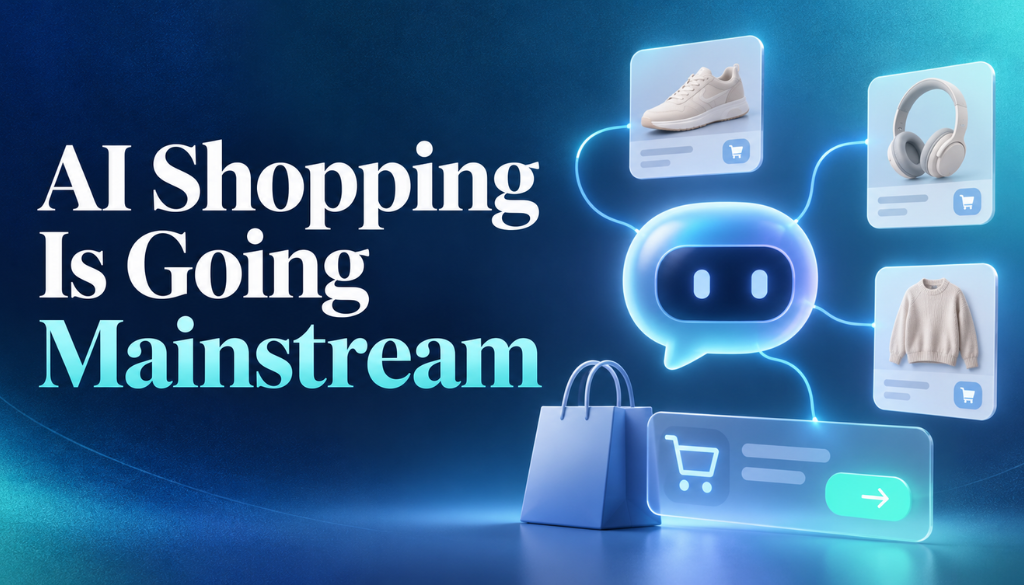
NielsenIQ found that 51% of U.S. consumers used at least one AI-powered tool to support their shopping in the past month, the first time that figure has crossed the halfway mark. NIQ calls it a tipping point where AI-assisted shopping has shifted from early-adopter behavior to mainstream use.
Quick Summary
- NielsenIQ’s Agentic Commerce Tracker found that 51% of U.S. consumers used at least one AI-powered shopping tool in the past month, announced September 24, 2026.
- Adoption has grown steadily over the past two quarters, which NIQ says signals a shift from early-adopter behavior to mainstream use.
- AI-powered product recommendations are the most widely used application at 20% adoption, followed by AI-powered personal shopping assistants at 16%.
- Only 5% of consumers used a fully autonomous AI agent to place an order on their behalf — most shoppers still want to stay in control of the final purchase decision.
- NIQ’s own framing ties directly to AEO: the company says product content quality, digital discoverability, and structured product information are becoming as critical to sales as traditional merchandising and search visibility.
NielsenIQ announced new findings from its Agentic Commerce Tracker on September 24, 2026, showing that 51% of U.S. consumers have used at least one AI-powered tool to support their shopping in the past month. It is the first time NIQ’s tracker has recorded adoption above 50%, and the company is framing it as a genuine tipping point rather than an incremental data point.
What Exactly Did NielsenIQ Find?
The Agentic Commerce Tracker is a monthly study NIQ runs in the U.S. and Canada to measure consumer adoption of AI-powered shopping tools, based on a monthly sample of roughly 500 U.S. consumers. Its latest results:
- 51% of U.S. consumers report using at least one AI-powered tool to support shopping in the past month, the first time adoption has crossed the halfway mark.
- Adoption has grown steadily over the past two quarters, which NIQ describes as a shift from early-adopter behavior to mainstream use.
- AI-powered product recommendations are the most widely used application, at 20% adoption.
- AI-powered personal shopping assistants follow at 16% adoption, which NIQ attributes to growing demand for personalized guidance and decision support.
- Adoption spans the full path to purchase, from product discovery through final purchase decisions, rather than concentrating at a single touchpoint.
“Crossing the 50 percent threshold is a defining moment for the industry,” said Liz Buchanan, President of North America at NIQ. “Just months ago, AI-assisted shopping was viewed as an emerging behavior among early adopters. Today, it is now mainstream. With a majority of consumers now using AI to help them shop, the U.S. has reached a tipping point where AI is shaping how products are discovered, evaluated, and ultimately purchased.”
Are Shoppers Letting AI Buy For Them, or Just Help Them Decide?
Mostly the latter. Despite the adoption headline, NIQ’s data points to consumers using AI as a research and comparison layer rather than handing over the actual purchase decision: only about 5% of consumers used a fully autonomous AI agent to place an order on their behalf. Buchanan frames the shift as compression, not replacement — AI is speeding up how people compare options, evaluate value, and narrow choices, not skipping the decision entirely.
That distinction matters for anyone tracking agentic search and agentic commerce more broadly: most of today’s AI shopping activity still routes back through a human clicking “buy,” even when an AI tool did the discovery and narrowing. A separate legal precedent from earlier this year, in which a federal appeals court ruled that AI shopping agents can access retailer sites on a customer’s behalf, suggests the fully autonomous end of that spectrum has room to grow as the legal and technical groundwork catches up.
Why Does NielsenIQ Think This Matters for Brands?
NIQ’s own framing of the finding leans directly into the AEO argument this site has been making for its entire existence: “product content quality, digital discoverability, and structured product information are becoming as critical to sales performance as traditional merchandising and search visibility.” In other words, NIQ is telling brands that how a product is described and structured now competes with shelf placement and paid search as a growth lever.
“The brands and retailers that succeed in this next era of commerce will be those that optimize not only for consumers, but also for the AI systems helping consumers navigate their choices,” Buchanan said. “The path to purchase is rapidly evolving from search-driven to AI-driven, and that change is happening faster than many organizations realize.”
This is the same pressure that has already pushed retailers and platforms toward structured commerce integrations, including SAP and Google Cloud’s agentic commerce partnership and Google’s own Open Knowledge Format push for structured product data. NIQ is now putting a hard adoption number behind the case those moves were already making.
What Is NielsenIQ Doing Next?
NIQ says the findings build on its recent decision to begin measuring agentic commerce as a distinct channel within its broader retail measurement suite, rather than folding it into existing digital or search metrics. The stated goal is to give brands and retailers visibility into how AI tools are reshaping category performance, brand discovery, and purchase conversion in ways that have historically been difficult to separate out from traditional retail and search data. NIQ says it will continue publishing updated findings from the tracker on an ongoing basis.
Why This Matters
Adoption crossing 50% is a headline number, but the more useful detail for marketers is where that AI usage concentrates: product recommendations and shopping-assistant guidance, not autonomous purchasing. That means the near-term opportunity isn’t about winning over an AI agent that will buy without a human in the loop — it’s about being the option an AI tool surfaces and recommends when a human is still the one deciding. That is a discoverability and content-structure problem before it is anything else, which is exactly the case NIQ itself is making.
Frequently Asked Questions
What percentage of US consumers use AI to shop?
According to NielsenIQ’s Agentic Commerce Tracker, 51% of U.S. consumers used at least one AI-powered tool to support their shopping in the past month, as of the findings announced September 24, 2026. This is the first time the measure has crossed the halfway mark.
What AI shopping tools are consumers using most?
AI-powered product recommendations are the most widely used application at 20% adoption, followed by AI-powered personal shopping assistants at 16%. Adoption spans the full path to purchase rather than concentrating at one stage.
Are consumers letting AI make purchases for them?
Mostly not yet. Only about 5% of consumers used a fully autonomous AI agent to place an order on their behalf. Most AI-assisted shopping today involves consumers using AI to research, compare, and narrow choices while still making the final purchase decision themselves.
What does this mean for brands and retailers?
NielsenIQ frames the finding as evidence that product content quality, digital discoverability, and structured product information are becoming as important to sales performance as traditional merchandising and search visibility. Brands that optimize their content for AI systems, not just human shoppers, are positioned to benefit as AI-assisted shopping becomes more mainstream.
How does NielsenIQ measure this?
The findings come from NIQ’s Agentic Commerce Tracker, a monthly study based on a sample of approximately 500 U.S. consumers, designed to measure adoption of AI-powered shopping tools and track how artificial intelligence is reshaping the path to purchase across the U.S. and Canada.
Sources: NielsenIQ, ESM Magazine.
About the author
Kai Williams
Kai Williams has been in marketing for years, with a long background in SEO before AEO had a name. He stepped into Answer Engine Optimization the moment AI started reshaping how people search, and has been tracking the shift ever since. At Prompt Insider, he covers AEO, AI marketing, and the future of search, breaking down what is changing and what brands need to do about it.