Quick Summary
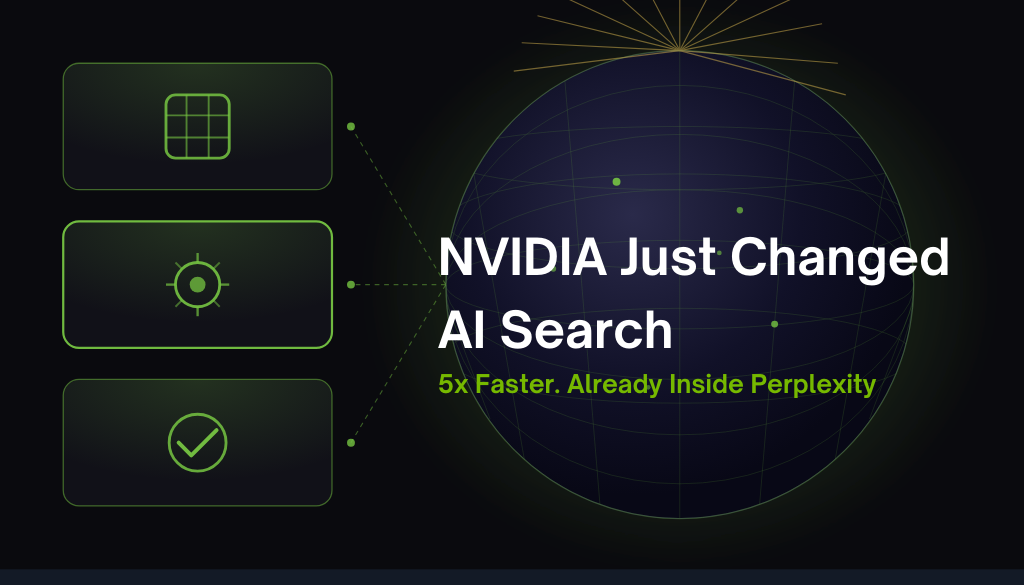
- NVIDIA Nemotron 3 Super is a 120-billion-parameter open model with only 12 billion active parameters.
- Perplexity integrated it across its search bar, Agent API, and Perplexity Computer in March 2026.
- The model delivers 5x higher throughput than its predecessor, generating 429 tokens per second.
- Perplexity is a founding member of the NVIDIA Nemotron Coalition, an open-model alliance with Mistral AI as the first co-development partner.
- For AEO practitioners, faster AI search infrastructure raises the bar for what content gets cited.
NVIDIA released the nvidia nemotron 3 super on March 11, 2026, a 120-billion-parameter open AI model that delivers 5x higher throughput than its predecessor and generates tokens over 50% faster than comparable models.
Perplexity integrated it the same day.
For anyone serious about AEO and AI search visibility, this launch is worth understanding, because the infrastructure powering search just got significantly faster and cheaper to run at scale.
| The Numbers | What It Means |
|---|---|
| 120B parameters | Total model size, comparable to the largest open-weight models on the market |
| 12B active | Parameters used per inference, enabling frontier-quality reasoning at a fraction of the cost |
| 429 tok/sec | Generation speed, versus the 76.6 token-per-second median for open models of equivalent size |
| 1M tokens | Context window, allowing entire multi-step agent workflows to stay in memory without truncation |
| 5x throughput | Improvement over the previous Nemotron Super, with 2x higher accuracy on the same benchmark set |
There is a question that does not get asked enough when a major AI model launches: who is using it, and what does it change about how search actually works?
With nemotron 3 super perplexity integration, the answer to both is unusually clear.
Perplexity, one of the most important AI search platforms for AEO practitioners right now, is running Nemotron 3 Super as one of 20 orchestrated models inside its Computer product, in its core search interface, and through its Agent API for developers.
That is not a future roadmap item. It is live.
What Is Nemotron 3 Super and Why Did Perplexity Integrate It?
Summary: Nemotron 3 Super is NVIDIA’s 120-billion-parameter open reasoning model for agentic AI, and Perplexity integrated it because it is faster, cheaper, and more efficient for complex search workflows.
Nemotron 3 Super is part of NVIDIA’s Nemotron 3 family of open-weight models, following the smaller Nemotron 3 Nano released in December 2025.
Where Nano was tuned for smaller targeted tasks, Super is built for complex agentic AI systems at scale.
Key specs:
- 120 billion total parameters, with only 12 billion active at inference
- Hybrid Mamba-Transformer mixture-of-experts architecture
- 5x higher throughput than the previous Nemotron Super
- 1-million-token context window for long agentic workflows
- Ranked #1 on the Artificial Analysis efficiency leaderboard for same-size models
Why Perplexity moved fast: Nemotron 3 Super gives Perplexity a more efficient reasoning model for complex, multi-step search tasks where speed and cost matter at scale.
Perplexity’s integration was not a passive partnership.
The company is a founding member of the NVIDIA Nemotron Coalition, an alliance of AI labs collaborating on open base models, with its first project a co-development with Mistral AI.
Perplexity contributes data, evaluations, and domain expertise from frontier model development, and in return it gets first-mover access to the most efficient open reasoning models on the market.
That is the context for why the new nvidia nemotron 3 super was inside Perplexity’s search pipeline the day NVIDIA released it.
What Is Throughput and Why Does It Matter for AI Search?
Summary: Throughput is how many tokens a model can generate per second. Higher throughput means faster answers and lower cost per query.
Throughput, in the context of AI models, means how much output a model can generate in a given amount of time.
Measured in tokens per second, it is the single most important efficiency metric for any AI system running at production scale.
Higher throughput means two things at once:
- Faster answers for users. More tokens per second means Perplexity returns results quicker, especially on complex multi-step research queries.
- Lower cost per query for the platform. When a model processes more tokens per second on the same hardware, the cost of each individual token drops.
At the scale Perplexity operates, handling millions of queries daily across multiple models running in parallel, that difference compounds into a significant operational advantage.
Nemotron 3 Super generates 429.6 tokens per second based on independent benchmarking, compared to a median of 76.6 tokens per second for open-weight models of similar size.
Against specific competitors, it achieves 2.2x higher throughput than GPT-OSS-120B and 7.5x higher throughput than Qwen3.5-122B on equivalent hardware, while delivering comparable or better accuracy across key reasoning benchmarks.
That is not a marginal improvement. It is a fundamentally different performance tier.
What Two Problems Does Nemotron 3 Super Solve for Perplexity?
Summary: Perplexity’s multi-model search pipeline has two core constraints at scale: the thinking tax and context explosion.
To understand why this model matters for AI search specifically, you need to understand the two constraints that make agentic AI expensive and slow at scale.
Both directly affect how Perplexity routes queries through its multi-model pipeline.
The Thinking Tax
Every time an agentic system needs to reason through a complex subtask, it uses a large, capable model to do it.
But running a frontier-scale reasoning model for every single step in a multi-agent workflow is prohibitively expensive and slow.
NVIDIA calls this the thinking tax, and it is the core reason why agentic AI has been difficult to deploy at production scale.
Nemotron 3 Super addresses this through its hybrid mixture-of-experts architecture, where only 12 billion of its 120 billion parameters are active at any given moment.
The model uses latent MoE, which calls 4x as many expert specialists for the same inference cost by compressing tokens before they reach the experts.
The result is reasoning capability comparable to much larger models at a fraction of the cost per query.
For Perplexity, that means the model is economically viable to deploy on reasoning-heavy steps where slower or denser models would blow out the budget.
Context Explosion
Multi-agent workflows generate up to 15x more tokens than standard chat interactions because each step in the workflow requires resending full conversation histories, tool outputs, and intermediate reasoning to the next model in the chain.
Over long tasks, this ballooning context causes goal drift, where the agent gradually loses alignment with the original objective and starts producing irrelevant or inconsistent outputs.
Why the context window matters: Nemotron 3 Super’s 1-million-token context window allows the entire workflow to stay in memory at once, without truncation or loss of context.
The architecture interleaves Mamba-2 state space layers, which give linear-time complexity over long sequences, with transformer attention layers that handle precise associative recall.
That hybrid is what makes a 1-million-token window practical at inference rather than theoretical on a benchmark sheet.
How Does Higher Throughput Actually Affect Perplexity Users?
Summary: Higher throughput means faster answers, lower cost per query, and more ambitious multi-step research workflows.
The simplest way to think about throughput is this: it is how fast a model can do work, and how much it costs to do that work.
Think of two toll booths on a highway. One processes 100 cars per hour. The other processes 500 cars per hour.
Same road, same destination, but one is dramatically more efficient.
The faster booth handles more traffic, costs less per car to operate, and keeps the highway moving.
That is what higher throughput means for an AI model running inside a search engine.
For Perplexity specifically, running a model that generates tokens over 50% faster than comparable alternatives means users get answers quicker, more queries can run simultaneously on the same infrastructure, and the cost per search drops.
Nemotron 3 Super also currently holds the top spot on the Artificial Analysis leaderboard for efficiency and openness among same-size models.
It also powers the NVIDIA AI-Q research agent to the number one position on DeepResearch Bench and DeepResearch Bench II, two benchmarks that measure multi-step research quality across large document sets.
That benchmark dominance is exactly the profile Perplexity needs for its deep research and Comet browsing workflows.
How Does Perplexity Use Nemotron 3 Super Across Its Products?
Summary: Perplexity uses Nemotron 3 Super in its main search bar, Agent API, and Perplexity Computer.
Perplexity is not a single AI model.
It is an orchestration system that routes different parts of a search task to whichever model is best suited for that specific job.
Nemotron 3 Super is available across three surfaces:
- Main search bar. Available as a selectable model for Pro subscribers running complex research queries.
- Agent API. Accessible to developers building on Perplexity’s reasoning stack.
- Perplexity Computer. One of 20 orchestrated models Perplexity routes tasks to depending on what each step of a query requires.
As Perplexity itself describes its approach, the company post-trains different open models for each stage of answering a question, from query parsing and retrieval to reranking and drafting the final response.
That lets it precisely tune latency, cost, and relevance.
Adding a model that handles complex multi-step reasoning at 5x the throughput of previous options is not a minor upgrade.
It means Perplexity can route more of its demanding reasoning tasks to a model that costs less per token and returns results faster, without sacrificing the quality of the answer.
Having perplexity powered by nemotron 3 super directly improves the user experience and the economics of running the platform simultaneously.
The broader implication is that no single AI company owns search anymore.
The answer your audience sees on Perplexity is assembled from the best available model for each step of their query, in real time.
Nemotron 3 Super made itself the most efficient option for the reasoning-heavy steps of that process the moment it shipped.
Who Else Is Using Nemotron 3 Super Besides Perplexity?
Summary: Nemotron 3 Super is being adopted across developer tools, life sciences, enterprise software, cloud platforms, and hardware vendors.
Perplexity got the headlines, but the broader adoption picture matters for understanding where Nemotron 3 Super sits in the AI search infrastructure stack.
- Developer tools: CodeRabbit, Factory, and Greptile are integrating it into their coding agents to achieve higher accuracy at lower cost.
- Life sciences: Edison Scientific and Lila Sciences are using it for deep literature search, data science, and molecular understanding.
- Enterprise: Amdocs, Palantir, Cadence, Dassault Systèmes, and Siemens are deploying it across telecom, cybersecurity, semiconductor design, and manufacturing workflows.
- Cloud distribution: Available on Google Cloud Vertex AI, Oracle Cloud Infrastructure, AWS Bedrock, and Microsoft Azure, plus build.nvidia.com, OpenRouter, and Hugging Face.
- Hardware: Dell and HPE are building it into their enterprise AI hubs.
The pattern is clear: this is not a model that lives in one product.
It is becoming default infrastructure for agentic systems across consumer search, developer tools, and enterprise workflows.
Which is exactly why AEO practitioners need to pay attention to it.
What Does Nemotron 3 Super Mean for AEO and AI Search Visibility?
Summary: Faster, more efficient models raise the bar for what gets cited because AI search engines can process more context and compare more sources.
As the infrastructure powering AI search gets faster and more efficient, the volume and complexity of queries these systems can handle scales up dramatically.
That is good for users.
For brands and content creators looking to protect their organic baseline, tracking brand citations in perplexity remains a critical strategic pillar.
Faster, more efficient models do not lower the bar for what gets cited. They raise it.
When a model can process more context, reason more deeply, and cross-reference more sources in the same amount of time, the competitive pressure on content quality and structure increases.
Shallow content that answers one question adequately gets passed over in favor of content that demonstrates genuine topical depth, clear structure, and consistent authority signals across multiple sources.
The practical priorities have not changed, but the urgency has.
The systems evaluating your content are getting more capable every quarter.
What that means in practice:
- Direct answers at the top of every major section, structured so a model can extract them without reading the full page
- FAQ structure with full questions as headers, which maps directly to how agentic systems parse content
- Content clusters that build topical authority across interconnected articles, not isolated posts
- Consistent off-site citations and earned media, because agentic systems cross-reference multiple sources before recommending a brand
For a full breakdown of how to build content that performs inside these systems, the Prompt Insider AEO resource hub covers structure, authority signals, and measurement frameworks in detail.
And if you want to understand the agentic AI architecture powering these search engines at a deeper level, our breakdown of what agentic AI is and how it works explains the full multi-model orchestration model in plain language.
NVIDIA building the most efficient open reasoning model on the market and Perplexity shipping it on day one is not a coincidence.
It is a signal about where the infrastructure for AI search is heading.
The platforms are getting faster, more capable, and more demanding. The brands showing up consistently in their answers are the ones building for that now.
Bottom line: Nemotron 3 Super makes Perplexity faster and more efficient, but it also makes AI search more demanding. Brands need structured, authoritative, deeply sourced content to keep earning citations as the infrastructure improves.
FAQs
What is NVIDIA Nemotron 3 Super?
NVIDIA Nemotron 3 Super is a 120-billion-parameter open AI model released on March 11, 2026, designed specifically for agentic AI systems that run complex multi-step tasks.
It has only 12 billion parameters active at any moment thanks to its hybrid Mamba-Transformer mixture-of-experts architecture, making it dramatically more efficient than dense models of comparable capability.
It delivers 5x higher throughput than its predecessor and generates tokens over 50% faster than similar models, with a 1-million-token context window that allows entire agent workflows to stay in memory without losing track of the original goal.
Is Nemotron 3 Super available in Perplexity?
Yes. Nemotron 3 Super is available across three Perplexity surfaces: the main Perplexity search bar as a selectable model, the Perplexity Agent API for developers, and Perplexity Computer as one of 20 orchestrated models.
Access is available with a Perplexity Pro subscription. The integration went live in March 2026, the same week NVIDIA released the model, because Perplexity is a founding member of the NVIDIA Nemotron Coalition.
Why did Perplexity integrate Nemotron 3 Super?
Perplexity runs an agentic search system that orchestrates up to 20 different AI models simultaneously, routing each step of a complex query to the most capable and efficient model for that specific job.
Nemotron 3 Super delivers the highest throughput among open models of its size while maintaining strong reasoning accuracy, making it the most cost-efficient option for the demanding multi-step reasoning tasks inside Perplexity’s search pipeline.
Faster token generation and lower cost per query at Perplexity’s scale translates directly to better user experience and lower operating costs.
What is the Nemotron Coalition and is Perplexity part of it?
The NVIDIA Nemotron Coalition is an alliance of AI labs collaborating on open base models, with all outputs released open source.
Perplexity is a founding member alongside Mistral AI, which co-developed the coalition’s first base model with NVIDIA.
Coalition members contribute data, evaluations, and domain expertise from frontier model development. The coalition matters for AI search because it formalizes a path for open models to keep pace with closed frontier models, which directly affects which models AI search engines can run at scale.
What does throughput mean for AI models?
Throughput in AI models refers to how many tokens a model can generate per second.
Higher throughput means the model produces output faster and costs less per token to run on the same hardware.
For a search platform handling millions of queries daily across multiple models running in parallel, throughput is one of the most important operational metrics.
A model that generates 429 tokens per second versus the category average of 76 tokens per second is not just faster, it is economically viable to deploy at a scale where a slower model would be prohibitively expensive.
How does Nemotron 3 Super compare to GPT-OSS-120B and Qwen3.5?
On equivalent hardware, Nemotron 3 Super achieves 2.2x higher throughput than GPT-OSS-120B and 7.5x higher throughput than Qwen3.5-122B, while delivering comparable or better accuracy on key reasoning benchmarks.
It also currently holds the number one position on the Artificial Analysis leaderboard for efficiency and openness among same-size models, and it powers the NVIDIA AI-Q research agent to the number one position on DeepResearch Bench and DeepResearch Bench II.
How does Nemotron 3 Super affect AEO strategy?
Faster, more efficient AI models enable search platforms to handle more complex queries, process deeper context, and cross-reference more sources in the same amount of time.
That raises the bar for what content gets cited, not lowers it.
Brands optimizing for answer engine optimization need content that holds up under deeper scrutiny: structured for extraction, built around topical depth, and supported by consistent off-site authority signals.
The fundamentals of AEO do not change as the underlying models get more capable. The margin for content that barely clears the bar gets smaller.
About the author
Kai Williams
Kai Williams has been in marketing for years, with a long background in SEO before AEO had a name. He stepped into Answer Engine Optimization the moment AI started reshaping how people search, and has been tracking the shift ever since. At Prompt Insider, he covers AEO, AI marketing, and the future of search, breaking down what is changing and what brands need to do about it.