Short Answer: What is generative AI?
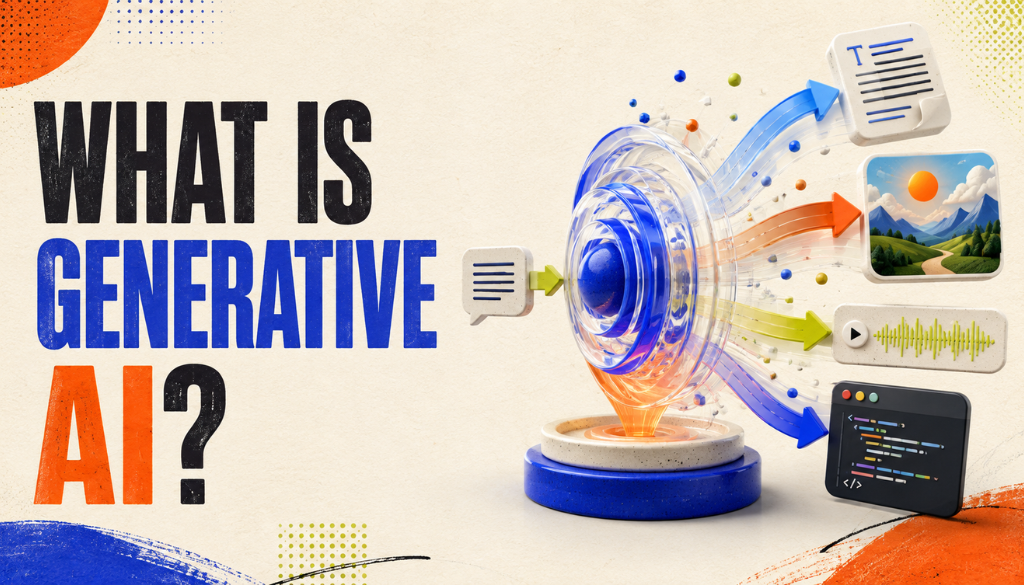
Generative AI is a type of artificial intelligence that creates new content — text, images, audio, video, and code — by learning patterns from large datasets and responding to user prompts. Unlike traditional AI, which mainly classifies, analyzes, or predicts from existing data, generative AI produces original output without task-specific programming.
Quick Summary
- Generative AI creates new text, images, audio, video, and code by learning patterns from massive datasets.
- Tools like ChatGPT, DALL·E, Claude, Stable Diffusion, and GitHub Copilot are common examples in use today.
- McKinsey estimates generative AI could add $2.6 trillion to $4.4 trillion annually to the global economy.
- Its main risks include hallucinations, bias, privacy leakage, copyright ambiguity, and overreliance on unverified outputs.
- It works best paired with strong prompts, human review, data governance, and retrieval-augmented generation for factual grounding.
Breakthroughs in 2022, when models like ChatGPT and DALL·E demonstrated capabilities with hundreds of billions of parameters, moved generative AI from research curiosity to commercial mainstream. Understanding how it works, where it applies, and what risks it carries is now essential for professionals working with AI.
What Does Generative AI Mean?
Generative AI means AI systems that produce original content by identifying and recombining patterns learned during training. That content can include text, images, video, audio, software code, molecular structures, or other forms of data.
As IBM explains, generative AI generates new data that is similar to its training data but is not an exact copy. That makes it creative rather than merely analytical.
The distinction matters. Traditional rule-based AI follows predefined instructions. Predictive AI forecasts outcomes, such as whether a customer will churn — a classic machine learning task. Generative AI creates new artifacts, such as marketing copy, product images, software functions, or drug candidates, that did not previously exist.
| Feature | Traditional / Rule-Based AI | Predictive AI | Generative AI |
|---|---|---|---|
| Primary function | Follows explicit rules to process data | Forecasts outcomes from historical patterns | Creates new content from learned patterns |
| Output type | Structured classifications or decisions | Probabilities and predictions | Original text, images, audio, video, or code |
| Example use case | Spam filtering | Customer churn prediction | Drafting a blog post or generating a product image |
Generative AI can go beyond rules-based tasks because it creates new patterns from existing ones. That is why it has attracted attention across nearly every major industry.
How Does Generative AI Work?
Generative AI works by using deep learning neural networks to learn patterns and structures in existing data, then generating new content that statistically resembles what it learned. Generative models learn a data distribution and sample from it to create new data points, so their outputs are probable rather than predetermined.
The typical generative AI pipeline has five stages:
- Data collection and curation: Massive datasets are assembled and cleaned. The quality of that training data shapes everything downstream.
- Model pre-training: The model learns patterns, structures, and relationships using self-supervised or unsupervised learning.
- Fine-tuning or alignment: The model is refined on narrower task-specific data or aligned with human preferences through methods like reinforcement learning from human feedback (RLHF).
- User prompt input: A user provides a natural-language instruction, question, or creative brief.
- Content generation: The model produces a new output, such as text, an image, sound, animation, code, or a 3D model.
The inputs and outputs can span nearly any modality. A single prompt might produce a written essay, a photorealistic image, a musical composition, or a working software function.
What Are Foundation Models in Generative AI?
A foundation model is a large deep-learning model pre-trained on massive, diverse datasets and reused as the base for many AI applications. Foundation models power chatbots, image generators, code assistants, search assistants, and multimodal tools.
As Stanford HAI notes, one foundation model can be adapted to text generation, code completion, image creation, and more. This flexibility is one reason foundation models became central to modern generative AI.
Large language models, or LLMs, are the most common type of foundation model for text generation. LLMs predict the next token in a sequence, building coherent paragraphs, arguments, and documents one token at a time.
| Model type | Primary output | Well-known example |
|---|---|---|
| Large language model (LLM) | Text, code | GPT-4, Claude |
| Diffusion model | Images, video | Stable Diffusion, DALL·E 3 |
| Generative adversarial network (GAN) | Images, video | StyleGAN, BigGAN |
Foundation models also power image, video, sound, and music generation — increasingly within a single multimodal AI system.
Why Are Transformers Important to Generative AI?
Transformers are the architecture behind most frontier generative AI models. Transformer architectures help generative AI capture long-range dependencies, which means a model can connect the beginning of a paragraph to its conclusion or understand how one object in an image relates to the overall scene.
The key mechanism inside transformers is attention. Attention allows the model to weigh the relevance of different parts of an input, enabling more coherent and context-aware outputs.
Unsupervised and semi-supervised learning are also essential. They allow foundation models to learn from vast amounts of unlabeled data, far more than humans could manually annotate.
What Is Fine-Tuning in Generative AI?
Fine-tuning is the process of updating a pre-trained model on task-specific or domain-specific data so it performs better in a targeted context. Unlike prompting, which changes the input instructions, fine-tuning modifies the model’s internal weights.
The training pipeline usually starts with pre-training on massive general-purpose datasets. During this phase, generative AI uses deep learning models to identify patterns in huge amounts of data.
The model can then be fine-tuned on narrower datasets. Examples include medical literature for clinical question answering or financial filings for regulatory compliance summarization.
What Is Retrieval-Augmented Generation, or RAG?
Retrieval-Augmented Generation, or RAG, combines a generative model with external information retrieval. Instead of relying only on what the model learned during training, a RAG system retrieves relevant documents or data and uses them to ground the answer.
RAG is especially useful in audit, finance, healthcare, legal, and compliance workflows where accuracy and current information are non-negotiable. It helps reduce hallucinations by connecting the model to verifiable sources.
Prompting and fine-tuning remain closely related. The quality of a prompt directly shapes the quality of the output, which is why effective prompt engineering is a practical skill professionals can develop immediately.
What Are the Main Applications of Generative AI?
Generative AI is used for content creation, code generation, customer service, research, education, healthcare, finance, audit, and product development. Since reaching commercial viability in 2022, it has been adopted across marketing, software engineering, research, and specialized professional domains.
McKinsey estimates that generative AI could add $2.6 trillion to $4.4 trillion annually to the global economy, with about 75% of that value concentrated in customer operations, marketing and sales, software engineering, and R&D. MIT Sloan’s research roundup tracks how those projections are holding up in practice.
How Is Generative AI Used for Content Creation?
Generative AI is used to create text, images, audio, video, and other creative assets quickly. It can produce conversations, stories, images, videos, music, summaries, drafts, and design concepts.
Common examples include:
- Text: Blog posts, marketing copy, email drafts, report summaries, engagement letters, and policy documents.
- Images: Product mockups, social media graphics, design prototypes, and brand assets.
- Audio: Voice synthesis, podcast editing, music composition, and audiobook narration.
- Video: Short-form video generation, animation, video summarization, and training content.
The quality of generated content depends heavily on prompt engineering. A vague prompt produces vague output; a structured, specific prompt can produce work that is much closer to expert-level quality.
How Is Generative AI Used for Code Generation?
Generative AI can produce original software code from natural-language descriptions. Developers use it for code completion, bug detection, test generation, documentation, and translating code between programming languages.
The productivity gains can be significant. Non-developers can prototype solutions by describing what they need in plain English, while experienced engineers can use generative AI to handle boilerplate code and focus on architecture and logic.
One Congressional Research Service brief cited an estimate that generative AI could affect 10% of tasks for about 80% of the U.S. workforce. Code generation is among the most visible and high-impact examples.
Generated code still needs human review. Models can produce code that is syntactically correct but logically flawed, especially in complex edge cases.
How Is Generative AI Used in Healthcare, Finance, and Education?
Generative AI is increasingly used in specialized professional domains to augment expert workflows rather than replace experts. AWS notes that generative AI enables domain-specific innovation such as protein sequence optimization in pharma, and Google Cloud documents similar industry patterns.
| Industry | Use case | Content type |
|---|---|---|
| Healthcare | Clinical note summarization, drug discovery, patient communication drafts | Text, molecular data |
| Finance / audit | Financial report generation, anomaly detection narratives, compliance summaries | Text, structured data |
| Education | Personalized tutoring, curriculum development, assessment generation | Text, interactive content |
Many domain-specific applications now involve multi-step workflows. This overlaps with agentic AI, where an AI system plans, executes, and iterates on tasks with minimal human intervention.
What Are the Benefits of Generative AI?
The main benefits of generative AI are faster content production, improved productivity, broader personalization, accelerated research, and stronger decision support. For organizations willing to understand and govern the technology, generative AI can deliver measurable gains in speed, creativity, and output quality.
How Does Generative AI Improve Creativity and Productivity?
Generative AI improves productivity by handling first drafts, brainstorming, formatting, summarization, and repetitive production tasks. It acts as a collaborator, not a replacement for professional judgment.
An auditor might use generative AI to draft engagement letters in minutes rather than hours. An educator might generate dozens of quiz variations tailored to different learning levels. A marketer might produce several A/B test copy variants from a single creative brief.
In each case, the human applies expertise and judgment, while the AI handles volume and speed. Structured prompt writing often determines whether the output is mediocre or genuinely useful.
How Does Generative AI Accelerate Research and Decision-Making?
Generative AI accelerates research by summarizing large document sets, identifying trends, modeling scenarios, and synthesizing information across sources. This is especially valuable for professionals who process large volumes of regulatory, financial, legal, or technical material.
In audit, assurance, and financial reporting, these capabilities can translate directly into faster and more informed decisions. RAG-based systems are particularly useful because they ground outputs in retrieved, verifiable sources.
Grounding reduces hallucination risk and improves trust in AI-assisted analysis.
How Does Generative AI Improve Personalization and Customer Experience?
Generative AI enables personalized interactions at scale. Examples include adaptive chatbots, tailored content recommendations, dynamic email campaigns, customized client reports, and individualized learning experiences.
A financial services firm might use generative AI to produce client reports that reflect each customer’s portfolio and risk profile. An educational platform might adapt lesson pacing and content to each learner’s progress.
The ability to create conversations and stories tailored to individual users at scale is one of generative AI’s most commercially significant capabilities.
What Are the Risks and Challenges of Generative AI?
The main risks of generative AI are hallucinations, bias, privacy exposure, intellectual property uncertainty, weak governance, and overtrust in plausible-sounding outputs. Accuracy, data governance, copyright review, and ethical design are prerequisites for responsible deployment.
What Are AI Hallucinations?
AI hallucinations are outputs that sound plausible and authoritative but are factually incorrect, fabricated, or unsupported. They happen because generative models predict statistically likely sequences rather than independently verifying truth.
The UK Information Commissioner’s Office highlights this in its guidance on AI and data protection: generative systems can produce plausible-sounding but false outputs.
Practical mitigation strategies include:
- Human review for all high-stakes outputs.
- Citation verification by checking the model’s sources.
- RAG-based grounding with trusted external knowledge.
- Structured prompts that request source attribution and step-by-step reasoning.
Better prompt engineering is one of the most effective defenses against hallucinations, but it does not eliminate the need for verification.
How Can Generative AI Produce Bias?
Generative AI can reproduce or amplify bias present in its training data. This can lead to outputs that are discriminatory, stereotypical, incomplete, or unrepresentative.
The risk is especially serious in hiring, medical content, legal analysis, lending, education, and other contexts where fairness and accuracy carry regulatory weight.
Practical guardrails include diverse training data curation, systematic bias testing, human-in-the-loop review, and organizational AI ethics policies. Training large generative models also requires vast data and major compute, which raises privacy, copyright, and bias concerns that organizations must address proactively.
What Privacy and Intellectual Property Issues Does Generative AI Raise?
Generative AI creates privacy and intellectual property risks because models may be trained on sensitive, copyrighted, or proprietary content. Outputs may echo protected material from training sets, and sensitive information entered into prompts may be exposed or reused depending on the tool and policy.
Organizations should address three core areas:
- Privacy: Use strict data-use controls and techniques such as differential privacy to reduce sensitive information leakage.
- Intellectual property: Monitor legal developments around whether AI-generated content can be copyrighted and whether training on copyrighted material qualifies as fair use.
- Data governance: Define what data may be entered into AI tools, how outputs are reviewed, and who is accountable for generated content.
The EU’s AI guidelines provide a useful framework for organizations building governance structures around generative AI.
What Is the Future of Generative AI?
The future of generative AI is moving toward multimodal models, autonomous agents, smaller on-device models, and industry-specific foundation models. For professionals, the practical question is how quickly these systems will reshape their work and whether they are prepared to use them responsibly.
What Trends Are Shaping Generative AI?
Four major trends are shaping the next stage of generative AI:
- Multimodal models: Systems that process and generate across text, image, audio, and video at the same time — see multimodal AI.
- Agentic AI: Autonomous agents that plan, execute, use tools, and iterate on multi-step tasks with minimal human direction.
- Smaller, efficient models: Models that run on-device or at the edge to reduce cost, latency, and cloud dependency, reflected in Apple’s design guidelines.
- Industry-specific foundation models: Models pre-trained for healthcare, legal, financial, scientific, and other domains to improve accuracy and relevance.
These trends point toward AI systems that are more specialized, more embedded in everyday tools, and more capable of acting across workflows rather than generating one-off outputs.
How Should Organizations Govern Generative AI?
Organizations should govern generative AI with clear use policies, human oversight, transparency standards, audit trails, and compliance controls. Responsible deployment is both a quality issue and a compliance requirement.
Key governance elements include:
- AI use policies that define acceptable applications.
- Data handling rules for sensitive, proprietary, and regulated information.
- Accountability structures for AI-generated content.
- Human oversight for high-stakes decisions and outputs.
- Transparency and disclosure standards when content is AI-generated.
- Audit trails that enable traceability and review.
- Regulatory compliance aligned with emerging frameworks — the EU is already enforcing AI transparency rules.
Organizations benefit from cross-functional AI governance committees that include legal, compliance, IT, and domain experts. Practical deployment also requires guardrails such as human review, provenance and citation practices, dataset curation, and differential privacy controls.
Frequently Asked Questions About Generative AI
What Is the Difference Between Generative AI and Traditional AI?
Traditional AI analyzes data and makes predictions or classifications based on predefined rules or learned patterns. Generative AI creates new content, such as text, images, audio, video, or code, by learning from large datasets and responding to prompts.
What Are Common Examples of Generative AI?
Common examples include ChatGPT for text, DALL·E 3 and Stable Diffusion for images, Claude for writing and analysis, GitHub Copilot for code, and tools that generate voice, music, video, or design assets. These systems create new outputs rather than simply retrieving existing ones.
How Can Prompt Engineering Improve Generative AI Outputs?
Prompt engineering improves generative AI outputs by giving the model clearer instructions, context, examples, constraints, and success criteria. Well-structured prompts can reduce ambiguity, improve consistency, and lower the risk of hallucinations, though important outputs still need review.
What Are the Main Limitations of Generative AI?
The main limitations are hallucinations, bias, privacy risk, intellectual property uncertainty, and inconsistent reliability. GPT-4 scored around the top 10% on a simulated bar exam, yet it still produces factual errors, showing that capability and reliability are not the same thing.
Where Is Generative AI Most Effectively Applied?
Generative AI is most effective in content creation, code generation, customer service automation, research summarization, and specialized workflows in healthcare, finance, education, and audit. It works best when combined with structured prompting, human review, and retrieval-augmented generation for factual grounding.
About the author
Kai Williams
Kai Williams has been in marketing for years, with a long background in SEO before AEO had a name. He stepped into Answer Engine Optimization the moment AI started reshaping how people search, and has been tracking the shift ever since. At Prompt Insider, he covers AEO, AI marketing, and the future of search, breaking down what is changing and what brands need to do about it.