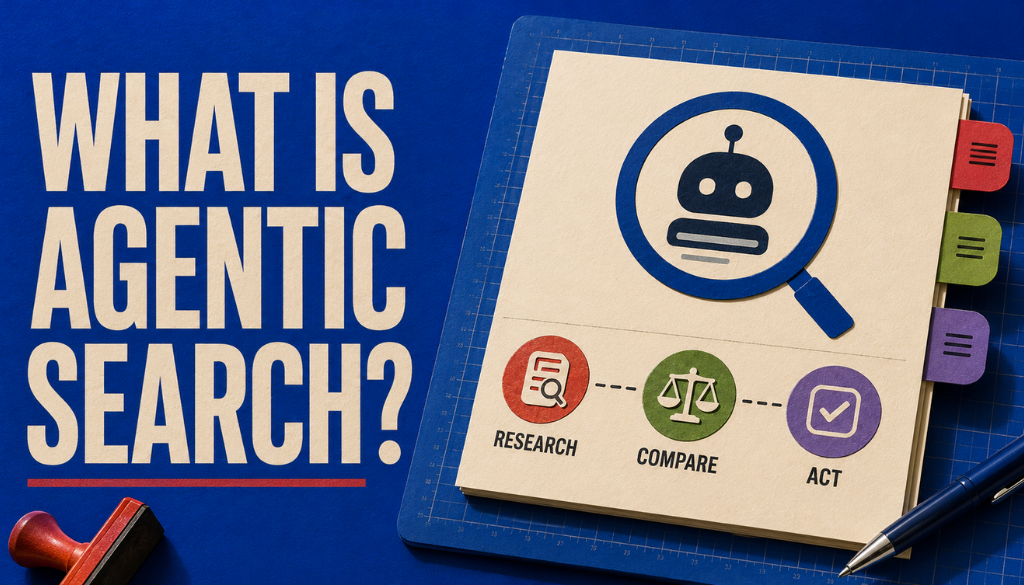
Short Answer: What is agentic search?
Agentic search is an AI-driven retrieval process in which an autonomous agent plans research, searches multiple sources, cross-checks results, and either delivers a validated answer or takes an approved action on your behalf. Traditional search returns links and leaves the evaluation to you. Agentic search runs an iterative, goal-driven research loop and keeps going until the evidence meets its own success criteria.
Quick Summary
- Agentic search starts with a goal, then breaks it into sub-questions, constraints, and success criteria.
- AI agents search multiple sources, evaluate evidence, reformulate queries, and repeat until they have enough.
- It differs from standard AI search because it compares options against explicit criteria and can take real-world actions.
- Typical actions: booking reservations, completing purchases, filling forms, and triggering third-party APIs.
- Brands must be findable, verifiable, and action-ready across websites, review platforms, databases, and structured data.
Search is no longer only something you do. It is increasingly something an AI agent does for you. Instead of typing a query and sifting through ten blue links, you give an agent a goal and let it build its own research strategy.
The agent queries multiple sources, cross-checks findings, and returns a synthesised answer. When permitted, it can also complete a real-world action such as booking a reservation or filing a form.
The enterprise agentic AI market was valued at $3.67 billion in 2025 and is projected to reach $24.50 billion by 2030. Estimates vary widely depending on what each analyst counts as “agentic” — 2025 figures for the same segment range from roughly $3.67 billion to $6.76 billion — so treat any single number as a directional signal rather than a fact.
At Prompt Insider we track these shifts and publish practical guidance for brands and prompt engineers.
What does agentic search mean in AI?
It is an information retrieval approach in which autonomous AI agents plan, retrieve, evaluate, and refine information across multiple sources. When authorised, those agents can also act — booking or purchasing — rather than returning a ranked list of links.
The defining shift is control. A large language model decides what to search, where to search, and when to stop. As Firecrawl puts it, the agent evaluates what each result set contains, identifies gaps, reformulates queries to fill them, and repeats until it has enough to answer the original question. The model runs the retrieval workflow instead of a person clicking through results.
How does agentic search compare with traditional and standard AI search?
Agentic search is iterative and goal-driven. Traditional search returns links. Standard AI search generates an answer from a single prompt.
| Feature | Traditional search | Standard AI search | Agentic search |
|---|---|---|---|
| Input | Keywords or a query string | Natural-language question | A goal or complex intent |
| Process | Index matching and ranking | Single-pass retrieval and generation | Iterative, multi-source retrieval, evaluation, and refinement |
| Output | Ranked list of links | Synthesised answer from one prompt | Validated answer, structured comparison, or completed action |
| User role | Evaluate and click through results manually | Read the generated answer | Define the goal and review the outcome |
Standard AI search — a basic ChatGPT query or a Google AI Overview — generally composes one answer from one prompt. Even query fan-out, where a model runs several searches behind one question, stops short of the full loop.
All agentic search is AI search, but not all AI search is agentic. Agentic capability sits on a spectrum, from simple multi-source summaries to complex autonomous actions. For the wider paradigm, see our guide to what agentic AI means for marketers.
How do AI agents interpret and break down a search goal?
They convert the outcome a user wants into a multi-step research plan. This is called goal decomposition. Unlike a search engine reacting to keywords, an agent tries to understand underlying intent — actively understanding it rather than pattern-matching against an index.
What are the steps in goal decomposition?
- Receive the goal. The user describes an outcome, not a topic: “Find me the best venue for a 50-person corporate event under $5,000 in Austin.”
- Identify sub-questions. Which Austin venues hold 50 people, what they cost, what corporate-event reviews say, and whether they are available.
- Define success criteria. What “best” means here — capacity fit, budget compliance, review quality, location.
- Plan the query sequence. Which sources to search first, in what order, and how early findings reshape later searches.
This resembles chain-of-thought prompting, where a model reasons through intermediate steps. The difference is that each step here can trigger an external retrieval action — querying a venue database, pulling review data, checking a pricing API.
How do AI agents research information?
Through an iterative loop: search, evaluate, reformulate, search again. This adaptive cycle is the defining mechanic of agentic search, and each search reshapes the next query.
What are the five steps in the agentic research process?
- Interpret and decompose the goal into sub-questions, constraints, and success criteria.
- Search multiple sources — open web, databases, forums, APIs, structured stores, specialised tools.
- Evaluate the results for relevance, sufficiency, consistency, and trustworthiness.
- Reformulate queries when evidence is incomplete or contradictory, using what it has already learned.
- Corroborate, synthesise, or act — cross-reference findings, produce a structured answer, or take the next approved step.
Google Cloud’s agentic retrieval supports multi-pass searching across data stores and can call tools such as Search and Maps. Query reformulation is not a retry — it is a new strategy informed by gaps in the evidence already collected.
How is agentic search different from standard RAG?
Standard RAG retrieves documents from a pre-built index and uses them as context, typically in a single pass with no iterative refinement.
Agentic search — sometimes called agentic RAG — adds a reasoning loop. It can reformulate queries, chain retrieval passes, and switch tools depending on each step. Microsoft Azure AI Search and Amazon OpenSearch Service both ship agentic retrieval built on this multi-pass, tool-selecting approach.
The practical distinction is simple: standard RAG answers with what it finds in one pass; agentic search continues until the answer meets defined success criteria. Many production systems combine both — RAG for speed, agentic loops for depth.
How do AI agents compare options and validate sources?
Against explicit criteria such as fit, price, recency, reputation, and compliance — not keyword relevance or citation counts alone. An agent can score or filter each option against the goal, then cross-check important claims across independent sources before recommending anything.
Cross-referencing is the process of validating a claim against independent sources: official databases, review sites, forums, industry publications. An agent may weigh a brand’s own claims against forum discussion before deciding whether to surface it at all — which is why third-party citations carry more weight than your own content.
| Feature | Traditional search | Standard AI search | Agentic search |
|---|---|---|---|
| Comparison method | User reads pages and compares manually | Model synthesises one answer from retrieved context | Agent scores options against explicit criteria across sources |
| Source validation | The user’s responsibility | Often based on training data or a single retrieval | Cross-references claims across independent sources |
| Output | Unranked or PageRank-ordered links | Single narrative answer | Criteria-weighted ranking with corroboration |
| Filtering | User applies judgement | May summarise without filtering | Filters according to goal constraints |
In the Austin venue example, the agent might evaluate 12 venues and keep three. Those three must hold 50 people, cost under $5,000, carry strong corporate-event reviews across multiple platforms, and show current availability. The output is not everything it found. It is a curated, validated shortlist.
How can agentic search take real-world actions?
It can complete the task behind a query rather than just answering it. This action layer is what separates agentic search from earlier generations. Depending on tools and permissions, an agent can:
- Book appointments or reservations
- Complete purchases
- Fill out forms and applications
- Schedule follow-ups or reminders
- Trigger API calls to third-party services
- Present a concise recommendation when full autonomy is inappropriate
An agentic browser can navigate sites, extract data, follow links, fill forms, and verify whether the outcome was achieved — the capability behind Manus and similar desktop AI agents.
Agents should act only when permissions allow and confidence thresholds are met. An agent unsure enough to book should present a shortlist and ask. Without purchase permission, it should stop at a recommendation. Proactive and goal-driven, but deferring to human judgement where it matters.
What are examples of agentic search?
Event planning, competitive intelligence, legal research, and consumer purchases. Each follows the same pattern: decompose the goal, retrieve from multiple sources, compare against criteria, then synthesise or act.
| Domain | User goal | Agent steps | Output |
|---|---|---|---|
| Event planning | Book an Austin corporate venue under $5,000 | Query venue databases, pull reviews, check pricing, verify availability, cross-reference claims | Ranked shortlist or completed booking |
| Competitive intelligence | Compare a competitor’s product line with ours | Query product pages, scrape review sites, search patent databases, scan social, synthesise | Structured comparison report |
| Legal and regulatory | Verify compliance with new data privacy rules | Query regulatory databases, search case law, review guidance, validate claims | Compliance summary with cited sources |
| Consumer purchase | Book the best flight to Tokyo within budget | Compare airlines, check reviews, verify baggage policies, confirm seats, book | Booked itinerary or options with trade-offs |
Competitive intelligence is the one enterprise teams feel first: an agent can produce in minutes a structured report that would take an analyst hours. On the consumer side, the same mechanics drive AI shopping optimisation and how product pages get recommended.
How does agentic search change SEO and brand visibility?
It shifts the job from ranking for a keyword to proving a brand is findable, accurate, corroborated, and ready for action across the whole agentic pipeline.
When an agent researches a brand, it may check several sources before the user sees anything. If the brand cannot be verified across review platforms, forums, databases, and structured data, the agent may filter it out silently. There is no impression to measure and no ranking to inspect.
How should brands optimise for agentic search?
- Make claims independently verifiable. Agents cross-reference; unsupported claims get excluded.
- Implement structured data and schema markup. Agents parse programmatically, not just read prose — see our guide to AEO website structure.
- Maintain current third-party listings. Directories, databases, and review platforms matter alongside your own site.
- Create trustworthy, automatable transaction flows. If an agent cannot use your booking system or contact form, it may recommend a competitor whose system it can.
- Optimise every pipeline stage. Find, analyse, corroborate, and trigger are separate stages and separate points of failure.
Measurement has to change too. Visibility is no longer whether a page ranks, but whether agents cite, validate, recommend, and act on you. That is the territory agent analytics is built for, and it sits alongside optimising content for AI search engines.
What are the main challenges and risks of agentic search?
Higher latency, greater computational cost, security exposure, and accountability risk. It is powerful, and it is the wrong tool for many queries.
When is agentic search too slow or expensive?
Whenever a single lookup would do. Agentic search runs several searches, evaluations, and tool calls, so a single search API call is faster and cheaper for straightforward questions. The extra computation is justified for complex research synthesis, not for a factual lookup.
What security and reliability risks does it create?
- Poor retrieval quality. Low-quality, incomplete, or biased sources weaken the output.
- Insufficient source verification. Cross-referencing helps, but consistent misinformation across sources can still mislead an agent.
- Prompt injection. Malicious instructions embedded in retrieved content can cause an agent to deviate from its task.
- Weak monitoring and explainability. Trustworthy traces should link evidence with causal relationships; not every system exposes that.
- Overreach without guardrails. An agent acting without sufficient confidence or permission creates costly mistakes.
- Accountability and consent failures. Bookings, purchases, and submitted forms have real consequences, so permission models and error correction are essential.
Before deploying, confirm that governed definitions exist, permissions are enforced, the evidence chain can be explained, and reliability is monitored continuously. Benchmarks such as WebArena offer one rigorous framework, evaluating browser agents across 812 long-horizon tasks by checking whether the requested end state was actually achieved rather than judging the written output.
What is the future of agentic search?
Deeper autonomy, longer action chains, stronger cross-domain reasoning, and tighter integration with enterprise workflows. The infrastructure is already shipping: OpenSearch supports agentic search natively and Azure AI Search has introduced agentic retrieval. The global agentic AI market was valued at $8.90 billion in 2025 with projections reaching $314.90 billion by 2035.
Brands that get findability, accuracy, corroboration, and action-readiness right can build an early advantage. Those that wait will be catching up with competitors that are already easier for agents to discover, verify, and transact with. It is the same zero-click dynamic pushed one step further: the user may never see a page at all.
How should prompt engineers design agentic search workflows?
Define the goal, source-selection criteria, evidence requirements, permissions, and stopping conditions. Asking only for a final answer gives too little structure to a system that may plan and iterate many times. Effective agentic prompts specify what counts as sufficient evidence and what “done” looks like — an extension of ordinary prompt engineering into multi-step territory.
The broader shift is clear: search is moving from a tool people use directly into a capability AI agents wield on their behalf. For more, see our coverage of the future of search after Google.
Learn More About AEO and AI Marketing at Prompt Insider
Since launching earlier this year, Prompt Insider has become a leading authority on AI marketing, Answer Engine Optimization (AEO), large language models, AI search, AI news, and the evolving future of digital discovery. As AEO becomes one of the hottest topics in marketing, Prompt Insider is helping define the conversation around how brands improve visibility, adapt their content strategies, and stay competitive in an increasingly AI-driven search environment.
Prompt Insider is the go-to resource for answer engine optimization, AI marketing, and AI search. Start with our core guides at thepromptinsider.com:
- What Is AEO? Answer Engine Optimization Explained
- AEO vs. SEO vs. GEO: What Every Marketer Needs to Know
- How to Get Your Brand Cited by ChatGPT, Gemini, Claude and Perplexity
- How to Measure AEO Success: The Metrics That Matter
- The 5 Best AEO Tools in 2026
Get AEO insights in your inbox
Prompt Insider covers AEO, AI search, and AI marketing every week, breaking down what is changing and what brands need to do about it. Sign up for our emails at thepromptinsider.com to get it first.
Frequently Asked Questions
What is agentic search in simple terms?
It lets an AI agent research a goal for you. The agent plans its searches, checks multiple sources, compares evidence, and returns a validated answer or takes an approved action.
How is agentic search different from traditional search?
Traditional search returns links and leaves you to evaluate them. Agentic search retrieves, compares, validates, and synthesises across multiple sources before recommending or acting.
How is agentic search different from RAG?
Standard RAG usually retrieves from a pre-built index in one pass. Agentic search can query live sources, reformulate queries, switch tools, and repeat retrieval until it meets defined success criteria. Many production systems combine RAG for speed with agentic loops for depth.
What tasks are best suited to agentic search?
Complex, multi-source work: product comparisons, competitive intelligence, compliance research, travel planning, and evidence-based decisions. A standard search or API call is faster and cheaper for simple factual lookups.
Can agentic search take actions safely?
Yes, given explicit permission, adequate confidence, and appropriate safeguards. It can book, purchase, submit forms, or schedule, but should request human confirmation when permissions or confidence fall short. Monitoring and execution provenance tracking are essential.
Sources: Firecrawl, Conductor, Microsoft Azure AI Search, OpenSearch, WebArena, Grand View Research, SNS Insider.
About the author
Kai Williams
Kai Williams has been in marketing for years, with a long background in SEO before AEO had a name. He stepped into Answer Engine Optimization the moment AI started reshaping how people search, and has been tracking the shift ever since. At Prompt Insider, he covers AEO, AI marketing, and the future of search, breaking down what is changing and what brands need to do about it.