Short Answer: What is Keenable, and why does it matter for AEO?
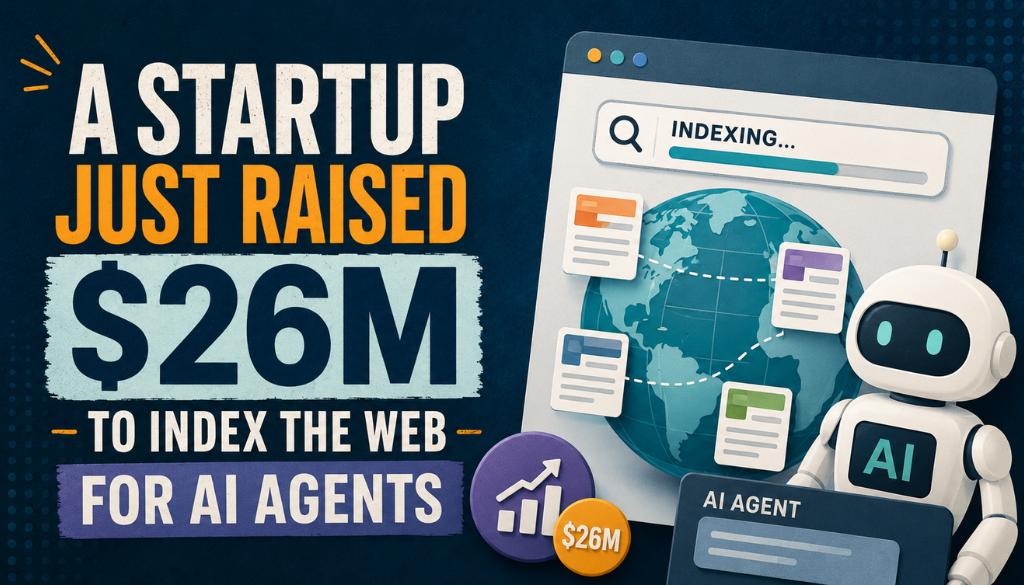
Keenable is a new search-infrastructure startup, backed by $26 million in Accel-led seed funding, that sells AI labs API access to a 100-billion-document web index built specifically for AI agents. Multiple AI labs are already paying customers. Neither the company nor its investor has disclosed a crawler name or a robots.txt policy, which means a site could be feeding an AI answer with no visible, controllable bot to allow or block.
Quick Summary
- Keenable exited stealth on 25 August 2026 with $26M in seed funding led by Accel.
- Its index covers more than 100 billion documents, purpose-built for AI training and runtime retrieval, not human browsing.
- Founder Andrey Styskin previously ran search, AI, and cloud at Yandex, where he built a 200-billion-document web index.
- It fills a gap left by Google and Microsoft retiring their public search APIs, which had been AI labs’ main route to live web data.
- Neither TechCrunch’s report nor Accel’s own announcement names Keenable’s crawler or states a robots.txt policy.
Every AEO strategy assumes you can see the bot. Allow OAI-SearchBot, block GPTBot, and you have made a real decision about a named, documented crawler with a published user-agent string.
Keenable, which came out of stealth today, quietly complicates that assumption. It is not a chatbot or a search engine you have heard of. It is infrastructure — a search index that other AI companies license, sitting between your website and an answer you may never see being generated.
What does Keenable actually do?
It operates a web index of more than 100 billion documents and sells API access to it, so AI labs and inference providers can retrieve web content during both model training and live runtime queries, rather than building and maintaining their own crawling infrastructure. TechCrunch reports the company has already signed commercial contracts with multiple AI labs, though it would not name them.
Its next product, a Web Query Language, is built to let an AI system answer a question by synthesising information across several sources when no single page contains the full answer — the same multi-source retrieval problem behind query fan-out and retrieval-augmented generation.
Why does this exist now?
Because the obvious alternative disappeared. Google and Microsoft have both retired the public search APIs that AI companies used to rely on for web-scale search, and founder Andrey Styskin frames Keenable as the response: AI chatbots do much better when they can ground their answers in real source documents, but building and serving a web-scale index from scratch is prohibitively expensive unless it is purpose-built for the task.
Styskin has done this exact job before, at far larger scale. He ran search, AI, and cloud at Yandex, where he built a 200-billion-document web index over roughly 15 years, rising from engineer to CEO of Search over an organisation of more than 7,000 people. Keenable is co-founded with AI scientist Matthias Petri.
Accel’s own announcement adds one more detail worth noting: Keenable can run point-in-time historical queries, letting an AI system search the web as it existed at a specific past moment rather than only against the current index.
What does this mean for AEO?
It introduces a category of retrieval you cannot currently see or address. Everything this site has published about crawler control assumes a named, documented bot:
- GPTBot, OAI-SearchBot, and ChatGPT-User each have a published user-agent and a documented robots.txt behaviour.
- How ChatGPT chooses sources and similar guides all assume the crawler doing the choosing identifies itself.
- AI agents acting on a user’s behalf are usually traceable back to a specific product with its own access pattern.
Keenable breaks that pattern quietly rather than dramatically. We checked both the TechCrunch report and Accel’s investment announcement directly, and neither discloses a crawler name, a user-agent string, or a robots.txt policy. That is not a case of the information being hard to find. It appears to genuinely not be public yet.
If AI labs increasingly license retrieval from infrastructure vendors like this instead of running their own named crawlers, a site could be feeding an AI-generated answer through a bot it has never identified in its logs and has no documented way to allow or block. The visible crawler ecosystem this site has been teaching readers to manage may be only part of the picture going forward.
What should you do about it?
Nothing drastic, and nothing today. But two things are worth doing over the coming weeks:
- Watch your server logs for unfamiliar user-agents making high-volume, systematic requests that do not match any documented AI crawler you already allow or block.
- Watch for Keenable to publish crawler documentation. A company selling infrastructure to multiple AI labs will eventually need to answer publisher questions about access and control, the same way OpenAI, Google, and Anthropic have.
We will update this piece, or publish a follow-up, if Keenable discloses a crawler identity or a robots.txt policy.
Frequently Asked Questions
What is Keenable?
A search-infrastructure startup that raised $26 million in Accel-led seed funding and operates a 100-billion-document web index built for AI agents to query via API, rather than for human browsing.
Does Keenable have a public crawler or robots.txt policy?
Not that has been disclosed. Neither TechCrunch’s report nor Accel’s announcement names a crawler user-agent or states how site owners can allow or block it.
Why did Keenable launch now?
Google and Microsoft retired the public search APIs that AI companies had relied on for web-scale search, leaving a gap that purpose-built retrieval infrastructure like Keenable is positioned to fill.
Who is behind Keenable?
Andrey Styskin, who previously ran search, AI, and cloud at Yandex and built a 200-billion-document web index there, co-founded the company with AI scientist Matthias Petri.
Should I change my robots.txt because of this?
Not yet. There is nothing to allow or block, since no crawler identity has been published. The practical step now is watching server logs for unfamiliar high-volume crawler activity and watching for Keenable to publish access documentation.
Sources: TechCrunch, Accel.
About the author
Kai Williams
Kai Williams has been in marketing for years, with a long background in SEO before AEO had a name. He stepped into Answer Engine Optimization the moment AI started reshaping how people search, and has been tracking the shift ever since. At Prompt Insider, he covers AEO, AI marketing, and the future of search, breaking down what is changing and what brands need to do about it.