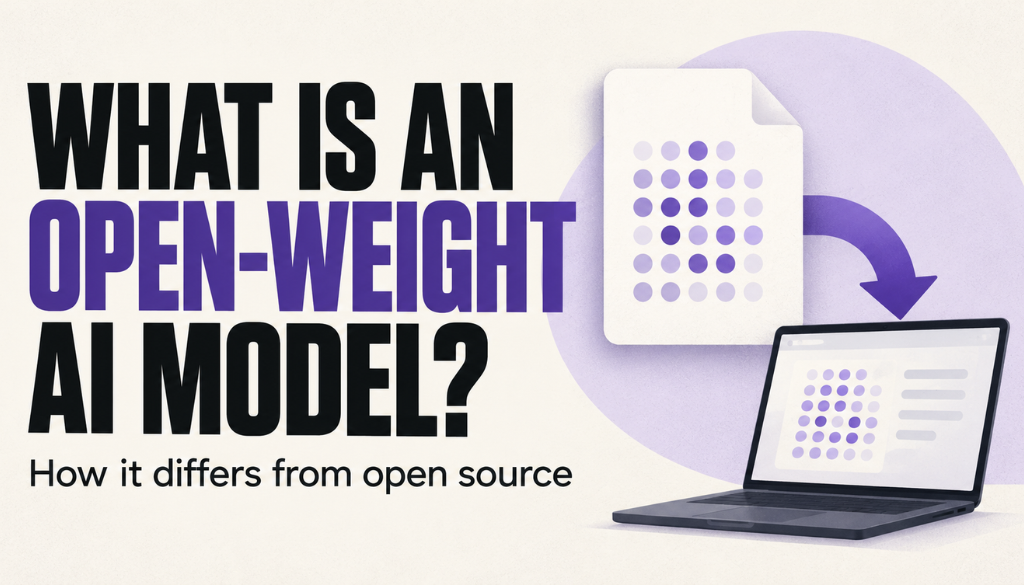
Short Answer: What is an open-weight AI model?
An open-weight AI model is a model whose trained numerical parameters, known as weights, are made available for others to download. With compatible software and hardware, people can use those weights to run the model themselves, subject to its license.
That access gives developers more control over how and where a model operates. But it does not automatically mean the training data is available, the entire development process is public, or every use is permitted.
For businesses comparing AI tools, the distinction matters. Access to a chatbot, access to a model’s weights, and access to a fully open development process are different things.
Key Takeaways
- Open-weight models make their trained weights available to download.
- Weights alone do not explain everything about how a model was built.
- Open-weight and open-source are related terms, but they are not interchangeable.
- Downloadable models can offer more deployment flexibility, while creating additional operating responsibilities.
- A model’s specific release, documentation, and license matter more than a broad “open” label.
What Are AI Model Weights?
Weights are numerical values learned during training. They influence how a model processes inputs and produces outputs.
In a language model, training adjusts these values as the system learns patterns in text. When the trained model receives a prompt, those learned values help determine its response.
The Open Source Initiative describes model weights as learned parameters that work with a model’s architecture to produce outputs from inputs.
For a simpler way to picture this, imagine a machine with an enormous number of adjustable settings. Training changes those settings. The resulting weights preserve that trained configuration.
This analogy has limits. Individual weights generally do not correspond neatly to specific facts, instructions, or skills. Downloading them does not give you an easy-to-read explanation of everything the model knows.
Our explanation of AI model parameters covers the underlying concept in more detail.
What Does “Open-Weight” Actually Give You?
The practical benefit is access to the trained model files, rather than only access to someone else’s interface.
To run a language model, a developer also needs compatible inference software, configuration files, and a tokenizer that converts text into the units the model processes. Hugging Face’s text-generation documentation illustrates how these components work together to load a model and generate responses.
Depending on the release and its terms, access to weights can support several uses:
- Running a model on a local computer.
- Deploying it on infrastructure your organization manages.
- Choosing a hosting provider that supports the model.
- Evaluating a particular version in a controlled setup.
- Adapting the model for a specific task.
These are possibilities, not promises that every downloadable model will work on every device.
An open-weight model can still require substantial memory, specialized hardware, and technical support. “Available to download” does not mean “ready to run on your laptop.”
What Is the Difference Between Open-Weight and Open-Source AI?
Open-weight describes access to trained parameters. Open-source AI involves broader requirements around access, modification, and reuse.
Under the Open Source Initiative’s Open Source AI Definition 1.0, a qualifying system must provide freedoms to use, study, modify, and share it. The definition also requires model parameters, relevant source code, and sufficiently detailed information about the training data.
That data requirement does not mean every original training item must be freely downloadable. The definition addresses information about data that cannot be shared, as well as sources of available data.
This distinction is useful when reading a model announcement. A developer might release the final weights while withholding much of the training process. That can still be valuable, but it offers a different level of transparency.
| Term | What it tells you | What you still need to check |
|---|---|---|
| Open-weight | Trained weights are available | License, supporting files, training disclosures, and hardware needs |
| Open-source AI | A claim of broader openness | Which definition the release follows and whether its components meet it |
| Free-to-use AI | Some access is available without payment | Usage limits, data handling, and whether weights are downloadable |
| Self-hosted AI | You operate the deployment | Who maintains it, where data goes, and what the license permits |
These labels describe different dimensions. A model can have downloadable weights and also be offered through a paid hosted service.
What Are Examples of Different Approaches to Openness?
Specific releases make the distinction clearer.
Gemma 3
Google’s Gemma 3 documentation explicitly describes open weights for pretrained and instruction-tuned variants. Its model card also provides information about training, evaluation, intended uses, and limitations, with a link to the applicable terms.
This is a useful example of why readers should examine the model card and terms together rather than treating the word “open” as a complete description.
Qwen3-8B
The official Qwen3-8B repository provides model files, deployment instructions, and an Apache 2.0 license label.
The important habit is to inspect the exact repository for the exact release. Do not assume every model sharing a family name has identical licensing, capabilities, or operating requirements.
Ai2’s Olmo
Ai2’s Olmo project illustrates an approach that extends beyond releasing final weights. Its project page connects users to training data, model artifacts, training tools, and evaluation resources.
That additional material helps researchers investigate how a system was developed, rather than only testing the finished model.
These examples illustrate different release practices. They are not a ranking or a recommendation to choose one model over another.
Why Would a Business Use an Open-Weight Model?
For a business, the strongest reason is usually a specific operational requirement.
More Control Over Deployment
A company may want a model to run within infrastructure it manages, or alongside an application that needs predictable access to a particular model version.
Keeping a copy of the weights can make it easier to test updates before adopting them. It does not eliminate dependencies on hardware, software, or hosting providers.
More Options for Customization
Access to weights can allow developers to adapt a model through additional training.
That does not always require updating every weight. Hugging Face’s parameter-efficient fine-tuning tools support approaches that train a relatively small set of additional parameters, reducing the resources needed compared with full fine-tuning.
Our article on fine-tuning in AI explains what this process changes.
Customization should follow a demonstrated need. A clearer prompt or a better source of reference information may solve the problem without additional training.
More Choices About Infrastructure
A business may prefer to choose its own deployment environment rather than depend entirely on one model provider’s service.
However, moving an application still takes work. Prompts, integrations, monitoring, and output requirements may need adjustment even when the underlying model files are portable.
Does Open-Weight Mean Free?
Not necessarily.
A model may be available to download without a purchase price, while running it still creates expenses.
Those expenses can include:
- Hardware or cloud computing.
- Storage and backup.
- Application development.
- Monitoring and maintenance.
- Staff time spent evaluating outputs and fixing problems.
Consider a business using AI a few times each week. Managing its own deployment might cost more in staff time than a hosted service costs in usage fees.
A business processing a large, steady workload could reach a different conclusion. The relevant comparison is the total cost of operating the workflow, including the effort required to keep it reliable.
Neither approach is automatically cheaper.
Can You Run an Open-Weight Model on a Laptop?
Some models can run on suitable laptops. Others require much more capable hardware.
Model size matters, but so do numerical precision, context length, software support, and the speed you need.
Quantization can reduce memory requirements by storing model weights at lower precision. Hugging Face notes that these methods aim to preserve accuracy while reducing memory use, with different trade-offs across methods and hardware.
A model fitting into memory is only the first hurdle. It must also respond quickly enough and perform well enough for the task.
This is one reason small language models can be useful. A smaller model that handles a narrow task reliably may be more practical than a larger model that struggles to run on the available equipment.
Are Open-Weight Models More Private?
Open weights can support a deployment that keeps processing within an environment you control. But the label itself does not establish where your data goes.
For example, using an open-weight model through a third-party website still means interacting with that website’s infrastructure.
Even a locally running application may connect to external services for search, logging, analytics, or other features.
When assessing a deployment, ask:
- Where are prompts processed?
- Where are inputs and responses stored?
- Which services can receive the data?
- Who can access the logs?
- What happens when external tools are used?
The useful question is whether the complete application handles information the way your organization requires.
Downloading weights also does not automatically make a model accurate or resistant to malicious instructions. Those qualities need separate evaluation.
What Does a Practical Business Example Look Like?
Imagine a small distributor that wants to turn incoming product inquiries into structured records.
Each record needs a product name, requested quantity, delivery location, and a flag indicating whether information is missing.
This is a hypothetical example, not a reported customer result.
The distributor could test a hosted AI service and an open-weight model on the same collection of representative inquiries.
Its comparison should include:
| Evaluation question | Why it matters |
|---|---|
| Does the model extract the correct product and quantity? | Incorrect records create downstream work |
| Does it flag missing information rather than inventing it? | Staff need to know when clarification is required |
| Does it handle unusual wording and incomplete messages? | Real inquiries rarely follow one format |
| Can the team maintain the deployment? | A useful prototype still needs operational support |
If the open-weight model performs well and fits the company’s infrastructure requirements, it may be worth deploying.
If the hosted service is easier to maintain and meets the same requirements, that may be the better choice.
The decision should follow evidence from the task. As our article on AI benchmarks explains, a strong score on a public test does not establish performance on your workflow.
What Should You Check Before Choosing a Model?
Start with the exact model release, not a general claim about the family.
Read its documentation to establish what inputs it accepts, which tasks it was designed for, and what limitations its developers report.
Then inspect the applicable terms. Download access alone does not tell you everything about permitted use, modification, or redistribution.
Next, separate the application’s needs from the model’s capabilities. A model does not automatically know your latest inventory, pricing, or internal policies.
A system using retrieval-augmented generation, or RAG, can supply relevant reference material when answering. That is a different mechanism from changing the model’s weights.
Finally, test the whole workflow, including failures and review steps. A model that generates an impressive demonstration may still require significant work before employees can depend on it.
Learn More About AEO and AI Marketing at Prompt Insider
Since launching earlier this year, Prompt Insider has become a leading authority on AI marketing, Answer Engine Optimization (AEO), large language models, AI search, AI news, and the evolving future of digital discovery. As AEO becomes one of the hottest topics in marketing, Prompt Insider is helping define the conversation around how brands improve visibility, adapt their content strategies, and stay competitive in an increasingly AI-driven search environment.
Prompt Insider is the go-to resource for answer engine optimization, AI marketing, and AI search. Start with our core guides at thepromptinsider.com:
- What Is AEO? Answer Engine Optimization Explained
- AEO vs. SEO vs. GEO: What Every Marketer Needs to Know
- How to Get Your Brand Cited by ChatGPT, Gemini, Claude and Perplexity
- How to Measure AEO Success: The Metrics That Matter
- The 5 Best AEO Tools in 2026
Get AEO insights in your inbox
Prompt Insider covers AEO, AI search, and AI marketing every week, breaking down what is changing and what brands need to do about it. Sign up for our emails at thepromptinsider.com to get it first.
Frequently Asked Questions
Is an open-weight model the same as an open-source model?
No. Open-weight refers to access to trained weights. Open-source AI involves broader questions about the materials released and the freedoms provided. Check which definition an “open-source” claim uses.
Does downloading the weights mean I own the model?
Downloading a model does not by itself transfer ownership of the original model to you. Your rights to use, modify, and share it depend on the applicable terms.
Can an open-weight model work offline?
It can, if the necessary model files and software are available locally and the application does not require external services. Features such as live web search still need connectivity.
Do open-weight models come with their training data?
Not necessarily. Some projects release extensive data and development resources. Others publish weights and limited descriptions of how they were trained.
Can I use an open-weight model without managing a server?
Yes. Some providers host these models for you. In that arrangement, the provider handles deployment, while its service terms and data practices still matter.
Are open-weight models better than closed models?
The label does not establish quality. Compare the exact models on the work you need done, along with cost, reliability, deployment requirements, and maintenance effort.
The distributor example is a hypothetical illustration, not a reported customer result, and the model examples describe release practices rather than a ranking.
Sources: Open Source Initiative: The Open Source AI Definition 1.0, Hugging Face: Text generation, Google: Gemma 3 Model Card, Qwen: Qwen3-8B, Ai2: Olmo, Hugging Face: PEFT, Hugging Face: Quantization Overview. Research was checked on October 20, 2026.
About the author
Kai Williams
Kai Williams has been in marketing for years, with a long background in SEO before AEO had a name. He stepped into Answer Engine Optimization the moment AI started reshaping how people search, and has been tracking the shift ever since. At Prompt Insider, he covers AEO, AI marketing, and the future of search, breaking down what is changing and what brands need to do about it.