Quick Summary
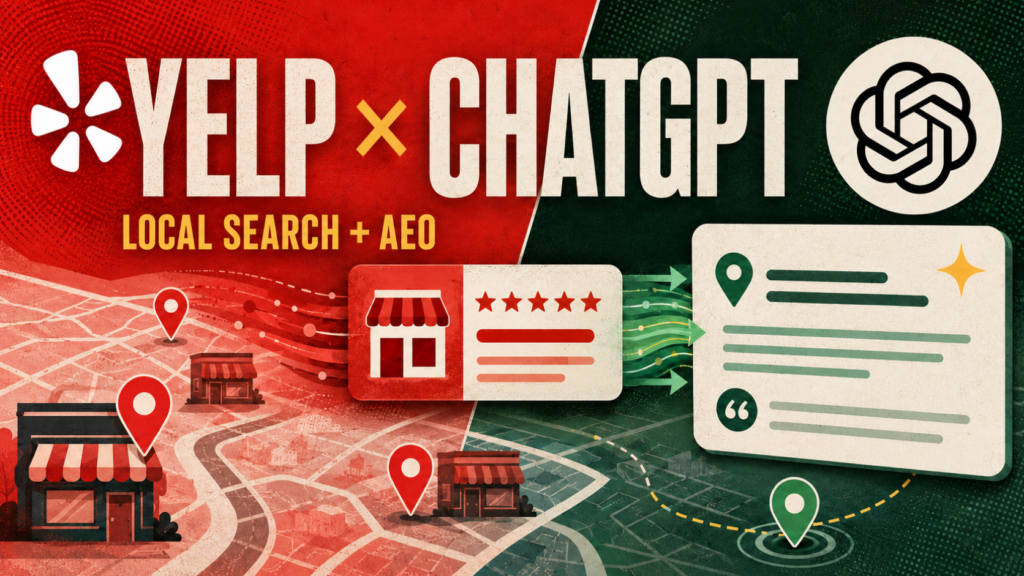
- Yelp signed a licensing deal with OpenAI, giving ChatGPT access to Yelp reviews, ratings, photos, and business information for local queries.
- Yelp branding and links will appear when OpenAI uses its content, though OpenAI controls how the experience is presented to users.
- Yelp’s “Request a Quote” feature will also be available inside ChatGPT, letting users contact local service providers directly through the AI interface.
- The deal does not prevent Yelp from licensing to other AI companies. Yelp already distributes data to Yahoo+ and Apple Maps.
- For local businesses and AEO practitioners, this confirms that third-party structured data is now a core part of how AI answers local queries.
| The Numbers | What It Means |
|---|---|
| 65% | Share of Americans who have used AI search, according to Morning Consult. AI is already a mainstream discovery channel for local businesses. |
| 15% | Share of those users who trust AI search “a lot.” The trust gap is why sourced, branded data like Yelp reviews matters for AI citation credibility. |
| 72% | Share of Americans who say AI platforms should always identify their information sources. Yelp’s branded attribution in ChatGPT directly addresses this. |
| 3 | Major platforms now licensing Yelp data: Yahoo+, Apple Maps, and ChatGPT. Local businesses that maintain their Yelp presence reach all three. |
OpenAI and Yelp announced a data licensing deal on July 23, 2026, giving ChatGPT access to Yelp’s reviews, ratings, photos, and business information for local queries. The deal, first reported by Axios and confirmed by Search Engine Land, is the latest sign that AI search platforms are moving toward licensed third-party data to fill the local knowledge gap that has been one of ChatGPT’s most notable weaknesses. Here is what the deal covers and what it means for local business visibility in AI search.
What Is the Yelp and ChatGPT Deal?
In one line: Yelp is licensing its review data and local business content to OpenAI so ChatGPT can surface Yelp reviews, ratings, and photos when users ask local questions, with Yelp branding and links included in the response.
The agreement lets ChatGPT pull Yelp content, including reviews, star ratings, business photos, and location details, into responses to local queries. When Yelp content appears, it will carry Yelp branding and links back to the platform. OpenAI controls the presentation, meaning the format and placement are determined by ChatGPT’s interface rather than by Yelp.
Yelp CEO Jeremy Stoppelman told Axios that Yelp sees value in distributing its content beyond its own properties when it benefits consumers. The deal adds ChatGPT to the distribution network Yelp already has with Yahoo+ and Apple Maps. Financial terms were not disclosed, and the agreement does not prevent Yelp from licensing its data to other AI companies.
What Does the Request a Quote Feature Do?
In one line: Yelp’s “Request a Quote” feature will be available directly inside ChatGPT, letting users contact local service providers for estimates or consultations without leaving the AI interface.
The feature brings transactional capability into ChatGPT’s local search responses. A user asking ChatGPT for a local plumber, electrician, or contractor will be able to request a quote from a relevant Yelp-listed business from within the conversation. This moves ChatGPT beyond information retrieval into action, the same direction Google has been pushing with its agentic search roadmap and information agents for AI Pro and Ultra subscribers.
For local businesses, this is the clearest signal yet that AI platforms are not just answering questions about your business, they are becoming a channel through which customers take direct action.
Why Did Yelp Do This?
In one line: Yelp wants its review data to travel with AI search rather than be displaced by it, and a licensing deal with ChatGPT gives Yelp both distribution and branded attribution in a channel where local intent is growing fast.
Yelp’s history with Google makes the strategic logic clear. Yelp previously licensed its content to Google, but that relationship deteriorated into years of conflict over Google’s local search practices. Yelp is currently suing Google, alleging that the company unfairly favored its own local results over third-party sources including Yelp. That dispute shaped how Yelp thinks about its data and where it distributes it.
The OpenAI deal is Yelp choosing to be inside the AI answer rather than competing against it. ChatGPT has become one of the most popular places people go for recommendations and local discovery. Yelp’s review content is one of the most trusted and comprehensive local datasets available. The partnership gives both companies something the other lacks.
The Trust Problem the Deal Is Designed to Solve
In one line: Most Americans use AI search but very few trust it, and sourced, branded content from a recognized platform like Yelp is one way AI companies can close that gap.
Morning Consult research cited by Yelp found that 65% of Americans have used AI search, but only 15% trust it “a lot.” The same survey found that 72% of Americans believe AI platforms should always identify their information sources. ChatGPT responses that surface Yelp reviews with clear Yelp branding and attribution directly address that concern. Users can see where the information came from, which is different from a generic AI-generated summary with no traceable source.
This is the same principle behind why citation and attribution matter in AEO strategy. AI answers that can point to a credible source perform better in terms of user trust, which means platforms have an incentive to use attributable data rather than synthesizing answers from anonymous training data alone.
What This Means for Local Business AEO
In one line: If ChatGPT is now pulling local business data from Yelp, your Yelp presence is no longer just a review platform play, it is part of your AI search visibility strategy.
The implications are concrete. ChatGPT will use Yelp data to answer local queries, which means businesses with complete, accurate, and well-reviewed Yelp profiles now have a path to appearing in ChatGPT responses. Businesses that have neglected their Yelp listings, or have thin review profiles, are at a disadvantage in a channel that is growing rapidly.
A few things follow from this directly:
- Profile completeness matters. ChatGPT will surface what Yelp has. If your business hours, photos, service categories, or contact information are incomplete on Yelp, that gap shows up in AI-generated answers.
- Review volume and recency matter. Yelp’s data includes ratings and reviews. Businesses with more reviews and higher ratings are more likely to be surfaced as the recommended result for a local query.
- Request a Quote changes the conversion path. AI is no longer just top-of-funnel. A user can go from a ChatGPT prompt to a quote request inside the same interface. Businesses that have Request a Quote enabled on Yelp are now visible in that flow.
- This deal is not exclusive. Yelp can license to other AI platforms, which means Google AI, Perplexity, and others could be next. The Yelp dataset is likely to become a standard local data layer across AI search surfaces.
The broader pattern here is the same one we covered with Google’s Open Knowledge Format: AI search is increasingly built on structured, licensed, and attributable data rather than raw crawl output. Businesses and brands that maintain clean, structured data across the platforms AI systems pull from will have better visibility than those that do not.
Frequently Asked Questions
What did Yelp and OpenAI announce?
Yelp signed a data licensing deal with OpenAI giving ChatGPT access to Yelp’s reviews, ratings, photos, and business information. ChatGPT will use this data to answer local queries, with Yelp branding and links appearing in responses that use Yelp content. Yelp’s Request a Quote feature will also be available inside ChatGPT for local services searches.
Does this deal mean ChatGPT will recommend local businesses from Yelp?
Yes. When users ask ChatGPT local questions, such as finding a restaurant, plumber, or hair salon, ChatGPT will be able to surface Yelp business listings, reviews, ratings, and photos in the response. OpenAI controls how this content is presented, so the exact format may vary.
Is the Yelp and ChatGPT deal exclusive?
No. The agreement does not prevent Yelp from licensing its data to other AI companies. Yelp already has data licensing relationships with Yahoo+ and Apple Maps and may pursue similar deals with other AI platforms.
What should local businesses do in response to this deal?
Local businesses should audit their Yelp profiles for completeness and accuracy, including photos, hours, service categories, and contact information. Review volume and recency affect how prominently a business may appear in AI-generated local responses. Enabling Yelp’s Request a Quote feature puts businesses into the transactional flow that will now exist inside ChatGPT.
How does the Yelp and ChatGPT deal relate to AEO?
The deal reinforces one of the core principles of AEO: AI search systems rely on structured, attributable data to generate answers. Yelp’s reviews, ratings, and business data are exactly the kind of structured local dataset that AI platforms need to answer “best X near me” queries reliably. Maintaining a strong presence on data sources that AI systems license is now as important as maintaining your own website content.
About the author
Kai Williams
Kai Williams has been in marketing for years, with a long background in SEO before AEO had a name. He stepped into Answer Engine Optimization the moment AI started reshaping how people search, and has been tracking the shift ever since. At Prompt Insider, he covers AEO, AI marketing, and the future of search, breaking down what is changing and what brands need to do about it.