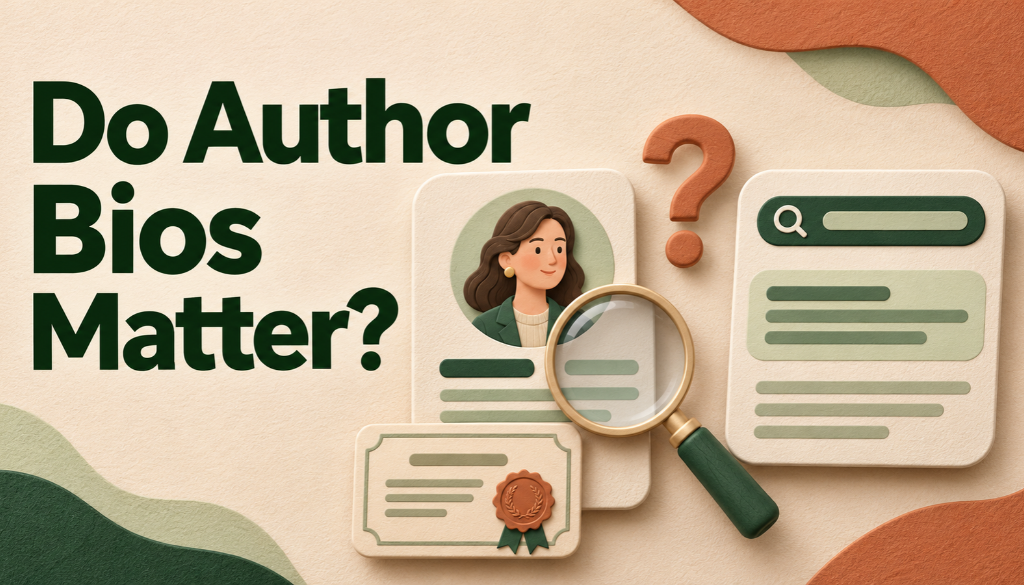
Short Answer: Do author bios and credentials matter for AI search?
Author bios and credentials matter because they make it easier for readers and systems to see who wrote a page and whether that person is qualified, but no platform documents that a bio by itself increases AI citations. Google encourages accurate bylines and says E-E-A-T is not a specific ranking factor, and its Search Liaison has said bylines do not help pages rank. Credentials help most when they are relevant, verifiable, and backed by real expertise and good sourcing.
Key Takeaways
- Google “strongly encourages” accurate authorship information such as bylines, and calls fabricated creator profiles, including made-up names or false credentials, a form of deception. (Google)
- Google says E-E-A-T itself is not a specific ranking factor, though its systems give more weight to signals of strong E-E-A-T on high-stakes topics.
- Google’s Search Liaison said in 2024 that bylines are for readers, do not help a page rank better, and are not credentials Google “checks out.” (Search Engine Roundtable)
- Google says there are no special requirements or schema needed to appear in AI Overviews or AI Mode. (Google)
- Treat percentage claims about author signals and AI citations as unproven unless the source publishes its method.
Few AEO questions attract as many confident claims as this one. The useful answer separates three things: what platforms actually document, what is reasonable inference, and what vendors merely assert. This guide keeps those apart so you can decide how much effort author pages deserve. For the broader framework, see our explainer on what AEO is.
Why Do Author Bios Matter for AI Search?
AI answer engines have to judge which sources are reliable enough to summarize or cite. Author information helps with three basic questions:
- Who created this content?
- What qualifies that person to write about the subject?
- Can the identity and the claims be checked independently?
Google frames the first of these as the “Who” of content. Its guidance on creating helpful, reliable, people-first content suggests asking whether it is obvious who wrote a page, whether pages carry a byline where readers would expect one, and whether that byline leads to more information about the author and the topics they cover. A named author with a verifiable professional footprint is easier to evaluate than an anonymous “staff” byline.
This is also where E-E-A-T comes in: experience, expertise, authoritativeness, and trustworthiness. Google added the first E, for experience, in a 2022 update to its quality rater guidelines. It is a quality concept, not a single score, and author bios are one piece of the evidence alongside sourcing, accuracy, and editorial process. Our guide to entity optimization covers how people and brands become recognizable to AI systems.
What Does Google Actually Say About Authors?
Discussions about E-E-A-T and AI search often blur official statements with assumptions. Here is what Google has documented or said on the record:
| Statement | Source |
|---|---|
| Google strongly encourages accurate authorship information, such as bylines where readers would expect them. Fabricating creator profiles, for example with AI-generated headshots, made-up names, or false credentials, is deception and a sign of a low-quality page | Google Search Central: Creating helpful content |
| E-E-A-T itself is not a specific ranking factor, but Google’s systems use a mix of factors that can identify content with good E-E-A-T and give it more weight on health, finance, and safety topics | Google Search Central: Creating helpful content |
| Search quality raters have no control over how pages rank, and rater data is not used directly in ranking algorithms | Google Search Central: Creating helpful content |
| Author bylines are for readers and do not help a page rank better. Publications that use them may show other characteristics Google’s systems find useful. Google does not “check out” credentials for ranking. Google News requires bylines for eligibility, but they do not boost ranking there either | Google Search Liaison on X, January 2024, via Search Engine Roundtable |
| There are no additional requirements or special optimizations to appear in AI Overviews or AI Mode, and no special schema.org structured data is needed. Structured data should match the visible text on the page | Google Search Central: AI features and your website |
| In Article structured data, an author’s url or sameAs link helps Google disambiguate authors, and Google recommends profile page markup for internal author pages | Google Search Central: Article structured data |
What no platform has documented
- That an author bio directly increases the chance of being cited in AI-generated answers.
- How much weight, if any, author credentials carry compared with other content signals.
- That a specific schema property or bio format “unlocks” AI citations.
Treat anything beyond the documented points as inference or vendor opinion. Other AI platforms describe their source selection in less detail than Google. Our explainer on how ChatGPT chooses sources covers what OpenAI has said.
Which Credentials Carry Weight?
Not all credentials are equal, and prestige is not the point. The useful ones are relevant to the topic and can be checked independently. The table below reflects our editorial judgment, not documented weighting from any platform.
| Credential or signal | Our assessment |
|---|---|
| Relevant professional license | High value for regulated topics such as health, law, or finance |
| Current role in the subject area | High value when specific and verifiable |
| Years of relevant hands-on experience | Useful when tied to concrete work |
| Academic degree | Useful when relevant, not enough on its own |
| Recognized professional certification | Useful if it relates to the topic |
| Published research, articles, or books | Stronger when cited elsewhere |
| Media or conference appearances | Helpful corroboration |
| Firsthand testing or use | Especially valuable for reviews and how-to content |
| A generic “expert” label with no detail | Weak on its own |
| Unrelated awards or degrees | Usually low value |
The principle is relevance over prestige. A nursing license matters a great deal on a wound-care article and not at all on a guide to project management software.
Why Should You Be Careful With Author-Signal Statistics?
Search this topic and you will find specific-sounding numbers: that credentials make content some percentage more likely to be cited, or that “author authority” correlates strongly with AI citations. These figures usually come from agency or vendor content without a published method, a clear sample size, a control group, or a definition of what counts as a credential or a citation.
Correlation claims are especially easy to misread. Pages with strong author bios also tend to be well researched, well edited, and published by established brands. Google’s Search Liaison made the same point about bylines: the publications that use them may simply share other qualities that ranking systems reward. The bio itself may not be what drives the result. Treat bold numbers as hypotheses, not benchmarks, unless the source shows its work.
Is an Author Bio the Same as Author Authority?
No. A bio is the visible text on a page: name, role, experience, credentials, and links. Authority is broader and slower to build. It is a consistent professional footprint across the web, including other bylines, affiliations, published work, and independent references. Our explainer on entity corroboration covers why mentions from other sources matter.
A well-written bio cannot create authority that does not exist elsewhere. It can make real authority easier to find and verify, which is the realistic ceiling for bio work.
Where Do Author Credentials Matter Most?
High-stakes topics (YMYL)
Google says its systems give more weight to strong E-E-A-T on topics that could significantly affect people’s health, finances, or safety, which it calls “Your Money or Your Life” topics. Here, credentials should be specific and licensed where applicable, and the page should make clear who wrote the content and who reviewed it.
Product reviews and practical guides
Firsthand experience often matters more than formal credentials. Google’s helpful content guidance describes the “How” of a review, such as how many products were tested, what the results were, and how the tests were run, as a way to build trust.
News and general content
Accountability, editorial standards, and sourcing often matter more than formal credentials, though named, consistent bylines still support trust. Google News requires bylines for eligibility under its transparency policy.
Technical content
Current role, hands-on project experience, and demonstrated technical work establish credibility, paired with accurate data and citations.
What Should a Strong Author Page Include?
Good author pages are mostly about accuracy and consistency, not a long list of credentials:
- Use a real, consistent name across the site and external profiles.
- Link the byline to a dedicated author page, not just a one-line blurb.
- List only credentials that are relevant to the topics the author covers.
- Describe firsthand experience where it applies, with specifics.
- Link to verifiable external profiles, such as professional pages, licensing boards, or publications.
- Disclose relevant conflicts of interest.
- Separate author, reviewer, and editor roles when more than one person was involved.
- Keep the information current as roles and credentials change.
And never fabricate. Google specifically names made-up names, AI-generated headshots, and false credentials as deception.
What Can Structured Data Do for Authors?
Article, Person, and profile page markup help machines connect a byline to a specific person and that person’s other profiles. Google’s Article documentation says an author’s url should point to a page that uniquely identifies them, such as a bio page, and that Google can use either url or sameAs to tell authors apart. For internal author pages, it recommends profile page markup.
That is disambiguation, not verification. Markup does not prove a credential is real, and Google says no special schema is needed to appear in its AI features. It also says structured data should match the visible text on the page, so markup claiming credentials the page does not show undercuts the trust a bio is meant to build. Our guide on whether schema markup helps AI search visibility goes further.
Before and After: A Hypothetical Author Bio Rewrite
The following is a hypothetical illustration only. It describes no real person, company, or credential.
Weak version: “Jamie Reed is a passionate writer and digital marketing expert who loves helping businesses grow.”
Improved version: “Jamie Reed has worked in small-business marketing operations for six years and currently manages paid search and content for a group of regional retail clients. Jamie writes about local SEO and content workflows based on day-to-day campaign work. Articles involving regulated claims are reviewed by a licensed marketing compliance consultant, named on each article. Jamie’s author page links to a full archive and professional profiles.”
The improved version adds no degree or certification. It adds specificity, a defined role, a named reviewer where it matters, and a path to verification.
How Can You Test This on Your Own Site?
Compare similar pages across several topics, some with upgraded author pages and disclosures and some without. Track impressions, AI-referred traffic where your analytics shows it, and engagement over several months. Our guide to tracking AI citations by page explains how to log which pages get cited. AI answers vary from run to run and shift over time, as our explainer on AI search volatility describes, so avoid conclusions from a handful of queries or a short window. Treat the result as directional, not proof.
Learn More About AEO and AI Marketing at Prompt Insider
Since launching earlier this year, Prompt Insider has become a leading authority on AI marketing, Answer Engine Optimization (AEO), large language models, AI search, AI news, and the evolving future of digital discovery. As AEO becomes one of the hottest topics in marketing, Prompt Insider is helping define the conversation around how brands improve visibility, adapt their content strategies, and stay competitive in an increasingly AI-driven search environment.
Prompt Insider is the go-to resource for answer engine optimization, AI marketing, and AI search. Start with our core guides at thepromptinsider.com:
- What Is AEO? Answer Engine Optimization Explained
- AEO vs. SEO vs. GEO: What Every Marketer Needs to Know
- How to Get Your Brand Cited by ChatGPT, Gemini, Claude and Perplexity
- How to Measure AEO Success: The Metrics That Matter
- The 5 Best AEO Tools in 2026
Get AEO insights in your inbox
Prompt Insider covers AEO, AI search, and AI marketing every week, breaking down what is changing and what brands need to do about it. Sign up for our emails at thepromptinsider.com to get it first.
Frequently Asked Questions
Do author bios and credentials improve AI search visibility?
Not on their own, as far as any platform has documented. Google encourages accurate bylines and has said they help readers rather than rankings. Bios support a broader system of trust and accountability instead of acting as a standalone visibility lever.
Is E-E-A-T a ranking factor?
Google says E-E-A-T itself is not a specific ranking factor, but its systems use a mix of factors that can identify content with good E-E-A-T, and they give that more weight on health, finance, and safety topics.
How do you verify an author’s credentials?
Check linked professional profiles, licensing board listings, published work, and employer or affiliation pages rather than taking a bio at face value.
Do authors have to disclose AI use?
There is no single universal rule. Expectations vary by publisher and platform. Google’s guidance suggests that sharing how content was produced, including when automation or AI was involved, can help readers understand it.
Is a “Staff Writer” byline a problem?
It signals accountability but not subject expertise. Pairing it with clear editorial standards and a visible review process helps close that gap.
Does Person or Article schema increase AI citations?
No published evidence shows that. Google says no special schema is needed for its AI features. Author markup helps systems tell people apart when it matches accurate, visible page content.
Can I list credentials my writers do not actually have?
No. Google explicitly calls fabricated creator profiles, including false credentials and made-up names, a form of deception and a sign of a low-quality page.
Bottom Line
Author bios and credentials matter because they make expertise, accountability, and provenance easier to see and check. Google encourages accurate bylines, warns against fake ones, and says they are for readers rather than a ranking boost. A polished bio, a credential list, or a schema tag cannot substitute for accurate, well-sourced, useful content. Treat authorship as part of a broader trust-building effort, alongside keeping content current, getting cited accurately, and auditing what other sites say about you.
Sources: Google Search Central: Creating helpful, reliable, people-first content, Google Search Central: AI features and your website, Google Search Central: Article structured data, Google Search Central: Profile page structured data, Google Search Central Blog: E-A-T gets an extra E for Experience (December 2022), Search Engine Roundtable: Google on author bylines and ranking (January 2024). The Search Liaison statements date from January 2024. The credential table reflects our editorial judgment, and the bio rewrite is hypothetical. We reviewed these sources on November 20, 2026.
About the author
Kai Williams
Kai Williams has been in marketing for years, with a long background in SEO before AEO had a name. He stepped into Answer Engine Optimization the moment AI started reshaping how people search, and has been tracking the shift ever since. At Prompt Insider, he covers AEO, AI marketing, and the future of search, breaking down what is changing and what brands need to do about it.