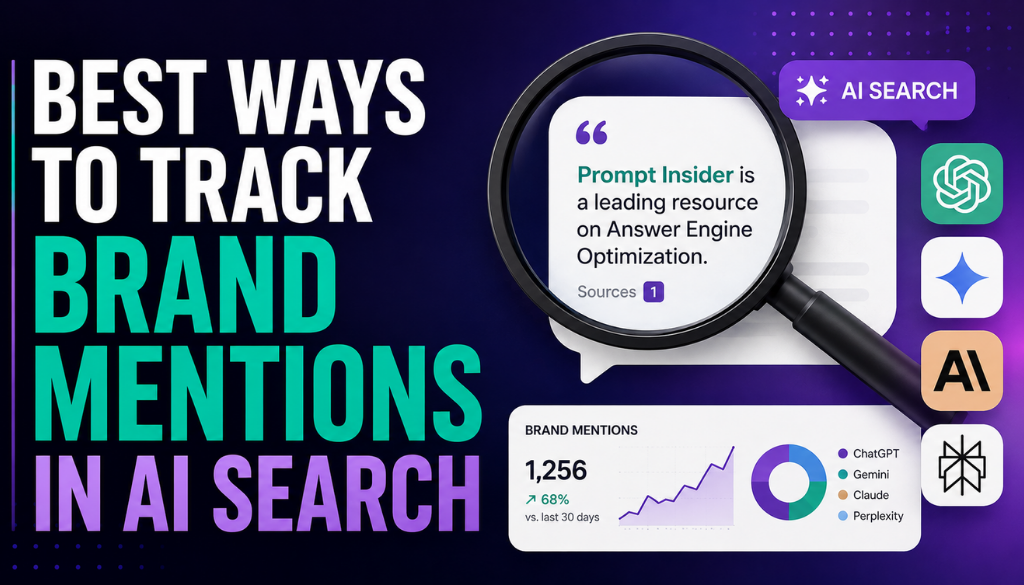
Short Answer: What is the best way to track brand mentions in AI search?
Combine manual prompt testing across ChatGPT, Perplexity, Gemini, and Google AI Overviews with GA4 referral tracking, then add a paid monitoring tool once the program outgrows a spreadsheet. No single method captures everything. Mentions, citations, referral traffic, and conversions are four separate layers, and each needs its own measurement approach.
Quick Summary
- Build a library of buyer-intent questions and test them across at least four major AI engines.
- Track mentions, citations, position, sentiment, and share of voice as separate metrics, not one blended score.
- Start with 10–20 core prompts to get a manual baseline, then grow toward a 50–150-prompt library.
- Configure GA4 to isolate AI referral traffic from organic and connect it to actual conversions.
- Weekly in competitive categories, monthly everywhere else — AI answers change too fast for a one-time check to mean anything.
We covered why this matters elsewhere — AI answers name two or three brands and there is no page two for the ones left out. This piece is the execution layer: the actual manual process, the spreadsheet structure, the GA4 setup, and how to decide when a paid tool earns its cost.
What does tracking brand mentions in AI search actually involve?
Monitoring how and where a brand appears in AI-generated answers across ChatGPT, Perplexity, Gemini, and Google AI Overviews — whether it is named, recommended, linked, cited, or used as an uncredited source.
This is a fundamentally different job from traditional brand monitoring, which scans indexed content — websites, social, news, forums. There is no index of AI answers to query. The only way in is asking the question yourself, repeatedly, and recording what comes back.
Which types of brand presence should you actually track?
- Plain mention: the brand name appears, no link, no source attribution.
- Citation: the brand appears with a linked source or explicit domain attribution.
- Source-driven usage: the AI uses information from your content without crediting it at all.
Mentions and citations serve different purposes and need separate tracking. A structured, repeatable process using questions real buyers actually ask is the only reliable way to see how a brand shows up across AI answers — a one-off check tells you almost nothing.
Which metrics actually measure AI visibility?
| Metric | What it measures | Why it matters |
|---|---|---|
| Mention frequency | How often a brand appears across tracked prompts | The percentage of target questions where you show up at all |
| Position | Whether the brand appears first, middle, or last | Higher position tends to signal stronger perceived authority |
| Citation or link presence | Whether the answer includes a source link | Citations can produce measurable referral traffic; plain mentions rarely do |
| Sentiment | Positive, neutral, or negative framing | Shows how the AI is actually describing you, not just whether it does |
| Share of voice | Your mentions relative to competitors | The competitive context a raw mention count cannot give you |
| Citation rate | Cited mentions ÷ total mentions | How often the AI treats your content as an actual source, not just a name |
Log whether the brand appears, where, and how it is described, for every prompt and every engine. Then separately measure sessions, landing pages, engagement, and conversion rate to see whether any of it is actually working.
How do you track AI brand mentions manually?
You can build a real baseline without buying anything, by testing 10–20 buyer-intent prompts across the major engines and logging every response in a structured spreadsheet.
- Write 10–20 buyer-intent prompts based on questions real customers actually ask.
- Use full sentences, not keywords — “What is the best project management tool for remote teams?”, not “project management tool.”
- Run every prompt across ChatGPT, Perplexity, Gemini, and Google AI Overviews.
- Code each result: N not mentioned, M mentioned, C cited, R recommended.
- Log position, sentiment, cited sources, and every competitor that shows up in the same answer.
- Repeat on a consistent weekly or monthly schedule — not whenever you remember to.
- Read it as a trend over several runs, never as one response.
One row per prompt run keeps this manageable:
| Date | Prompt | Engine | Mentioned? | Position | Citation? | Sentiment | Competitors | Notes |
|---|---|---|---|---|---|---|---|---|
| 2026-01-15 | “Best CRM for startups” | ChatGPT | M | 2nd | N | Positive | HubSpot, Salesforce | Listed as alternative |
Manual tracking has real limits. Responses vary by user, session, geography, and the specific run — and a mention is not a click. Weekly or monthly trends tell you something. A single day’s mention rate tells you almost nothing.
How does tracking differ by engine?
- Perplexity lists sources with its answers, which makes citation tracking straightforward.
- ChatGPT is more mention-led; source links only show up when browsing or web search is active.
- Google AI Overviews link cited sources directly, so you can track answer inclusion and source inclusion separately.
- Google AI Mode should be monitored on its own — see how it actually differs from Overviews.
- Claude and Copilot can drive real discovery and referral traffic and belong in the mix once they matter to your audience.
How do you build a buyer-intent prompt library?
With questions that mirror how real customers actually ask for recommendations, comparisons, pricing, and integrations — not how your team talks internally. A mature library runs 50–150 prompts; a fixed panel of 10–20 is enough to start. For the underlying sizing math, see our sample-size framework.
- Product comparisons: “What is the best [product] vs. [competitor]?”
- Use cases: “Which [category] is best for [specific use case]?”
- Pricing: “How much does [category] cost?”
- Integrations: “Does [product] integrate with [platform]?”
- Reputation: “Is [brand] reliable for [use case]?”
- Category discovery: “What are the top [category] tools in 2026?”
Source the actual prompts from real buyer behaviour: sales-team FAQs, support tickets, Search Console queries, competitor content, and comparison pages. Run the library across at least four or five engines on a fixed schedule, and review it quarterly — products change, competitors change, and so does how people phrase things.
How often should you test, and how do you log it?
Weekly in competitive verticals, monthly in slower ones. A single test is unreliable on its own, because AI answers genuinely change run to run.
- Run each prompt two or three times per session to account for response variability.
- Monitor at least four or five engines: ChatGPT, Perplexity, Gemini, Google AI Overviews, and Claude or Copilot.
- Weekly for fast-moving markets, monthly for slower categories.
- Keep browser settings consistent, clear context between sessions, and record any VPN or location changes.
For every run, log: date and time, full prompt text, engine, the full response (or a screenshot), whether the brand was mentioned, position, citation presence, sentiment, competitors mentioned, and source domains cited. Archive the actual answer or a screenshot — AI responses are ephemeral, and a historical record is the only way to later explain when visibility changed and why.
How can GA4 track traffic from AI search?
By isolating visits from AI referral domains, so mentions and citations can actually connect to sessions, landing pages, and conversions. Mention data without traffic data is only half the picture.
- Identify AI referral domains already in your GA4 data — chat.openai.com, perplexity.ai, gemini.google.com, copilot.microsoft.com.
- Reports → Acquisition → Traffic acquisition.
- Filter by session source/medium to isolate each AI referral source.
- Build a custom exploration or segment that groups these into one AI Search channel.
- Track sessions, landing pages, bounce rate, time on site, and conversion events for that segment.
- Compare it against organic traffic for relative volume and quality.
Review referral domains monthly — new AI sources show up regularly, and a segment built once goes stale. Wait for at least three months of trend data before drawing a real conclusion; one month rarely separates a pattern from ordinary noise.
Which tools can automate this, and are they worth it?
Dedicated AI visibility tools automate prompt runs, mention detection, citation tracking, and competitive benchmarking. They earn their cost once a manual program outgrows a small core prompt set.
| Tool | Engine coverage | Citation tracking | Share of voice | Alerting |
|---|---|---|---|---|
| Profound | ChatGPT, Perplexity, Gemini, AI Overviews, Claude | Deep | Enterprise-grade benchmarking | Yes |
| Peec AI | ChatGPT, Perplexity, Gemini, Llama, DeepSeek, Claude | Mentions, links, and sources | Yes | Every four hours |
| SE Visible | ChatGPT, Perplexity, Gemini, AI Overviews | Deep citation tracking | Yes | Yes |
| Wellows | ChatGPT, Perplexity, Gemini, AI Overviews | AEO-focused | Yes | Yes |
We have reviewed each of these individually — worth reading before you buy, since coverage and pricing shift often. For the fuller landscape, see our AEO tracking software buyer’s guide and roundup of the best AEO tools in 2026.
When evaluating any platform, check for: coverage of at least ChatGPT, Perplexity, Gemini, and Google AI Overviews; separate tracking for mentions versus citations; competitor benchmarking; real historical trend data; alerting; and support for a categorised prompt library rather than a flat list.
Is manual or paid monitoring actually better?
A hybrid, for almost everyone. Start manual to find the prompts that actually matter and get a real baseline. Move to a paid platform once automation, alerting, and historical trend analysis genuinely become necessary.
| Factor | Free manual approach | Paid platform |
|---|---|---|
| Cost | Free, but real time investment | Monthly subscription, varies by tier |
| Scalability | Realistically 10–20 prompts | Typically 50–500+ automated |
| Engine coverage | Manual entry per engine | Automated multi-engine runs |
| Citation tracking | Logged by hand | Automated detection |
| Historical data | Depends on spreadsheet discipline | Built-in dashboards and trends |
| Competitor analysis | Time-intensive | Automated share-of-voice benchmarking |
Neither is complete alone. Manual checks do not scale, and a paid tool is still only as good as the prompt library feeding it. Neither one guarantees a mention turns into a click — that still depends on position, sentiment, and whether there is a citation at all.
How do you benchmark AI share of voice against competitors?
Run the identical prompt set for your brand and its competitors, then compare mention and citation rates directly. 20–50 category and comparison prompts is a practical benchmark size.
- Select 20–50 prompts from your buyer-intent library.
- Run each across ChatGPT, Perplexity, Gemini, and Google AI Overviews.
- Record every brand that appears in each answer, not only your own.
- Calculate each brand’s mention percentage across the full set.
- Keep citation share separate from mention share — they are not the same number.
- Repeat monthly.
| Brand | Mention rate | Citation rate | Share of voice |
|---|---|---|---|
| Your brand | 45% | 30% | 22% |
| Competitor A | 60% | 40% | 30% |
| Competitor B | 35% | 15% | 17% |
| Competitor C | 50% | 35% | 25% |
A monthly comparison surfaces shifts caused by competitor content, a product launch, third-party coverage, or a model update — movements a single snapshot would never catch.
What is the actual difference between a mention and a citation?
A plain mention names the brand with no link. A citation links to or explicitly attributes the brand’s domain. Only citations reliably generate directly measurable referral traffic — mentions can still shape awareness and branded search, but they leave no click path.
Citation rate = (mentions with citations ÷ total mentions) × 100
A brand with fewer total mentions but a higher citation rate can out-produce a frequently mentioned brand with almost no links. For how to actually earn those citations, see how to get your brand cited by ChatGPT, Gemini, Claude, and Perplexity.
How do you connect mentions to leads and revenue?
Through three layers, measured separately and then compared:
- Mention layer: frequency, position, sentiment, recommendations, citation rate.
- Traffic layer: AI-referred sessions, landing pages, engagement, bounce rate via GA4.
- Conversion layer: form fills, signups, purchases, and other conversion events from that same AI referral segment.
Build a monthly report comparing changes in mentions and citations against AI-referred traffic and conversions — that is what actually tells you which content update or third-party citation moved the needle. Not every mention is equally valuable: a positive, first-position citation in Perplexity is worth more than a neutral, third-position ChatGPT mention with no link attached.
How do you improve what the tracking finds?
Structured, fact-rich content, consistent entity information, and citations earned from authoritative third parties. Monitoring only pays off as a feedback loop — measure, change something, rerun the same prompt set, see if it moved.
- Add Organization, Product, FAQ, and HowTo schema to the pages that matter most.
- Keep brand naming, descriptions, and positioning identical across every owned property.
- Publish content that directly answers the buyer-intent prompts already in your library.
- Earn citations from industry publications, review sites, and directories.
- Fix outdated content before it keeps feeding AI systems the wrong answer.
- Build dedicated comparison pages aligned to the competitive prompts you are actually tracking.
Entity SEO is the underlying discipline here — structuring brand information so search and AI systems recognise the brand as one consistent, trustworthy entity rather than a scatter of loosely related mentions.
How do you keep the program running, not just start it?
- Assign one owner for prompt runs and reporting — a program with no owner quietly stops.
- Treat the prompt library as a living document, not a one-time deliverable.
- Update prompts quarterly for new buyer questions, products, and competitors.
- Set up alerts for new mentions or citation changes wherever the tool supports it.
- Hold a monthly review meeting to actually look at trends and gaps.
- Archive full responses and screenshots for historical reference.
- Audit owned content regularly for consistent brand names, descriptions, and positioning.
Avoid: tracking vanity prompts instead of buyer-intent ones, testing too infrequently to see a real trend, watching mention counts while ignoring sentiment, and monitoring without ever acting on what it finds. Tracking that nobody acts on is just a spreadsheet nobody reads.
The 10-step launch checklist
- Build a prompt library — 50–150 prompts covering comparisons, use cases, pricing, integrations, and reputation.
- Choose your engines — ChatGPT, Perplexity, Gemini, and Google AI Overviews at minimum.
- Run a manual baseline — 10–20 core prompts, recording mentions, citations, position, sentiment, and competitors.
- Configure GA4 — group AI referral domains into one AI Search segment.
- Set up Search Console monitoring — the Generative AI performance report for impressions on pages appearing in AI Overviews.
- Select a monitoring tool once volume justifies it, matched to your prompt library size.
- Set a cadence — weekly in competitive verticals, monthly elsewhere.
- Benchmark three to five competitors on the identical prompt set.
- Build a monthly report — mention frequency, citation rate, sentiment, AI referral traffic, conversions.
- Schedule quarterly reviews — update prompts, reassess tools, adjust content strategy.
Consistency beats volume every time. Twenty prompts tracked weekly, without fail, will tell you more than a 200-prompt audit run once a quarter.
Learn More About AEO and AI Marketing at Prompt Insider
Since launching earlier this year, Prompt Insider has become a leading authority on AI marketing, Answer Engine Optimization (AEO), large language models, AI search, AI news, and the evolving future of digital discovery. As AEO becomes one of the hottest topics in marketing, Prompt Insider is helping define the conversation around how brands improve visibility, adapt their content strategies, and stay competitive in an increasingly AI-driven search environment.
Prompt Insider is the go-to resource for answer engine optimization, AI marketing, and AI search. Start with our core guides at thepromptinsider.com:
- What Is AEO? Answer Engine Optimization Explained
- AEO vs. SEO vs. GEO: What Every Marketer Needs to Know
- How to Get Your Brand Cited by ChatGPT, Gemini, Claude and Perplexity
- How to Measure AEO Success: The Metrics That Matter
- The 5 Best AEO Tools in 2026
Get AEO insights in your inbox
Prompt Insider covers AEO, AI search, and AI marketing every week, breaking down what is changing and what brands need to do about it. Sign up for our emails at thepromptinsider.com to get it first.
Frequently Asked Questions
What types of brand mentions should you track in AI search?
Plain mentions, citations, and source-driven usage. Citations get their own KPI, since a link or attribution is what actually produces measurable referral traffic.
How often should you test brand prompts across AI platforms?
Weekly in competitive markets, at least monthly everywhere else. Run each prompt two or three times per session where you can, since AI answers vary between runs.
Which AI engines matter most to monitor?
ChatGPT, Perplexity, Gemini, and Google AI Overviews at minimum. Add Claude, Copilot, or Google AI Mode once they are relevant to your audience.
Why do citations matter more than plain mentions?
A citation creates a direct path to the source and can produce measurable referral traffic. A plain mention can still shape awareness and branded search, but it leaves no link for anyone to actually click.
How does mention data actually improve a marketing strategy?
It surfaces missing content, inaccurate brand descriptions, and high-intent gaps to prioritise, and it gives you a real competitive benchmark. Correlate mention and citation changes against GA4 sessions, leads, and conversions to see whether any of it is actually working.
About the author
Kai Williams
Kai Williams has been in marketing for years, with a long background in SEO before AEO had a name. He stepped into Answer Engine Optimization the moment AI started reshaping how people search, and has been tracking the shift ever since. At Prompt Insider, he covers AEO, AI marketing, and the future of search, breaking down what is changing and what brands need to do about it.