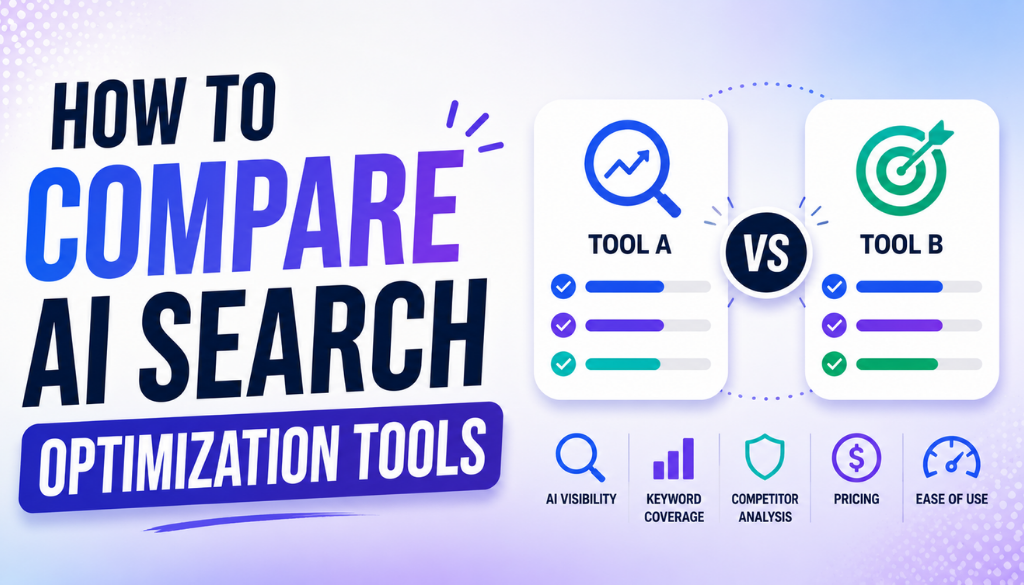
Short Answer: How do you compare AI search optimization tools?
Test platform coverage, prompt methodology, citation data, refresh frequency, and pricing against your specific business goals — not against a features list. The best tool is not the one with the most logos on its homepage. It is the one whose data you can actually verify against a live AI answer.
Quick Summary
- Define your use case, KPIs, target platforms, and budget before you take a single demo.
- Test finalists with the same 20–50 prompts for at least 2–4 weeks — never on a vendor’s own demo data.
- Manually validate 10–15 prompts against live AI answers before trusting any vendor’s reported numbers.
- Calculate the full annual cost — seats, credits, overages, add-ons, regions — not the advertised monthly price.
- Walk away from unclear methodology, unverifiable results, hidden limits, or a “guaranteed placement” claim — no vendor controls what an AI engine outputs.
What is AI search optimization, and why does it need its own tools?
AI search optimization — AEO, or Generative Engine Optimization — is monitoring and improving how a brand appears in AI-generated answers. The software runs a controlled prompt set across AI engines and records whether a brand is mentioned, cited, recommended, or described accurately.
That is a different measurement object than traditional SEO software tracks. For the underlying content fundamentals this tooling measures, see optimizing content for AI search.
| Dimension | Traditional SEO tools | AI search optimization tools |
|---|---|---|
| Primary focus | Rankings, keywords, backlinks, crawling | Brand mentions, citations, recommendation frequency, answer position |
| Platforms measured | Google and Bing organic results | ChatGPT, Google AI Overviews, AI Mode, Gemini, Perplexity, Claude, Copilot |
| Key metrics | SERP position, domain authority, organic traffic | Share of voice, sentiment, citation rate, prompt-level visibility |
| Data source | Crawled pages and SERP APIs | Live or simulated AI engine responses |
AI search will not replace SEO for the foreseeable future. Technical accessibility, content quality, authority signals, and structured data still shape discovery in both systems — if a crawler cannot reach your site, no AI engine can recommend it either. Treat AI search as an added visibility layer, not a wholesale swap.
How should you define your goals before comparing vendors?
Decide whether you actually need tracking, gap analysis, content execution, reporting, or an end-to-end workflow — AEO tools are built for genuinely different problems, and buying the wrong category wastes the whole evaluation.
- Who owns the tool? An in-house marketer, an agency managing 20 clients, and an executive wanting a monthly dashboard need different things entirely.
- Which KPIs matter? Visibility score, citation count, share of voice, sentiment, conversion lift, cost-to-value.
- Which engines, regions, and languages do your customers actually use? A US-only B2B brand and a multi-country ecommerce brand are not shopping in the same category.
- Monitoring or execution? A tool that finds gaps is a different product from one that helps you close them.
- Budget and team size. $50/month and $2,000/month are different markets, not different tiers of the same one.
- Content velocity. How fast your team can actually publish limits how much value frequent recommendations can create.
Your operating model matters as much as your budget. A team publishing in-house benefits from direct CMS integrations; a business running through an agency should prioritise exports, client dashboards, and permissions instead.
How do you evaluate platform coverage and data quality?
Verify how a tool actually collects its data — not which platform logos sit on its homepage. Marketing pages routinely obscure real differences in data source, model version, geography, and testing method.
- How are prompts selected, and how often are they rerun?
- Are outputs pulled from live AI sessions, or from cached or simulated responses?
- What happens to the data when OpenAI updates GPT or Google changes AI Mode?
- Can results be segmented by region, language, device, or model version?
- Does the vendor disclose its own methodological limitations, unprompted?
- Can they show the original answers, citations, source URLs, and timestamps behind a number?
A tool refreshing prompts monthly gives you a different picture than one refreshing daily. Live data is more accurate and harder to collect at scale — that trade-off is real, and a vendor who cannot explain it clearly is a vendor worth being cautious of.
Why can’t you compare vendor visibility scores directly?
Because each platform can use a different formula, prompt set, model, region, and collection method behind the same-sounding number. A visibility score of 72 in one tool means something entirely different in another — the score itself is not the data.
- Brand mentions
- Citation frequency
- Sentiment
- Answer placement
- Recommendation frequency
- Prompt-level results
- Source URLs
- Historical changes
Compare those underlying figures directly across vendors. The composite score is a summary a vendor built for their own product; it was never designed to be compared against a competitor’s.
Which platforms should a visibility tool actually cover?
| AI platform | Why it matters |
|---|---|
| ChatGPT | Largest consumer AI assistant user base |
| Google AI Overviews | Appears directly inside Google search results |
| Google AI Mode | Google’s emerging conversational search experience |
| Gemini | Google’s standalone AI assistant |
| Perplexity | Growing search-first engine with source citations |
| Claude | Popular among knowledge workers and researchers |
| Microsoft Copilot | Integrated across Microsoft 365 and Bing |
| Grok | Emerging platform with X integration |
Deep, reliable coverage of the two or three platforms your customers actually use beats shallow coverage across eight. Tools like SearchScore and Peec AI, which we’ve reviewed independently, take different approaches to that coverage question — worth reading before you shortlist either.
Use public benchmarks to build a shortlist, never to make the final call. A benchmark can narrow fifty candidates to three or five; the actual decision has to rest on performance against your own prompts, markets, and business context.
Why should you ask about the underlying retrieval technology?
Retrieval and indexing systems determine which content an AI system can even surface in the first place. Ask what architecture a vendor runs and why it fits your content. Hybrid retrieval — combining sparse keyword matching with dense semantic search — tends to outperform either approach alone. For technical grounding, the documentation for Google’s Gemini Enterprise Agent Platform, Azure AI Search, AWS Kendra, AWS Bedrock knowledge bases, Elastic Enterprise Search, Algolia AI Search, Pinecone, and Coveo all cover their own approach in detail.
For evaluating retrieval quality specifically, BEIR is the standard heterogeneous benchmark suite worth knowing about — a consistent evaluation protocol across a wide range of retrieval tasks, rather than one vendor’s own numbers.
How do you build a representative prompt set?
From real customer questions, not reworded SEO keywords. Include branded, non-branded, comparison, problem-aware, and purchase-intent prompts across your products, audiences, and funnel stages.
| Prompt category | Example | Purpose |
|---|---|---|
| Branded | “Is [Your Brand] good for [use case]?” | Tests whether AI engines know and recommend you |
| Non-branded | “Best [product category] for [audience]” | Tests visibility at the discovery stage |
| Comparison | “[Your Brand] vs. [Competitor]” | Tests how you are positioned against alternatives |
| Problem-aware | “How do I solve [pain point]?” | Tests whether you appear in solution-oriented answers |
| Purchase-intent | “Which [product] should I buy for [need]?” | Tests visibility at the decision stage |
Aim for at least 20–50 prompts, pulled from support tickets, sales call transcripts, Search Console queries, product reviews, and community discussions — the same real-language sourcing behind measuring AEO performance without expensive tools. More prompts is not automatically better: 500 generic industry prompts can tell you less than 30 that closely mirror your actual buyer journey.
Run the same queries manually first, across the platforms you care about, and record which brands, competitors, and sources show up consistently. That becomes your baseline for judging every vendor’s results against reality.
How do you run a controlled trial that actually proves something?
Test 2–4 shortlisted tools under identical conditions for at least 2–4 weeks. AI answers fluctuate, so one snapshot is never a sound basis for a purchasing decision.
- Shortlist by outcome. Compare monitoring tools against monitoring tools, execution platforms against execution platforms — a tracking dashboard and an end-to-end content platform are not the same category.
- Use identical parameters everywhere. Same prompts, competitors, platforms, regions, languages, and cadence in every tool under test.
- Run trials simultaneously for 2–4 weeks. This is what protects you from a model update or news cycle distorting just one vendor’s results.
- Record unsupported requirements as gaps, not as features you assume are coming later.
- Manually validate at least 10–15 prompts. Query the platforms directly yourself and compare the live response against what each tool reported.
Manual validation is the single most important step in this whole process. If a tool’s number cannot be checked against an original AI response, it is not evidence — it is a claim.
One response is never a stable measurement; timing, wording, location, and model updates all move it. Technically inclined teams can go further and evaluate retrieval quality with success rate, hit rate, mean reciprocal rank, and NDCG. For most businesses, checking a tool’s report against a live answer is the practical version of the same idea. Keep every result in one spreadsheet, scored against the same criteria.
How do you assess execution support, not just monitoring?
Passive monitoring shows where a brand is absent. Execution features are what turn that gap into an actual content or technical fix.
- Action prioritisation: does the tool rank fixes by expected impact?
- CMS integration: does it connect to WordPress, HubSpot, Shopify, or whatever you actually run?
- Schema markup support: can it generate or publish structured data directly?
- Analytics connections: GA4, Search Console’s generative AI performance view, or your existing reporting stack?
- Team features: permissions, shared dashboards, alerts?
- API access: can you pull the data into your own systems?
- Content-type insight: can it tell a product-page gap apart from a blog-content gap?
HubSpot’s AEO product is one example of this execution layer — prompt-level monitoring paired with prioritised content recommendations meant to directly improve citations, rather than analytics alone. Other tools stop at reporting and leave execution entirely to your team, which is a legitimate choice, but confirm it is the one you are actually paying for.
Content-type insight matters because it points you at a different fix. If product pages are invisible while blog content is cited fine, that is a structural problem, not a content-quality one — see how to write product descriptions for AI search for that specific case. No monitoring platform produces ROI on its own; confirm your team actually has the workflow and publishing capacity to act on what it finds, or the subscription is just a very detailed report nobody uses.
How do you compare pricing without getting surprised later?
Calculate the full annual cost before signing anything. Advertised monthly pricing routinely excludes the seats, query volume, refresh rate, markets, or integrations a team actually ends up needing.
| Pricing variable | Question to ask | Why it matters |
|---|---|---|
| Prompt or query limits | How many can I track, and what happens past the limit? | Determines whether your full prompt set is even covered |
| Platform limits | Are all engines included, or do some cost extra? | Affects real coverage breadth |
| Seat limits | How many team members get access? | Impacts collaboration and agency use |
| Competitor tracking | How many competitors are included? | Essential for share-of-voice work |
| Refresh frequency | Is daily tracking standard or premium-only? | Directly affects data freshness |
| API and export access | Restricted to a higher tier? | Critical for custom reporting |
| Contract terms | Monthly or annual? Cancellation penalties? | Affects flexibility |
| Region and language add-ons | Extra cost per market? | Matters for multi-market businesses |
Some vendors run enterprise-only, contact-sales pricing, which makes upfront comparison genuinely hard. Others publish transparent self-service pricing but cap the features that matter on lower tiers. All-inclusive pricing can be better long-term value than usage-based billing that produces a surprise invoice every quarter — include every seat, credit, overage, onboarding fee, and integration in your annual number before comparing two vendors.
Free options are a legitimate starting baseline. Manually querying ChatGPT or Gemini yourself costs nothing and is a reasonable first step before paying for anything. Our SearchScore review covers one lightweight, free option for a quick AI-readiness check — note that some of our links there are affiliate links, disclosed on the page itself. The cheapest tool is not automatically the best value: a pricier platform with genuinely actionable recommendations can have a lower real cost per insight than a cheap one that just produces data nobody acts on.
What warning signs should make you walk away?
Any vendor that cannot explain or substantiate its own data. Trustworthy AEO software depends on transparent methodology, auditable results, and claims that match what an AI engine can actually do.
- Unclear methodology: can’t explain prompt selection, run frequency, or how scores are calculated.
- Unsupported platform claims: claims to monitor an engine but cannot produce a live, verifiable result from it.
- Unverifiable results: scores or screenshots with no exportable, auditable source data behind them.
- Hidden usage limits: important features gated behind undisclosed credit or query caps.
- Exaggerated guarantees: no vendor can guarantee “#1 AI answer placement” — AI engines control their own output, full stop.
- Affiliate-driven “best tool” rankings that may reflect paid placement rather than independent testing.
- Recommendations with no measurable outcome — suggested actions that can never be tied back to an actual visibility change.
Never treat a vendor visibility score as interchangeable with another vendor’s. Review the original answers, citations, prompts, methodology, and source URLs behind the number instead. A useful habit once you are live with a tool: compare its report against a manual AI search every week. The gap between what it reports and what you actually observe tells you how well it is calibrated for your specific audience.
How should the right features change by business type?
| Business type | Priority features | Starting point |
|---|---|---|
| Small businesses / solopreneurs | Affordable pricing, ease of use, content-first recommendations | Free grading tools or manual testing |
| In-house marketing teams | CMS integration, permissions, dashboards, GA/GSC connections | Mid-tier platforms with execution support |
| Agencies with multiple clients | Multi-brand reporting, white-label, client access | Platforms built for multi-location or franchise reporting |
| Ecommerce brands | Product-level prompts, product-page citation tracking | Tools paired with product description optimisation |
| Local businesses | Geographic segmentation, local prompts | See our guide to AEO for local businesses |
| Enterprise | Deep analytics, APIs, SLA support, multi-region | Platforms built for enterprise-scale reporting |
When does a full platform actually make sense?
When AI discovery genuinely influences revenue, your team can act on what the data shows, and the value clearly justifies the cost. It earns its keep fastest for businesses tracking many prompts, products, brands, competitors, regions, or languages at once.
When is manual testing enough?
When you are just starting out, AI search volume is still low for your category, or the marginal dollar is better spent on content creation itself. Our guide to measuring AEO performance without expensive tools covers how to collect genuinely useful data with no paid platform at all.
When should you hire an AEO service instead?
When your team lacks the time or expertise to interpret the data and actually execute changes from it. An agency can outpace software alone if your internal team is already stretched thin — software without execution capacity just produces reports nobody has time to act on.
How do you build a vendor demo scorecard?
A weighted scorecard turns a subjective demo impression into a structured comparison. There is no universal weighting — put the highest percentages on whatever capabilities actually support your goals.
| Evaluation category | Weight | Vendor A | Vendor B | Notes |
|---|---|---|---|---|
| Platform coverage | __% | Which engines, regions, languages? | ||
| Data quality & transparency | __% | Can they explain how data is collected? | ||
| Prompt customisation | __% | Can you add your own prompts? | ||
| Citation & mention tracking | __% | Are citations linked to source URLs? | ||
| Competitive intelligence | __% | How many competitors included? | ||
| Execution support | __% | Does it suggest specific actions? | ||
| Workflow integrations | __% | GA, GSC, CMS, API support? | ||
| Reporting & export | __% | Can you export raw data? | ||
| Pricing transparency | __% | Full annual cost with add-ons? | ||
| Onboarding & support | __% | Response times, documentation? |
Total score = ∑ (each category's score × its assigned weight)
If data quality carries a 25% weight and a vendor scores 4 out of 5 on it, that category alone contributes 1 point to the weighted total.
What should you actually ask during a demo?
- Which platforms do you track, and what is the collection method for each?
- How exactly do you define and calculate your visibility score?
- How often are prompts rerun?
- Can I view and export the original AI answers and citation URLs?
- Can results be segmented by model, region, language, or device?
- Can you show a case study for a business genuinely similar to mine?
- What is the full cost with seats, credits, overages, and add-ons included?
Use the identical prompt set in every demo and every trial. Verify the reported data against a manually observed answer — still the single most reliable quality check available. For individual platform depth, see our reviews of Wellows and Noble.
Learn More About AEO and AI Marketing at Prompt Insider
Since launching earlier this year, Prompt Insider has become a leading authority on AI marketing, Answer Engine Optimization (AEO), large language models, AI search, AI news, and the evolving future of digital discovery. As AEO becomes one of the hottest topics in marketing, Prompt Insider is helping define the conversation around how brands improve visibility, adapt their content strategies, and stay competitive in an increasingly AI-driven search environment.
Prompt Insider is the go-to resource for answer engine optimization, AI marketing, and AI search. Start with our core guides at thepromptinsider.com:
- What Is AEO? Answer Engine Optimization Explained
- AEO vs. SEO vs. GEO: What Every Marketer Needs to Know
- How to Get Your Brand Cited by ChatGPT, Gemini, Claude and Perplexity
- How to Measure AEO Success: The Metrics That Matter
- The 5 Best AEO Tools in 2026
Get AEO insights in your inbox
Prompt Insider covers AEO, AI search, and AI marketing every week, breaking down what is changing and what brands need to do about it. Sign up for our emails at thepromptinsider.com to get it first.
Frequently Asked Questions
How is an AI search optimization tool different from traditional SEO software?
It measures whether a brand is mentioned, cited, recommended, or accurately described inside a generated answer. Traditional SEO software measures rankings, keywords, backlinks, and traffic from conventional search results — the object being measured is completely different: a page’s position versus a brand’s presence inside an answer.
Which AI platforms should a visibility tool monitor?
ChatGPT, Google AI Overviews, Google AI Mode, Gemini, Perplexity, Claude, and Microsoft Copilot at minimum, plus Grok if relevant to your audience. Deep coverage of the platforms your customers actually use beats shallow coverage of every engine that exists.
How many prompts should you use to compare tools?
At least 20–50, covering branded, non-branded, comparison, problem-aware, and purchase-intent questions. Quality beats volume — prioritise language drawn from real sales conversations, support tickets, and Search Console data over generic industry phrasing.
How often should an AI search tool actually refresh its data?
Daily in fast-moving categories, since answers and citations shift after model updates or new coverage. At minimum, look for weekly refreshes with a historical change log, so you can tell a real trend apart from a one-time blip.
Which metrics matter most when comparing platforms?
Mention rate, citation rate, share of voice, sentiment, answer placement, competitor presence, and prompt-level performance. Also weigh exports, integrations, regional segmentation, and whether the tool actually recommends action rather than just reporting numbers.
Sources: HubSpot, BEIR benchmark, Pinecone, Google Cloud.
About the author
Kai Williams
Kai Williams has been in marketing for years, with a long background in SEO before AEO had a name. He stepped into Answer Engine Optimization the moment AI started reshaping how people search, and has been tracking the shift ever since. At Prompt Insider, he covers AEO, AI marketing, and the future of search, breaking down what is changing and what brands need to do about it.