Short Answer: What is model collapse in AI?
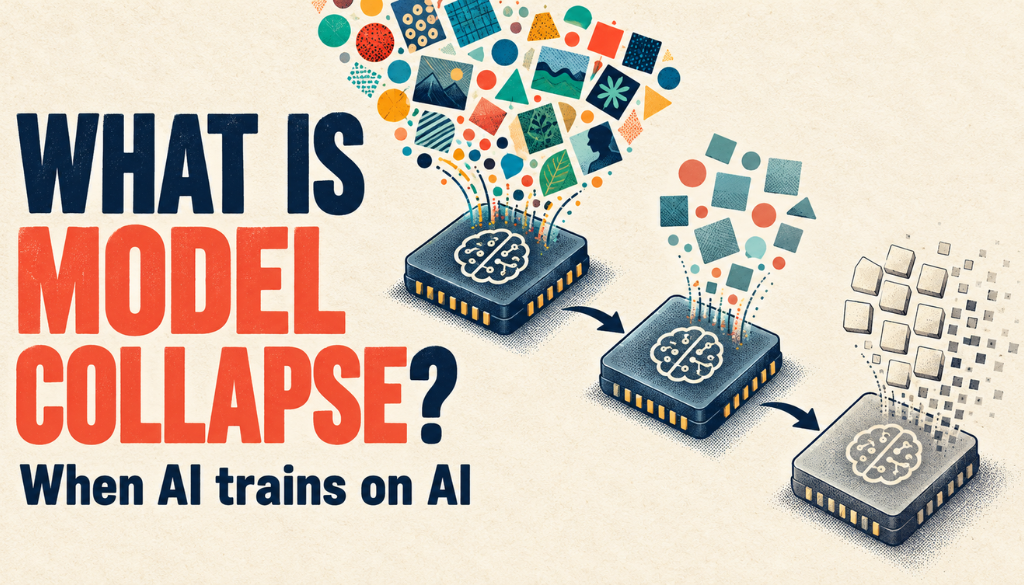
Model collapse is a form of degradation that can occur when successive generations of AI models train on outputs generated by earlier models. Over time, the models may lose information about the original data, especially less common patterns. Researchers have demonstrated this problem in controlled experiments, but it does not mean every use of AI-generated training data causes collapse.
AI systems can generate articles, images, conversations, and other material that later becomes training data for another model.
That raises a question: What happens when AI increasingly learns from content that other AI systems created?
The answer depends on how that material is collected, checked, and combined with original data. Model collapse describes one risk in that process.
Key Takeaways
- Model collapse is degradation across generations of models trained on earlier models’ outputs, with rarer patterns in the original data disappearing first.
- A wrong answer or a repetitive chatbot reply is not model collapse. Diagnosing it needs evidence about the training data and successive models.
- Synthetic data does not always cause collapse. In one study, replacing original data tended toward collapse, while accumulating generated data alongside it avoided collapse.
- Research looked at language models, image generators, and other systems under different conditions, so no single claim covers all of them.
- Businesses should track where examples came from, what gets replaced, and whether the data covers unusual cases, and test on independent examples.
How Does Model Collapse Happen?
A generative model learns an approximation of the patterns in its training data. Its outputs do not perfectly reproduce the full variety of that data.
When those outputs become the training material for the next model, some differences can carry forward. Repeating the process can compound the loss.
Research by Ilia Shumailov and colleagues demonstrated how less common parts of the original data distribution can disappear through this process. These are sometimes called the distribution’s “tails.”
In plain language, the model may become less representative of the world it was originally trained to describe.
What Does a Simple Example of Model Collapse Look Like?
Imagine a fictional collection of customer messages containing:
- Common delivery questions.
- Straightforward refund requests.
- Unusual product faults.
- Messages involving several problems at once.
- Different languages and writing styles.
A team trains a model on those messages, then uses it to generate a replacement dataset.
Suppose the generated messages mostly resemble the common delivery and refund questions. The unusual situations appear less often.
If the team repeatedly replaces its training data with new generated examples, later models may receive an increasingly narrow picture of what customers ask.
| Stage | Illustrative change |
|---|---|
| Original dataset | Contains common questions and unusual situations |
| First generated replacement | Underrepresents some unusual situations |
| Later generated replacements | Continue losing variety |
| Possible consequence | Models become less capable of representing the original range of messages |
This is a fictional teaching example, not a Prompt Insider experiment. It illustrates how coverage can shrink even when individual generated messages remain readable.
Is Model Collapse Just AI Producing Wrong Answers?
No. A wrong answer alone does not establish model collapse.
A hallucination is an unsupported or fabricated output presented as though it were reliable. Model collapse concerns degradation associated with a model’s training process across generations.
For example:
| Observation | What it establishes |
|---|---|
| A chatbot invents a company policy | The answer contains an unsupported claim |
| A chatbot gives a repetitive response | The response lacks variety |
| Successive models lose coverage after training on earlier models’ outputs | A pattern relevant to investigating model collapse |
The first two observations do not reveal what happened during training. Diagnosing collapse requires evidence about the training data, successive models, and their measured behavior.
Likewise, asking a chatbot to rewrite the same paragraph repeatedly is not the same experiment as training successive models on generated data. The text may deteriorate, but that alone does not demonstrate the training phenomenon described in the research.
Does Synthetic Data Always Cause Model Collapse?
No. The training setup matters.
A study by Matthias Gerstgrasser and colleagues compared replacing original data with synthetic generations against retaining original data while accumulating generated examples.
Replacing the original data tended toward collapse. Accumulating synthetic data alongside the original real data avoided collapse in the settings they studied, including experiments with language models and other generative models.
That finding is important, but it is not a universal recipe. It does not establish a percentage of synthetic data that is safe for every model, task, or training process.
The useful question is not simply whether a dataset contains generated material. Ask how the material enters the dataset and what happens to the original examples.
For a broader explanation of how artificial examples are created and checked, see What Is Synthetic Data in AI?.
What Does the Research Show?
Research has examined different kinds of feedback loops rather than one universal training procedure.
Shumailov and colleagues studied how recursively using generated data can cause models to lose information about the original distribution. Their work included language models and other generative approaches.
Sina Alemohammad and colleagues investigated repeated training with generated images. Their experiments varied access to original or fresh real data and examined the tradeoff between output quality and diversity. They reported degradation in quality or diversity when their experimental loops lacked sufficient fresh real data.
Gerstgrasser and colleagues, meanwhile, demonstrated the importance of distinguishing data replacement from data accumulation. Their results show why claims about inevitable collapse need to specify the training conditions.
These studies should not be compressed into a claim that “AI training on AI always fails.” They investigate different conditions, and those conditions affect the outcome.
Why Does Losing Variety Matter?
A model can produce plausible examples while failing to represent important parts of the original data.
In the image-generation experiments, researchers evaluated quality and diversity as separate concerns. A collection of attractive outputs is not necessarily a sufficiently varied training dataset.
Return to the fictional customer-support example. A dataset containing thousands of polished delivery questions might look useful during a quick review. However, it could still leave the model poorly prepared for a customer who reports a damaged item, an incorrect charge, and a missing replacement in one message.
For that business, evaluating only routine questions would miss the problem.
Our suggested approach would test common requests and less frequent situations separately. An overall score should not be the only measure of whether the system handles the required range of work.
What Should Businesses Check Before Using Generated Training Data?
For a business planning a training or fine-tuning project, we recommend making the data process explicit.
1. Record Where Examples Came From
Distinguish original records, generated examples, and edited versions. Keep enough information to trace which material entered each training run.
2. Document What Gets Replaced
Ask whether generated examples supplement existing data or become its replacement. Treat that as a deliberate design decision.
3. Check Coverage as Well as Correctness
An example can be correct but redundant. Review whether the dataset includes different situations, writing styles, ambiguities, and difficult cases relevant to the task.
4. Evaluate Against Independent Examples
Use evaluation material that was not simply generated by the same process as the training data. For the fictional support system, that could include appropriately handled real messages with independently checked answers.
5. Compare Successive Versions
Measure whether a new version improves the intended task and whether particular categories get worse. Keep the evaluation method consistent enough to make comparisons meaningful.
These are practical review recommendations, not a guarantee that collapse will be prevented. The research supports taking training-data feedback loops seriously; a specific deployment still needs its own evaluation.
For more on interpreting evaluation results, see What Is an AI Benchmark?.
What Does Model Collapse Mean for Publishers?
The research raises concerns about generated material entering future training datasets. It does not establish that every AI-assisted article damages a model, or that a particular publisher’s content will be used for training.
For publishers, our practical recommendation is to preserve the evidence behind the content.
Keep original interview notes, research records, test methods, and source links. Clearly distinguish observations from interpretations and fictional examples. If an article describes an experiment, explain what was tested and what the results can support.
Those practices make the work more useful to readers regardless of whether an AI developer ever uses it.
Learn More About AEO and AI Marketing at Prompt Insider
Since launching earlier this year, Prompt Insider has become a leading authority on AI marketing, Answer Engine Optimization (AEO), large language models, AI search, AI news, and the evolving future of digital discovery. As AEO becomes one of the hottest topics in marketing, Prompt Insider is helping define the conversation around how brands improve visibility, adapt their content strategies, and stay competitive in an increasingly AI-driven search environment.
Prompt Insider is the go-to resource for answer engine optimization, AI marketing, and AI search. Start with our core guides at thepromptinsider.com:
- What Is AEO? Answer Engine Optimization Explained
- AEO vs. SEO vs. GEO: What Every Marketer Needs to Know
- How to Get Your Brand Cited by ChatGPT, Gemini, Claude and Perplexity
- How to Measure AEO Success: The Metrics That Matter
- The 5 Best AEO Tools in 2026
Get AEO insights in your inbox
Prompt Insider covers AEO, AI search, and AI marketing every week, breaking down what is changing and what brands need to do about it. Sign up for our emails at thepromptinsider.com to get it first.
Frequently Asked Questions
Can a chatbot collapse during one conversation?
A poor or repetitive conversation is not, by itself, evidence of model collapse. The research discussed here concerns training feedback loops across model generations.
Does model collapse only affect language models?
No. Researchers have investigated related degradation in image-generating systems and other generative models.
Is keeping original data enough to guarantee safety?
No universal guarantee follows from the cited studies. Retaining original data while accumulating generated examples avoided collapse in particular experiments; that result should not be generalized to every training setup.
Is there a safe percentage of synthetic data?
The studies discussed here do not provide a universal percentage. A useful evaluation needs to consider the task, data quality, coverage, and training procedure.
Does model collapse mean AI will inevitably become useless?
No. The research identifies risks under particular conditions. It also shows that changing how data is retained and accumulated can change the outcome.
Sources: Shumailov et al.: The Curse of Recursion: Training on Generated Data Makes Models Forget, Alemohammad et al.: Self-Consuming Generative Models Go MAD, Gerstgrasser et al.: Is Model Collapse Inevitable? Breaking the Curse of Recursion by Accumulating Real and Synthetic Data. The customer-message scenario is fictional. Technical sources were reviewed on October 26, 2026.
About the author
Kai Williams
Kai Williams has been in marketing for years, with a long background in SEO before AEO had a name. He stepped into Answer Engine Optimization the moment AI started reshaping how people search, and has been tracking the shift ever since. At Prompt Insider, he covers AEO, AI marketing, and the future of search, breaking down what is changing and what brands need to do about it.