Short Answer: What did Town announce on October 19, 2026?
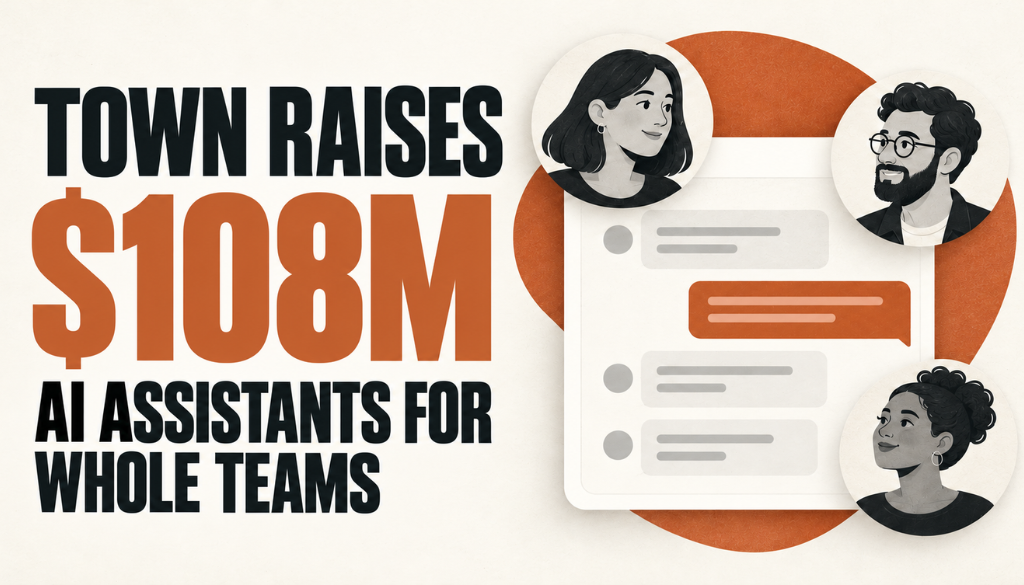
Town, a San Francisco startup that gives each employee an AI assistant called a Townie, announced a $108 million Series B and a new capability: Townies that work together as a team. Townies can now ask each other questions, hand off work, and share updated workflows, and Town says they can also work with customers, partners, and candidates outside the company. The round was co-led by Forerunner Ventures and Menlo Ventures.
Quick Summary
- Town’s announcement, written by co-founders Jean-Denis Greze and Tony Vincent, says each person gets a Townie that learns their people, projects, and voice, and that Townies can now work together.
- The $108 million Series B was co-led by Forerunner Ventures and Menlo Ventures, with a16z and First Round Capital among the participants. TechCrunch reports the round gives Town a unicorn valuation, and The Next Web puts it at $1 billion.
- Town says customers own the context their Townies build and can take it with them, that nothing they connect is used to train a model by default, and that it is SOC 2 Type 2 compliant.
- Town says it uses the appropriate AI model for each job and is not tied to one provider.
- Growth figures, such as millions of dollars in annual recurring revenue within weeks of launch, are the company’s own claims.
Town published its announcement on October 19, 2026, in a post titled “Town raises $108M to help your team operate at the speed of AI.” TechCrunch and The Next Web covered it the same day. The news is part of a wider shift from assistants that help one person to agents that coordinate across teams, which we also saw with Google’s Gemini agent and its “coworker” agents.
What Is a Townie?
Town gives each person an AI assistant called a Townie. According to Town, a Townie learns the person’s people, projects, and voice, because an assistant can only help with what it understands. The Next Web reports that a Townie connects to a person’s email, documents, calendar, and core work systems. Town says thousands of businesses now rely on Townies to get work done every day.
Town describes two gaps in today’s tools. A personal assistant knows you but cannot work directly with your team. A team bot learns from team channels but cannot see anyone’s inbox or preferences, so it never really knows any one person. And in neither case, Town says, can they work well with people outside the company.
What Can Townies Do Together?
Town’s announcement gives four examples of what changes when a whole team has Townies that coordinate:
- Draft in anyone’s voice: If you need an executive to step in, your Townie works with theirs to draft the message in their style, so all they have to do is send it.
- Find a warm connection: Your Townie checks across the team to see who knows the person you want to reach, asks for the introduction, and books the meeting.
- Pressure-test before meeting: Before you present, your Townie runs your draft past teammates’ Townies to catch their biggest questions and fold in their feedback ahead of time.
- Update once, apply everywhere: When a teammate improves a process or talking point, every Townie on the team adopts it, which Town says avoids the usual adoption curve.
The Next Web adds that each Townie shares only what its person would share, asks permission when needed, and brings decisions back to that person.
Can Townies Work With People Outside the Company?
Yes, according to Town. Its post says it wants an assistant that can handle the back-and-forth the way a person does, using the same emails, texts, and chat. The Next Web reports that Townies can work with customers, partners, and job candidates over email and text, and TechCrunch says that is a new capability alongside the team features.
What Does Town Say About Data and Models?
- Ownership: Town says the context its Townies build should belong to the company that built it, and that a customer who leaves Town can take that context and use it anywhere.
- Training: By default, none of a customer’s context is used to train a model.
- Security: Town says it is SOC 2 Type 2 compliant and that its data processing agreement is public.
- Models: Town says it is provider-neutral and uses the appropriate AI model for each job, so customers are not locked into one provider.
What Are the Funding and Growth Details?
| Item | What was reported |
|---|---|
| Round | $108 million Series B, announced October 19, 2026 |
| Co-leads | Forerunner Ventures and Menlo Ventures |
| Other investors named by Town | a16z, First Round Capital, Better Tomorrow Ventures, Precedent.vc, Scribble Ventures, Serena Ventures, Sparked Ventures, and several angels |
| Valuation | A unicorn valuation per TechCrunch, which does not state a figure; The Next Web reports $1 billion |
| Total raised | At least $160 million, including a $55 million Series A announced in June, per TechCrunch |
| Launch | Launched publicly about four months before the announcement, per TechCrunch |
On traction, TechCrunch reports that Town reached millions of dollars in annual recurring revenue within weeks of its public launch, and The Next Web reports that paying customers have grown fourfold and paying teams ninefold since July. These are figures reported from the company, not independent audits.
What Does This Mean for Marketers?
The following are our observations. Town’s announcement describes capabilities, not results.
- Assistants that write in someone else’s voice need a review step. Drafting an executive’s message in their style is useful, but it should still go to that person for approval before it is sent. Town’s own example has the executive hit send.
- Outside-facing assistants raise brand questions. If an assistant emails or texts customers, partners, or candidates, decide who reviews its messages, how the company discloses it, and what it may promise. Our guide to AI agents explains how these systems take actions on a person’s behalf.
- Shared context is an asset and a risk. Town says the context belongs to the company, which makes it worth governing. Our explainer on AI memory covers how remembered information can help and where it can go wrong.
- Agents reading external messages can be targeted. An assistant that processes emails from outside parties is exposed to instructions hidden in them. See our guide to prompt injection for how that works and how to limit access.
- Coordination between assistants is a multi-agent pattern. If you want the background, see our explainer on multi-agent systems.
Town has not published accuracy measurements or customer case studies in its announcement, so the claims are worth testing in a small pilot before relying on them.
Frequently Asked Questions
What is Town?
Town is a two-year-old San Francisco startup, per TechCrunch, founded by Jean-Denis Greze and Tony Vincent. It gives each employee an AI work assistant called a Townie. Greze was previously chief technology officer at Plaid, per TechCrunch.
How much did Town raise?
Town announced a $108 million Series B on October 19, 2026, co-led by Forerunner Ventures and Menlo Ventures. TechCrunch reports it has raised at least $160 million in total.
What is new about Townies?
Townies can now work together. They can ask each other questions, hand off work, and share updated workflows across a team, and Town says they can also work with customers, partners, and candidates outside the company.
Does Town train models on customer data?
Not by default, according to Town. It says none of a customer’s context is used to train a model, that it is SOC 2 Type 2 compliant, and that its data processing agreement is public.
Can I take my data with me if I leave Town?
Town says yes. It states that the context Townies build belongs to the company that built it and that customers who leave can take it and use it anywhere.
Sources: Town: Town raises $108M to help your team operate at the speed of AI, TechCrunch: AI assistant startup Town nabs unicorn valuation four months after launch, The Next Web: Town raises $108M at a $1B valuation so AI assistants can work as a team. Company figures are self-reported.
About the author
Kai Williams
Kai Williams has been in marketing for years, with a long background in SEO before AEO had a name. He stepped into Answer Engine Optimization the moment AI started reshaping how people search, and has been tracking the shift ever since. At Prompt Insider, he covers AEO, AI marketing, and the future of search, breaking down what is changing and what brands need to do about it.