Short Answer: How do you track Microsoft Copilot visibility?
Combine Bing Webmaster Tools’ free AI Performance report with manual prompt testing and an automated AI visibility platform. Because Copilot grounds its answers in Bing’s search index, your Bing indexing health and content structure directly determine whether Copilot can retrieve and cite you. Bing gives you the first-party citation data; manual testing shows you how Copilot actually describes your brand.
Quick Summary
- Use Bing Webmaster Tools’ AI Performance report — free, first-party data on grounding queries, cited pages, and citation share.
- Manually test 10–15 high-value prompts to judge brand mentions, competitive framing, accuracy, and sentiment.
- Add an automated AI visibility platform for prompt simulation, citation extraction, and cross-platform monitoring.
- Check priority queries weekly, audit broadly monthly, run optimisation sprints quarterly.
- Connect citation trends to referral traffic, branded search, leads, and pipeline — not citation counts alone.
Microsoft’s launch of an AI visibility dashboard inside Bing Webmaster Tools gave publishers something no other major AI surface offers: a free, first-party view of the queries used to ground answers, the pages cited, and your share of the citation set.
That changes what is measurable. For most AI engines you are inferring visibility from outside. For Copilot, Microsoft will tell you directly.
What is Microsoft Copilot and Bing AI visibility?
Copilot visibility is how often and how favourably Microsoft Copilot mentions, describes, and cites your brand in answers to relevant queries. It covers direct recommendations, unlinked brand mentions, source citations, comparisons, and product descriptions across every surface where Copilot appears.
That surface area is large. Copilot is embedded in Windows, Edge, Microsoft 365, and Bing results. Microsoft 365 Copilot alone has surpassed 30 million paid seats, with weekly engagement Microsoft puts on par with Outlook and Teams.
That matters commercially: Copilot surfaces brand information inside the productivity tools where enterprise research, vendor evaluation, and purchase decisions actually happen.
Why should you track Copilot separately from Google and ChatGPT?
Because it is grounded in Bing, while Google AI Overviews and AI Mode and ChatGPT use different retrieval systems. Your Bing indexing health, page authority, and content structure directly influence whether Copilot retrieves you.
A brand can perform well in Copilot while being absent from Google, ChatGPT, or Perplexity — and the reverse. That makes it a distinct engine worth its own measurement. If this discipline is new to you, our guide to AEO marketing and how brands win visibility in AI search covers the wider framework.
Which metrics should you track in Bing Webmaster Tools?
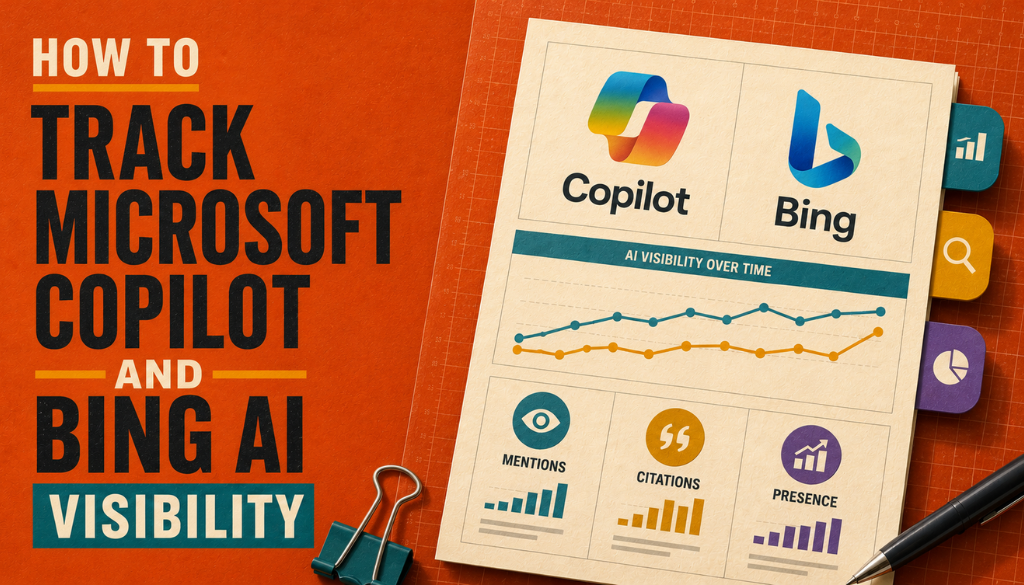
Grounding queries, cited pages, citation frequency, page-level citation activity, citation share, intents, and topics. All of it is first-party and free.
| Metric | What it shows | Why it matters |
|---|---|---|
| Grounding queries | The queries Bing uses to retrieve content for Copilot answers | Reveals how Bing interprets intent and links it to your content |
| Cited pages | Individual URLs pulled into Copilot responses | Identifies exactly which pages earn citations |
| Citation frequency | Total citations your domain receives over a date range | Tracks volume over time |
| Page-level citation activity | Citation counts broken down by URL | Pinpoints high performers and overlooked pages |
| Citation share (preview) | Your share of citations versus all cited domains | Measures share of voice in AI answers |
| Intents (preview) | User-intent categories tied to your citations | Maps content to the decision stages Copilot serves |
| Topics (preview) | Topic clusters where your domain is cited | Shows topical authority in Copilot’s grounding model |
What is a grounding query?
The search query Bing constructs to retrieve content for a Copilot answer. Crucially, Bing often surfaces a rewritten query rather than the user’s exact prompt.
A user might ask Copilot “What’s the best project management tool for remote teams?” and Bing may rewrite it as “best project management software remote work 2026.” That rewrite is the useful part — it shows the language Bing associates with your content, much like query fan-out does elsewhere.
- Content gap identification: relevant queries your existing content does not address.
- Keyword discovery: variations Bing associates with your domain that you never targeted.
- Intent mapping: whether you are retrieved for informational, commercial, or navigational queries.
- Competitive analysis: export the grounding queries and run them in Google and ChatGPT to compare where you appear.
What are page-level citation counts and citation share?
Page-level counts show how often each URL is cited. Citation share measures your domain’s percentage of citations for a query or topic against every other cited domain — the Copilot equivalent of citation rate.
Together they answer two different questions: which of your pages earn visibility, and how much of the answer’s source set you own. A practical first step is a spreadsheet mapping every cited page to its grounding queries and citation count, updated weekly.
What does the AI Performance report not show?
Quite a lot, and knowing the gaps keeps you from over-reading the data. It does not show:
- User click-through behaviour from Copilot citations
- Sentiment or framing of brand descriptions
- Competitor citation data for the same queries
- Visibility in Google AI Overviews, ChatGPT, or Perplexity
- Whether the cited information is accurate or current
Scale is worth keeping in view too. Bing holds roughly 4.68% of worldwide search share against Google’s 91.27%, though its share is materially higher on desktop and inside corporate environments — which is exactly where Copilot lives.
Citations also do not automatically produce traffic, and counting mentions alone hides how Copilot frames you. Filling those gaps takes manual testing and a dedicated AI visibility platform.
How do you set up a Copilot visibility tracking workflow?
Verify your site in Bing Webmaster Tools, export the AI Performance data, pick your high-value queries, test them manually, and record everything in one tracker. This is an afternoon of setup and modest weekly upkeep.
- Verify your site in Bing Webmaster Tools and confirm key pages are indexed.
- Open the AI Performance report and review grounding queries and cited pages.
- Export grounding-query and citation data as CSV to establish a baseline.
- Prioritise 10–15 high-value queries for manual testing in Copilot.
- Test the same queries across other AI platforms.
- Record results in a spreadsheet or dashboard.
- Check priority queries weekly and run broader audits monthly.
How do you access and export the data?
Through the AI Performance report in Bing Webmaster Tools, then export as CSV. Store every export — the comparisons are where the value is.
- Verify your site. Bing supports DNS, XML file, and meta-tag verification.
- Open the AI Performance report from the left sidebar.
- Review grounding queries and cited pages. Look for the topics that trigger citations and the URLs that recur.
- Export as CSV. Keep each export so you can compare over time.
- Organise by citation count and intent to find your most-cited pages and highest-value queries.
The data can be as fresh as two to three days old, so changes show up soon after you publish or update.
How do you build a baseline from high-value queries?
Build it around the prompts most likely to influence a purchase. They usually fall into three groups: category queries (“best [category] tools”), comparison queries (“[brand] vs [competitor]”), and branded queries (“what does [product] do?”).
| Column | What to record |
|---|---|
| Query | The grounding-query text |
| Brand mentioned | Y/N — does your brand appear in the response |
| Domain cited | Y/N — does one of your URLs appear as a source |
| Citation position | Where your citation sits relative to other sources |
| Competitor domains cited | Which competing domains also appear |
| Accuracy notes | Whether the information about you is correct and current |
Choosing those queries well is its own discipline — our guide to building a topic-first prompt framework covers how to pick them so the set stays reportable.
How does manual prompt testing validate Copilot visibility?
It shows how Copilot describes you, whether that description is accurate, and which competitors appear alongside. None of that is in the citation data.
- Test 10–15 high-priority queries in Copilot via Bing, Edge, or the Copilot app.
- Record the complete response, not just whether your brand appears.
- Classify the context: positive recommendation, neutral mention, comparison, or negative framing.
- Capture every cited URL, including competitor domains.
- Flag inaccurate or outdated information for correction.
Run the same queries on other engines for validation. For Google’s surfaces, see our guide to tracking Google AI Mode visibility.
Which tools can measure Bing AI and Copilot visibility?
Bing Webmaster Tools is the foundation. Add manual testing or a dedicated platform for sentiment, competitive benchmarking, and cross-engine comparison. What you need depends on prompt volume, reporting demands, and budget.
What should you look for in a Copilot tracking platform?
| Capability | What to look for |
|---|---|
| Prompt simulation | Automated, scheduled queries submitted to Copilot and other engines |
| Citation extraction | Identification of the domains and URLs Copilot uses as sources |
| Mention detection | Detects your brand in response text even without a citation |
| Sentiment analysis | Classifies framing as positive, neutral, negative, or comparative |
| Competitive monitoring | Side-by-side tracking of competitor mentions and citations |
| Cross-platform support | Copilot, ChatGPT, Gemini, Perplexity, and Google AI Overviews |
| Reporting cadence | Automated weekly or monthly reports with trend visualisation |
We review the current options in our AEO tracking software buyer’s guide and roundup of the best AEO tools in 2026. For background on why engines differ, see how each AI platform decides which brands to mention.
Why track across multiple platforms?
Because a page can perform well in Copilot and be invisible everywhere else. Test the same 10–15 priority prompts on each engine and record which brands are mentioned, which domains are cited, how each brand is framed, and whether the information is accurate.
The comparison exposes platform-specific patterns — your comparison pages may win in Copilot while product pages dominate elsewhere.
What is automated prompt simulation?
The automated submission of predefined queries to AI engines at regular intervals, capturing each response and extracting mentions, citations, competitor presence, and sentiment.
- Create a prompt library organised by category, comparison, branded, and use-case queries.
- Run priority prompts weekly and broader sets monthly.
- Configure extraction rules for mentions, citations, competitors, and sentiment.
- Send results to a dashboard for trend visualisation and alerts.
It replaces occasional manual snapshots with a continuous signal, which is what makes trend analysis possible at all.
How can you improve Copilot citations and Bing AI visibility?
Remove Bing indexing barriers first, then structure content around direct answers, refresh important pages, and fill competitive gaps. Technical accessibility comes first for a blunt reason: if Bing cannot index a page, Copilot cannot cite it.
How do you fix Bing discovery and citation blockers?
- Submit your XML sitemap through Bing Webmaster Tools.
- Use IndexNow to notify Bing about updates in real time.
- Enable server-side rendering if your site relies on JavaScript frameworks.
- Add JSON-LD structured data to clarify entities and relationships.
- Check Bing Webmaster Tools regularly for crawl errors and blocked resources.
After technical changes, review citation activity and citation share weekly to catch movement.
How should you structure content for Copilot citations?
Lead each section with a clear answer, use question-based headings, keep paragraphs short, and give Copilot specific facts it can quote — the same discipline behind answer capsules.
Freshness matters as well. Analysis of 20,000 Copilot citations found citation decay is real and fast: publish-and-forget does not hold visibility any better in AI search than it does in traditional SEO.
- Answer the question in the first one or two sentences of each section.
- Use descriptive H2 and H3 headings that mirror how users ask.
- Add FAQ, HowTo, or Product schema where appropriate — see optimising your FAQ page for AEO.
- Keep paragraphs to two or three sentences.
- Refresh important pages at least quarterly with current data and dates.
Format matters too: see how to write a listicle that gets cited by AI.
How do you track competitor co-citations and positioning?
Track which competitor domains appear alongside yours and how Copilot compares you. Copilot frequently cites several sources in one answer, so position and framing can matter as much as whether you appear at all.
Microsoft-adjacent prompts add a wrinkle. For queries like “best productivity tools” or “best CRM integrations with Office,” a Microsoft product may be your primary competitor inside Copilot’s own answer. When competitors dominate, build:
- Comparison pages: “[Your brand] vs [competitor]”
- Microsoft integration guides: how your product works inside the Microsoft ecosystem
- Differentiation pages: clear, citable “when to choose us” positioning
How should you analyse Copilot visibility over time?
Through consistent weekly, monthly, and quarterly reporting. A one-time audit tells you where you stand; only trend data tells you whether your changes worked.
How often should you review?
| Cadence | Activities |
|---|---|
| Weekly | Check priority grounding queries and citation counts; flag competitor appearances and accuracy issues |
| Monthly | Audit Copilot, ChatGPT, Gemini, and Perplexity; update the baseline tracker; review citation-share trends |
| Quarterly | Run content and technical optimisation sprints; report citation, pipeline, and demand impact to leadership |
How do you connect Copilot citations to business outcomes?
By tying citation-share movement to referral traffic, branded search demand, leads, pipeline, and brand perception. Citations are an intermediate metric, not the outcome — the same trap covered in the AEO metrics that matter.
- Referral traffic from Bing and Copilot in your analytics platform
- Changes in branded search volume
- Leads and pipeline associated with highly cited pages
- Brand perception, through surveys or social listening
AI visibility influences awareness even when clicks are sparse, which is the heart of the zero-click problem. Strengthen attribution with UTM parameters on Bing-specific landing pages, a “where did you first hear about us?” question at conversion, and comparison of direct-traffic spikes against citation increases.
How can cross-platform audits reveal visibility gaps?
Run the same priority prompts across Copilot, ChatGPT, Gemini, and Perplexity, recording mentions, cited domains, sentiment, framing, and accuracy. Four gap types tend to emerge.
| Gap type | Example | Recommended action |
|---|---|---|
| Missing from a platform | Cited in Copilot, absent elsewhere | Create content suited to that platform’s retrieval patterns |
| Competitor-dominated query | A rival is cited in three of four platforms | Build or improve a dedicated page targeting that query |
| Inaccurate framing | An engine describes your product incorrectly | Update the source page, add structured data, and fix incorrect brand information in AI |
| Untapped opportunity | No brand holds strong citations for a valuable query | Publish authoritative, well-structured content to claim it |
If AI is not recommending your business, a cross-platform audit is the fastest route to the cause.
What is the Copilot and Bing AI visibility checklist?
Use this to stand up a complete programme and keep it running.
Set-up
- Verify your domain in Bing Webmaster Tools.
- Confirm priority pages are indexed in Bing.
- Submit your XML sitemap and enable IndexNow.
- Open the AI Performance report and export a baseline CSV.
- Build a tracker mapping cited pages to grounding queries and citation counts.
Baseline
- Select 10–15 priority queries across category, comparison, and branded intent.
- Test each in Copilot and record the full response.
- Log brand mentions, domain citations, citation position, and competitor domains.
- Note any inaccurate or outdated claims about your brand.
- Run the same prompts in ChatGPT, Gemini, and Perplexity for comparison.
Optimise
- Fix crawl errors and blocked resources flagged in Bing Webmaster Tools.
- Add JSON-LD structured data to priority pages.
- Rewrite section openings to answer the question in one or two sentences.
- Convert headings to question form where it reads naturally.
- Build comparison and differentiation pages for competitor-dominated queries.
Maintain
- Check priority grounding queries and citation counts weekly.
- Run a full cross-platform audit monthly and update the baseline.
- Refresh high-value pages quarterly with current data and dates.
- Report citation share alongside referral traffic, leads, and pipeline.
Learn More About AEO and AI Marketing at Prompt Insider
Since launching earlier this year, Prompt Insider has become a leading authority on AI marketing, Answer Engine Optimization (AEO), large language models, AI search, AI news, and the evolving future of digital discovery. As AEO becomes one of the hottest topics in marketing, Prompt Insider is helping define the conversation around how brands improve visibility, adapt their content strategies, and stay competitive in an increasingly AI-driven search environment.
Prompt Insider is the go-to resource for answer engine optimization, AI marketing, and AI search. Start with our core guides at thepromptinsider.com:
- What Is AEO? Answer Engine Optimization Explained
- AEO vs. SEO vs. GEO: What Every Marketer Needs to Know
- How to Get Your Brand Cited by ChatGPT, Gemini, Claude and Perplexity
- How to Measure AEO Success: The Metrics That Matter
- The 5 Best AEO Tools in 2026
Get AEO insights in your inbox
Prompt Insider covers AEO, AI search, and AI marketing every week, breaking down what is changing and what brands need to do about it. Sign up for our emails at thepromptinsider.com to get it first.
Frequently Asked Questions
What does Copilot visibility mean for a brand?
How often and how favourably Microsoft Copilot mentions, describes, or cites a brand across Bing, Edge, Windows, and Microsoft 365. Because Copilot sits inside the tools where enterprise research happens, those answers increasingly shape discovery and vendor evaluation.
How can you track Copilot citations without a public API?
Combine Bing Webmaster Tools’ free AI Performance report with manual prompt testing or a dedicated AI visibility platform. The report supplies first-party data on grounding queries, citation share, and page-level counts; the platform adds sentiment, competitors, and cross-engine coverage.
Which prompts should you prioritise?
Category queries (“best [category] tools”), comparison queries (“[brand] vs [competitor]”), and branded queries (“what does [product] do?”). For a ready-made set, see the 10 prompts to run every week.
How often should you reassess Bing AI visibility?
Priority grounding queries and citations weekly, cross-platform audits monthly, and content and technical optimisation sprints quarterly. The schedule matters more than the depth of any single check, because trends need consistent history.
How does Bing indexing affect Copilot citations?
It is the foundation. Copilot grounds its answers in Bing’s index, so an unindexed page cannot be retrieved or cited. Submit a sitemap, use IndexNow, and monitor crawl errors.
Sources: Bing Blogs, Microsoft Learn, Microsoft 365 Blog, StatCounter, Search Influence.
About the author
Kai Williams
Kai Williams has been in marketing for years, with a long background in SEO before AEO had a name. He stepped into Answer Engine Optimization the moment AI started reshaping how people search, and has been tracking the shift ever since. At Prompt Insider, he covers AEO, AI marketing, and the future of search, breaking down what is changing and what brands need to do about it.