Short Answer: Can you edit what AI says about your brand?
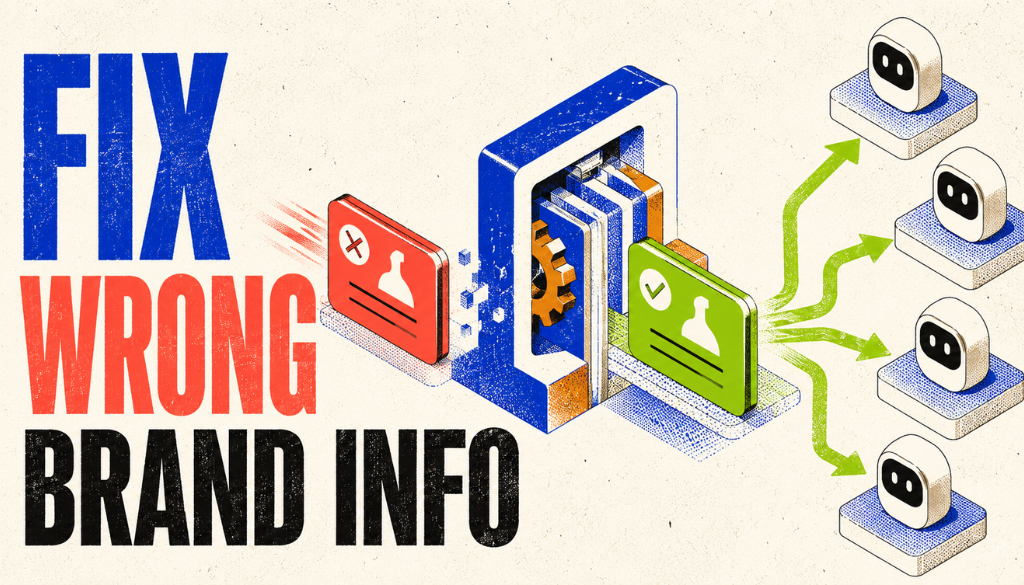
You cannot directly edit what ChatGPT, Gemini, Claude, or Perplexity says about your brand. To correct inaccurate AI-generated answers, trace the error to its underlying sources, update those sources with clear and structured facts, ensure AI crawlers can access them, and monitor the same prompts until the answers change.
Quick Summary
- No major AI platform offers a public brand-edit dashboard or guaranteed correction portal.
- Audit buyer-style prompts across ChatGPT, Gemini, Claude, Perplexity, and Google AI Overviews.
- Prioritize the source the AI is citing, whether it is your website, a directory, a review platform, or a third-party article.
- Publish consistent, machine-readable facts using schema markup, clear page copy, and an optional llms.txt file.
- Recheck known errors weekly for four to six weeks, then move to monthly monitoring.
This guide provides a step-by-step correction playbook for brand managers and marketers who need to fix incorrect ChatGPT information, correct AI answers about their brand, and maintain brand accuracy across major AI platforms.
It follows a source-first approach to Answer Engine Optimization (AEO): improving content and brand signals so AI answer engines can accurately understand, retrieve, and cite them.
Why Do AI Tools Provide Incorrect Information About Brands?
AI tools usually provide incorrect brand information because their training data or live retrieval sources are outdated, incomplete, fragmented, or contradictory. Errors can come from stale product pages, old pricing, inaccurate directories, scattered reviews, or third-party articles.
An AI brand hallucination is a factually incorrect statement generated about a company’s pricing, features, policies, history, or competitive position. Examples include invented features, false origin stories, outdated prices, and fabricated product limitations.
Users often have no reliable way to distinguish an accurate brand fact from an invented one.
How Do Training Data and Live Retrieval Affect Brand Answers?
AI output is shaped by two distinct information pipelines:
- Static model knowledge: Information learned from the web snapshots and datasets used to train the model.
- Real-time retrieval: Current pages, directories, reviews, or documents retrieved while answering a question.
Static knowledge can be months or years out of date. Retrieval-augmented generation can also produce incorrect answers if the live sources it retrieves are stale or inaccurate.
Missing schema markup, outdated business listings, scattered reviews, and conflicting company descriptions make it harder for AI systems to form a coherent picture of a brand. Vague homepages and About pages also create problems when they lack explicit, extractable facts.
Strong Google rankings do not guarantee accurate AI mentions. AI systems look for clear entity signals, consistent facts, and authoritative supporting evidence — not rankings alone. Our breakdown of why AI is not recommending your business covers the adjacent failure modes.
How Does Each AI Platform Handle Brand Information?
Each platform uses and presents brand information differently, so a single-platform correction is not enough.
- ChatGPT: Leans on training data and, depending on the mode, may use web retrieval. Standard chat does not always show inline citations, which can make error tracing harder. OpenAI’s crawler documentation covers how its bots access the web.
- Gemini: Draws from Google’s broader index and training data and may surface Knowledge Panel-style facts. Google’s Gemini support page explains its current capabilities.
- Claude: Often gives cautious or hedged answers and may rely on authoritative long-form content. Anthropic’s documentation outlines how its training data works.
- Perplexity: Cites live web pages directly in its answers, making source tracing easier — see our guide to showing up on Perplexity.
- Google AI Overviews: Uses Google’s search infrastructure and displays supporting web links for many generated answers. Google’s AI Overviews help page describes the format.
These platforms can disagree about the same company, product, price, or feature. Brand corrections therefore need to be audited and monitored across multiple systems — our analysis of how each AI platform decides which brands to mention explains why they diverge.
How Do You Audit Incorrect Brand Information Across AI Platforms?
Start by testing the exact questions customers and buyers ask — not just your company name. Prompt wording can change which facts or brands an AI tool includes, so a narrow branded search will not reveal the full problem.
Run a consistent prompt set across ChatGPT, Gemini, Claude, Perplexity, and relevant Google AI Overviews. Use a clean browser session with no prior conversation context, then save the prompt, output, screenshot, date, time, and model used.
| Prompt category | Example prompt | Platforms to test |
|---|---|---|
| Branded | “What does [Brand] do?” | ChatGPT, Gemini, Claude, Perplexity |
| Pricing | “How much does [Brand] cost?” | All four plus Google AI Overviews |
| Feature | “Does [Brand] integrate with [Tool]?” | All four |
| Comparison | “[Brand] vs. [Competitor]: Which is better?” | All four |
| Purchase intent | “Best [category] software for [use case]” | All four |
Cover four main prompt groups: branded questions, comparison questions, problem-led questions, and purchase-intent questions.
A focused 30-minute check across ChatGPT, Claude, and Perplexity can provide a useful initial baseline.
How Should You Classify AI Brand Errors?
Classify each error by its subject and severity. Common error types include pricing inaccuracies, feature omissions, incorrect competitive comparisons, outdated integrations, and fabricated limitations.
Use this severity scale:
- Critical: Incorrect pricing, fabricated product limitations, or false claims about company history.
- Moderate: Missing features or outdated integration details.
- Low: Outdated but non-harmful details, such as a former office address.
Document every factual claim, including the ones that appear correct. This creates a baseline for measuring whether AI answers improve or regress.
Repeat the audit monthly with the same prompts. Consistent prompts make changes easier to identify over time.
How Do You Find the Source of Incorrect AI Brand Information?
Trace each incorrect claim to the page or dataset likely supporting it. Because you cannot directly edit a generated answer, source tracing is the most important part of the correction process.
Open every cited URL and find the sentence, table, or page element that supports the incorrect claim. If the platform does not provide citations, search for the answer’s exact phrasing and inspect likely source pages.
How Do You Trace Errors on Each AI Platform?
Use the platform’s sourcing behavior to guide your investigation:
- Perplexity and Google AI Overviews: Start with the source links displayed in the answer. Google’s documentation on AI features explains how those links are surfaced.
- ChatGPT: If no citations appear, search Google for the exact phrasing used in the answer. The likely origin page may appear among the top results.
- Claude: Check authoritative long-form sources such as industry reports, Wikipedia, and major review sites.
- Gemini: Compare the claim with Google Search results, Knowledge Graph information, and highly ranked pages for the same query.
Create a source-tracking spreadsheet with these columns: platform, prompt used, incorrect claim, likely source URL, source type, and fix status.
Useful source types include your own website, third-party articles, directories, review platforms, reseller pages, and analyst reports.
This spreadsheet maps your brand’s digital publishing ecosystem: the websites that publish information about your company and the sources AI systems appear to trust or cite. Understanding the difference between brand mentions and brand citations helps you judge which sources actually matter.
There is no guaranteed brand-accuracy request that directly edits the output of a major AI engine. Built-in feedback and report tools can flag a bad answer, but the practical correction still requires fixing the underlying evidence.
Which Brand Sources Should You Correct First?
Correct the specific source the AI is citing first. If an AI answer relies on an outdated review profile or comparison article, updating your homepage alone may not change the answer.
Remediation should cover both owned content and third-party sources, including reseller networks.
Which Third-Party Sources Should You Prioritize?
Prioritize these sources in order of relevance to the incorrect answer:
- Review platforms: Update outdated G2, Capterra, and Trustpilot profiles. Respond to reviews containing incorrect facts by stating the current information. You may not be able to remove unfavorable reviews, but you can counter outdated claims with consistent, authoritative content.
- Business directories: Update Google Business Profile, LinkedIn Company Page, Crunchbase, and relevant industry directories. Standardize important facts across every profile.
- Comparison articles and listicles: Contact the publisher with the exact correction, supporting evidence, and a link to your authoritative source page.
- Wikipedia and Wikidata: Use established editorial processes to update or request corrections. Wikipedia’s verifiability policy requires reliable published sources, so make sure clear and citable evidence exists.
- Press mentions and analyst pages: Contact the journalist, publisher, or analyst who published the outdated information. A short professional request with the correct fact and supporting source is often sufficient.
Also audit your own legacy content. Old blog posts, press releases, reseller pages, and cached pricing pages can preserve retired claims long after a product changes.
When you update your own pages, request re-indexing where appropriate so search and retrieval systems can rediscover the corrected content.
What Should a Publisher Correction Request Say?
Keep the request concise, factual, and easy to verify:
Hi [Name], your [article title] currently states [incorrect claim]. The accurate information is [correct fact], which you can verify at [source URL]. Would you be able to update the article? Happy to provide any additional details.
Reinforce important corrections with credible third-party validation. Earned media, analyst reports, and industry partnerships can strengthen the corrected signal.
Set up alerts for new brand mentions so you can find and address emerging misinformation early.
How Do You Publish Authoritative Brand Facts for AI Crawlers?
Create a central source of truth on your own website and present its facts in both human-readable and machine-readable formats. This helps prevent future errors while supporting corrections already in progress.
The approach has two parts: structured data markup and clear content architecture.
What Is Structured Data, and Which Schema Types Should Brands Use?
Structured data is machine-readable page markup that identifies entities and facts using a standardized vocabulary such as Schema.org. It helps search engines and other systems interpret information about an organization, product, offer, article, or FAQ. Google’s structured data introduction is the practical implementation reference.
At minimum, consider implementing:
- Organization schema with parentOrganization, sameAs, founder, foundingDate, and description.
- Product schema on product pages.
- Offer schema on product and pricing pages.
- FAQPage schema on eligible FAQ pages that mirror the buyer questions found in your audit.
- Article schema on blog posts and case studies.
Fixing structured data on your own properties is one of the lowest-effort, highest-impact steps within your direct control.
How Should Key Brand Pages Be Written for AI Extraction?
Lead with direct facts, use descriptive headings, and avoid burying critical details under marketing language. Our guide to writing content for AI search goes deeper on the formatting patterns that get extracted.
Use these content guidelines:
- Put a direct factual answer within the first 50 words of every critical About, Pricing, Product, and FAQ page.
- Add HTML comparison tables to product pages so AI systems can extract and compare facts more easily.
- Create FAQ pages based on the exact buyer questions found during your audit.
- Use timestamps when facts may change.
- Prefer explicit statements over vague promotional language.
For example, “Founded in 2018 in Austin, Texas” is more extractable than “We’re reimagining the future of work.”
What Is a Brand Truth Matrix?
A Brand Truth Matrix is a central document containing the approved facts your company publishes across its website, directories, product profiles, and external communications.
Build a matrix covering at least 50 core facts, including pricing, features, founding details, leadership, integrations, product limitations, policies, locations, and company descriptions.
Use it as the single source of truth for content updates. Every public profile and important page should reflect the same approved facts.
What Is an llms.txt File?
An llms.txt file is a machine-readable text file placed at a website’s root to summarize authoritative information and direct AI systems toward important content. It can include a company description, products, pricing, policies, and links to canonical pages.
An llms.txt file complements rather than replaces schema markup, crawlable pages, sitemaps, and consistent third-party information.
Perplexity’s retrieval system particularly benefits from well-structured, server-rendered pages with clear entity signals. For additional checklists, see our guide to how brands win visibility in AI search.
How Do You Make Sure AI Crawlers Can Access Corrected Content?
Audit your robots.txt, rendering, HTTP responses, and sitemap. Content and schema corrections cannot influence retrieval systems if their crawlers cannot access the relevant pages.
Some brands unintentionally block GPTBot, ClaudeBot, or PerplexityBot in robots.txt, making updated information unavailable to those crawlers.
Use this technical checklist:
- Audit robots.txt: Check whether GPTBot, Google-Extended or Googlebot, ClaudeBot, and PerplexityBot are disallowed. Google’s crawler overview lists its user agents.
- Use server-side rendering: Render pricing, product details, and key facts in crawlable HTML. JavaScript-only content may be invisible to crawlers that do not execute client-side scripts.
- Check page speed and accessibility: Important pages should load quickly and return the correct HTTP status code, typically 200, rather than a soft 404 or unnecessary redirect.
- Update the XML sitemap: Include all critical About, Pricing, Product, and FAQ pages.
| AI platform | Crawler name | Where to check |
|---|---|---|
| ChatGPT | GPTBot | robots.txt |
| Gemini | Google-Extended | robots.txt |
| Claude | ClaudeBot | robots.txt |
| Perplexity | PerplexityBot | robots.txt |
Crawler access is a prerequisite for the other corrections in this guide. Tracking which bots actually reach your pages is the job of agent analytics, and published crawler identifiers make verification straightforward.
How Do You Monitor Whether AI Brand Corrections Worked?
Re-run the exact prompts from your initial audit and compare each answer with your official company information. Log the date, platform, model, prompt, answer, sources, and accuracy of every claim.
This creates a repeatable feedback loop:
- Correct the source.
- Allow the page to be recrawled or rediscovered.
- Re-run the original prompt.
- Compare the new answer with the baseline.
- Continue strengthening evidence if the error remains.
Answers often differ across platforms, so monitoring must remain cross-platform.
Which Tools Can Track AI Brand Accuracy?
A practical monitoring stack can include:
- Google Search Console: Monitor discovery, indexing, and organic search patterns.
- GA4: Track traffic and behavioral changes.
- AI referral tracking: Look for traffic from chat.openai.com, perplexity.ai, gemini.google.com, and claude.ai.
- A spreadsheet or dashboard: Track claim fidelity and compare answers across platforms over time.
Claim fidelity is the degree to which an AI-generated statement matches the company’s verified facts. Pair it with citation rate to see both accuracy and share of answer.
How Long Do AI Brand Corrections Take to Appear?
Retrieval-based answers can change within days or weeks after a source is updated and rediscovered. Perplexity and grounded Gemini answers may update faster because they can retrieve current web content.
Model-internal knowledge in ChatGPT or Claude can take significantly longer to change. Timing depends on training-data refreshes and the amount of authoritative evidence supporting the corrected fact across the web.
How Often Should You Check Corrected AI Answers?
Use this monitoring schedule:
- Weeks 1–6: Re-run every known error prompt weekly across all four platforms.
- Months 2–3: Check every two weeks and expand the prompt set as buyer questions or products change.
- Month 4 onward: Conduct monthly audits as part of ongoing brand maintenance.
For a broader monitoring strategy, see our guide to how each AI platform decides which brands to mention.
What Mistakes Prevent AI Brand Corrections From Working?
The most common mistake is treating an AI answer as the problem rather than as the output of a larger information system. Effective corrections address the sources, accessibility, consistency, and authority behind the answer.
Avoid these seven mistakes:
- Contacting only the AI vendor. Major platforms do not provide a public dashboard that guarantees direct brand corrections. Feedback tools such as a thumbs-down button can flag a problem, but they do not guarantee a fix.
- Updating only your website. If an AI system cites an outdated G2 profile, directory, or listicle, changing your homepage may not affect the answer. Correct the cited source directly.
- Using vague marketing language. AI systems need explicit, extractable statements rather than aspirational taglines. Publish the exact fact in clear language.
- Blocking AI crawlers. A restrictive robots.txt file can make corrected content invisible. Check access for GPTBot, ClaudeBot, Google-Extended, and PerplexityBot.
- Relying only on traditional SEO rankings. High rankings do not guarantee accurate AI answers. Build consistent entity signals, structured data, and supporting evidence across multiple sources.
- Treating correction as a one-time project. Training data and retrieval sources continue to change. Maintain a standardized monthly audit.
- Publishing inconsistent facts. Conflicting details across your website, directories, and review profiles fragment brand signals. Standardize them through a Brand Truth Matrix.
Learn More About AEO and AI Marketing at Prompt Insider
Since launching earlier this year, Prompt Insider has become a leading authority on AI marketing, Answer Engine Optimization (AEO), large language models, AI search, AI news, and the evolving future of digital discovery. As AEO becomes one of the hottest topics in marketing, Prompt Insider is helping define the conversation around how brands improve visibility, adapt their content strategies, and stay competitive in an increasingly AI-driven search environment.
Prompt Insider is the go-to resource for answer engine optimization, AI marketing, and AI search. Start with our core guides at thepromptinsider.com:
- What Is AEO? Answer Engine Optimization Explained
- AEO vs. SEO vs. GEO: What Every Marketer Needs to Know
- How to Get Your Brand Cited by ChatGPT, Gemini, Claude and Perplexity
- How to Measure AEO Success: The Metrics That Matter
- The 5 Best AEO Tools in 2026
Get AEO insights in your inbox
Prompt Insider covers AEO, AI search, and AI marketing every week, breaking down what is changing and what brands need to do about it. Sign up for our emails at thepromptinsider.com to get it first.
What Are the Most Common Questions About Correcting AI Brand Information?
Can I Submit a Correction Directly to ChatGPT, Gemini, Claude, or Perplexity?
No major platform offers a public brand-edit dashboard or correction portal that guarantees an answer will change. You can use feedback tools, but the practical solution is to correct the underlying pages, listings, structured data, and third-party sources.
What Should I Fix First: My Website or a Third-Party Source?
Fix whichever source the AI is citing first. If your own website is vague or outdated, update it too; if the error comes from a directory, review site, or comparison article, correct that source directly.
Does Schema Markup Help AI Platforms Get Brand Facts Right?
Schema markup makes organization, product, offer, article, and FAQ information machine-readable and easier to interpret. It supports accuracy, but it should be combined with clear page copy, crawler access, and consistent third-party evidence.
How Long Does It Take for Corrected Brand Information to Appear?
Retrieval-based answers may change within days or weeks after updated content is rediscovered. Training-data-dependent answers in ChatGPT or Claude may take much longer and often require broader authoritative evidence across the web.
Does Ranking First on Google Guarantee Accurate AI Answers?
No. A page can rank highly and still be misrepresented or omitted in AI-generated answers. AI visibility depends on clear entity signals, consistent facts, structured content, accessible pages, and authoritative supporting sources — not rankings alone.
About the author
Kai Williams
Kai Williams has been in marketing for years, with a long background in SEO before AEO had a name. He stepped into Answer Engine Optimization the moment AI started reshaping how people search, and has been tracking the shift ever since. At Prompt Insider, he covers AEO, AI marketing, and the future of search, breaking down what is changing and what brands need to do about it.