Short Answer: What is a mixture of experts in AI?
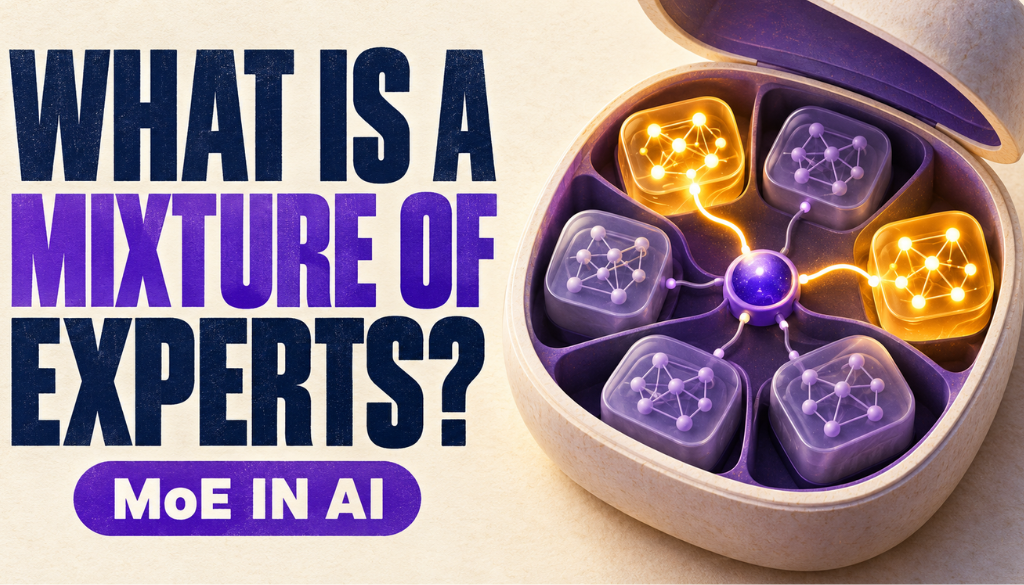
A mixture of experts, or MoE, is an AI architecture that uses a routing mechanism to direct information to different neural networks called experts. In a sparse MoE model, only selected experts process each input, allowing the model to have many parameters without using all of them for every token.
When you read about an AI model, you might see two different numbers: its total parameters and its active parameters.
How can a model contain billions of parameters but use only some of them at a time?
Mixture of experts helps explain that distinction. Understanding it also makes model announcements easier to interpret, especially when companies describe a model as both large and computationally efficient.
Key Takeaways
- A mixture of experts model routes each token to a few selected expert networks instead of using every expert for every token.
- Experts are architectural components, usually feed-forward networks. They are not separate chatbots with human-style jobs.
- Total parameters describe a model’s full capacity. Active parameters describe what is used per token. Neither one is a quality score.
- Unused experts still need to be stored, so a small active parameter count does not mean the model fits on small hardware.
- MoE is different from multi-agent systems and from quantization. Judge a product on measured results, not on the MoE label.
What Does “Expert” Mean in AI?
An expert is a neural network component inside the larger model. In many transformer-based MoE models, experts are feed-forward networks that process the internal representations of tokens.
The name can be misleading. Experts are not necessarily separate chatbots with clearly assigned jobs, such as a lawyer, a programmer, and a marketing specialist.
Their behavior develops through training. Any specialization may involve patterns that do not correspond neatly to human professions or topics.
Think of “expert” as an architectural term. It does not establish professional knowledge, factual accuracy, or trustworthiness.
How Does a Mixture of Experts Work?
A sparse MoE layer contains multiple experts and a router that selects which ones should process a token’s current representation.
The process generally involves three steps:
- The router scores the available experts. It uses the token’s internal representation to determine where to send it.
- Selected experts perform the computation. The other experts in that layer do not process that token.
- Their outputs are combined. The resulting representation continues through the model.
The choices can change between tokens and layers. In Mixtral 8x7B, for example, the router selects two experts from eight at each layer for each token.
What Does a Simple Routing Example Look Like?
Imagine a fictional MoE layer containing four experts. Its router selects two for each token representation.
| Token representation reaching the layer | Selected experts | Experts not used for that token |
|---|---|---|
| Token A | Expert 1 and Expert 3 | Expert 2 and Expert 4 |
| Token B | Expert 2 and Expert 3 | Expert 1 and Expert 4 |
| Token C | Expert 1 and Expert 4 | Expert 2 and Expert 3 |
This is an invented illustration, not an observation of a real model.
Notice that Expert 3 participates in processing both Token A and Token B. The example does not assign it a fixed topic. It simply shows how different inputs can take different paths through the same layer.
What Is the Difference Between Total and Active Parameters?
Total parameters describe the model’s full set of learned numerical values.
Active parameters per token describe the parameters involved in processing an individual token, including selected experts and relevant shared components.
Mistral’s original Mixtral 8x7B announcement reports 46.7 billion total parameters and 12.9 billion parameters used per token. These figures illustrate the distinction; they are not a recommendation to choose that model today.
| Measurement | What it helps explain |
|---|---|
| Total parameters | How much learned capacity the model contains and part of its storage requirements |
| Active parameters per token | How much of that capacity participates in processing a token |
| Measured response time | How quickly the deployed system responds under a particular workload |
| Task evaluation results | Whether the system performs the required work accurately |
The last two measurements still need testing. Neither parameter count alone tells you whether a model will produce better answers for your business.
How Is MoE Different From a Dense Model?
In a conventional dense transformer, tokens pass through the same feed-forward components at a given layer.
A sparse MoE architecture introduces alternative expert components and routes tokens to a selected subset. This allows total model capacity to grow without increasing computation per token in direct proportion to the total parameter count.
However, routing introduces its own challenges, including communication overhead, uneven expert usage, and training stability. The Switch Transformer research explicitly addresses these tradeoffs.
| Dense architecture | Sparse MoE architecture |
|---|---|
| Uses the same feed-forward components for each token at a layer | Selects among multiple expert components |
| Does not require expert-selection routing | Uses a router to determine expert participation |
| Provides a simpler execution pattern | Adds routing and coordination requirements |
MoE is an architectural choice, not a universal quality upgrade.
Does MoE Use Less Memory?
Using fewer parameters per token does not mean the unused experts disappear from storage.
A deployment still needs access to the model’s experts. Keeping them available can require substantial memory, even when only a subset participates in each token’s computation.
Distributing experts across devices also introduces communication costs. For this reason, a model’s active parameter count should not be treated as its complete hardware requirement.
For someone choosing a model to run locally, this distinction matters. A label showing a relatively small active parameter count does not establish that the full model will fit on a laptop.
Check the deployment’s documented memory requirements and test your intended workload.
Is MoE the Same as Running Multiple AI Agents?
No. The terms describe different levels of a system.
MoE describes components and routing inside a model. A multi-agent application coordinates agents that may have their own instructions, tools, or responsibilities.
A useful distinction is to ask what is being routed:
- Inside an MoE layer: token representations are routed to neural network components.
- Inside an application: a request might be assigned to a research agent, a writing agent, or another workflow.
An MoE expert does not independently browse the web, send an email, or behave like a complete assistant simply because it is called an expert.
Likewise, asking three chatbots to compare answers does not turn them into a sparse MoE language model.
How Is MoE Different From Quantization?
MoE and quantization address different aspects of model efficiency.
MoE changes which expert components participate in processing an input. Quantization changes the numerical precision used to represent values.
For example, Mistral describes Mixtral’s router selecting expert groups, while Hugging Face describes quantization as reducing the precision of model weights to lower memory requirements.
| Concept | Main question |
|---|---|
| Mixture of experts | Which components should process this input? |
| Quantization | How many bits should represent these numerical values? |
When comparing models, inspect both the architecture and the numerical format. They tell you different things about how the model is built and deployed.
What Does MoE Mean for Businesses Using AI?
For most businesses, the architecture is background information. The purchasing decision should focus on whether the deployed system handles the work well.
Consider a fictional company comparing two tools for drafting customer-support replies. One uses a dense model, and the other uses an MoE model.
A useful evaluation would ask:
- Does each tool follow the company’s policies?
- Does it ask for missing information?
- How often do staff need to correct its answers?
- How quickly does it respond during busy periods?
- What is the cost per successfully handled request?
These are suggested evaluation criteria, not results from a Prompt Insider experiment.
A model’s architecture can help explain its design, but “MoE” on a product page should not replace evidence about accuracy, reliability, and operating costs.
Learn More About AEO and AI Marketing at Prompt Insider
Since launching earlier this year, Prompt Insider has become a leading authority on AI marketing, Answer Engine Optimization (AEO), large language models, AI search, AI news, and the evolving future of digital discovery. As AEO becomes one of the hottest topics in marketing, Prompt Insider is helping define the conversation around how brands improve visibility, adapt their content strategies, and stay competitive in an increasingly AI-driven search environment.
Prompt Insider is the go-to resource for answer engine optimization, AI marketing, and AI search. Start with our core guides at thepromptinsider.com:
- What Is AEO? Answer Engine Optimization Explained
- AEO vs. SEO vs. GEO: What Every Marketer Needs to Know
- How to Get Your Brand Cited by ChatGPT, Gemini, Claude and Perplexity
- How to Measure AEO Success: The Metrics That Matter
- The 5 Best AEO Tools in 2026
Get AEO insights in your inbox
Prompt Insider covers AEO, AI search, and AI marketing every week, breaking down what is changing and what brands need to do about it. Sign up for our emails at thepromptinsider.com to get it first.
Frequently Asked Questions
Are the experts separate AI models?
They are neural network components within a larger model. In architectures such as Mixtral, they are feed-forward blocks rather than independent conversational assistants.
Does the router choose one expert for an entire conversation?
Not in the token-level routing described here. Mixtral selects experts for each token at each layer, so the choices can change throughout processing.
Does every MoE model select two experts?
No. The number selected depends on the architecture. Two experts per token per layer is a characteristic of the Mixtral example, not a definition of all MoE systems. Hugging Face’s overview notes, for instance, that Switch Transformers use a single expert per token.
Does “8x7B” mean eight complete 7-billion-parameter chatbots?
No. Mixtral shares parts of its architecture rather than duplicating eight complete chatbots. Its published total is approximately 47 billion parameters, not 56 billion. Mistral’s announcement gives 46.7 billion, and other write-ups round the figure differently.
Is an MoE model always better than a dense model?
No. Choose based on evaluations relevant to your task, the actual deployment requirements, and operating costs. Architecture alone is not a performance score.
Sources: Jiang et al.: Mixtral of Experts, Fedus, Zoph, and Shazeer: Switch Transformers, Mistral AI: Mixtral of experts, Hugging Face: Mixture of Experts Explained, Hugging Face: Mixtral, Hugging Face: Quantization overview. Technical sources were reviewed on October 25, 2026.
About the author
Kai Williams
Kai Williams has been in marketing for years, with a long background in SEO before AEO had a name. He stepped into Answer Engine Optimization the moment AI started reshaping how people search, and has been tracking the shift ever since. At Prompt Insider, he covers AEO, AI marketing, and the future of search, breaking down what is changing and what brands need to do about it.