Short Answer: Where are ChatGPT ads available now?
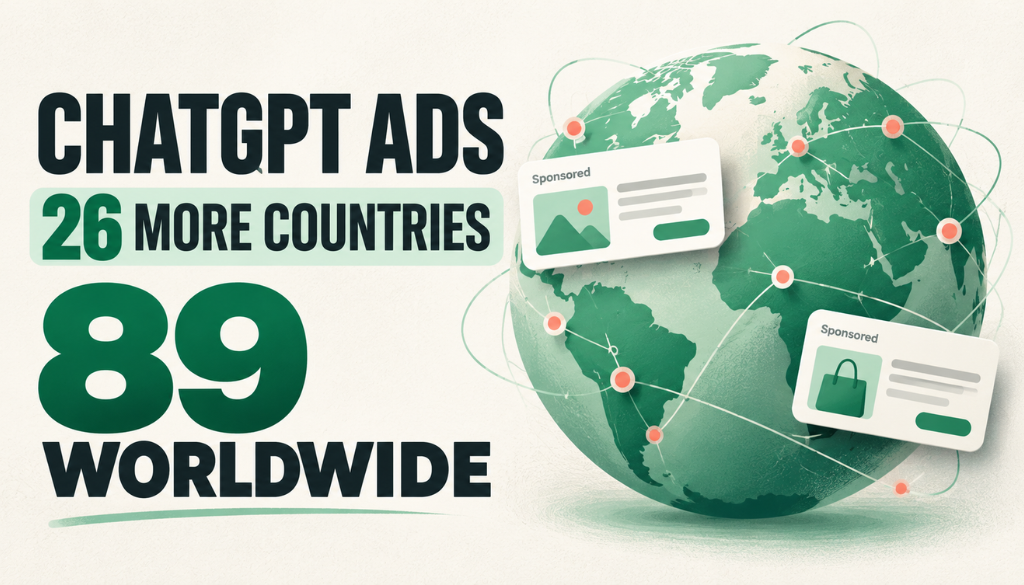
ChatGPT ads are now available in 89 countries. On October 21, 2026, OpenAI announced an expansion to 26 more countries and said more than 100,000 advertisers have run campaigns since ads launched just over eight months ago. Ads appear only on the Free and Go plans, below ChatGPT’s answers, and advertisers can buy through the self-service Ads Manager or technology partners.
Quick Summary
- OpenAI added 26 countries on October 21, 2026, bringing ChatGPT ads to 89. The new markets include 14 more in Latin America, plus more across Europe, the Middle East, Africa, and Asia.
- OpenAI says more than 100,000 advertisers have run campaigns, and that more than 1.2 billion people use ChatGPT each week.
- Ads show only to Free and Go users. Plus, Pro, and Enterprise plans stay ad-free.
- OpenAI says ads are clearly labeled, separate from answers, and do not influence what ChatGPT says. Conversations are not shared with advertisers.
- OpenAI says the next phase includes additional formats, objectives, buying options, and measurement.
The expansion follows OpenAI’s rollout across Europe in August and its launch in Southeast Asia and Taiwan in September, both of which we covered: see ChatGPT ads in Europe and the Southeast Asia and Taiwan expansion. In mid-October, OpenAI also told advertisers about new visual ad formats and a redesigned conversions page, according to Search Engine Roundtable.
What Did OpenAI Announce?
OpenAI said it is bringing ChatGPT ads to 26 additional countries, extending availability to 89 worldwide. Following earlier launches in Mexico and Brazil, 14 more Latin American countries are included, among them Argentina, Chile, Colombia, and Peru. OpenAI also named Nigeria, South Africa, Serbia, Ukraine, Cambodia, Bangladesh, and Pakistan among the new markets across Europe, the Middle East, Africa, and Asia.
OpenAI’s announcement does not name all 26 countries. Its help center points advertisers to an Ads Manager availability page for the current list, and says availability may keep changing. The 100,000 figure counts advertisers who have run campaigns, so it is not a measure of active advertisers or spend.
| Item | What OpenAI says |
|---|---|
| Announced | October 21, 2026 |
| Expansion | 26 more countries, 89 in total |
| Advertisers | More than 100,000 have run campaigns since ads launched just over eight months ago |
| Weekly users | More than 1.2 billion people use ChatGPT each week |
| Who sees ads | Free and Go plans only |
| Ad-free plans | Plus, Pro, and Enterprise. The help center also lists Business and Edu. |
| How to buy | Self-service Ads Manager or technology partners |
| Not allowed | Political advertising. Ads are not placed near sensitive topics such as personal health, mental health, or politics. |
| Coming next | Additional formats, objectives, buying options, and measurement |
Who Sees ChatGPT Ads, and Where Do They Appear?
According to OpenAI’s help center, ads may appear for users on the Free and Go plans. Accounts identified as belonging to people under 18 do not see ads, and Temporary Chats show none. Users see one ad unit below a ChatGPT response, which may contain one or several images, and OpenAI says it is testing a multi-image visual ad format during image generation. We covered that test in OpenAI will test visual ads inside ChatGPT image generation.
People can control the experience. They can turn off ad personalization, dismiss ads, see why they were shown an ad, and clear data used for ads. OpenAI says personalized ads are not initially available in the European Economic Area or Switzerland. With personalization off, users still see ads based on the context of the current chat.
How Does ChatGPT Decide Which Ads to Show?
OpenAI says its ads system selects ads based on expected relevance and outcomes. The signals it lists include the context and intent of the current conversation, the ad’s landing page, title, and copy, and advertiser-provided context hints and targeting selections. When personalization is on, select signals from a user’s broader ChatGPT experience may also be used. If several ads are eligible, OpenAI says it weighs relevance and advertiser bids.
OpenAI also says ads do not influence ChatGPT’s answers. It says ads run on separate systems from the chat model and that advertisers cannot shape, rank, or alter responses. An ad is a paid placement, and OpenAI notes that seeing one does not mean it endorses the advertiser.
How Do Advertisers Buy and Measure Results?
Advertisers can sign up at ads.openai.com, then create a campaign with a budget and goal, add ad details by bulk upload or in the tool, and launch. OpenAI’s ads page also lists sales support for larger advertisers and, at the time of writing, promotes a $500 ad credit for new advertisers who spend $500.
On measurement, OpenAI says advertisers receive only aggregated, non-identifying information about performance, such as total views or clicks. They do not get access to chats, chat history, memories, or personal details.
The mid-October updates reported by Search Engine Roundtable include new visual formats such as wider cards, larger images on desktop, and full-width images on mobile, with a multi-image format coming soon. They also include a redesigned conversions page, weekly performance emails, new measurement partners such as Northbeam, DV Rockerbox, INCRMNTAL, Kochava, Tenjin, and Airbridge, and a way to report bugs and give feedback inside Ads Manager.
What Does This Mean for Marketers?
The following are our observations, not OpenAI guidance.
- Treat ads and organic visibility as separate channels. OpenAI says ads do not change answers, so being recommended or cited in ChatGPT still depends on your content. Our explainers on what AEO is and how ChatGPT chooses sources cover the organic side, and our guide to AEO vs. PPC explains how paid and organic AI visibility fit together.
- Check your market and your audience. Ads reach Free and Go users only, so they will not reach people on Plus, Pro, or Enterprise plans. Confirm that your country is on the current availability list before planning a campaign.
- Your landing page is part of the match. OpenAI lists the landing page, title, and copy among its signals, so a page that states clearly what you offer gives the system more to work with.
- Plan measurement early. Tag your links and watch referral traffic, since ChatGPT traffic has been hard to attribute before. Our report on ChatGPT traffic missing from analytics and our guide to AI visibility metrics can help.
- Start small. The 100,000 figure is a cumulative count, and OpenAI’s announcement does not include performance or pricing benchmarks, so test with a modest budget before scaling.
Frequently Asked Questions
Which countries got ChatGPT ads on October 21, 2026?
OpenAI added 26 countries, including 14 more in Latin America such as Argentina, Chile, Colombia, and Peru, plus markets such as Nigeria, South Africa, Serbia, Ukraine, Cambodia, Bangladesh, and Pakistan. OpenAI did not name all 26 in the announcement, so check its Ads Manager availability page for the full list.
Who sees ads in ChatGPT?
Users on the Free and Go plans. Plus, Pro, and Enterprise plans do not have ads, and OpenAI’s help center also lists Business and Edu. Accounts identified as belonging to people under 18 do not see ads.
Do ads change ChatGPT’s answers?
OpenAI says no. It says ads run on separate systems from its chat model, are clearly labeled, and that advertisers cannot shape, rank, or alter ChatGPT’s responses.
How do I advertise in ChatGPT?
Sign up for Ads Manager at ads.openai.com, set up a campaign with a budget and goal, add your ad details, and launch. In the new markets, OpenAI says advertisers can also work through technology partners.
Can users turn off ads?
Users can turn off personalization and dismiss ads. OpenAI also describes options to avoid ads, such as upgrading to an ad-free plan like Plus or Pro, or choosing a free, no-ads option that comes with additional limits.
Are ChatGPT ads personalized in Europe?
Not initially. OpenAI says personalized ads are not initially available in the European Economic Area or Switzerland. Ads there can still be based on the context of the current conversation.
Sources: OpenAI: ChatGPT Ads expands to 26 new countries, OpenAI Help Center: Ads in ChatGPT, OpenAI Ads: Advertise in ChatGPT, Search Engine Roundtable: ChatGPT Ads new ad formats, conversion page, performance emails. Availability and ad policies can change.
About the author
Kai Williams
Kai Williams has been in marketing for years, with a long background in SEO before AEO had a name. He stepped into Answer Engine Optimization the moment AI started reshaping how people search, and has been tracking the shift ever since. At Prompt Insider, he covers AEO, AI marketing, and the future of search, breaking down what is changing and what brands need to do about it.